The scan report says “ovarian cyst”, and somewhere in the conversation the word surgery came up. Now you are wondering whether you really need an operation, what it would cost, how long you would be away from work, and whether it will affect your chances of having a baby later.
Those are exactly the right questions. This post walks through the surgery decision in order: which cysts usually need no operation at all, when surgery does make sense, the difference between removing only the cyst and removing the ovary, what laparoscopic surgery costs in India today, what recovery looks like, and the ovarian reserve questions worth asking your surgeon before the date is fixed.
If you are still trying to understand the scan itself, our guide to reading an ovarian cyst ultrasound report is the better starting point. If you have sudden, severe one-sided pain, read our guide to a ruptured ovarian cyst and when to go to hospital instead.
Most Ovarian Cysts Do Not Need Surgery
This is the most important point, so it comes first. The commonest cysts in women of reproductive age are functional cysts: a follicle that did not release its egg, or a corpus luteum that filled with fluid after ovulation. They come and go with the cycle.
A Cochrane review of eight randomised trials (686 women) found that most functional cysts resolved without treatment within a few cycles, and that birth control pills did not make them go away faster. The authors concluded that watchful waiting for two or three cycles is appropriate, and that cysts which persist tended to be a different kind of cyst, where surgery is often indicated (Grimes DA et al., Cochrane Database Syst Rev, 2014, PMID 24782304).
Radiologists have reached a similar position for simple cysts. The Society of Radiologists in Ultrasound consensus update states that most small simple cysts do not need follow-up, and that in premenopausal women follow-up imaging is suggested only for simple cysts larger than about 5 to 7 cm (Levine D et al., Radiology, 2019, PMID 31549945).
So if your report describes a thin-walled, fluid-filled cyst of a few centimetres with no solid parts, the usual plan is a repeat scan after one to three cycles, not an operating theatre. For how a cyst differs from the many small follicles seen in PCOS, read our guide on when an ovarian cyst matters and how it differs from PCOS.
When Surgery Becomes the Right Choice
Your gynaecologist will weigh the cyst type, its size, your symptoms, your age and your plans for pregnancy. Surgery is usually discussed when:
- The cyst persists or grows across two or three repeat scans instead of shrinking.
- It is large, often 5 to 7 cm or more, where the chance of the ovary twisting (torsion) rises.
- It looks like a non-functional cyst that will not go away on its own, such as a dermoid cyst (mature teratoma) or a cystadenoma.
- It causes ongoing pain or pressure that is affecting daily life.
- The scan shows features that need a tissue diagnosis, such as solid areas or unusual blood flow. Your doctor may add a CA-125 or other blood tests here. Most such cysts still turn out to be benign.
- It has twisted or ruptured with heavy bleeding. That is an emergency operation, and our guide on ovarian torsion and fertility after surgery covers it.
Endometriomas (chocolate cysts) are a special case. Surgery is not automatic for them, because removing the cyst can also remove healthy ovarian tissue. That trade-off is explained in our guide to chocolate cysts and conceiving, and touched on in the ovarian reserve section below.
Cystectomy or Oophorectomy: What Is Being Removed?
These two words sound alike but mean very different operations.
Ovarian cystectomy removes only the cyst and leaves the ovary in place. For a woman who may want a baby in future, or who simply wants to keep her hormones working naturally, this is the usual aim. The surgeon peels the cyst wall away from the healthy ovarian tissue and stops any bleeding.
Oophorectomy removes the whole ovary, sometimes with the tube (salpingo-oophorectomy). It is considered when the ovary cannot be saved (for example after a long-standing torsion), when the cyst is very large and has replaced the ovary, when cancer is suspected, or for some women past menopause. Losing one ovary does not stop periods or fertility, because the other ovary keeps working.
Before signing the consent form, ask your surgeon plainly: “Is the plan to remove only the cyst, and in what situation would you need to remove the ovary?” A clear answer now saves a lot of worry later.
Laparoscopy or Open Surgery
Most benign ovarian cysts in India are now removed by laparoscopy (keyhole surgery). The surgeon makes two to four small cuts on the abdomen, inserts a camera and fine instruments, and removes the cyst, usually inside a small bag so its contents do not spill.
A Cochrane review of randomised trials found that, compared with open surgery (laparotomy), laparoscopy for benign ovarian tumours was associated with fewer complications such as fever and urinary infection, less pain after surgery, fewer days in hospital and lower total cost (Medeiros LR et al., Cochrane Database Syst Rev, 2009, PMID 19370607). The authors noted that the number of studies was small, so these results should be read with some caution.
Open surgery uses a single larger cut on the lower abdomen. It is still the right choice for very large cysts, when cancer is a real concern, or when previous surgery has left heavy adhesions. It is not a lesser operation, just one suited to a different situation.
If you have a scan report and are unsure whether your cyst needs surgery or another scan in a few weeks, Dr. Suganya Venkat, an OB-GYN with over 15 years of experience, can go through it with you over a video consultation from anywhere in India.
Ovarian Cyst Surgery Cost in India (Checked November 2026)
On 3 November 2026 we checked the ovarian cyst surgery cost page on medifee.com (an aggregator that carries Pristyn Care’s estimates). The figures it lists for private hospitals are:
| What it lists | Approximate cost |
|---|---|
| Laparoscopic ovarian cystectomy (typical range) | ₹50,000 to ₹70,000 |
| Open (cut) ovarian cystectomy | ₹40,000 to ₹55,000 |
| Oophorectomy (ovary removal) | ₹40,000 to ₹60,000 |
| Overall range by city (Chennai, Bengaluru, Mumbai, Delhi, Hyderabad, Pune) | ₹60,000 to ₹1,30,000 |
| Overall range by city (Coimbatore, Madurai, Kochi, Jaipur and other cities) | ₹50,000 to ₹1,30,000 |
| Pre-surgery blood tests and imaging | ₹2,000 to ₹5,000 |
Source: medifee.com ovarian cyst surgery cost page, checked 3 November 2026. These are aggregator estimates, not quotes. Large corporate hospitals often quote above these ranges. Always ask for a written package estimate.
What changes the final bill
- Hospital tier. A corporate chain hospital usually charges more than a well-run mid-size private hospital for the same operation done the same way.
- City. Metro hospitals generally sit higher than those in smaller cities.
- Day care or admission. Many straightforward laparoscopic cystectomies need one night or less in hospital. An extra night, or a higher room category, adds to every line of the bill, because some hospitals scale surgeon and theatre charges to the room you choose.
- Cyst type and complexity. A large dermoid or an endometrioma with adhesions takes longer than a simple cyst, and a frozen section (a quick tissue test during surgery) adds cost.
- What the package excludes. Ask whether histopathology (the lab report on the removed cyst), medicines, follow-up visits and any extra disposable instruments are included.
- Government hospitals. Government medical college hospitals charge far less, though waiting times vary.
Insurance
Ovarian cyst surgery is a treatment for a diagnosed condition, so most health insurance policies in India cover it, subject to the policy’s terms. Check two things early: whether your policy has a waiting period for gynaecological conditions or pre-existing illness, and whether the hospital needs pre-authorisation. A planned surgery gives you time to sort both out.
Recovery After Laparoscopic Cyst Removal
Recovery varies from woman to woman, and your surgeon’s instructions come first. As a general picture after a straightforward laparoscopic cystectomy:
- Hospital stay: often same day or one night.
- First few days: some tummy soreness, bloating and tiredness. Shoulder-tip pain for a day or two is common and comes from the gas used during surgery; it settles on its own.
- Walking: from the same or next day, which helps recovery.
- Desk work: many women return in about one to two weeks.
- Heavier lifting and exercise: usually after a few weeks, once your surgeon is happy with the healing.
- Stitches and wounds: small cuts, kept clean and dry. Ask whether the stitches dissolve or need removal.
Recovery after open surgery is longer, typically several days in hospital and a few weeks before normal activity.
Call your surgeon promptly if you develop fever, increasing pain, redness or discharge from a wound, heavy bleeding, or vomiting that does not settle. These are uncommon, and they are easier to manage when picked up early.
The histopathology report usually comes back a week or so after surgery. Keep a copy along with the operation notes. They tell any future doctor exactly what was removed and how.
If you are planning a pregnancy afterwards, our guide on trying to conceive after laparoscopy covers timing.
Ovarian Reserve: Questions to Ask Before Surgery
Any surgery on the ovary can remove some healthy egg-containing tissue along with the cyst. How much depends on the cyst type and the technique.
The concern is best studied for endometriomas. A meta-analysis of eight prospective studies (237 women) found a significant fall in AMH (anti-Mullerian hormone, a blood marker of egg reserve) after surgery to remove endometriomas (Raffi F et al., J Clin Endocrinol Metab, 2012, PMID 22723324). That does not mean surgery is wrong for an endometrioma. It means the decision is worth making carefully, especially if both ovaries are involved or your reserve is already on the lower side.
Helpful questions to take to your surgeon:
- What type of cyst do you think this is, and could it go away without surgery?
- Is the plan to remove only the cyst? When would you need to remove the ovary?
- Should I have an AMH test before surgery? (Our guide on low AMH and pregnancy explains what the number means.)
- If I am planning a pregnancy soon, or IVF, should that change the timing or the plan?
- Will the removed tissue go for histopathology, and is it in the package?
- When can I go back to work, and when can we start trying for a baby?
A good surgeon welcomes these questions. Asking them is part of working with your doctor, not doubting them.
Practical Takeaways
- Many cysts settle on their own. Functional cysts are usually watched with a repeat scan over two or three cycles.
- Surgery is for cysts that persist, grow, are large, cause pain, look non-functional, or need a tissue diagnosis.
- Cystectomy keeps the ovary; oophorectomy removes it. Know which one is planned.
- Laparoscopy is the usual route for benign cysts, with a shorter stay and quicker recovery than open surgery.
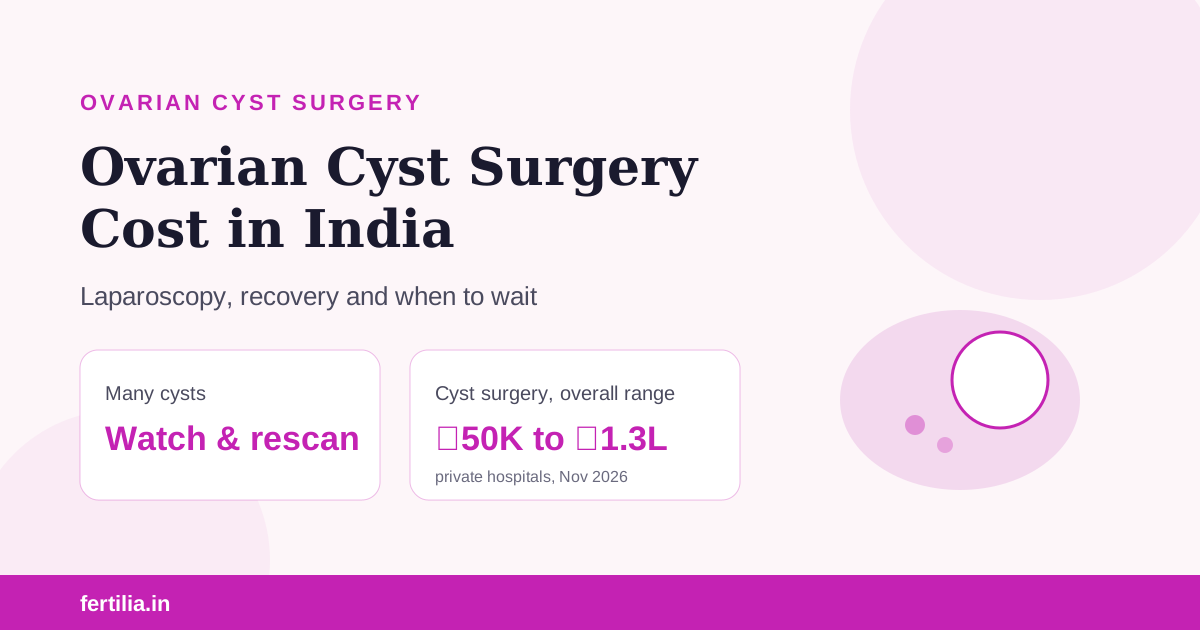
- Expect roughly ₹50,000 to ₹1,30,000 at a private hospital, depending on city, hospital tier and complexity (aggregator figures checked November 2026). Get a written package estimate.
- Ask about ovarian reserve before surgery, especially for endometriomas or if you are planning a pregnancy.
Frequently Asked Questions
What is the cost of ovarian cyst surgery in India?
On 3 November 2026, medifee.com listed laparoscopic ovarian cystectomy at about ₹50,000 to ₹70,000 and an overall city range of about ₹50,000 to ₹1,30,000 at private hospitals. Corporate hospitals often quote more and government hospitals far less. The final bill depends on city, hospital tier, length of stay, cyst complexity and what the package includes.
Ovary me cyst ka operation kitne ka hota hai, and does every cyst need an operation?
Ovary cyst surgery at a private hospital usually costs somewhere between ₹50,000 and ₹1,30,000, based on aggregator figures checked in November 2026. But many cysts need no operation at all. Functional cysts, the most common type in women who still have periods, usually go away by themselves within a few cycles, so a repeat scan is often the first step.
Can an ovarian cyst go away without surgery?
Yes, functional cysts commonly do. A Cochrane review found that most resolved without treatment within a few cycles, and that birth control pills did not speed this up. Cysts that persist are more likely to be another type, such as a dermoid or endometrioma, which do not go away on their own.
How long does it take to recover from laparoscopic ovarian cyst removal?
Many women go home the same day or the next day, walk from the first day, and return to desk work in about one to two weeks. Heavier lifting and exercise usually wait a few weeks. Your surgeon’s advice for your operation comes first.
Will removing an ovarian cyst affect my fertility?
Removing a cyst while keeping the ovary usually preserves fertility, and losing one ovary still leaves the other working. Some healthy ovarian tissue can be lost during surgery, which is best studied for endometriomas, where AMH tends to fall after surgery. Ask about an AMH test and the surgical plan if pregnancy is on your mind.
Is laparoscopy better than open surgery for an ovarian cyst?
For benign cysts, laparoscopy is generally associated with less pain, fewer complications, a shorter hospital stay and lower total cost than open surgery. Open surgery remains the right choice for very large cysts, when cancer is suspected, or when there are heavy adhesions.
Does health insurance cover ovarian cyst surgery in India?
Most policies cover it as treatment for a diagnosed condition, subject to waiting periods for gynaecological or pre-existing conditions and pre-authorisation rules. Check your policy wording and speak to the hospital’s insurance desk before the surgery date.
You Do Not Have to Decide Alone
An ovarian cyst on a report can feel like a decision you need to make immediately. Usually it is not. There is time to repeat a scan, understand the cyst type, ask about your ovarian reserve and compare estimates, and the right plan for you may well be no surgery at all.
💜 Want a second look at your scan report? Message Dr. Suganya on WhatsApp to book a ₹399 video consultation, available online across India. You can also download our free period health guide.