Many women first hear the word “thalassemia” at their booking visit, when the doctor looks at the blood count and says, “Your red cells are a little small. Let us do one more test, and we may need your husband’s blood too.” It can sound alarming, especially if nobody in the family has ever been unwell.
Here is the reassuring part first. Being a thalassemia carrier (also called thalassemia minor or thalassemia trait) is common in India, and a carrier is usually a perfectly healthy person who needs no treatment. The test matters for a different reason: it tells you and your partner, together, what your baby could inherit, early enough for you to have choices.
I’m Dr. Suganya Venkat, an OB-GYN with more than 15 years of clinical experience. I also hold an MD in Pathology, so reading a blood report line by line is familiar ground for me, and this is one report I wish every couple understood before their first pregnancy.
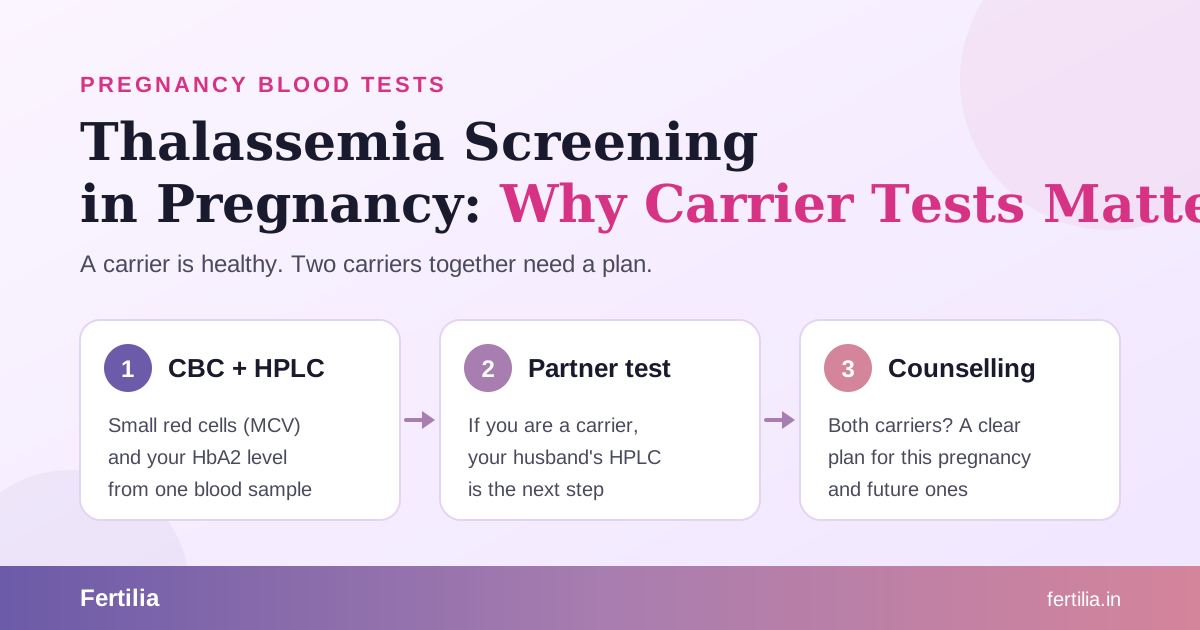
The short answer: thalassemia screening in pregnancy usually starts with your complete blood count (CBC) and an HPLC test (high-performance liquid chromatography) that measures the types of haemoglobin in your blood. If you are found to be a carrier, your husband is tested next. If only one of you is a carrier, your baby cannot have thalassemia major. If both of you are beta thalassemia carriers, each pregnancy has a 1 in 4 chance of an affected baby (with alpha thalassemia, the odds depend on the exact gene changes), and a genetic counsellor can explain the testing options for this pregnancy and future ones.
Here is what this post covers:
- What thalassemia is, and the difference between a carrier and the disease
- Why carrier testing matters so much in India
- How the CBC and HPLC test work, and how to read the key numbers
- Why iron deficiency can confuse the picture
- Why your husband’s test is the most important next step
- What happens if both of you are carriers
- Planning before pregnancy, including IVF options
- Common questions
Thalassemia: Carrier Versus Disease
Haemoglobin is the protein inside red blood cells that carries oxygen. It is built from protein chains called globins. Thalassemia is a group of inherited conditions where the body makes less of one of these chains. The two main types are beta thalassemia (the beta chain is affected) and alpha thalassemia (the alpha chain is affected). You may also see it spelt “thalassaemia”, the British spelling, on some reports.
Beta thalassemia is inherited in an autosomal recessive pattern, which means a child usually needs to inherit a changed gene from both parents to have the significant form of the condition, although dominant mutations have also been reported (Galanello R et al., Orphanet J Rare Dis, 2010, PMID 20492708).
- Carrier (thalassemia minor or trait): one changed gene, one working gene. Galanello and Origa describe thalassemia minor as clinically asymptomatic, although some people may have moderate anaemia. Most carriers live normal, healthy lives.
- Thalassemia major: a changed gene from both parents. Children usually show severe anaemia in the first two years of life and need regular blood transfusions (Galanello R et al., Orphanet J Rare Dis, 2010, PMID 20492708).
- Thalassemia intermedia: a middle form that appears later and is milder than major.
For a carrier mother, the main practical points are how her anaemia is managed during pregnancy (we come to iron below) and what her partner’s test shows.
Why Carrier Testing Matters in India
Inherited haemoglobin disorders are among the most common single-gene conditions in India. In a multicentre study of 56,780 college students and pregnant women across six cities in six states, the overall prevalence of beta thalassemia trait was 2.78 percent, ranging from 1.48 to 3.64 percent between states, and from 0 to 9.3 percent between the 59 community groups studied (Mohanty D et al., J Community Genet, 2013, PMID 23086467). The same study found HbE trait to be common in Assam and West Bengal.
Researchers at the ICMR’s National Institute of Immunohaematology in Mumbai have estimated that 7,500 to 12,000 babies with beta thalassemia major are born in India every year (Colah RB et al., Indian J Med Res, 2011, PMID 22089620). The same team noted that more than 90 percent of the couples referred to them for prenatal testing for beta thalassemia came only after already having an affected child.
That last figure is the heart of this post. For most of those couples, the first sign that they were carriers was a child’s diagnosis. Screening during or before pregnancy lets a couple find out first, while they still have time to think, ask questions, and choose.
Two other points are worth knowing:
- Marrying within the family or community raises the chance that both partners carry the same gene change, because relatives share more of their genes. This is not a reason for worry or blame, just a reason to make sure both partners are tested.
- A healthy family history does not rule out carrier status. Carriers are usually well, so the gene can pass silently through several generations before two carriers happen to have a child together.
The Tests: CBC First, Then HPLC
Thalassemia screening in pregnancy is simple and needs only a blood sample. Your obstetrician may order both tests at the booking visit, or start with the CBC and add HPLC if the red cell numbers suggest it. Our guide to first trimester tests and when they are done shows where this fits among the other booking blood tests.
Step 1: The CBC (complete blood count)
Two numbers on your CBC report are the first clue:
- MCV (mean corpuscular volume): the average size of your red cells. Below about 80 fL is called microcytic (small cells).
- MCH (mean corpuscular haemoglobin): the average amount of haemoglobin in each cell. A low MCH means pale, under-filled cells.
Small, pale cells point to two common causes: iron deficiency and thalassemia trait. The CBC cannot tell them apart, which is why the next test exists.
Step 2: The HPLC test (haemoglobin variant analysis)
HPLC separates the different types of haemoglobin in your blood and reports each as a percentage. The ones to look at:
- HbA2: the key marker for beta thalassemia trait. Raised HbA2 is the characteristic feature of a beta thalassemia carrier, and a value of 4.0 percent or more falls in the typical carrier range (Colaco S et al., Sci Rep, 2022, PMID 35354866).
- HbF (fetal haemoglobin): may be mildly raised in some carriers.
- Abnormal variants: HPLC also picks up haemoglobin variants such as HbE and HbS (sickle haemoglobin). These matter because a beta thalassemia carrier and an HbE carrier, or a beta thalassemia carrier and an HbS carrier, can together have a child with a significant combined condition. In a western Indian centre’s experience, HbE-beta thalassemia was variable but often severe and transfusion dependent (Colah R et al., Indian J Hematol Blood Transfus, 2018, PMID 30127556).
Write down the exact HbA2 and HbF values from your report rather than just “normal” or “abnormal”. Those numbers are what the next doctor will want.
The borderline zone
Some reports come back with HbA2 between 3.0 and 3.9 percent. This is the borderline range, and it is where careful interpretation matters. In an ICMR study of 205 people with borderline HbA2, 168 were positive for a defect after testing for iron deficiency and analysis of the globin genes, and 149 of them were beta thalassemia carriers. Twenty of those carriers had HbA2 below 3.5 percent and an MCV above 80 fL, so the usual red flags were missing (Colaco S et al., Sci Rep, 2022, PMID 35354866). The authors recommend DNA (molecular) testing for people in this range.
The practical message: a borderline HbA2 is a reason to ask about DNA testing, especially if your husband is a carrier, rather than a result to set aside.
💜 Got an HPLC report and not sure what the numbers mean? Message Dr. Suganya on WhatsApp and go through it together over a ₹399 video consultation, from anywhere in India or abroad.
The Iron Question
Iron deficiency anaemia is very common in Indian women, and it overlaps with thalassemia trait in three ways that are worth understanding.
1. Both cause small, pale red cells. A low MCV on its own does not tell you which is present. Ferritin (your iron stores) and HPLC together sort it out. Our guide to iron deficiency anaemia signs and tests explains ferritin and how it is read.
2. Both can be present at the same time. A carrier can also be low on iron, particularly in pregnancy, when iron needs rise. Iron deficiency anaemia is one of the recognised causes of a borderline HbA2 result (Colaco S et al., Sci Rep, 2022, PMID 35354866). When HbA2 is clearly raised, though, researchers have reported that iron deficiency does not compromise the diagnosis of high-HbA2 beta thalassemia trait (Passarello C et al., Haematologica, 2012, PMID 22102712).
3. Iron treats iron deficiency, not the trait. If you are a carrier with normal ferritin, extra iron will not change your small red cells, and your doctor will usually not add more than the standard pregnancy supplement. If you are a carrier who is also iron deficient, iron treatment is still needed and helps. This is why your doctor checks ferritin rather than assuming. If your iron tablets upset your stomach, our post on managing iron tablet side effects in pregnancy has practical tips.
In pregnancy there is a timing point too. Outside pregnancy, a doctor might correct iron first and repeat HPLC a few months later. During pregnancy, waiting is usually not the best use of time, so your doctor may move straight to testing your husband in parallel.
Why Your Husband’s Test Is the Key Step
Your own result answers one question: are you a carrier? Your baby’s risk depends on both parents. So once a woman is found to be a carrier, the most useful next step is a CBC and HPLC for her husband.
Here is what the combinations mean for each pregnancy:
| Your result | Husband’s result | What it means for the baby |
|---|---|---|
| Carrier | Not a carrier | Cannot have thalassemia major. With beta thalassemia trait, a 1 in 2 chance of being a carrier, like you. With alpha thalassemia, the carrier odds depend on your exact gene changes. |
| Not a carrier | Carrier | Same as above. |
| Beta thalassemia carrier | Beta thalassemia carrier | In each pregnancy: 1 in 4 chance of inheriting a changed beta gene from both of you, 1 in 2 chance of being a carrier, 1 in 4 chance of being neither. A baby who inherits both changes has beta thalassemia, which can range from thalassemia major to a milder intermedia form, depending on the exact gene changes. |
| Alpha thalassemia carrier | Alpha or beta thalassemia carrier (or the other way round) | The odds depend on the exact gene changes in both of you, so DNA testing of both of you and genetic counselling are needed to work them out. They can include a 1 in 4 chance in each pregnancy of a severe form: if both of you carry two missing alpha genes on the same chromosome, a baby can inherit no working alpha genes, a condition called Hb Bart’s hydrops fetalis (Harteveld CL et al., Orphanet J Rare Dis, 2010, PMID 20507641). |
| Beta thalassemia carrier | HbE or HbS carrier (or the other way round) | A possible significant combined condition. Treated like a two-carrier couple and referred for counselling. |
The “1 in 4” applies to every pregnancy independently. It does not mean one child in four will be affected; each pregnancy has the same odds, like a fresh roll of the dice.
Screening the woman first and then her husband is the usual sequence in antenatal care. A Kolkata study of 20,883 pregnant women used exactly this approach: HPLC with red cell indices for the women, then husbands of all carrier women were advised and persuaded to be screened, and couples where both were carriers were counselled about prenatal diagnosis (Choudhuri S et al., Hemoglobin, 2015, PMID 25970198). The word “persuaded” says a lot: when a husband’s test does not happen, the screening cannot give the couple its answer.
If your husband works away or lives abroad, any accredited lab near him can run a CBC and HPLC. The reports can be shared with your obstetrician digitally.
A note on alpha thalassemia
Alpha thalassemia carriers usually have low MCV and MCH but a normal or slightly reduced HbA2, so HPLC alone does not confirm it. Molecular (DNA) analysis is usually needed (Harteveld CL et al., Orphanet J Rare Dis, 2010, PMID 20507641). If both partners have small red cells, normal iron stores, and a normal HbA2, your doctor may suggest DNA testing to look for alpha thalassemia.
If Both of You Are Carriers
This is the result couples worry about most, so it helps to know what the path looks like. It is a well-trodden one, and you will not be making these decisions alone.
1. Genetic counselling. A genetic counsellor or fetal medicine specialist goes through both of your reports, confirms the exact gene changes (DNA testing of both parents is usually done at this point), and explains the options for this pregnancy.
2. Testing the baby, if you choose to. The baby’s status can be diagnosed during pregnancy:
- CVS (chorionic villus sampling) takes a small sample of placental tissue, usually from around 11 weeks.
- Amniocentesis takes a small sample of amniotic fluid, from around 15 weeks.
Both are done under ultrasound guidance by a fetal medicine specialist. Our post on amniocentesis and how it compares with CVS explains each procedure, its timing, and its small procedural risk. One point to know: those procedures are often discussed for chromosome testing, but for thalassemia the lab runs a specific DNA test for the parents’ known gene changes, which is why both parents’ results are needed first.
Over 30 years, one ICMR centre offered prenatal diagnosis to 3,478 couples from across India. About 23 percent of the fetuses tested were affected, close to the expected 1 in 4, and more couples came in the first trimester and in their first pregnancy with each passing decade (Colah RB et al., Hemoglobin, 2021, PMID 33829933). That shift towards earlier testing is what screening makes possible.
3. Decisions after the result. Most often the result shows the baby is a carrier or unaffected, and the pregnancy continues with routine care. If the baby is affected, the couple discusses the options with the specialist team, including continuing the pregnancy with plans for care after birth, or ending the pregnancy within the legal time limits. Both are legitimate choices, and the specialists will explain what each involves for your family.
Why earlier testing helps. CVS is usually done in the late first trimester, so finding out that you are a carrier at 8 to 10 weeks leaves time for your husband’s test and counselling. If screening happens later, amniocentesis is still available. Colah and colleagues noted that only 15 to 20 percent of pregnant women in India register at public antenatal clinics in the first trimester (Colah RB et al., Indian J Med Res, 2011, PMID 22089620), so asking for the test at your first visit is one of the most useful things you can do.
What about NIPT?
The NIPT blood test you may have heard about screens the baby’s chromosomes for conditions such as Down syndrome. Standard NIPT panels do not diagnose thalassemia in the baby. Our NIPT guide explains what it does cover. For a carrier couple, the established route to a diagnosis remains CVS or amniocentesis with DNA testing.
Planning Before Pregnancy
The best time for a thalassemia test is before pregnancy, ideally before marriage or while planning a family. Testing early means:
- There is no time pressure if you are a carrier and your husband needs testing.
- Iron deficiency can be corrected and HPLC repeated calmly if the first result is borderline.
- A carrier couple can learn about all their options before conceiving.
For couples who are both carriers, one option for future pregnancies is IVF with PGT-M (preimplantation genetic testing for a monogenic, or single-gene, condition), where embryos are tested for the specific gene change before transfer. This is different from PGT-A, which counts chromosomes only and does not detect thalassemia; our PGT-A guide explains that distinction. PGT-M is a significant decision with its own costs and limits, so it is worth discussing with a fertility specialist and genetic counsellor well in advance.
If a couple already has a child with thalassemia major, a stem cell transplant from a matched sibling can be a curative option for that child, and directed cord blood banking at a later sibling’s birth is one situation where cord blood banking has clear support. Our post on cord blood banking in India covers when it makes sense.
What It Is Called at Home
Across Tamil Nadu, Andhra Pradesh, Telangana, and the Hindi-speaking states, families mostly use the English words: “thalassemia”, “thalassemia minor”, or “trait” for a carrier, and “thalassemia major” for the condition that needs transfusions. If a relative says someone is “thalassemia minor”, they mean a carrier, not a person with the disease. A common worried question in Hinglish, “thalassemia minor hai toh pregnancy mein kya karein?”, has a short answer: get your husband’s HPLC done, and keep your iron levels checked.
Practical Takeaways
- Ask for an HPLC test at your first antenatal visit, or before pregnancy, if it is not already on your list. It is a single blood sample.
- Keep the actual numbers. Note your MCV, MCH, HbA2, and HbF values, not just “normal”.
- If you are a carrier, get your husband tested promptly. His result decides what your baby could inherit.
- Ask about ferritin so that iron deficiency is treated when present and not assumed when absent.
- If HbA2 is borderline (3.0 to 3.9 percent), ask whether DNA testing is advised, particularly if your husband is a carrier.
- If both of you are carriers, ask for a referral to a genetic counsellor or fetal medicine specialist early in pregnancy.
- Share your results with siblings. Your brothers and sisters may be carriers too, and can test before their own pregnancies.
Frequently Asked Questions
Is thalassemia minor dangerous in pregnancy?
For most women, no. Thalassemia minor (carrier status) is usually clinically silent, though some carriers have mild anaemia. Your obstetrician will monitor your haemoglobin through pregnancy and check ferritin to see whether you also need iron treatment. The main reason the result matters is your husband’s test and what your baby could inherit.
What is the normal HbA2 level in an HPLC test?
Most laboratories print their own reference range on the report, so read your value against the range given there. As a guide, HbA2 of 4.0 percent or more is in the typical beta thalassemia carrier range, and 3.0 to 3.9 percent is a borderline zone where further testing, including DNA testing, may be advised (Colaco S et al., Sci Rep, 2022, PMID 35354866).
I am a carrier. Will my baby definitely be a carrier?
No. If your husband is not a carrier, your baby cannot have thalassemia major. With beta thalassemia trait, your baby has a 1 in 2 chance of being a carrier like you and a 1 in 2 chance of not being one. With alpha thalassemia, the odds depend on your exact gene changes, which DNA testing identifies.
Should my husband get tested even if I am not a carrier?
If your own HPLC is clearly normal, your doctor may not consider your husband’s test essential for this pregnancy. A normal HPLC does not rule out every carrier state, though: alpha thalassemia carriers can have a normal HbA2, some beta thalassemia carriers have a normal or borderline HbA2, and iron deficiency can be present alongside a carrier state rather than instead of one. So if your red cells are small and the cause is not fully settled, your doctor may suggest further tests, such as DNA testing, before deciding. Many couples test both partners anyway, especially before marriage or before planning a pregnancy, and that is a sensible choice. If your result is borderline, your doctor will usually recommend testing him.
Can iron tablets fix thalassemia trait?
No. Thalassemia trait is genetic, and iron does not change it. Iron treats iron deficiency, which can exist alongside the trait. Your doctor will decide on iron based on your ferritin level, and you should not stop or start iron on your own.
Is thalassemia screening done in every pregnancy in India?
Practice varies between hospitals and states. Antenatal thalassemia screening is done at many centres in India (Colah RB et al., Indian J Med Res, 2011, PMID 22089620), but not every booking panel includes HPLC. If you are unsure whether it was done, look for an “HPLC” or “Hb variant analysis” report in your file, or ask your obstetrician directly.
If we are both carriers, can we still have a healthy baby?
Yes. If you are both beta thalassemia carriers, there is a 3 in 4 chance in each pregnancy that the baby will not inherit a changed gene from both of you. Prenatal testing can tell you the baby’s status during the pregnancy, and for future pregnancies IVF with PGT-M is another option to discuss with a specialist.
Getting Help With Your Reports
A thalassemia result is one of those reports that is easy to misread on your own, and a few minutes of explanation usually turns worry into a clear plan. At Fertilia, Dr. Suganya Venkat goes through CBC, ferritin, and HPLC reports with women and their partners over video consultations, so you can walk into your next obstetric visit knowing which questions to ask. If you are planning a pregnancy or are already pregnant, our pregnancy care program supports you through it, alongside your obstetric team.
💜 Want someone to go through your and your husband’s reports with you? Message Dr. Suganya on WhatsApp to book a ₹399 video consultation. Bring both HPLC reports if you have them, and we will plan the next step together.
This post is for education and does not replace advice from your own obstetrician, haematologist, or genetic counsellor, who know your full history.