Your blood report came back and your doctor mentioned that you are Rh-negative. Perhaps it was said in passing, perhaps someone in the family remembered a frightening story from decades ago, and now you are worried that your blood group is a problem for your baby.
Let me put your mind at ease, because this is genuinely one of the most reassuring topics in all of pregnancy care. Being Rh-negative is not a disease, and it does not mean something is wrong with you or your baby. It simply means your care includes one extra, very reliable step: a well-established injection called anti-D, given at the right times, that prevents the only real concern from ever developing.
Rh sensitisation, the thing the anti-D injection prevents, used to be a serious cause of harm to babies. Today, because of this single injection given on schedule, it has become very rare. This guide explains what being Rh-negative means, why it matters in pregnancy, why your first baby is usually safe, and exactly when and why the anti-D injection is given.
What Being Rh-Negative Means
Your blood group has two parts. The first is the familiar letter, A, B, AB, or O. The second is the Rh factor, written as positive or negative, which describes whether your red blood cells carry a particular protein called the Rh D antigen.
If your cells carry it, you are Rh-positive. If they do not, you are Rh-negative. That is the entire difference. About 85 to 93 percent of Indians are Rh-positive, so being Rh-negative is less common here, but it is completely normal and, outside of pregnancy, makes no difference to your health at all.
So the first thing to hold on to is this: Rh-negative is not an illness. It is just a feature of your blood, like your eye colour. It becomes something to plan around only in pregnancy, and only in a specific situation, which is what we will look at next.
Why Rh-Negative Matters in Pregnancy
The situation that matters is when an Rh-negative mother is carrying an Rh-positive baby. A baby can be Rh-positive if the father is Rh-positive and passes that on.
Normally, your blood and your baby’s blood stay in separate circulations and do not mix. But at certain moments, such as during delivery, a bleed, or a procedure, a small amount of the baby’s blood can cross into yours. If that baby is Rh-positive, your body sees the Rh D protein as foreign and may start making antibodies against it. This is called Rh sensitisation, and once it happens, those antibodies stay.
Here is the important part. Sensitisation almost never harms the pregnancy it happens in. The trouble, if any, comes in a future pregnancy with another Rh-positive baby, when those antibodies can cross the placenta and attack the new baby’s red cells, causing anaemia and jaundice in the baby (a condition called haemolytic disease of the newborn). It is one of the reasons your baby’s blood group and jaundice are watched after birth, which our guide to newborn jaundice explains.
If the father is also Rh-negative, then the baby will be Rh-negative too, and none of this applies. This is why your partner’s blood group is sometimes checked as well.
Why Your First Baby Is Usually Safe
This is the reassurance most Rh-negative mothers are searching for, so let me say it plainly.
In a first pregnancy, your body has usually not made any anti-Rh antibodies yet. Even if a little of the baby’s blood mixes with yours around the time of delivery, the antibodies take time to form, so the first baby is almost always completely unaffected.
The purpose of everything that follows, the antibody tests and the anti-D injection, is to make sure your body never gets the chance to become sensitised, so that your next pregnancy is just as safe as your first. In other words, the care is preventive and forward-looking. It is not treating a problem in this baby; it is protecting the babies still to come.
Rh-negative and unsure what it means for your pregnancy? Dr. Suganya Venkat explains your specific situation in plain language, walks you through the anti-D schedule, and helps you feel calm and prepared. Chat on WhatsApp
The Anti-D Injection: What It Does
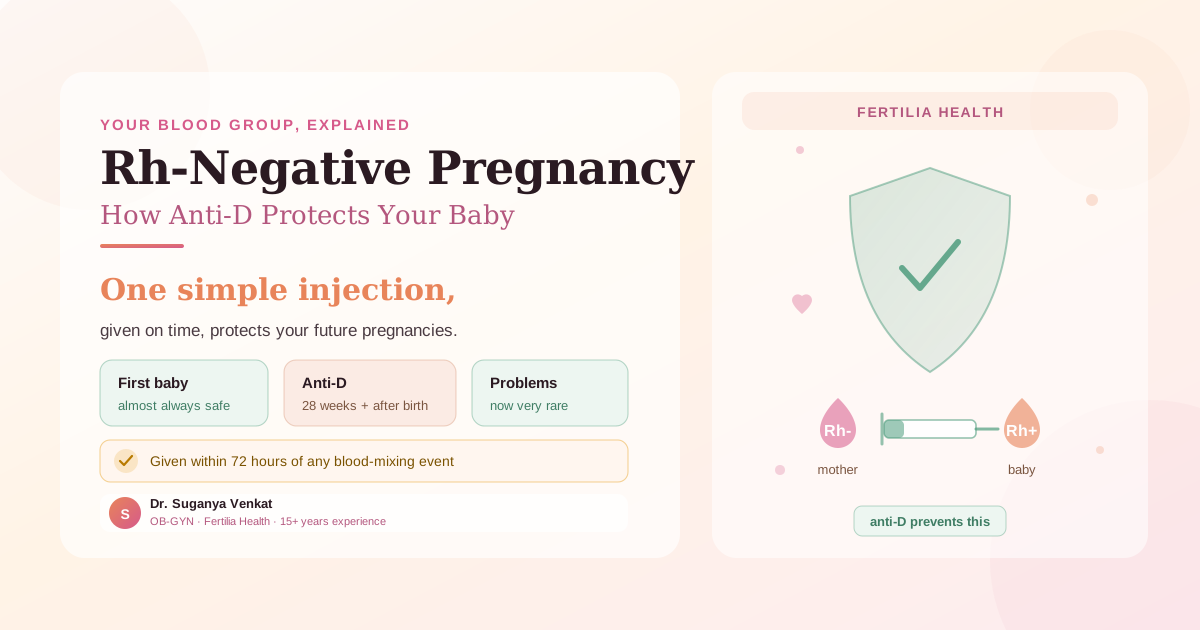
The anti-D injection, also known as anti-D immunoglobulin or by brand names such as Rhoclone and Rhogam, is the single tool that prevents sensitisation.
It works in a quietly clever way. The injection contains ready-made anti-Rh antibodies that mop up any of the baby’s Rh-positive cells that have entered your bloodstream, and clear them away before your own immune system notices them and starts making its own permanent antibodies. Because your body never gets sensitised, no lasting antibodies form, and your future pregnancies stay protected.
The evidence for it is strong and long-standing. Giving anti-D after childbirth substantially reduces the chance of an Rh-negative mother becoming sensitised (Crowther and Middleton, Cochrane Review, 2000), and giving it routinely during pregnancy lowers that chance further still (McBain, Crowther and Middleton, Cochrane Review, 2015). This is why the injection is offered to every Rh-negative mother carrying, or possibly carrying, an Rh-positive baby.
When the Anti-D Injection Is Given
Anti-D is given at specific moments, each one a time when the baby’s blood could mix with yours. Your obstetrician manages the timing, but it helps to know the schedule so nothing is missed.
- Routinely at around 28 weeks. This is the standard antenatal dose, sometimes with a second dose at around 34 weeks, given because small amounts of blood can cross in the third trimester without any obvious event.
- Within 72 hours after delivery, if your baby is confirmed to be Rh-positive on the cord blood test. This is the most important dose of all, because delivery is when the most blood mixing happens. If it is somehow missed, it can still help if given up to a few days later, so ask about it.
- After any potentially sensitising event, at any stage of pregnancy. These include a miscarriage or threatened miscarriage with bleeding, an ectopic pregnancy, any vaginal bleeding, an amniocentesis or chorionic villus sampling, an external attempt to turn a breech baby, or abdominal trauma such as a fall or accident.
The rule of thumb is simple: if there is any chance the baby’s blood has mixed with yours, anti-D is given, ideally within 72 hours. If you are Rh-negative and you ever have bleeding or a fall in pregnancy, mention your blood group straight away so the injection is not overlooked.
The Blood Tests That Go With It
A few simple blood tests sit alongside the anti-D schedule, and knowing what they are removes the mystery.
- Your blood group and Rh type, checked early in pregnancy, which is how being Rh-negative is picked up in the first place. Our first trimester guide lists the routine early tests.
- An antibody screen (the indirect Coombs test), which checks whether you have already made anti-Rh antibodies. If it is negative, you are not sensitised, and anti-D keeps it that way. This is usually repeated during pregnancy.
- Your baby’s blood group from the cord blood at birth, which decides whether the postnatal anti-D dose is needed. If your baby turns out to be Rh-negative, you do not need it.
Some hospitals now also offer a test that reads the baby’s Rh type from the mother’s blood during pregnancy, which can tell in advance whether anti-D is even required. It is not yet routine everywhere in India, so most women simply follow the standard schedule, which is safe and effective.
Is the Anti-D Injection Safe?
Yes. Anti-D has been used safely for more than fifty years and is one of the best-established injections in pregnancy care.
It is given into a muscle, usually the upper arm, and most women feel nothing more than a little soreness at the site. Occasionally there is mild tenderness, a brief low-grade temperature, or a headache, all of which settle quickly. Serious reactions are very rare. It does not harm your baby, it does not affect your fertility, and it does not cause problems in future pregnancies. It is a purified antibody preparation, not a live vaccine, and it cannot give you or your baby an infection through modern screened products.
If you have ever had a strong allergic reaction to an immunoglobulin injection before, mention it to your doctor, but for the great majority of women anti-D is a simple, safe, routine step.
What If You Are Already Sensitised?
Occasionally, usually from a previous pregnancy before anti-D was available or if a dose was missed, a mother is found to already have anti-Rh antibodies. If this is your situation, it is understandable to feel anxious, so let me be clear that it is still very manageable today.
Anti-D no longer helps once antibodies have formed, so instead your pregnancy is watched more closely. This means regular blood tests to measure the antibody level, and a gentle, completely safe ultrasound of the blood flow in the baby’s brain (a middle cerebral artery Doppler) that shows whether the baby is becoming anaemic. If needed, specialist care, including in-utero treatment in the rare cases that require it, is available at larger centres. Being sensitised is a reason for closer monitoring by a specialist, not a reason to lose hope. Many sensitised pregnancies go on to healthy babies.
Anti-D Injection Cost in India
The anti-D injection is affordable and widely available. The standard 300 microgram dose, sold under brand names such as Rhoclone and Rhogam, typically costs somewhere between Rs 1,800 and Rs 4,000 in private pharmacies, depending on the brand. A smaller 150 microgram dose, used for early-pregnancy events such as an early miscarriage, costs less.
In government hospitals, anti-D is often provided free or at a nominal charge, and it is included in many maternity insurance packages. Given how much it protects, it is one of the most worthwhile injections in the whole of pregnancy. If cost is a worry, ask your obstetrician about the government-hospital and insurance options, because no Rh-negative mother should miss this injection over price.
How Care Works
Your Rh-negative pregnancy is managed by your own obstetrician, in person. The blood tests, the timing of each anti-D dose, and the checks after delivery are theirs to arrange, and they will keep track of the schedule for you. This is exactly where that care belongs, and it does not change.
Where our program helps is the layer between those visits, where the worry tends to live. That includes understanding your blood reports and antibody results, knowing which situations mean you should ask for anti-D, keeping a simple record of the doses you have received across pregnancies, and having somewhere to bring your questions so a decades-old family story does not become tonight’s anxiety. We do this online, pan-India, over a video call, alongside your medical team and never instead of them. Dr. Suganya is an OB-GYN, so the guidance you get between visits matches the care you get at the hospital. Being Rh-negative is one of the reasons a pregnancy is watched a little more closely, which we cover in our guide to high-risk pregnancy.
What You Can Do Now
- Know your blood group and your partner’s. If you are Rh-negative and your partner is Rh-negative, your baby is Rh-negative and anti-D is not needed. Otherwise, plan for the standard schedule.
- Put the 28-week dose in your calendar. The routine antenatal dose is the one most easily forgotten. Ask your doctor to confirm the date.
- Report any bleeding, fall, or procedure at once, mentioning your blood group. Anti-D works best within 72 hours of a blood-mixing event, so speak up quickly.
- Ask about the postnatal dose before you go home. After delivery, check that your baby’s blood group has been tested and that you have had anti-D if your baby is Rh-positive.
- Keep a record of every anti-D dose. A simple note of the dates protects your future pregnancies and helps any new doctor pick up your care.
FAQ: Rh-Negative Pregnancy and Anti-D
What does it mean to be Rh-negative in pregnancy?
It means your red blood cells do not carry the Rh D protein. On its own it does not affect your health, and most Rh-negative women have normal pregnancies. It matters only if your baby is Rh-positive and some of the baby’s blood mixes with yours, which can make your body form antibodies. The anti-D injection is given at set times to prevent this from happening.
Is my first pregnancy at risk if I am Rh-negative?
Almost never. In a first pregnancy your body has usually not yet made anti-Rh antibodies, so the first baby is almost always unaffected. The tests and the anti-D injection are given to protect your future pregnancies by making sure your body never becomes sensitised. That is why the care is preventive rather than a treatment for this baby.
When is the anti-D injection given?
Routinely at around 28 weeks (sometimes with a second dose near 34 weeks), within 72 hours after delivery if your baby is Rh-positive, and after any event that could mix blood, such as bleeding, a miscarriage, an ectopic pregnancy, an amniocentesis, an attempt to turn a breech baby, or abdominal trauma. If there is any chance of blood mixing, anti-D is given, ideally within 72 hours.
Is the anti-D injection safe for me and my baby?
Yes. Anti-D has been used safely for over fifty years. It is given into the muscle and usually causes nothing more than mild soreness, occasionally a brief low temperature or headache. It does not harm your baby, does not affect fertility, and cannot cause an infection through modern screened products. It is a purified antibody, not a live vaccine.
How much does the anti-D injection cost in India?
The standard 300 microgram dose (brands such as Rhoclone and Rhogam) usually costs between about Rs 1,800 and Rs 4,000 in private pharmacies. A smaller 150 microgram dose for early-pregnancy events costs less. Government hospitals often provide it free or at a nominal charge, and many maternity insurance packages include it, so no one should miss it over cost.
Do I need anti-D if my partner is also Rh-negative?
No. If both parents are Rh-negative, the baby will be Rh-negative too, so there is no Rh mismatch and anti-D is not needed. This is why your partner’s blood group is sometimes checked. If your partner is Rh-positive or unknown, the standard anti-D schedule is followed to be safe.
What happens if I am already sensitised?
Anti-D no longer helps once antibodies have formed, so instead your pregnancy is monitored more closely with regular antibody-level blood tests and a safe ultrasound of the blood flow in the baby’s brain to check for anaemia. Specialist care is available if needed. Being sensitised means closer monitoring, not a lost cause, and many sensitised pregnancies result in healthy babies.
The Bottom Line
Being Rh-negative is not a problem with you or your baby. It is simply a blood group that calls for one extra, highly reliable step in your care. Your first pregnancy is almost always safe, and the anti-D injection, given on time, protects every pregnancy that follows. Sensitisation, which once caused real harm, is now very rare precisely because this injection works so well.
Know your blood group, mark the 28-week dose, speak up about any bleeding or falls, and confirm the injection after delivery. Do those few things, with your obstetrician guiding you, and Rh-negative becomes a footnote in an otherwise ordinary, healthy pregnancy.
You do not have to carry old family fears alone between visits. For calm, well-informed support through an Rh-negative pregnancy, alongside your own obstetrician, Dr. Suganya’s Pregnancy Care program helps you understand your reports, keep track of your anti-D schedule, and stay reassured and prepared.
Want steady support through an Rh-negative pregnancy? Dr. Suganya Venkat helps you understand your blood reports, keep your anti-D schedule on track, and set old worries aside, all alongside your own hospital team. Chat on WhatsApp
Dr. Suganya Venkat is an OB-GYN with a DNB from GKNM Hospital, Coimbatore, an MD Pathology from CMC Vellore, and 5 Gold Medals in MBBS from SRMC. She has 15+ years of clinical experience in obstetrics and women’s health.