
You opened a lab app to book a vitamin D test and found three different names and three different prices. “Vitamin D Total” for ₹1,650. A “Vitamin D Profile Gold” for ₹2,675. A “Vitamin D Screening” package for ₹599 with a crossed-out ₹1,245. A friend paid ₹399 for hers. You are not sure which one your doctor meant, whether the expensive one is better, or whether you need the test at all, since everyone you know seems to be taking a weekly vitamin D sachet anyway.
This post answers those questions. It covers what a vitamin D test costs in India right now, which version to book, how to read the number on your report, and when testing is worth the money.
Here is what this post covers:
- Which vitamin D test to book, and which ones you can skip
- Prices from the labs’ own websites, checked on 30 October 2026, city by city
- What your ng/mL result means, and why reports disagree on “normal”
- Who benefits from testing, who may not need it, and when to retest
If your question is about symptoms and treatment rather than the test itself, start with our guide to vitamin D deficiency in women. For the fertility side, see vitamin D and fertility.
Why So Many Indian Women Are Asked to Check Vitamin D
Low vitamin D is very common in India, despite the sunshine. A review of Indian studies reported a prevalence of vitamin D deficiency of 70% to 100% in the general population, across urban and rural settings and across income groups, and pointed to little food fortification and limited sun exposure as reasons (G R and Gupta A, Nutrients, 2014, PMID 24566435).
That is why vitamin D turns up on so many lab slips: fatigue workups, fertility workups, PCOS reviews, bone health checks and full-body packages. It is a simple blood test. The cost is where women get confused, because the same test is sold under several names and at very different prices.
Which Vitamin D Test to Book
Lab menus list several vitamin D tests. Only one is the standard test for checking whether you are low.
25-hydroxy vitamin D (the one you usually need). Also written as 25(OH)D, 25-OH vitamin D, “Vitamin D Total”, “Vitamin D 25 Hydroxy” or “calcidiol”. This is the form of vitamin D that circulates in your blood and reflects what you get from sun, food and supplements combined. The Endocrine Society’s 2011 guideline suggested measuring serum 25-hydroxyvitamin D by a reliable assay as the initial diagnostic test in people at risk of deficiency (Holick MF et al., J Clin Endocrinol Metab, 2011, PMID 21646368). When a doctor writes “Vit D3 test” or “vitamin D test” on your slip, this is almost always what they mean.
“Vitamin D Gold” or D2 plus D3 profile. This reports vitamin D2 and vitamin D3 separately as well as the total. For a routine check, the total 25-hydroxy result is the number your doctor reads. The split can occasionally help a specialist, for example when someone is taking a vitamin D2 preparation, but it cost about ₹850 to ₹1,280 more than the standard test at Metropolis across the five cities we checked.
1,25-dihydroxy vitamin D (calcitriol). This is the active hormone form. It is a different test for specific kidney, calcium and parathyroid questions, and it is not used to check whether you are deficient. In someone who is low on vitamin D, it can come back normal. At Metropolis Chennai it costs ₹3,570, more than twice the standard test, so check that this is the test your doctor asked for before you pay for it.
“Vitamin D3 test”. Many women search for this. On most lab menus it simply leads to the 25-hydroxy test. Read the parameter listed on the booking page: if it says “25 Hydroxy” or “Total”, you have the right one.
Vitamin D Test Prices in India (Checked 30 October 2026)
I checked these prices on each lab’s own website on 30 October 2026. Prices on booking sites change often and depend on the city you select. Use the tables to know what is reasonable, then check the price for your city on the day you book.
Metropolis Healthcare (metropolisindia.com)
| Test | Chennai | Coimbatore | Bengaluru | Mumbai | Delhi |
|---|---|---|---|---|---|
| Vitamin D Total, 25 Hydroxy | ₹1,650 | ₹1,600 | ₹1,780 | ₹1,800 | ₹900 |
| Vitamin D Profile Gold (D2, D3 and total) | ₹2,675 | ₹2,750 | ₹2,725 | ₹2,650 | ₹2,180 |
| Vitamin D 1,25-Dihydroxy | ₹3,570 |
Empty cells are prices I did not check on the day, not prices that do not exist. Metropolis lists the 25-hydroxy test as needing no fasting, with a report after about 6 hours.
Apollo 24|7 (apollo247.com)
Apollo 24|7 shows a high “MRP” and a discounted price. The discounted price is what the booking page showed for the 25-Hydroxy Vitamin D (D2+D3) test.
| City | Price shown | MRP shown |
|---|---|---|
| Chennai | ₹2,239 | ₹5,597 |
| Bengaluru | ₹2,209 | ₹5,523 |
| Mumbai | ₹2,029 | ₹5,072 |
| Delhi | ₹1,709 | ₹4,273 |
The same Apollo pages also carried a city price table with lower figures (₹1,900 for Chennai, for example). When one page shows two prices for the same test, trust the amount at checkout.
Redcliffe Labs, Chennai (redcliffelabs.com)
| Test or package | Price shown | MRP shown | What it includes |
|---|---|---|---|
| Vitamin D Test | ₹399 | ₹957 | 25-hydroxy vitamin D |
| Vitamin D Screening | ₹599 | ₹1,245 | Vitamin D Total, 25 Hydroxy |
| Vitamin D and Vitamin B12 Test | ₹899 | ₹3,473 | 25-hydroxy vitamin D and vitamin B12 |
Redcliffe’s Chennai page also mentioned ₹499 in its text, so again, the checkout price is the one to compare.
What the tables show:
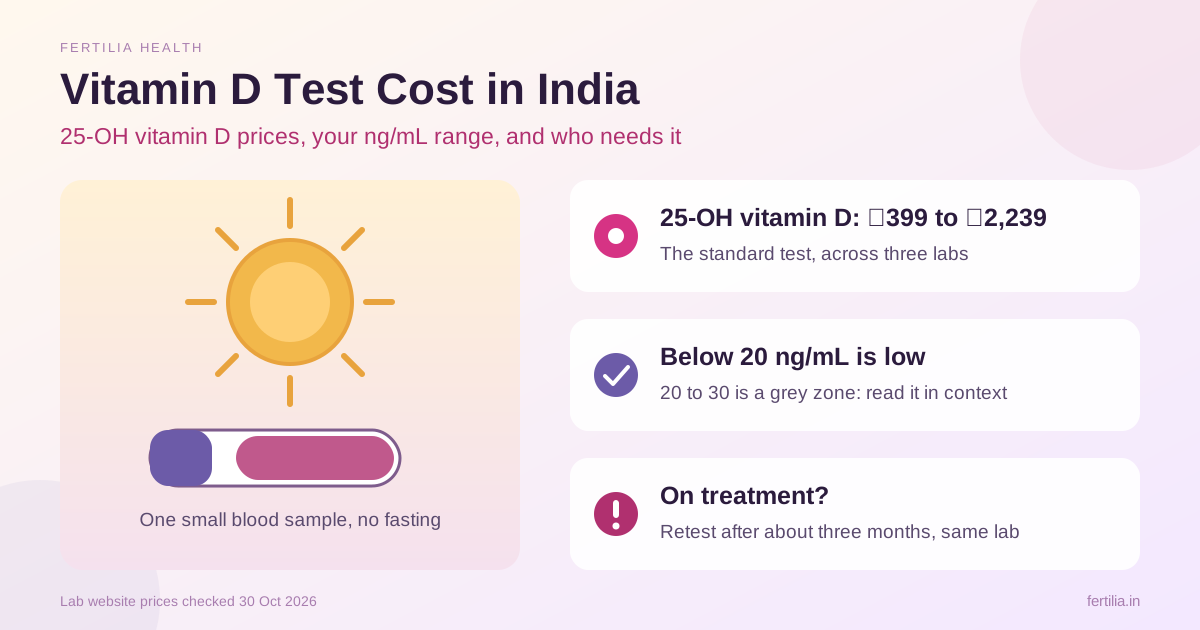
- The same 25-hydroxy test ranged from ₹399 to ₹2,239 across these three labs on one day.
- City matters, even within one lab. Metropolis listed ₹900 in Delhi and ₹1,800 in Mumbai for the identical test.
- The MRP is not a useful guide. A ₹5,597 MRP and a ₹2,239 checkout price are the same test.
- The extra-cost versions rarely change the plan. For most women, the Gold profile and the 1,25-dihydroxy test add cost without adding a more useful answer.
- Combinations can be good value. If your doctor wants B12 as well, a combined vitamin D and B12 test can cost less than booking each separately.
I could not load current prices from Thyrocare or Dr. Lal PathLabs on the day of checking, so they are not in these tables rather than being guessed. Both are large national chains and worth comparing on their own websites. If cost is a concern, ask the laboratory at your nearest government hospital what it charges.
💜 Not sure whether you need a vitamin D test, or which one? Message Dr. Suganya on WhatsApp to book a ₹399 video consultation. Share any recent reports, any supplements you already take, and whether you are trying to conceive or pregnant.
How to Read Your Vitamin D Result
Most Indian labs report 25-hydroxy vitamin D in ng/mL. Some reports, and most UK or European ones, use nmol/L. To convert, multiply ng/mL by 2.5: 20 ng/mL is 50 nmol/L.
Here is where it gets confusing. Expert bodies do not agree on where “normal” starts, and different reports reflect that.
| Result (ng/mL) | What many Indian lab reports print | What the Institute of Medicine committee concluded |
|---|---|---|
| Below 20 | Deficiency | Below the level that meets most people’s needs |
| 20 to 30 | Insufficiency | At or above 20 meets the needs of at least 97.5% of people |
| 30 to 100 | Sufficiency | No consistent added benefit from higher levels |
| Above 100 | Hypervitaminosis (too high) | Not covered in that summary |
The left column is the band Metropolis prints on its report page (deficiency below 20, insufficiency 20 to 30, sufficiency 30 to 100, hypervitaminosis above 100 ng/mL), and many other labs use similar bands. The right column comes from the Institute of Medicine committee that set North American intake requirements in 2011: it concluded that a serum 25-hydroxyvitamin D level of at least 20 ng/mL meets the requirements of at least 97.5% of the population, that higher values were not consistently associated with greater benefit, and it called for laboratory ranges to be reassessed to avoid both undertreatment and overtreatment (Ross AC et al., J Clin Endocrinol Metab, 2011, PMID 21118827). The 2024 Endocrine Society guideline adds that there was no clear evidence defining the optimal 25(OH)D level for disease prevention (Demay MB et al., J Clin Endocrinol Metab, 2024, PMID 38828931).
What this means for you:
- Below 20 ng/mL: this is under the level the Institute of Medicine committee found meets the needs of at least 97.5% of people, and most lab reports flag it as low. A result just under 20 is not the same as a very low one, so whether you need a treatment course, and what kind, depends on how low it is and why you were tested. Your doctor will read it with you.
- 20 to 30 ng/mL: this is the grey zone. One report may flag it in red as “insufficient” while the evidence above says it meets most people’s needs. Whether to treat depends on why you were tested: a woman with low bone density, or one preparing for fertility treatment, may be advised differently from a healthy woman tested as part of a package. If your report prints this band in red, take it to your doctor as a question about your situation.
- 30 to 100 ng/mL: most Indian lab reports print this as sufficient, but a lab’s printed range is not a target to aim for. There is no need to push higher. The Institute of Medicine committee found that higher values were not consistently associated with greater benefit, and for some outcomes observed U-shaped associations, with risks at both low and high levels (Ross AC et al., J Clin Endocrinol Metab, 2011, PMID 21118827). If your result is towards the upper end of this band while you are taking supplements, ask your doctor whether the dose still needs to continue.
- Above 100 ng/mL: usually seen in people taking high-dose supplements for a long time. Toxicity is rare, but there is no single number that marks where it starts. A higher figure you may see quoted online, such as 300 ng/mL, is not a safe ceiling. Whether a high level is causing harm depends on your calcium level, kidney function, symptoms and how much vitamin D you have been taking, so your doctor may check calcium and kidney function alongside it. A review of vitamin D toxicity suggested that the more prudent upper limit of 250 nmol/L (100 ng/mL) might be retained to ensure a wide safety margin (Jones G, Am J Clin Nutr, 2008, PMID 18689406). A high result is a reason to review your supplement dose with your doctor.
Your number can vary from lab to lab. In a study where serum from the same 10 healthy adults was sent to six laboratories, the mean 25-hydroxyvitamin D result ranged from 17.1 to 35.6 ng/mL, enough to move the same person from “low” to “normal” depending on the lab (Binkley N et al., J Clin Endocrinol Metab, 2004, PMID 15240586). That study is old and methods have been worked on since, but the practical lesson holds: if you are tracking your level, use the same lab each time.
Who Needs a Vitamin D Test, and Who May Not
Because deficiency is so common in India, it is tempting to test everyone. The evidence points to a more selective approach. The 2024 Endocrine Society guideline, which looked at healthy people without a specific reason for testing, found no clinical trial evidence to support routine 25(OH)D screening in the general population, including people with obesity or darker skin, and suggested against routine testing in those groups (Demay MB et al., J Clin Endocrinol Metab, 2024, PMID 38828931). The 2011 guideline also found insufficient evidence to recommend screening people who are not at risk of deficiency (Holick MF et al., J Clin Endocrinol Metab, 2011, PMID 21646368).
That is not a reason to skip the test when you have a real reason for it. Testing is usually worthwhile when:
- You have symptoms that fit, such as bone pain, muscle weakness or aches, or unexplained tiredness that your doctor is working up alongside ferritin and thyroid tests. Our 3-test guide for tiredness explains why these are often checked together.
- You have a condition that affects bone or vitamin D, such as osteoporosis or low bone density, a low calcium level, coeliac disease or another condition that affects absorption, a past bariatric surgery, or chronic kidney or liver disease.
- You take a medicine known to lower vitamin D, such as some anti-epileptic medicines or long-term steroids.
- Your doctor is planning a high-dose treatment course, and wants a baseline so the dose fits your actual level.
- You are already on treatment and your doctor wants to check that the course worked.
- You are preparing for fertility treatment and your fertility doctor has asked for it. Many fertility units include vitamin D in their workup. Our fertility workup cost guide shows how it fits with the other tests.
What about pregnancy? The 2024 Endocrine Society guideline suggests vitamin D supplementation during pregnancy without first testing, and suggests against routine 25(OH)D testing in pregnancy (Demay MB et al., J Clin Endocrinol Metab, 2024, PMID 38828931). Your obstetrician may still test you if there is a specific reason, and that is the plan to follow. If you are pregnant and wondering about calcium as well, see calcium in pregnancy.
Should you test before starting supplements? If your doctor is recommending a standard daily maintenance dose, a test first is often not essential. If a high-dose course is being considered, or you have one of the reasons listed above, testing first means the dose is matched to your level rather than guessed. Vitamin D is stored in the body, so high doses taken for months without a reason or a plan are not a good idea either.
I’m Dr. Suganya Venkat, an OB-GYN with more than 15 years of experience, and my MD is in pathology, so lab reports are a large part of my week. In my video consultations at Fertilia, vitamin D reports often arrive from health packages that included the test by default. Before booking another one, I usually ask two things: why are we testing, and what will we do differently with the answer? If neither has a clear reply, the money is often better left in your pocket.
When to Retest
Retesting too soon is one of the commonest ways women overpay.
After starting treatment, wait about three months. 25-hydroxyvitamin D has a half-life of roughly 15 days (Jones G, Am J Clin Nutr, 2008, PMID 18689406), so your level keeps changing for several weeks after a dose change. A test two or three weeks into a course shows a level that is still moving. Most doctors recheck at around three months, which is also what our vitamin D deficiency guide suggests for confirming correction.
Once your level is in range, there is usually no need to repeat it every few months. Your doctor may check it again if your situation changes: a new pregnancy, a new medicine, or symptoms coming back.
Use the same lab for the before-and-after comparison, for the reasons in the lab-to-lab study above.
Practical Tips Before You Book
- No fasting is needed. Metropolis, Redcliffe and Apollo 24|7 all list the test as needing no fasting or preparation.
- Mention biotin. Metropolis’s own vitamin D page asks patients taking more than 5 mg of biotin a day (common in hair and nail supplements) to stop it at least 8 hours before blood collection. If you take a hair supplement, tell the lab.
- Home collection works well. It is a single small blood sample, and all three labs above advertise home collection.
- Compare the checkout price for your own city, not the MRP and not the price in the page text.
- Check whether vitamin D is already in a package your doctor has asked for, so you do not pay for it twice. The same goes for thyroid tests: our thyroid test cost guide covers those prices.
- Living outside India? US lab prices and what to ask for are in vitamin D and B12 for Indian women in the US.
What It Is Called in Tamil and Hindi
Many women search for this test in their own language, or mix languages in one search.
- Tamil: vitamin D parisodhanai (வைட்டமின் டி பரிசோதனை), the vitamin D test. Women often ask “vitamin D test evvalavu?” for the price.
- Hindi: vitamin D jaanch (विटामिन डी जांच). Searches such as “vitamin D test kitne ka hota hai” ask what the test costs, which is the question this post answers.
Practical Takeaways
- Book 25-hydroxy vitamin D (also called “Vitamin D Total”). It is the standard test, and in our check it cost ₹399 to ₹2,239.
- Skip the Gold profile and the 1,25-dihydroxy test unless your doctor has asked for them specifically.
- Read the cut-offs with care. Below 20 ng/mL is flagged as low on most reports, and your doctor will decide whether it needs treatment. Between 20 and 30, the right step depends on why you were tested.
- Test when there is a reason: symptoms, a relevant condition or medicine, a planned high-dose course, or a fertility workup your doctor has asked for.
- Retest after about three months of treatment, at the same lab, and not every few weeks.
- Never start or stop high-dose vitamin D on the basis of a report alone. Talk it through with the doctor who ordered it.
Frequently Asked Questions
How much does a vitamin D test cost in India?
A 25-hydroxy vitamin D test cost between ₹399 and ₹2,239 on the labs’ own websites on 30 October 2026. Redcliffe Chennai listed ₹399, Metropolis listed ₹900 in Delhi to ₹1,800 in Mumbai (₹1,650 in Chennai), and Apollo 24|7 showed ₹1,709 in Delhi to ₹2,239 in Chennai. Prices change often, so check the checkout price for your city.
Is the vitamin D3 test different from the 25-OH vitamin D test?
Usually not. When a doctor or a search says “vitamin D3 test”, the lab almost always runs the 25-hydroxy vitamin D test, which covers vitamin D from all sources. A separate D2 and D3 breakdown (the “Gold” profile) exists but costs more and is rarely needed for a routine check.
Vitamin D test kitne ka hota hai, and do I need to fast?
The standard 25-hydroxy vitamin D test cost ₹399 to ₹2,239 across the three labs we checked in October 2026. No fasting is needed, and you can eat and drink normally. If you take a biotin supplement above 5 mg a day, stop it at least 8 hours before the sample, as Metropolis advises.
What is a normal vitamin D level in ng/mL?
Below 20 ng/mL is flagged as low on most lab reports, though whether it needs treatment depends on how low it is and your situation. Many Indian lab reports call 20 to 30 ng/mL “insufficient” and 30 to 100 ng/mL “sufficient”. The Institute of Medicine committee concluded that 20 ng/mL meets the needs of at least 97.5% of people. Your doctor will read your result against your reason for testing.
Should I get a vitamin D test before taking supplements?
It depends on the dose and your situation. Before a high-dose course, or if you have symptoms or a condition that affects vitamin D, testing first helps match the dose to your level. For a standard daily maintenance dose in a healthy woman, a test is often not essential. Ask your doctor which applies to you.
How often should I repeat a vitamin D test?
If you are being treated for a low level, recheck after about three months, at the same lab. Once your level is in range, repeat testing is usually only needed if something changes, such as a pregnancy, a new medicine or returning symptoms.
Why is the same vitamin D test so cheap at one lab and so expensive at another?
Labs set prices by city and run frequent discounts, and some pages show both an MRP and a lower checkout price. On the same day, the identical test cost ₹900 at Metropolis Delhi and ₹1,800 at Metropolis Mumbai. For tracking your level over time, staying with one lab matters more than finding the lowest price each time.
Talking It Through
A vitamin D report is easy to get and easy to over-read, especially when the result lands in the grey zone between 20 and 30 and the report prints it in red. If you have a result and are not sure what it means for you, or whether you need the test at all, you do not have to work it out alone.
💜 Have a vitamin D report and questions about it? Message Dr. Suganya on WhatsApp to book a ₹399 video consultation, available online across India. You can also download our free guide to getting pregnant for a step-by-step look at preparing your body for conception.