The scan report is mostly reassuring, and then one word stands out: “retroverted.” Sometimes it is written as “RV uterus” or “uterus retroverted, normal size.” You were scanning for a cyst or checking your lining, and now there is a new question. A quick search tells you that a tilted uterus makes it harder to conceive, that you need special sex positions, or that you should lie with your legs up the wall afterwards.
I’m Dr. Suganya Venkat, an OB-GYN with more than 15 years of experience, and when a woman brings me a report with that word circled, the first thing I tell her is this: a tilted uterus, on its own, does not stop you getting pregnant. It is one of the most common normal variations of the female pelvis. What deserves a closer look is not the tilt itself, but whether the uterus moves freely or is held in place.
This post covers what “retroverted” means, what the research says about conception, the sex-position advice you may have read, the difference between a mobile and a fixed tilt, what happens to a tilted uterus during pregnancy, and when it is worth getting checked.
What a Retroverted Uterus Is
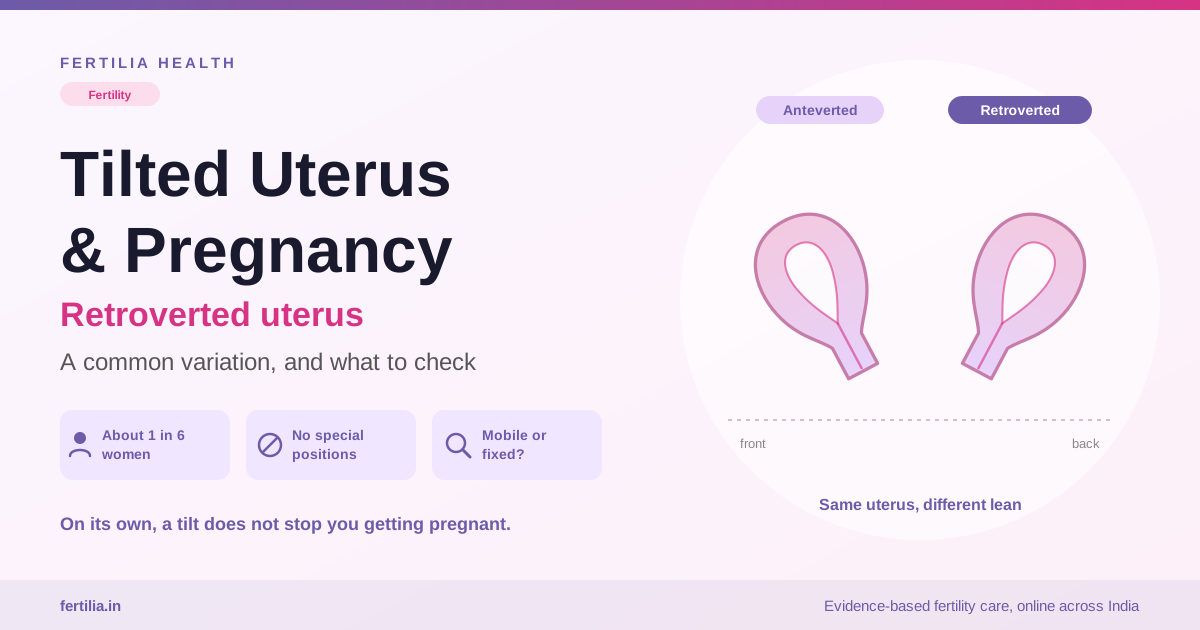
Picture the uterus as a pear sitting in the middle of the pelvis, with the narrow end (the cervix) at the bottom. In most women, the top of the pear leans forward, over the bladder. Doctors call this anteverted. In a retroverted uterus, the top leans backward, towards the spine and rectum.
You may also see these terms on a report:
- Retroverted: the whole uterus tilts backward at the cervix.
- Retroflexed: the body of the uterus bends backward on itself. Many women have both, written as “retroverted, retroflexed” or “RVF.”
- Axial or mid-position: the uterus points straight up, neither forward nor back.
A tilted uterus is far from rare. A 2025 review of more than 300 publications on the subject found that about 16 to 18% of women, roughly 1 in 6, have one, and that it is more likely to be developmental (the way a woman is built) than acquired later. The same review concluded that uterine retroversion is most commonly symptom-free and needs no treatment (Haylen BT et al., Int Urogynecol J, 2025, PMID 40498384).
Your sonologist notes the direction of the uterus mainly so the scan can be read correctly and so any doctor doing a procedure later knows which way to angle an instrument. Our guide to what a transvaginal scan shows and why it is done explains the other lines you will usually see on the same report.
Does a Tilted Uterus Make It Harder to Get Pregnant?
For most women, no. A uterus that tilts backward still has an open cervix, a normal cavity, two tubes and two ovaries. Ovulation, the tubes picking up the egg, sperm meeting the egg and the embryo implanting all happen the same way whichever direction the uterus leans.
Sperm also move quickly. A classic study timed and counted sperm as they travelled from the external cervical os (the opening of the cervix) to the fallopian tubes in women (Settlage DS et al., Fertil Steril, 1973, PMID 4737661). The journey does not depend on gravity or on the angle of the uterus.
The things that usually decide how quickly a couple conceives are the same with or without a tilt:
- Regular ovulation. Cycles between about 21 and 35 days usually mean you are ovulating.
- Open tubes. Past pelvic infection, endometriosis or surgery can affect them.
- Sperm health. A semen analysis is part of every fertility workup, not an extra.
- Age. Egg numbers and quality change with time for every woman.
- Timing. Intercourse every one to two days through the fertile window.
There is one finding worth mentioning so you are not surprised by it elsewhere. In a 2025 study of 249 pregnancies at a single academic medical centre, women whose uterus was still tilted at the first-trimester nuchal translucency (NT) scan were more likely to have conceived through IVF (11% vs 3%) (Schneider ER et al., Am J Perinatol, 2025, PMID 39631743). The authors called for more research, and the study was not designed to show that the tilt caused any difficulty conceiving. A woman who needs IVF often has a reason, such as endometriosis, that can also hold the uterus back. That is why the next sections matter more than the tilt alone.
If conception is taking time, the usual timelines still apply: see a doctor after 12 months of trying if you are under 35, after 6 months if you are 35 or older, without waiting if you are over 40, and sooner at any age if your cycles are irregular or you have painful periods. Our guide on how long it takes to conceive naturally goes through those steps for both partners.
If your report says “retroverted” and you want to know whether anything else in it needs attention, you can go through it with Dr. Suganya over a video consultation, from anywhere in India.
Sex Positions, Pillows and Legs Up the Wall
This is the advice most women find first, and it causes a lot of needless worry. The old idea was that a tilted uterus points the cervix away from where semen collects, so a couple should choose a particular position, put a pillow under the hips, or have the woman lie still with her legs raised.
The evidence does not support any of it. The American Society for Reproductive Medicine’s committee opinion on optimizing natural fertility (Penzias A et al., Fertil Steril, 2022, PMID 34815068; full text on asrm.org) states that there is no evidence that coital position affects the chance of pregnancy, and that sperm can be found in the cervical canal seconds after ejaculation, whatever the position. The same document says the belief that lying on your back after sex helps sperm travel, or stops semen leaking out, has no scientific foundation. Some leakage afterwards is normal and does not mean the sperm that matter have been lost.
What does make a difference is timing: intercourse every one to two days through the fertile window. Our post on the fertile window and how to use it explains how to find those days without turning the month into a schedule.
The one place position does matter is comfort. Some women with a tilted uterus feel a deep ache in certain positions, because the uterus and ovaries can sit closer to where the deepest pressure falls. If that happens, choose positions that feel comfortable. Comfortable, relaxed sex is easier to keep regular, and regularity helps far more than any angle.
Mobile or Fixed: The Part That Matters
When I examine a woman with a retroverted uterus, the question I am answering is whether it moves. Two situations can look identical on a report:
A mobile retroverted uterus. The uterus leans back but moves freely when gently pressed during an examination or a scan. This is the common, normal variant described above. It needs nothing done.
A fixed retroverted uterus. The uterus is held back by scar tissue (adhesions) or by disease behind it, and does not move when pressed. This is less common, and the tilt is then a sign of something else. The usual causes are:
- Endometriosis, especially deep endometriosis behind the uterus, which can bind the back of the uterus to the bowel. Researchers studying women who had surgery for deep endometriosis behind the uterus note that a backward-displaced uterus may be associated with both pelvic pain and this form of the disease (Seracchioli R et al., Aust N Z J Obstet Gynaecol, 2019, PMID 30136296).
- Adenomyosis, a related finding rather than a proven cause of a fixed uterus. In women attending a pelvic pain centre, a sharply backward-bent uterus (a flexion angle above 210 degrees) was found in 25% of those with adenomyosis compared with 6.8% of those without it (Xholli A et al., J Clin Med, 2022, PMID 35683601). Our guide on getting pregnant with adenomyosis covers that condition in detail.
- Adhesions after pelvic infection or surgery, such as a past caesarean, appendix surgery or a treated pelvic infection.
A fixed tilt rarely comes alone. These signs make it worth a proper assessment:
- Period pain that keeps you from work or study, or that has worsened over the years
- Deep pain during sex, not just at the entrance
- Pain while passing stools, especially during your period
- Pelvic pain on non-period days
- More than a year of trying without conception (six months if you are 35 or older, and sooner if you are over 40)
Our guide to endometriosis and fertility explains how that condition is assessed, and if pain during sex is the main concern, how doctors tell dyspareunia from vaginismus explains how the cause of that pain is worked out.
How a fixed tilt is checked. A pelvic examination is the starting point. A transvaginal scan can add a lot: the sonologist presses gently with the probe and watches whether the uterus and bowel slide over each other. A good slide suggests the space behind the uterus is free; no slide raises the possibility of adhesions or deep endometriosis. When the picture is still unclear, an MRI or a laparoscopy may be suggested, but only when symptoms or the fertility picture point that way, not for the tilt alone.
What Happens to a Tilted Uterus in Pregnancy
Once you conceive, the uterus grows quickly. In the first three months a retroverted uterus sits lower and further back, and then, as it enlarges, it usually rises up and forward out of the pelvis on its own.
The same 2025 study gives useful numbers here. Among women whose uterus was tilted at the NT scan, 98% had resolved by the second trimester. The tilted group was about four times as likely to have had some bleeding in the first trimester (16.9% vs 4.2%), but their rate of second-trimester pregnancy loss was no higher than that of women with a forward-tilting uterus (Schneider ER et al., Am J Perinatol, 2025, PMID 39631743). The authors’ conclusion was that this gives reassuring information for counselling. Any bleeding in pregnancy should still be reported to your doctor, and it usually leads to a scan; with a tilted uterus, that scan is often normal.
Two practical points in early pregnancy:
- The early scan may be done vaginally. A uterus lying further back can be harder to see through the abdomen in the first weeks. A transvaginal scan gives a clearer view and is safe in pregnancy. Our guide to what is seen on an early pregnancy scan at 6 to 8 weeks explains what to expect.
- Some women feel more pressure low in the back or pelvis in the first trimester. This usually eases as the uterus rises.
The rare exception: an incarcerated uterus. Occasionally a growing retroverted uterus becomes wedged under the bony ridge at the back of the pelvis and cannot rise. This is called incarceration of the gravid uterus. It is uncommon: one large Chinese maternity hospital recorded 11 cases among 140,162 deliveries, roughly 1 in 13,000. Previous abdominal or pelvic surgery was the most frequent risk factor, difficulty passing urine was the most common symptom, and the overall outlook was described as good (Zhang M et al., J Clin Ultrasound, 2025, PMID 39282883). A review of the condition lists endometriosis, adhesions, fibroids and a uterine shape difference among the other risk factors, and recommends that repositioning the uterus be attempted so that a caesarean is not needed simply because of its position (Shnaekel KL et al., Obstet Gynecol Surv, 2016, PMID 27770131).
The practical message is simple. If you are pregnant and find you cannot pass urine, or can pass only small amounts with a constant feeling of fullness, go to your hospital straight away rather than waiting to see if it settles, because the bladder may need to be drained. This is different from simply needing to pass urine more often, which is common in early pregnancy. It is easy to check, and caught early it is usually straightforward to manage.
By the time of birth, the uterus is well up in the abdomen like anyone else’s, and an early tilt does not by itself decide how you deliver.
Does a Tilted Uterus Need Treatment?
A mobile, symptom-free retroverted uterus needs no treatment at all. There is no medicine, device or surgery that a woman needs simply because her uterus leans back.
Two points come up often:
- Exercises and massages to “correct” the tilt. You will see these recommended online. There is no good evidence that they change the position of the uterus in a lasting way, or that changing it would help you conceive. Gentle exercise is good for you for other reasons; it is not a fertility treatment for a tilt.
- Surgery to lift the uterus. Operations to hold the uterus forward were done more often in the past. Today a surgeon may stitch the uterus forward during an operation for deep endometriosis, as an add-on aimed at lowering the risk of adhesions after surgery; in the Seracchioli study of 42 women, about 17% had a retroverted and 29% a retroflexed uterus again at one year, and the authors described the correction as temporary (Seracchioli R et al., Aust N Z J Obstet Gynaecol, 2019, PMID 30136296). It is not an operation offered to improve fertility in a woman with only a tilted uterus.
If a fixed tilt is found, treatment is aimed at its cause (such as endometriosis or adhesions) and at your fertility plan as a whole, not at the angle of the uterus.
One more practical note: if you go on to need IUI or an embryo transfer, the doctor simply angles the catheter to follow your uterus. A mock transfer is sometimes done beforehand to map the route; our post on why doctors do a mock embryo transfer explains how that works.
Practical Steps if Your Report Says “Retroverted”
- Read the rest of the report. Uterine size, the endometrium, the ovaries and any cysts or fibroids tell you more about fertility than the direction of the uterus.
- Write down your symptoms. Painful periods, deep pain during sex or pain with bowel movements are worth mentioning even if you have been told such pain is normal.
- Keep the basics going. Intercourse every one to two days through the fertile window, folic acid before conception, and a balanced Indian diet with dal, vegetables, curd and whole grains.
- Forget the special positions. Choose whatever is comfortable. Lying still afterwards is optional, not required.
- Know your timeline. Twelve months of trying under 35, six months at 35 or above, or sooner with irregular cycles or significant pain, is the point to start a fertility workup. If you are over 40, start it without waiting.
- In pregnancy, go to hospital straight away if you cannot pass urine, and report any other new difficulty passing urine in the first or early second trimester the same day.
At Fertilia, when a woman shares a scan report with “retroverted uterus” on it, the conversation usually moves quickly on to her cycles, ovulation and timing, because that is where the answers tend to be. If you would like a structured plan for trying to conceive, our free guide to getting pregnant covers the basics, and the fertility program offers doctor-led support over 90 days.
FAQ: Retroverted (Tilted) Uterus and Pregnancy
Can you get pregnant with a retroverted uterus?
Yes. A tilted uterus is a normal variation seen in about 1 in 6 women, and on its own it does not stop sperm reaching the egg or an embryo implanting. If conception is taking longer than expected, the usual fertility tests (ovulation, tubes, semen analysis, thyroid) still apply, and the cause is usually something other than the tilt.
What is the best position to conceive with a tilted uterus?
There is no best position. The American Society for Reproductive Medicine states that there is no evidence that coital position affects the chance of pregnancy, and sperm reach the cervical canal within seconds whatever the position. Choose what is comfortable, and focus on having intercourse every one to two days during the fertile window.
Should I lie down with my legs up after sex if my uterus is tilted?
You can if you like, but you do not need to. Sperm reach the fallopian tubes within minutes, and the belief that lying on your back afterwards improves the chance of pregnancy has no scientific foundation. Some leakage of fluid afterwards is normal.
Is a retroverted uterus a sign of a problem?
Usually not. Most tilted uteri are mobile, and for many women the tilt is simply how they are built. A tilt matters when the uterus is fixed in place, which can be a sign of endometriosis or adhesions. A sharply bent-back uterus has also been linked with adenomyosis. Painful periods, deep pain during sex and pain with bowel movements are the clues that it is worth checking.
Does a tilted uterus cause miscarriage?
The evidence does not show that. In a 2025 study, women whose uterus was still tilted at the first-trimester NT scan had more first-trimester bleeding, but their rate of second-trimester loss was no higher than that of women with a forward-tilting uterus, and in 98% of them the uterus was no longer retroverted by the second trimester. Any bleeding in pregnancy should still be reported so it can be checked.
Will a tilted uterus affect my delivery?
In most pregnancies, no. The uterus rises out of the pelvis during the second trimester, and by the time of birth an early tilt does not by itself decide how you deliver. The rare exception is an incarcerated uterus that stays trapped in the pelvis, which is why trouble passing urine in early pregnancy should be checked promptly.
Can a retroverted uterus become anteverted?
Yes, it can change. Most tilted uteri move forward as pregnancy grows, and the position can be different after childbirth. A mobile uterus may also look different from one scan to the next depending on how full your bladder is. None of these changes needs treatment.
A retroverted uterus is usually just the way your body is built, and it is noted on a report because a scan happened to look. For most women, getting pregnant depends on ovulation, open tubes, healthy sperm and good timing, exactly as it does for everyone else. The tilt is worth a second look only when it comes with pain or a longer wait than expected, and then the answer lies in finding its cause.
If you would like to talk through your scan report or your plan for trying to conceive, you can speak with Dr. Suganya over a video consultation, wherever you are in India.