A woman in her mid-twenties messaged me a few months ago, frustrated. She had been told by two different doctors that she “probably had PCOS” because her periods had stopped, but neither ultrasound nor blood work had ever confirmed it. What she did mention, almost as an aside, was that she had started training for a half marathon eight months earlier and had also cut her portions down “to be healthier.” Her periods stopped soon after.
That story is not PCOS. It is very likely the opposite condition, one that gets missed constantly because “no periods” and “PCOS” have become almost synonymous in casual conversation, on the internet, and sometimes even in a rushed consultation. I’m Dr. Suganya Venkat, an OB-GYN with over 15 years of experience, and I see this misattribution often enough that it deserves its own explanation: hypothalamic amenorrhea, a real and common cause of missing periods that is diagnosed and treated in almost the opposite way to PCOS.
What this post covers
- What hypothalamic amenorrhea actually is, in plain terms
- The three triggers that cause it, alone or combined
- Why it looks like PCOS on the surface but is clinically its opposite
- How your doctor tells the two apart
- Why the fix is not a prescription, and what recovery actually involves
- What happens to your bones if this goes untreated for a long time
What hypothalamic amenorrhea is
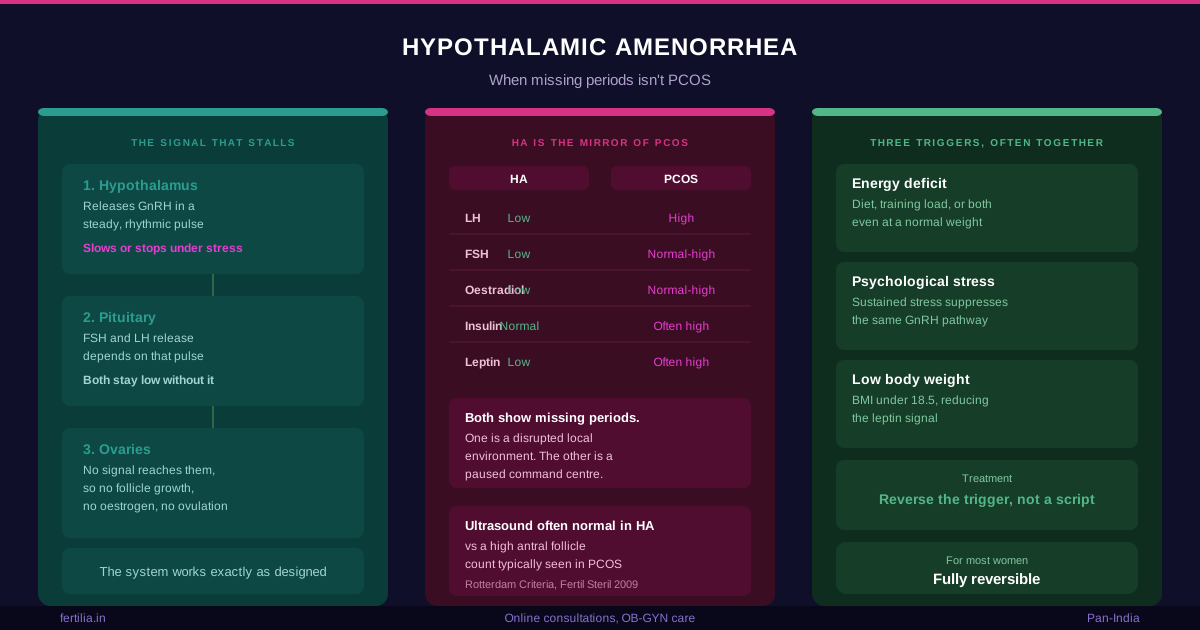
Ovulation depends on a signal that starts in the brain, not the ovary. The hypothalamus releases GnRH (gonadotropin-releasing hormone) in a steady, rhythmic pulse. That pulse tells the pituitary gland to release FSH and LH, which then tell the ovaries to grow a follicle, produce oestrogen, and eventually ovulate. Miss the pulse, and the whole chain stalls before it starts.
Hypothalamic amenorrhea, often shortened to HA, is what happens when the hypothalamus decides, in effect, that this is not a safe time to reproduce, and slows or stops that pulse. Without the pulse, FSH and LH stay low, the ovaries stay quiet, oestrogen drops, and periods stop. The Endocrine Society’s clinical practice guideline on functional hypothalamic amenorrhea describes this as a diagnosis of exclusion driven by stress on the body, whether that stress is physical, nutritional, or psychological (Gordon et al., Journal of Clinical Endocrinology and Metabolism, 2017; PMID 28368518).
The word “functional” matters here. Nothing is structurally wrong with the hypothalamus, the pituitary, or the ovaries. The system is working exactly as designed, protecting the body from a pregnancy it has assessed, correctly or not, as unsupportable right now. That framing changes everything about how it’s treated.
The three triggers, alone or together
Three inputs drive this response, and most women who develop HA have more than one at play at the same time.
Energy deficit. This is the gap between the calories you take in and the calories your body needs, including what training or daily activity burns. It does not require being underweight. A woman at a completely normal BMI who has quietly increased her exercise load, cut carbohydrates, or started intermittent fasting without adjusting her intake upward can create a large enough energy deficit to switch off the reproductive axis. The hypothalamus is highly sensitive to this signal specifically, more than to weight itself.
Psychological stress. Major life stress, whether from work, relationships, illness, or a significant life transition, activates the same stress-hormone pathways that suppress GnRH pulsing. This does not need to be a single dramatic event. Sustained, low-grade stress over months does the job just as effectively.
Low body weight. A BMI under 18.5 kg/m² on its own, independent of exercise or intentional dieting, is a recognised trigger, because very low body fat reduces the hormonal signals (including leptin) that tell the hypothalamus energy stores are adequate for reproduction.
In practice, these overlap constantly. A woman training seriously for endurance sport is usually managing an energy deficit, a demanding schedule, and often a lower body weight all at once. Each factor alone might not be enough to stop ovulation. Together, they frequently are.
Why it looks like PCOS but is clinically the opposite
The confusion is understandable, because from the outside, both conditions present the same way: periods that have gone missing or become very irregular. That is where the resemblance ends. If you did our complete guide to PCOS symptoms, root causes and treatment, the hormone pattern below will look like a mirror image of what’s described there, and that is exactly the point.
| Hypothalamic amenorrhea | PCOS | |
|---|---|---|
| LH | Low | Often high, or a high LH:FSH ratio |
| FSH | Low or low-normal | Normal or high |
| Oestradiol | Low | Normal to high |
| Insulin | Normal to low | Often elevated (insulin resistance) |
| Leptin | Low | Often elevated |
| Ovaries on ultrasound | Often normal, sometimes small or with a few small follicles | Often show a high antral follicle count |
A woman with PCOS usually has an ovary that is trying to ovulate against a background of excess androgens and, frequently, insulin resistance, following the Rotterdam Criteria used to establish that diagnosis (Azziz et al., Fertility and Sterility, 2009; PMID 18950759). A woman with HA has an ovary that would ovulate perfectly well, if only it were receiving the signal to do so. One is a disrupted local environment. The other is a paused command centre. The distinction is not academic. It decides what treatment actually helps.
How your doctor tells them apart
There is no single test that says “this is HA” the way a swab confirms an infection. It is built from a hormone panel plus a careful history, and from ruling out other explanations for the same symptom.
The hormone panel typically shows LH and FSH at the low end or below the normal range, oestradiol low, and, if checked, insulin and leptin not elevated the way they often are in PCOS. This is the same baseline hormone panel used to assess fertility more broadly; our guide on Day-3 FSH, LH and estradiol testing walks through what each number means and how they’re read together.
Ruling out other causes matters just as much as the hormone numbers, because low oestrogen with missing periods has a short list of other explanations that need to be excluded before HA is confirmed:
- Thyroid dysfunction, checked with a TSH, since both an underactive and an overactive thyroid can stop periods
- High prolactin, which independently suppresses the same GnRH pulse and needs its own workup; our guide on high prolactin in women covers this in more depth if that’s part of your picture
- Premature ovarian insufficiency, where the ovaries themselves, rather than the signal reaching them, have stopped responding, usually distinguished by a high rather than low FSH
The history is where the trigger usually surfaces, and it’s the part a rushed consultation is most likely to skip. Questions about training volume, recent weight change, dietary restriction, sleep, and life stress over the months before periods stopped are not small talk. They are the diagnostic tool that a hormone panel alone cannot replace.
If your periods have stopped and you are not sure which of these fits your situation, you can talk it through with Dr. Suganya Venkat over a video consultation at Fertilia. Fertilia works with women across India, entirely online, through video and phone.
The treatment is reversing the trigger, not a prescription
This is the part that surprises women the most. Where PCOS management often involves lifestyle change alongside medication for specific symptoms, HA has no pharmaceutical fix at all. The treatment is identifying and reversing whatever combination of energy deficit, stress, or low weight caused it in the first place.
In practice, that usually means:
- Increasing caloric intake to close the energy deficit, sometimes substantially, working with a dietitian to build this back up gradually and sustainably rather than all at once
- Reducing exercise load, at least temporarily, particularly high-volume endurance training, which is one of the most common precipitating factors seen in this diagnosis
- Addressing the stress component, which for many women is genuinely as important as the physical changes; a randomised trial by Berga and colleagues found that women with functional hypothalamic amenorrhea who received a structured course of cognitive behavioural therapy were significantly more likely to resume ovarian activity than those who did not (Berga et al., Fertility and Sterility, 2003; PMID 14556820)
This is not a plan to work through alone, and it is not a plan built around a single “eat more fat” fix or any one supplement. It genuinely benefits from a team: your OB-GYN to confirm the diagnosis and monitor recovery, a dietitian to rebuild intake safely, and often a therapist or counsellor where stress or disordered eating patterns are part of the picture. If a coach or training programme is part of what led here, that conversation matters too. This is also a collaborative process with whichever doctor first raised the “maybe PCOS” concern, not a correction of their judgement. HA and PCOS genuinely look similar on first presentation, and the hormone panel is exactly the tool that tells them apart.
The reassuring part: for most women, this is fully reversible. Once the trigger is meaningfully addressed, cycles typically return within a matter of months, and this is not a lifelong condition the way PCOS’s underlying tendency often is.
Bone health, and why this isn’t something to sit on indefinitely
Oestrogen protects bone density, and prolonged low oestrogen, the state HA creates, allows bone loss to happen faster than it would otherwise. This is the one part of HA that does carry a real, cumulative risk if it goes unaddressed for a long stretch of time, particularly in younger women who are still building peak bone mass.
This is not a reason for alarm if you’ve just noticed your periods have stopped in the past few months. It is a reason to get it evaluated rather than wait it out for a year or two, hoping it resolves on its own. If HA has been present for an extended period, your doctor may discuss short-term oestrogen supplementation specifically to protect bone density while the underlying trigger is being addressed, a decision made together with your OB-GYN based on how long the amenorrhea has been present and your individual risk factors.
What you can do this week
- If your periods have stopped and PCOS hasn’t been confirmed by ultrasound and bloodwork against the Rotterdam Criteria, ask specifically whether HA has been considered
- Write down, honestly, what changed in your eating, training, and stress levels in the months before your periods stopped. This history is often the missing piece
- Don’t wait a year to get it evaluated. The earlier this is addressed, the less bone-health impact it carries
- If a trigger is identified, treat the reversal as the actual treatment plan, not a lifestyle suggestion on the side
- Loop in support beyond just a gynaecologist if disordered eating, over-exercising, or significant stress is part of the picture; this responds better with a full team
Frequently Asked Questions
Is hypothalamic amenorrhea the same as PCOS? No. Both cause missing or irregular periods, but the hormone pattern is close to opposite. PCOS typically shows high or high-normal LH, normal to high oestrogen, and often elevated insulin. HA shows low LH, low FSH, and low oestrogen. A hormone panel distinguishes the two.
Can I have hypothalamic amenorrhea at a normal weight? Yes. Low body weight is only one of three triggers. An energy deficit created by exercise and diet, even at a completely normal BMI, or significant psychological stress, can each independently suppress the same hormonal pathway.
How long does it take for periods to return after hypothalamic amenorrhea? It varies by how completely the trigger is addressed and how long the amenorrhea has been present, but many women see cycles return within a few months of restoring adequate energy intake, reducing excessive exercise, and managing stress. There’s no fixed timeline, which is why ongoing monitoring with your doctor matters more than a calendar date.
Do I need medication to treat hypothalamic amenorrhea? Generally no, for the underlying cause. The treatment is reversing the energy deficit, stress, or low weight that triggered it. Your doctor may discuss temporary oestrogen supplementation specifically to protect bone density if the condition has been present for a long time, but that addresses the bone-health consequence, not the root cause.
Can hypothalamic amenorrhea affect my fertility? Yes, while it is active, because without the GnRH pulse there is no ovulation. The encouraging part is that this is usually reversible. Once the underlying trigger is addressed and cycles resume, most women return to normal fertility without needing fertility treatment.
Will my doctor need to rule out other conditions before diagnosing HA? Yes. Thyroid dysfunction and high prolactin can both cause a similar picture and need to be excluded with blood tests, and premature ovarian insufficiency is ruled out by checking FSH is low rather than high. HA is generally diagnosed once these other causes have been excluded.
Is it safe to keep exercising while recovering from hypothalamic amenorrhea? Some reduction in training load is usually part of recovery, particularly for high-volume endurance exercise, alongside increased caloric intake. The specifics depend on your individual situation and are best worked out with your doctor and, ideally, a dietitian familiar with this condition, rather than a blanket rule.
If your periods have stopped and you want to understand whether this is PCOS, hypothalamic amenorrhea, or something else entirely, you can reach out to Dr. Suganya Venkat for a video consultation at Fertilia. Fertilia works with women across India, entirely online, through video and phone consultations.