Your AMH is fine. The scan shows eggs growing. The HSG says both tubes are open. Your husband’s semen analysis came back normal. Then the doctor says “unexplained infertility”, and the conversation moves straight to IUI or IVF. You leave with one question that nobody answered: if nothing is wrong, what did we miss?
I’m Dr. Suganya Venkat, an OB-GYN with over 15 years of clinical experience, and couples with this label often come to Fertilia for a second-opinion video consultation. Many arrive with the same list of “extra” tests they found online. Some of those tests are worth doing. Many are not, and a few cost real money and months of waiting for very little information.
This post sorts them out, using the European Society of Human Reproduction and Embryology (ESHRE) evidence-based guideline on unexplained infertility (Romualdi D et al., Hum Reprod, 2023, PMID 37599566) as the backbone.
What This Post Covers
- What “unexplained” means on your file
- The basic workup that has to be complete before the label applies
- Tests that are worth adding in specific situations
- Tests the evidence does not support for routine use
- How the treatment decision is made: waiting, IUI or IVF
- What you can do while you decide
What “Unexplained Infertility” Means
Unexplained infertility is a diagnosis made when a couple has not conceived after at least 12 months of regular, unprotected intercourse, and the standard tests on both partners come back normal. The ESHRE 2023 guideline (Romualdi D et al., Hum Reprod, 2023, PMID 37599566) defines it as infertility with apparently normal ovarian function, tubes, uterus, cervix and pelvis, a woman aged 40 or younger, adequate frequency of intercourse, and a normal semen analysis. The same paper notes that roughly 30% of infertile couples fall into this group.
Two things in that definition matter for you.
First, it is a diagnosis by exclusion. It depends on which tests were done. If one of the standard tests was skipped, the label came too early.
Second, “unexplained” describes the limits of today’s tests. A normal HSG cannot see egg quality, how an egg and sperm meet inside the tube, or the earliest days of an embryo. So the label means no measurable cause was found, and many couples in this group still go on to conceive, some without any treatment at all.
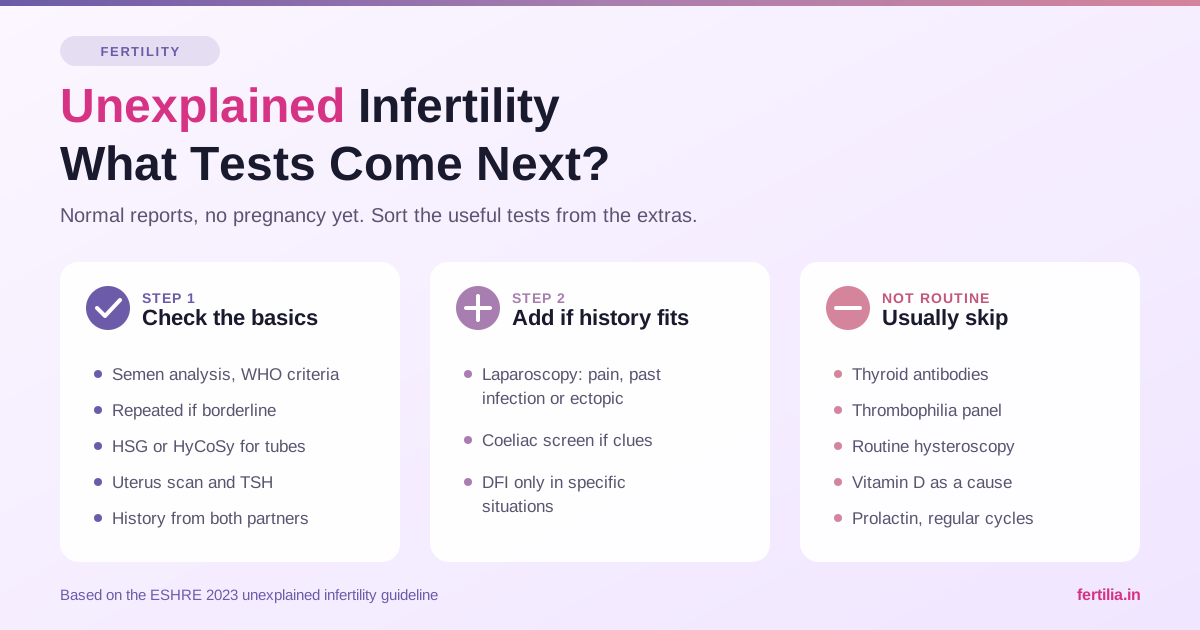
Step One: Check That the Basic Workup Is Complete
Before adding anything new, go back to your file and look for these. In second-opinion consultations, this is where gaps usually turn up.
| Test | What it answers | What to look for on your file |
|---|---|---|
| Semen analysis (husband) | Count, motility, morphology | Done at a lab using WHO criteria. If any value was low, was it repeated about 3 months later? |
| Cycle history | Are you ovulating? | Regular cycles of 24 to 38 days usually mean ovulation is happening |
| Tubal test (HSG or HyCoSy) | Are the tubes open? | A clear report on both tubes |
| Pelvic ultrasound | Is the uterus normal in shape? | Comment on the cavity and any fibroids, polyps or septum |
| TSH | Thyroid function | A result within the normal range |
| Your BMI, and medical history for both partners | General health, past infections, surgeries | History recorded for both of you, not only the wife |
All six of these appear in the ESHRE 2023 guideline (Romualdi D et al., Hum Reprod, 2023, PMID 37599566). The guideline recommends at least one semen analysis by WHO criteria, a repeat after a 3-month gap if the first result is below the reference limit, HSG or HyCoSy for the tubes (it treats the two as comparable), ultrasound to check the uterus, TSH and BMI as good practice, and a medical, reproductive and sexual history from both partners.
The semen analysis is a gap I see often. Husbands often get one test at a small lab, and if the report is “normal” nobody checks whether it was borderline. Our guide to reading a semen analysis report against WHO ranges shows you what each number means. If your HSG report is unclear, our HSG report walkthrough explains the common findings line by line.
For a fuller picture of the standard workup and what each layer tells you, see Dr. Suganya’s 7-layer fertility workup for Indian women.
Tests Worth Adding, but Only in Certain Situations
These are reasonable next tests when your history points towards them. They are not for everyone.
Laparoscopy, if your history raises the possibility of endometriosis or tubal damage
An HSG shows whether the tubes are open. It cannot show mild endometriosis, thin adhesions or subtle damage around the tube ends. The ESHRE 2023 guideline (Romualdi D et al., Hum Reprod, 2023, PMID 37599566) does not recommend routine laparoscopy for unexplained infertility, but it advises discussing the benefits and risks of laparoscopy with women at high risk: those with a past pelvic infection, a previous ectopic pregnancy, or signs of endometriosis.
In practice, the questions I ask are: do you have painful periods that stop you working, pain during sex, or pain on passing stools during your period? Did you ever have a pelvic infection or an ectopic pregnancy? If the answer is yes, laparoscopy can make sense. Our post on what a diagnostic laparoscopy finds that an HSG cannot covers the procedure, recovery and cost in India.
If mild endometriosis is found, ESHRE no longer counts the couple as unexplained, because now there is an explanation.
A repeat semen analysis, if the first one was borderline
If any value on your husband’s first report was below the WHO reference limit, the guideline recommends a second test after about 3 months. Sperm take roughly that long to develop, and one report can swing quite a lot with fever, illness or a short abstinence period.
Sperm DNA fragmentation, only in specific situations
This is the test couples ask me about most. The ESHRE 2023 guideline (Romualdi D et al., Hum Reprod, 2023, PMID 37599566) recommends against sperm DNA fragmentation testing when the semen analysis is normal by WHO criteria. It may still come up when the semen report is abnormal, or when there have been repeated miscarriages, which is a different workup. Our guide to sperm DNA fragmentation (DFI) explains what the test measures and when it is used.
Coeliac screening, if there are clues
ESHRE’s 2023 guideline (Romualdi D et al., Hum Reprod, 2023, PMID 37599566) says testing for coeliac disease in women with unexplained infertility can be considered. I think about it when there is ongoing bloating, loose stools, low iron that does not improve with tablets, or a family member with coeliac disease. It is a simple blood test.
💜 Told your reports are normal but you’re still not pregnant? Message Dr. Suganya’s team on WhatsApp A ₹399 video consultation goes through both partners’ reports with you, checks whether the basic workup is complete, and helps you plan the next step alongside your fertility specialist.
Tests the Evidence Does Not Support for Routine Use
This list surprises many couples, because several of these tests are widely offered. The ESHRE 2023 guideline (Romualdi D et al., Hum Reprod, 2023, PMID 37599566) recommends against each of the following as routine tests in unexplained infertility. For most of them the evidence behind the recommendation is of very low quality, so these are judgement calls rather than settled science. Still, none of them has earned a place as a routine test.
| Test | ESHRE 2023 position in unexplained infertility |
|---|---|
| Thyroid antibodies (TPO) and other autoimmune panels | Not recommended. No further thyroid tests if TSH is normal |
| Thrombophilia panel | Not recommended |
| Vitamin D, to explain the infertility | Not recommended for diagnosis |
| Prolactin, in women with regular cycles | Not recommended |
| Mid-luteal (Day 21) progesterone, with regular cycles | Not recommended routinely |
| Endometrial biopsy, without another reason | Not recommended |
| Hysteroscopy, when the ultrasound of the cavity is normal | Not recommended |
| Sperm DNA fragmentation, antisperm antibodies, male hormone blood tests or semen infection tests, with a normal semen analysis | Not recommended |
| Genetic or genomic tests | Not recommended |
| Oxidative stress markers in women | Not recommended |
A few points to keep this in proportion.
Some of these tests have other good reasons to be done. Vitamin D, for example, may be checked for your general health. A different history also changes the list: repeated miscarriages, irregular cycles, or symptoms of a thyroid problem each open a separate conversation, and the tests that fit those situations are different. If your thyroid antibodies have already been checked and came back positive, our guide to Hashimoto’s, anti-TPO antibodies and conception explains what that result means and what helps.
If a test on this list has already been done and came back abnormal, do not ignore it. Bring it to your doctor and ask what it changes in the plan. These tests are usually ordered in good faith, and a conversation about the result is more useful than a second round of testing.
How the Treatment Decision Is Made
Once the workup is complete and still normal, the next step depends on your chances of conceiving on your own over the coming year. ESHRE’s 2023 guideline (Romualdi D et al., Hum Reprod, 2023, PMID 37599566) advises basing the decision to start treatment on this prognosis. The main factors are the woman’s age, how long you have been trying, and whether you have been pregnant before.
Option 1: Keep trying, with a time limit
For a younger couple trying for a shorter time, waiting is a legitimate choice. In a Scottish trial of couples with unexplained infertility for over two years, 17% of women in the expectant management group had a live birth over six months without any treatment (Bhattacharya S et al., BMJ, 2008, PMID 18687718). The same trial found that clomiphene tablets alone, or IUI without stimulation, were unlikely to give better live birth rates than waiting.
Waiting works best with a clear review date, so it does not drift into years.
Option 2: IUI with ovarian stimulation
The ESHRE 2023 guideline (Romualdi D et al., Hum Reprod, 2023, PMID 37599566) recommends IUI with ovarian stimulation as the first-line treatment for unexplained infertility, with low-dose stimulation and careful monitoring to keep the risk of twins down.
In a New Zealand trial of women with unexplained infertility and a lower chance of natural conception, three cycles of IUI with clomiphene or letrozole gave a 31% cumulative live birth rate, compared with 9% in the group that kept trying on their own (Farquhar CM et al., Lancet, 2018, PMID 29174128).
If IUI does not work after a few cycles, our post on what happens after a failed IUI covers what gets reviewed before the next decision.
Option 3: IVF, when age, time or failed IUI point that way
The same guideline (Romualdi D et al., Hum Reprod, 2023, PMID 37599566) says IVF is probably not recommended over stimulated IUI as a first step, but that the decision should be individualised by age, duration of infertility, previous treatment and previous pregnancy. It also recommends against using ICSI over conventional IVF in unexplained infertility.
Time is a real factor here. In the American FASTT trial, couples who skipped the injectable-hormone IUI step and moved to IVF sooner conceived faster, with a median time to pregnancy of 8 months against 11 months in the conventional pathway (Reindollar RH et al., Fertil Steril, 2010, PMID 19531445).
So for a woman in her late 30s, or a couple who has been trying for several years, moving to IVF sooner is often the reasonable call. Our IVF decision framework walks through how I think about that choice with couples.
What Does Not Help, According to the Guideline
ESHRE’s 2023 guideline (Romualdi D et al., Hum Reprod, 2023, PMID 37599566) recommends against endometrial scratching for unexplained infertility. It also says antioxidant supplements for either partner, inositol, and acupuncture are probably not recommended. Before you spend on these, ask what evidence supports them for your situation. Our review of endometrial scratching before IVF looks at the trial data in more detail.
What You Can Do While You Decide
The same guideline recommends a healthy diet and regular exercise, with support when needed, and psychological support for couples who need it. These are good-practice points, not cures, but they are within your control.
- Collect every report for both of you in one folder. Include dates and lab names. Gaps become obvious when everything is in one place.
- Ask for a repeat semen analysis if the first was borderline or done at a small lab.
- Keep a simple cycle record. Note period dates and cycle length for three months. It helps confirm ovulation and plan timing.
- Have sex every two to three days through the cycle, rather than only on the “right” day. It takes pressure off and covers the fertile window.
- Steady your meals. Regular meals built around dal, vegetables, curd, ragi or millets, and an egg or paneer for protein support a healthy weight for both partners.
- Agree on a review date with your doctor. Whether you are waiting or doing IUI, decide in advance when you will reassess.
- Look after your mind. Months of “everything is normal” can feel worse than a clear answer. Our psychiatrist’s guide to mental health while trying to conceive is a good place to start.
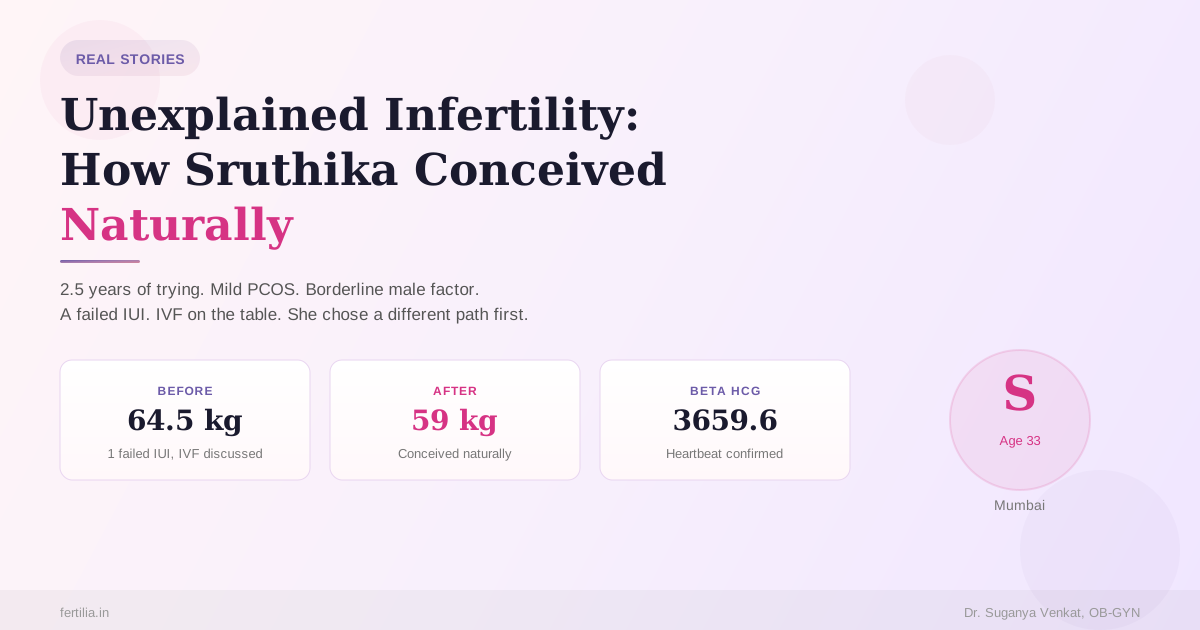
If you would like to read how one couple with an unexplained infertility label moved from a failed IUI towards conception, Sruthika’s story is on our blog.
Key Takeaways
- Unexplained infertility means the standard tests are normal. It does not mean there is no chance of pregnancy.
- First, confirm the basic workup is complete: semen analysis by WHO criteria (repeated if borderline), tubal test, uterine ultrasound, TSH and history from both partners.
- Laparoscopy, repeat semen tests and coeliac screening make sense in specific situations.
- Thyroid antibodies, thrombophilia, vitamin D, routine hysteroscopy and sperm DNA fragmentation with a normal semen report are not recommended as routine tests.
- The treatment choice depends on age and how long you have been trying: a time-limited wait, IUI with ovarian stimulation, or IVF sooner.
Frequently Asked Questions
What tests should be done after an unexplained infertility diagnosis? First, check that the basic workup is complete for both partners: a semen analysis by WHO criteria, repeated after about 3 months if any value was low, a tubal test (HSG or HyCoSy), a pelvic ultrasound of the uterus, TSH, and a full history. Further tests such as laparoscopy or coeliac screening are added only when your history points to them.
Should I get a thrombophilia test or thyroid antibody test for unexplained infertility? The ESHRE 2023 guideline (Romualdi D et al., Hum Reprod, 2023, PMID 37599566) recommends against both as routine tests in unexplained infertility, and says no further thyroid testing is needed if TSH is normal. A history of repeated miscarriage is a different situation, and your doctor may test differently then.
Do I need a hysteroscopy if all my reports are normal? Not routinely. If the ultrasound shows a normal uterine cavity, the ESHRE 2023 guideline (Romualdi D et al., Hum Reprod, 2023, PMID 37599566) says no further evaluation is needed and does not recommend hysteroscopy to look for problems the scan did not show. Hysteroscopy is useful when the scan suggests a polyp, fibroid or septum.
Can you get pregnant naturally with unexplained infertility? Yes, many couples do. In one trial of couples with unexplained infertility for over two years, 17% had a live birth over six months without treatment (Bhattacharya S et al., BMJ, 2008, PMID 18687718). Your own chances depend mainly on your age and how long you have been trying.
Is IUI or IVF better for unexplained infertility? The ESHRE 2023 guideline (Romualdi D et al., Hum Reprod, 2023, PMID 37599566) recommends IUI with ovarian stimulation as the first-line treatment, and says IVF is probably not recommended over it as a first step. The choice is individualised, and an older age, a long time trying or failed IUI cycles often point towards IVF sooner.
How many IUI cycles should we try before IVF? There is no fixed number for everyone. The New Zealand trial that showed IUI with stimulation improved live births used three cycles (Farquhar CM et al., Lancet, 2018, PMID 29174128). Many couples reassess after a few cycles, sooner if the woman is older.
Does my husband need more tests if his semen analysis was normal? Usually not. The ESHRE 2023 guideline (Romualdi D et al., Hum Reprod, 2023, PMID 37599566) recommends against sperm DNA fragmentation, antisperm antibody, male hormone blood tests and semen infection tests when the semen analysis is normal by WHO criteria. What matters is that the analysis was done properly, at a lab using WHO criteria, and repeated if any value was borderline.
💜 Want a calm second look at your reports before the next step? Talk to Dr. Suganya’s team on WhatsApp A ₹399 video consultation reviews both partners’ tests, flags any gaps, and helps you weigh waiting, IUI or IVF alongside your fertility specialist, wherever you are in India or abroad. For longer support, see the Fertility program.