The prescription arrives, and along with it, a small box of pens or vials, syringes, and alcohol swabs that a nurse in the clinic demonstrated once, quickly, before sending you home. Many women tell me the injections themselves turned out to be less frightening than the anticipation. But that first night, alone with the box on the bathroom counter, is daunting for almost everyone.
You are not expected to have done this before. You are not expected to enjoy it. What you need is a clear, unhurried walkthrough of exactly what to do, why each step matters, and what is a real problem versus what is just uncomfortable. That is what this post covers.
The Short Version
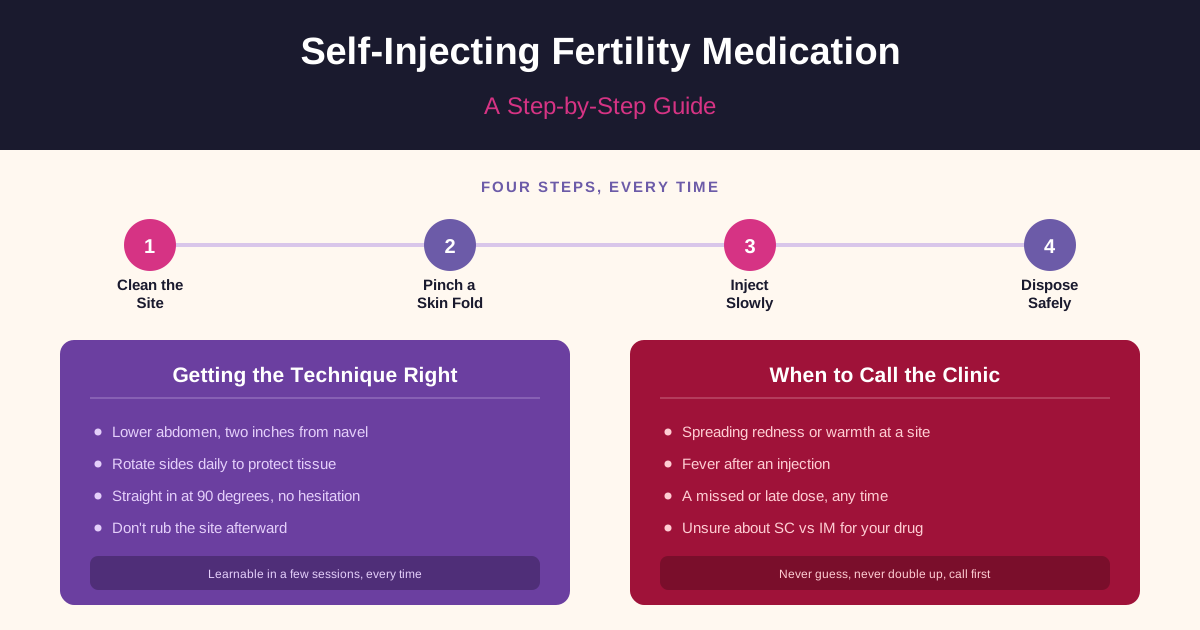
If you need the steps right now: wash your hands; prepare your dose exactly as prescribed; pick a fresh spot on the lower abdomen, about two inches from the navel and away from yesterday’s site; clean it with an alcohol swab and let it dry; pinch a fold of skin; insert the needle at the angle your device leaflet specifies (usually straight in for a short pen needle); press steadily until the dose is delivered and hold for the count your leaflet gives; withdraw; do not rub; drop the needle straight into a sharps container. Each step is explained below, along with what is normal afterwards and what is not.
Why You Might Be Self-Injecting at All
Injectable gonadotropins (FSH, hMG) and the hCG trigger are used when oral medication like letrozole or clomiphene has not produced the response your doctor is looking for, or when an IUI or IVF protocol calls for injectables from the start; our guide on letrozole dose and success rates explains what usually happens before injections become the next step. Because the dose must be precise and the timing exact, daily self-administration at home is how these protocols are designed, not a sign that your case is unusually difficult. It is what the overwhelming majority of women on injectable fertility protocols do, and the technique is learnable within a few sessions.
Subcutaneous vs Intramuscular: Know Which One You Have
This is the first thing to get right, because the two techniques are different, and using the wrong one changes how the medication is absorbed.
Subcutaneous (SC) injections go into the fatty layer just under the skin, most commonly the lower abdomen. Most modern fertility medications, including FSH (follicle-stimulating hormone), hMG (human menopausal gonadotropin), and the hCG trigger shot, are given this way. SC injections use a short, fine needle and are generally the ones women self-administer.
Intramuscular (IM) injections go deeper, into muscle tissue, most often the upper outer buttock or thigh. Some preparations, particularly certain progesterone-in-oil formulations used for luteal support after embryo transfer, are given intramuscularly. IM injections use a longer needle and are more often given by a partner, a family member, or a home-visit nurse, because the technique and the angle are harder to manage on yourself.
A randomised trial of 195 women undergoing IVF compared intramuscular and subcutaneous recombinant FSH and found no marked difference between the routes in eggs retrieved, ongoing pregnancy rate, or overall local symptoms (Out et al., Fertility and Sterility, 1997, PMID 9022603). That is part of why SC has become the default for most gonadotropin protocols: comparable results, an easier technique, and a needle you can manage yourself.
Your prescription or clinic instructions will specify which route your particular medication needs. If you are ever unsure, call your clinic before you inject rather than guessing.
What You Will Need Before You Start
Lay everything out on a clean, flat surface before you begin, so you are not searching for something with a loaded syringe in hand.
- Your medication (pen device or vial, kept at the temperature your clinic specified, most gonadotropins need refrigeration at 2-8°C)
- The correct needle, if you are using a vial-and-syringe format rather than a pre-loaded pen
- Two alcohol swabs
- A cotton ball or gauze
- A puncture-proof sharps container (more on disposal below)
- Your dose written down or confirmed against your prescription, checked once before you draw it up
If your medication needs refrigeration, take it out roughly fifteen to twenty minutes before your injection time so it is closer to room temperature. An injection straight from the fridge tends to sting more.
Step-by-Step: Subcutaneous Self-Injection
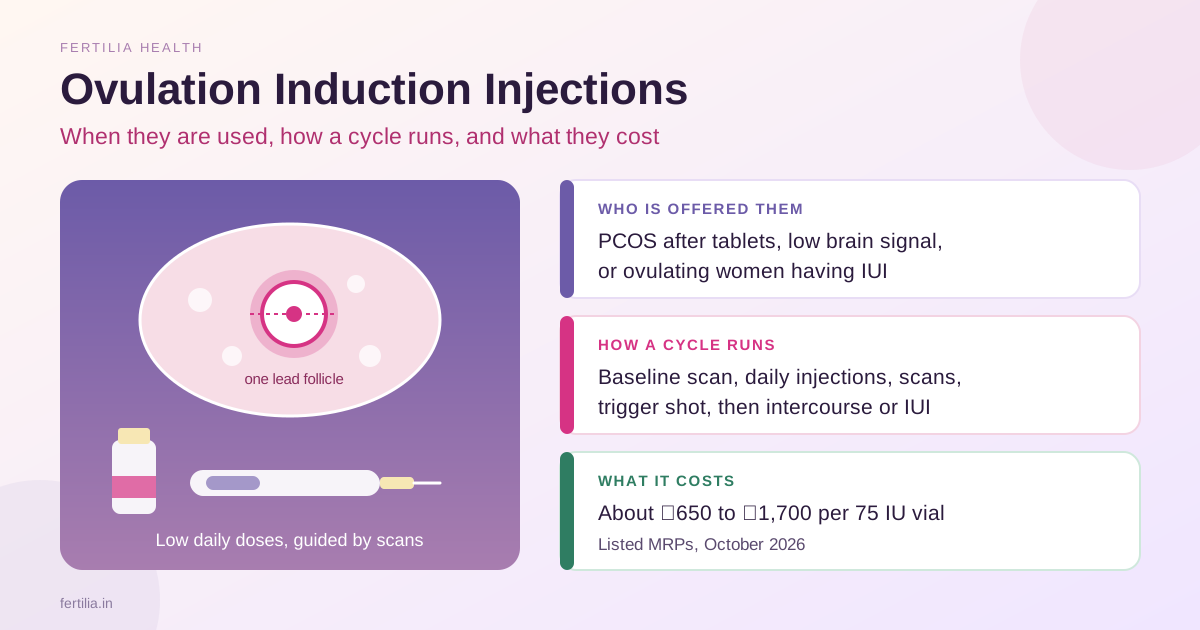
Both pen devices and vial-and-syringe formats are common in India. The recombinant FSH you are most likely to be handed is Gonal-f (Merck) or Foligraf (Bharat Serums), both sold as multi-dose pens, while hMG such as Menopur (Ferring) comes as a vial that is reconstituted and drawn up. As a rough indication of cost, a 900 IU Gonal-f pen was listed at about Rs 18,000 to 27,000 on the major online pharmacies when this post was last updated (September 2026), and a stimulation cycle usually needs more than one pen; the estimate your clinic gives for your specific protocol is the number to plan around. The steps below apply to either format, with the drawing-up step relevant only to vials.
1. Wash your hands thoroughly with soap and water for at least twenty seconds.
2. Prepare your medication. For a pen device, attach a fresh needle and dial to your prescribed dose. For a vial, draw up the correct dose into the syringe, checking the markings carefully against your prescribed amount, and gently flick the syringe to release any air bubbles before pushing them out.
3. Choose your injection site. The lower abdomen, about two inches to either side of your navel, is the standard site for most women. Avoid your navel itself, any area with a scar, stretch marks, or a bruise from a previous injection.
4. Rotate your sites. Use a different spot each day, alternating left and right sides of the abdomen, and moving slightly within that general area. This matters more than it might seem: injecting the same exact spot repeatedly can cause the tissue underneath to harden over time (a build-up called lipohypertrophy), which then absorbs medication less predictably. A simple habit that works well is picturing a clock face around your navel and moving to the next “hour” each day.
5. Clean the site with an alcohol swab in a circular motion, working outward from the centre, and let it air-dry for a few seconds. Injecting before the alcohol has dried can make the shot sting more.
6. Pinch a comfortable fold of skin between your thumb and forefinger, enough to lift the fatty layer away from the muscle underneath, not a tight squeeze. That fatty layer is exactly where a subcutaneous injection needs to go.
7. Insert the needle at the angle your device leaflet or clinic nurse specifies. With a short pen needle into a pinched fold this is usually straight in, at 90 degrees; some longer needles are inserted at 45 degrees. Go in with one smooth, confident motion. Hesitating partway through tends to make it hurt more, not less.
8. Press steadily until the dose is delivered, then keep the needle in place for the count of five to ten seconds your device leaflet specifies before withdrawing. That pause is what stops medication leaking back out of the site.
9. Withdraw the needle at the same angle you inserted it, then release the pinched skin.
10. Do not rub or massage the site afterward. Clinics advise against rubbing a subcutaneous injection site; gentle pressure with a cotton ball for a few seconds, if there is a small bead of blood, is all that is needed.
11. Dispose of the needle immediately in your sharps container. Never leave a used needle uncapped or lying on the counter, even briefly.
A pen device follows the same site selection, cleaning, pinch, and angle principles, simply without the drawing-up step. In a randomised crossover study of 60 volunteers, recombinant FSH given by pen device caused moderate-to-severe pain on injection in 22 percent of subjects, against 70 percent for a conventional syringe (Craenmehr et al., Reproductive Biomedicine Online, 2001, PMID 12513852). If you have a choice of format, the pen is usually the more comfortable one; either works well once you are used to the routine.
What’s Normal, and What to Call Your Clinic About
Normal: a small bruise, mild redness, a slight sting during injection that fades within a minute, and occasionally a small hard lump under the skin that softens over a day or two.
Worth mentioning at your next check-in, not urgent: a lump that has not softened after several days, or noticeably more discomfort at one site than others (a sign it may be time to spend more days on the other side).
Call your clinic the same day: a large, spreading area of redness or warmth around an injection site, a fever, or a site that looks infected. These are uncommon, but they are not something to wait out.
Call your clinic urgently, whatever the injection sites look like: rapid abdominal bloating or a visibly swollen belly, severe pelvic pain, persistent nausea or vomiting, breathlessness, passing much less urine than usual, or gaining more than a kilogram in a day. These are the warning signs of ovarian hyperstimulation syndrome (OHSS), the one complication of stimulation that needs same-day medical review rather than a wait-and-see approach. It is uncommon, clinics watch for it, and it is very manageable when caught early; our guide to OHSS symptoms, prevention and when to call your doctor explains what it is and how it is treated.
If your protocol involves the hCG trigger shot, that particular injection is timed to the hour by your clinic, not something to adjust yourself. For everything that comes after it, our guide to what happens during the two-week wait covers the period right after transfer.
If today is your first injection and you would like to talk through the technique and what to expect on your first night with Dr. Suganya, message her on WhatsApp for a ₹399 video consultation, available online, pan-India. If you are mid-cycle and want support around the whole process rather than a single question, her IVF Support program runs alongside your clinic’s treatment, not in place of it.
Cold-Chain Handling on a Working Day
Most gonadotropins and many trigger medications need to stay refrigerated at 2-8°C until use. If you are managing this around a job or travel, an insulated pouch with an ice pack keeps medication cool for several hours, and most pharmacies that stock these medications can advise on how long a specific brand tolerates being out of the fridge. Our guide on managing an IVF cycle while working full-time goes into the cold-chain and scheduling logistics of a full stimulation cycle in more detail, so this post will not repeat it here.
Missed or Late Doses: What to Do
If you realise you are running late for your scheduled injection time, or you missed it entirely, the answer is always the same: call your clinic before you do anything else. Do not guess, do not skip the dose to “get back on schedule,” and do not double up to compensate. Fertility injection timing is calibrated to your individual follicle growth and hormone levels, and your clinic needs to know what happened to decide whether to adjust that day’s plan. This is especially true for the trigger shot, where timing is fixed to a specific hour rather than a general window.
Partner-Administered Injections Are Completely Normal
Some women prefer to give their own injections from day one. Others ask a partner, a sister, or a parent to do it, either for all of the injections or just the ones that are harder to reach comfortably (intramuscular injections, in particular, are easier for someone else to give). Neither approach is more correct than the other, and neither affects how well the medication works. If a partner is doing the injecting, it helps for both of you to review this same technique together and, if possible, ask your clinic’s nurse to watch a practice run before you are on your own.
Safe Disposal of Needles and Syringes
Clinics and hospitals dispose of used needles as sharps waste under India’s Bio-Medical Waste Management Rules, 2016, through licensed collection and treatment. That is why the cleanest route for a container you have filled at home is to hand it back to your clinic or a nearby hospital, which already has that disposal chain, rather than put it in household waste, where a loose needle is a real injury risk to waste workers.
In practice, this means:
- Use a proper puncture-proof sharps container. A rigid plastic container with a screw-on lid works if a purpose-made sharps box is not available.
- Never recap, bend, or break a used needle by hand. This is when most accidental needle-stick injuries happen.
- Keep the container upright, closed between uses, labelled, and out of reach of children.
- Once the container is about three-quarters full, seal it and hand it over to your clinic or a nearby hospital. Many fertility clinics will take back a full sharps container at your next visit if you ask, and it is worth asking at the very first visit so you know the plan.
This is a small habit to build early in your protocol, since a typical stimulation cycle generates a meaningful number of used needles over just eight to twelve days.
What the Daily Injection Routine Feels Like
The daily ritual of self-injecting carries its own kind of weight, separate from the physical discomfort, and it rarely gets talked about directly. For most women the first two or three nights are the hard part; once the sequence is familiar, the injection itself takes under a minute and the routine settles into the day like any other. If it does not, and the dread is building rather than fading, say so at your next scan. It is a common enough experience that your clinic will have heard it before, and a nurse-supervised practice run or a partner taking over the injecting often resolves it.
If you are doing this while also managing a household, a job, or other children, our guide on preparing your body for IUI or IVF covers the broader picture of what supports you through a treatment cycle, beyond the injections themselves.
Frequently Asked Questions
Do fertility injections hurt?
Most women describe a brief sting lasting a few seconds, followed by little to no ongoing discomfort. Subcutaneous injections, which is what most fertility medications are, use a short, fine needle specifically because the technique is designed to minimise discomfort. Injecting slowly, letting the alcohol dry fully first, and rotating your sites all help keep it manageable.
There is a hard lump at one site that has not gone down after a week. What should I do?
Stop using that side until it settles and mention it at your next scan or check-in. A lump that persists beyond a week is usually a small area of thickened tissue from injecting too close to the same spot, and it will resolve, but your clinic may want to look at it and adjust your rotation. If it is also red, warm, or painful to touch, call the same day rather than waiting.
I dropped the needle, or it bent while I was attaching it. Can I still use it?
No. A needle that has touched any surface, or that is bent, goes straight into the sharps container, and you attach a fresh one. Pen needles are supplied in numbers for exactly this reason, and it is worth asking your clinic for a few spares at the start rather than running short mid-cycle.
I pressed the pen but I’m not sure the full dose went in. Should I inject again?
No. Never re-inject to make up for a dose you are unsure about. Set the pen down without changing anything, and call your clinic with the pen in hand; the dose counter on most pens shows how much was delivered, and the clinic will tell you whether anything needs to be done.
How do I know if my medication needs to be subcutaneous or intramuscular?
Your prescription and the instructions given by your clinic’s nurse will specify the route for each medication. Most gonadotropins (FSH, hMG) and the hCG trigger are subcutaneous. Some progesterone-in-oil preparations used after embryo transfer are intramuscular and typically require a longer needle and a different injection site. If you are ever unsure which your medication needs, call your clinic before injecting rather than assuming.
What should I do with used needles when I’m travelling?
Carry a small, travel-sized sharps container (available at most pharmacies) and transfer its contents to your main container when you return home, or dispose of it through a hospital or clinic in the city you are visiting. Never place a used needle loose in a hotel bin or a travel bag.
I forgot to take my injection out of the fridge before bedtime. Can I still use it cold?
Yes, a medication that has not been warmed up is still effective, it will simply sting a little more on injection. If you have time, letting it sit at room temperature for ten to fifteen minutes makes the shot more comfortable, but a cold injection is not unsafe and does not need to be skipped or delayed.
Learning to self-inject is one small, very learnable skill in the middle of a much bigger process. Dr. Suganya Venkat has walked hundreds of women at Fertilia through exactly this, from the first nervous night with the box on the counter to a routine that feels almost ordinary by the second week.
If you have a specific question about your medication, dose, or technique, do not wait for your next scheduled appointment. WhatsApp Dr. Suganya for a ₹399 online video consultation, available pan-India.