“Doctor, I have finished three rounds of Clomid and my scan still shows nothing.” This is one of the more common messages I get on WhatsApp from women in the middle of PCOS treatment. The tablets have been taken exactly as prescribed. The follicular study has been done, sometimes more than once. And the report keeps saying the same thing: no dominant follicle.
If this is where you are right now, I want to start with the most useful thing I can tell you: this happens to a meaningful number of women with PCOS, it has a name, and it has a well-mapped set of next steps. Nothing about this means your body is not going to respond to treatment. It means the first tool tried was not the right one for your particular biology, and there are others.
This post walks through what clomiphene-resistant PCOS actually means, why it happens, and the sequence of evidence-based options that follow, in the order most gynaecologists work through them.
What “Clomiphene-Resistant” Means
Clomiphene citrate (sold in India as Siphene, Fertomid or Clomid) works by nudging the brain into releasing more FSH, which pushes a follicle in the ovary toward maturity. In most women with PCOS who are going to respond to it, that response shows up at 50 mg or 100 mg a day.
Clomiphene resistance describes the situation where a monitored follicular study shows no dominant follicle developing despite the dose being pushed to 150 mg per day for five days, typically over three to six cycles. This is a specific clinical definition, not a guess. It requires monitoring: without a follicular study, there is no way to confirm whether the ovary genuinely did not respond, or whether ovulation happened without being observed.
It is worth separating this from a related but different problem. Some women ovulate reliably on clomiphene but still do not conceive, often because of the drug’s effect on cervical mucus or the uterine lining. That is a different situation with a different next step, and it is covered in the clomiphene post linked above. Clomiphene resistance specifically means the follicle itself is not developing.
Roughly one in five to one in four women with PCOS do not ovulate on clomiphene, even at the maximum dose. If you are in this group, you have company, and the path forward is well established.
Why It Happens
Clomiphene resistance is not random. A few factors show up repeatedly in the women who experience it:
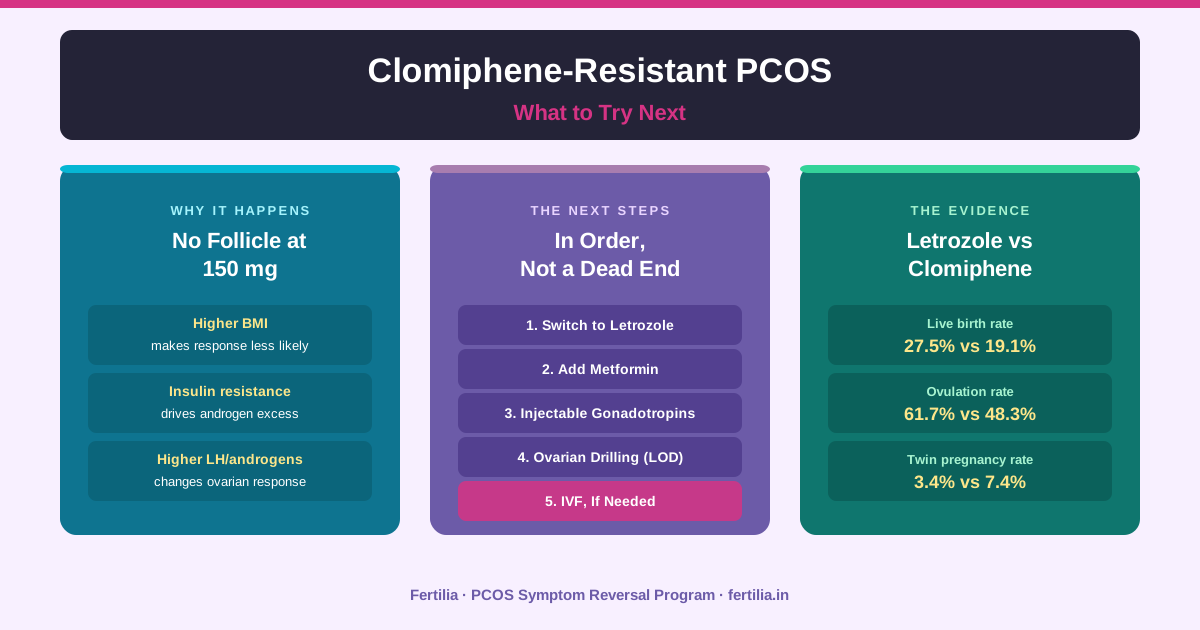
Higher BMI. Clomiphene works less predictably as body weight rises, largely because of its interaction with the insulin and androgen pathways that already drive PCOS. This is one of the reasons the lifestyle layer of PCOS management, working on insulin sensitivity through food and movement, is not a side conversation. It changes how well the medical treatment that follows actually performs.
More pronounced insulin resistance. High circulating insulin drives the ovaries to produce more androgens, and a heavier androgen burden makes it harder for a single follicle to out-compete the others and reach full maturity. This is the same mechanism metformin is prescribed to address, which is why it often enters the conversation at this stage.
A higher LH-to-FSH ratio or higher circulating androgens. Some women’s baseline hormone profile makes the ovary less responsive to the FSH surge clomiphene is trying to trigger. Your gynaecologist may look back at your hormone panel at this point to see if this pattern is present.
None of these factors are something you did. They describe the underlying biology of PCOS in your particular case, and they are exactly what the next steps are designed to work around.
Step 1: Switch to Letrozole
For most women whose PCOS has not responded to clomiphene, letrozole is the next step, and current international guidance treats it as the preferred one.
Letrozole works through a completely different mechanism to clomiphene: it is an aromatase inhibitor that temporarily lowers oestrogen production, which triggers the same FSH surge from a different direction. Because the pathway is different, a good number of women who do not respond to clomiphene do go on to ovulate on letrozole.
The evidence for this is strong. In the largest head-to-head trial, 750 women with PCOS were randomised to letrozole or clomiphene for up to five cycles (Legro RS et al., N Engl J Med 2014;371(2):119-29, PMID 25006718). Letrozole produced a higher per-cycle ovulation rate (61.7% vs 48.3%), a higher live birth rate over five cycles (27.5% vs 19.1%), and a lower twin pregnancy rate (3.4% vs 7.4%). On the strength of this and other trials, the 2023 international evidence-based PCOS guideline (Teede HJ et al., Eur J Endocrinol 2023;189(2):G43-G64, PMID 37580861) recommends letrozole as the first-line pharmacological agent for anovulatory infertility in PCOS.
If your gynaecologist started you on clomiphene first, that is not unusual. Cost and prescriber familiarity both play a real role in India, and clomiphene is still an entirely reasonable place to start. When it does not work, letrozole is the natural next move, not a sign that anything went wrong the first time. For the full picture on dosing, monitoring and what to expect, our letrozole guide covers the same ground the clomiphene post does for this drug.
Step 2: Add Metformin, If It Is Not Already on Board
If insulin resistance is part of your picture, whether that shows up as a higher BMI, a raised HOMA-IR, or a family history of diabetes, this is the point where metformin often enters the conversation if it was not already part of your treatment.
In the largest trial directly comparing these approaches, 626 women with PCOS were randomised to clomiphene alone, extended-release metformin alone, or the combination for up to six months (Legro RS et al., N Engl J Med 2007;356(6):551-66, PMID 17287476). Live birth rates were 22.5% with clomiphene alone, 7.2% with metformin alone, and 26.8% with the combination, showing metformin’s main value here is as an add-on that improves the odds alongside an ovulation-inducing drug, not as a standalone replacement for one.
Metformin will not, on its own, make a follicle mature that is not responding to letrozole or clomiphene. What it does is address the insulin-driven androgen excess that can be part of why the ovary is not responding in the first place, which is why doctors often layer it in at this stage rather than earlier. If you want the full explanation of who benefits from metformin and what dose is typical, the metformin guide covers it.
Step 3: Injectable Gonadotropins
If letrozole at the maximum dose across several monitored cycles has still not produced a dominant follicle, the next tool is injectable gonadotropins, daily FSH injections given under close monitoring.
Gonadotropins bypass the pituitary signalling that oral drugs rely on and stimulate the ovary directly. A chronic low-dose step-up protocol, where the FSH dose is raised gradually across a cycle, is the standard approach used specifically in women whose PCOS has not responded to clomiphene, precisely to reduce the risk of stimulating too many follicles at once (van Wely M et al., Fertil Steril 2006;86(6):1710-5, PMID 17022982).
This step requires more from you: near-daily monitoring scans in the stimulation window, and a real conversation with your doctor about the risk of a multiple pregnancy if more than one or two follicles mature. It also costs more, since the injections are needed every cycle. This is usually the point where a fertility specialist, rather than a general gynaecologist, takes over the monitoring, and where IUI often gets added alongside the injections to make the most of a well-timed ovulation.
Talk it through before deciding what’s next. If you have been on clomiphene without a follicle developing, or you are not sure which of these steps fits your specific hormone profile and history, you can discuss your reports with Dr. Suganya Venkat over a video consultation. She is an OB-GYN with over fifteen years of clinical experience, and she works with women across India and the diaspora entirely online, so distance from Coimbatore is never the barrier.
Talk to Dr. Suganya on WhatsApp
Step 4: Laparoscopic Ovarian Drilling
Laparoscopic ovarian drilling (LOD) is a one-time surgical option that sits alongside gonadotropins as a genuine alternative once oral induction has been fully explored. A small number of punctures made on the ovarian surface reduce androgen-producing tissue, which can restore natural ovulation for one to three years afterward in the right candidate.
A 2019 meta-analysis comparing letrozole directly with LOD in women resistant to clomiphene found the two approaches produced broadly similar live birth outcomes, so the choice between them tends to come down to individual factors: your AMH, your age, whether gonadotropins have already been tried, and whether a one-time procedure or a monthly injection cycle fits your situation better. Our ovarian drilling guide walks through who benefits, the important AMH conversation to have first, and current India pricing.
Step 5: When IVF Enters the Picture
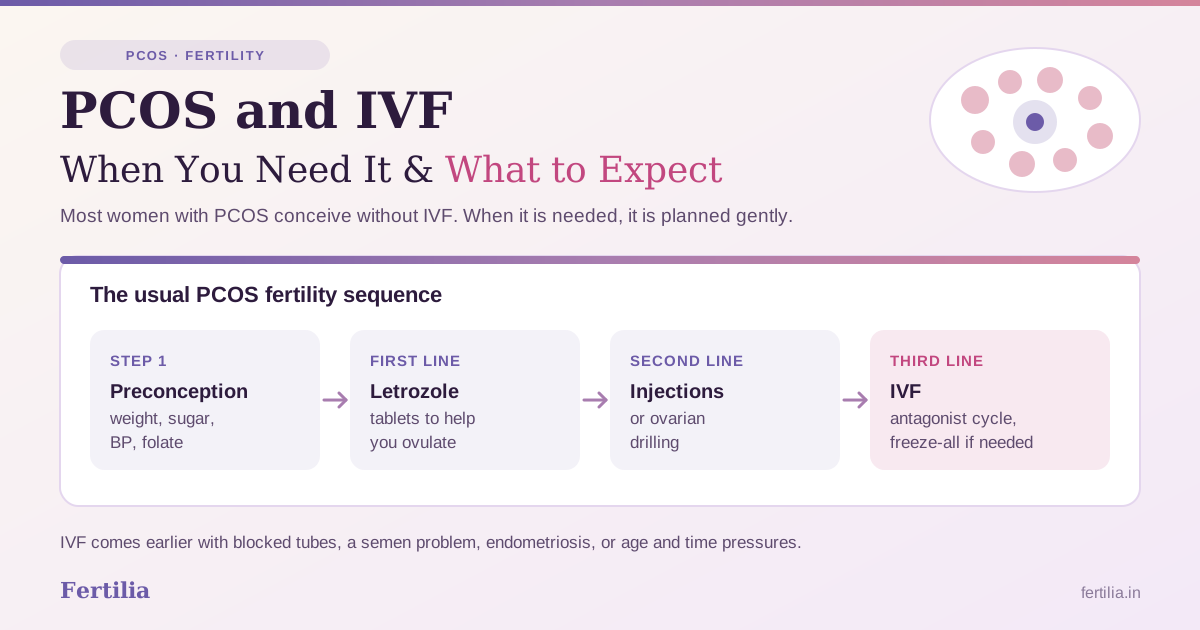
Clomiphene resistance on its own does not mean IVF is the only remaining path. Many women who do not respond to clomiphene go on to ovulate and conceive with letrozole, metformin as an add-on, gonadotropins, or LOD, without ever needing IVF.
IVF becomes the relevant conversation when clomiphene resistance is layered with something else: a blocked fallopian tube, a significant male-factor finding on semen analysis, diminished ovarian reserve, or simply time, particularly for women closer to their late thirties who do not have several years to work through each oral option in sequence. Our IUI vs IVF guide explains how that decision typically gets made, and it is worth reading if IVF has already come up in your consultations.
A Fork in the Road, Not a Dead End
I want to say this plainly, because it is easy to hear “clomiphene resistant” and feel like the ground has shifted under you. It has not. It means the first tool tried was not the one your particular PCOS needed, and there is a well-evidenced next step, usually more than one.
The great majority of women who do not respond to clomiphene do go on to ovulate with letrozole, with metformin added, or with the further steps outlined here. Fertilia’s clinical record includes a meaningful share of women who arrived after a “failed” clomiphene cycle and are now further along than they expected to be at this stage, some pregnant, some simply ovulating regularly for the first time in years.
Alongside whichever medical step is next, the lifestyle layer that PCOS treatment does not skip matters here too: steady insulin levels, consistent sleep, and movement that supports rather than stresses your hormones all make the next drug or procedure more likely to work. At Fertilia, this is the layer we build in, running alongside whatever your gynaecologist has prescribed, not replacing it.
If you want to see how the full PCOS treatment path fits together, our PCOS and pregnancy guide covers the arc from diagnosis to conception. You can also download the PCOS Reversal Guide for a structured look at each phase, medical and lifestyle, side by side.
What This Is Called in Hindi and Tamil
Many women search for this in mixed-language terms. For clarity:
Hindi: Clomid ya Siphene lene ke baad bhi follicle nahi banta, isko “clomiphene resistant PCOS” kehte hain. Iska matlab yeh nahi ki koi ilaj nahi hai. Agla step aksar letrozole hota hai, jo alag tarike se kaam karta hai aur bahut si mahilaon mein successful hota hai.
Tamil (Roman script): Clomid allathu Siphene edutha pinnum follicle valaraadha nilaimai “clomiphene resistant PCOS” endru azhaikkapadugiradhu. Adutha step pothuvaaga letrozole, adhu verae vidhamaaga velai seiyum, palar pengalukku adhu vetri tharum.
Frequently Asked Questions
What does clomiphene-resistant PCOS mean?
It means a monitored follicular study shows no dominant follicle developing despite clomiphene being given at an adequate dose, typically escalated to 150 mg per day, over three to six cycles. It is a specific, monitoring-confirmed finding, not a general sense that “clomiphene isn’t working.”
Why did clomiphene not work for me?
A higher BMI, more pronounced insulin resistance, or a higher androgen burden are the factors most consistently linked to a poor response to clomiphene. None of these mean the drug was the wrong choice to try first; they explain why the next drug, working through a different mechanism, is often more effective.
Is letrozole better than clomiphene if clomiphene has already failed?
Letrozole works through an entirely different pathway to clomiphene, which is exactly why it can succeed where clomiphene did not. In the largest trial comparing the two head-to-head, letrozole produced meaningfully higher ovulation and live birth rates in women with PCOS (Legro et al., NEJM 2014, PMID 25006718), and it is now the guideline-recommended first-line option.
Should I add metformin if I am clomiphene-resistant?
If insulin resistance is part of your picture, this is a reasonable point to discuss adding metformin with your gynaecologist. In the largest trial testing this combination, clomiphene plus metformin produced a higher live birth rate than clomiphene alone (Legro et al., NEJM 2007, PMID 17287476). Metformin works best as an add-on alongside an ovulation-inducing drug rather than as a standalone treatment.
What if letrozole also does not work?
The next steps are injectable gonadotropins (daily FSH injections under close monitoring) or laparoscopic ovarian drilling, a one-time surgical procedure. Both are evidence-based options at this stage, and the choice between them usually comes down to your AMH, age, cost considerations and personal preference. Your gynaecologist or fertility specialist will help you weigh these based on your specific reports.
Does clomiphene resistance mean I will need IVF?
Not necessarily. Many women who do not respond to clomiphene go on to ovulate and conceive with letrozole, metformin, gonadotropins or ovarian drilling, without needing IVF at all. IVF becomes the relevant conversation when another fertility factor, such as a tubal blockage or a significant male-factor finding, is also present, or when age makes a faster path more sensible.
How many cycles of clomiphene should I try before considering resistance confirmed?
Standard practice is to escalate the dose across three to six monitored cycles, up to 150 mg per day, before concluding that clomiphene resistance is present. This requires monitoring with a follicular study each cycle; without it, you cannot know for certain whether the ovary responded.
If you have been through one or more cycles of clomiphene without a follicle developing and want to understand your specific next step, you do not have to work this out alone.
Book a video consultation with Dr. Suganya on WhatsApp
Fertilia’s PCOS symptom reversal program works alongside whatever your gynaecologist prescribes next, from letrozole to gonadotropins, adding the nutrition, movement and cycle-aware support that helps the medical step you take actually work, delivered entirely online across India and to the diaspora.