Many women reach us after their doctor has prescribed letrozole, or after a friend mentioned it as the drug that worked for her. Sometimes there is already a follicular study underway; sometimes the prescription is new and the monitoring has not started yet. The questions that come in are usually the same: what does this tablet actually do, why this one and not the other, what should the cycle look like, and what are the realistic chances?
This post covers all of that.
What Letrozole Is and How It Works
Letrozole belongs to a class of drugs called aromatase inhibitors. Aromatase is an enzyme the body uses to convert androgens, such as testosterone, into oestrogen. Letrozole temporarily blocks that conversion.
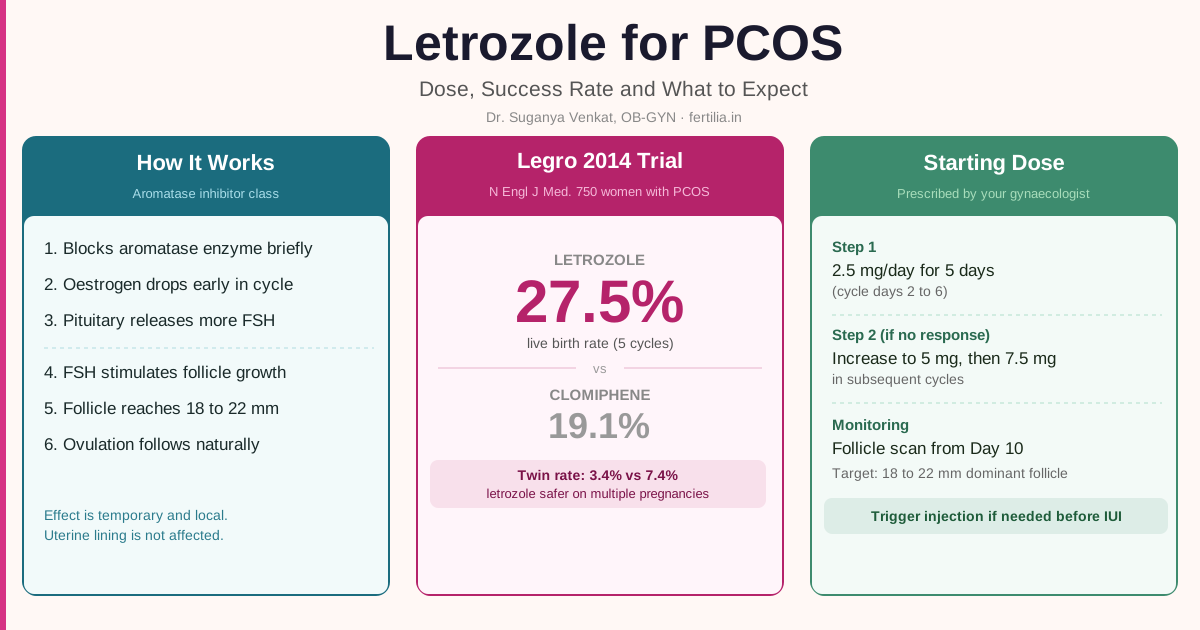
When oestrogen levels drop early in the cycle, the pituitary gland reads this as a signal that more is needed, so it releases a higher pulse of FSH (follicle-stimulating hormone). That FSH surge is what the ovaries need to develop follicles, the fluid-filled sacs that each carry one egg.
In a woman with PCOS, the ovaries often have many small antral follicles visible on a scan, but none of them grows to full maturity and releases an egg on their own. Letrozole provides the FSH boost that can push one or two of those follicles into complete development, leading to ovulation.
Because the block on aromatase is temporary and resolves after the five-day course ends, letrozole does not carry over and affect the uterine lining the way clomiphene can. That distinction matters more than it might sound, as you will see in the next section.
Letrozole vs Clomiphene: What the Research Showed
For years, clomiphene (Clomid) was the standard first drug prescribed for ovulation induction in PCOS. That changed with a landmark trial published in the New England Journal of Medicine in 2014.
Legro and colleagues randomised 750 women with PCOS and anovulatory infertility across multiple centres to either letrozole or clomiphene for up to five cycles of treatment (Legro RS et al., N Engl J Med. 2014;371(2):119-29, PMID 25006718). The results clearly favoured letrozole:
- Live birth rate per woman over five cycles: 27.5% with letrozole vs 19.1% with clomiphene
- Per-cycle ovulation rate: 61.7% with letrozole vs 48.3% with clomiphene
- Multiple pregnancy (twin) rate: 3.4% with letrozole vs 7.4% with clomiphene
The lower twin rate is not a minor footnote. Twin pregnancies carry substantially higher risks for both mother and babies, including preterm birth, low birth weight, and complications during delivery. Letrozole producing fewer multiples at similar doses makes it not only more effective but safer for what follows conception.
Since this trial, letrozole has been endorsed as the first-line pharmacological treatment for ovulation induction in PCOS by the 2023 international evidence-based PCOS guideline (Teede HJ et al., Eur J Endocrinol. 2023, PMID 37580861) and by the ASRM Practice Committee. Clomiphene remains available and effective for some women, but letrozole is now the preferred starting point for most clinicians treating PCOS-related anovulation.
Standard Dosing and Timing
Starting dose
Letrozole for ovulation induction is typically started at 2.5 mg per day. If this dose does not produce a mature dominant follicle on the monitoring scan, the doctor increases it to 5 mg in the next cycle, and to 7.5 mg if needed after that.
Most women with PCOS respond at 2.5 mg or 5 mg. The 7.5 mg dose is used when the lower doses do not produce ovulation.
When to take it
The tablets are taken for five consecutive days, starting from cycle day 2 or day 3 (the day after the first day of proper flow). Many doctors prescribe days 2 to 6 or days 3 to 7; the two windows produce comparable results, and your doctor’s preference is the right one to follow.
Take the tablet at roughly the same time each day. A light meal alongside can help with any initial nausea. The tablets are taken whole, not crushed.
What a Monitored Cycle Looks Like
For most women, especially in the first one or two cycles, the doctor will recommend a follicular monitoring scan (also called a follicular study or folliculometry). This is a series of transvaginal ultrasound scans done every two to three days from around day 10 of the cycle.
Each scan measures the developing follicles and the uterine lining. The target is one dominant follicle reaching 18 to 22 mm in diameter. At that size, natural ovulation usually follows within 24 to 36 hours.
In some cases, particularly before an IUI procedure, the doctor will give a trigger injection (an hCG injection such as Pregnyl or Ovitrelle) to set ovulation at a predictable time, usually 36 hours after the shot. This allows intercourse or insemination to be timed precisely.
If the scan by day 14 to 16 shows no dominant follicle, or if a follicle grows but does not rupture (a condition called luteinised unruptured follicle), the cycle is considered anovulatory at the current dose, and the plan for the next cycle will be adjusted.
Follicular monitoring is not compulsory for every single cycle once a response has been confirmed, but skipping it entirely means you cannot know whether ovulation is actually happening at your dose. At least two or three monitored cycles before any decision about changing the treatment plan is the sensible approach.
If you want to understand what the scan measurements mean and how to read the report, the follicular study guide on the blog covers that in detail.
What Happens If There Are Too Many Follicles
Occasionally, particularly at higher doses, letrozole stimulates more than two mature follicles. If the monitoring scan shows three or more follicles above 14 mm, your doctor will usually advise avoiding intercourse or IUI that cycle. This is a precaution to reduce the risk of a triplet or higher-order pregnancy, which carries significant medical risks for both mother and babies.
This situation is more common at the 5 mg and 7.5 mg doses. It is the reason monitoring matters: it catches over-response before it becomes a problem.
Success Rates: What to Realistically Expect
Success rates for letrozole depend on several factors including age, how many other fertility barriers are present, the number of cycles completed, and whether the partner’s semen analysis is normal.
From the Legro 2014 NEJM trial in women with PCOS:
- Per-cycle ovulation rate with letrozole: approximately 61 to 62%
- Live birth rate per woman over five cycles: 27.5%
- Rates in women over 35 were somewhat lower, consistent with age-related fertility decline
These numbers apply to women with PCOS and anovulatory infertility who have open tubes and a partner with a normal semen analysis. If additional factors are present, the rates will differ.
One important point: one cycle is not a complete trial. The cumulative probability of conception grows substantially with each additional ovulatory cycle. A woman who ovulates on cycle one but does not conceive has not failed letrozole; she has completed one of several needed opportunities.
If you are uncertain whether ovulation is the primary barrier or whether other factors need investigation first, the fertility workup guide walks through what a baseline assessment covers.
Common Side Effects
Letrozole is generally well tolerated. The most commonly reported side effects during the five-day course include:
- Mild headache
- Brief dizziness or lightheadedness
- Fatigue
- Hot flashes (usually short-lived)
- Occasional nausea
These effects are related to the temporary drop in oestrogen and resolve within a day or two of finishing the tablets. They do not persist into the rest of the cycle for most women.
Compared to clomiphene, letrozole has meaningfully lower rates of:
- Cervical mucus changes: clomiphene’s anti-oestrogenic action can dry out cervical mucus, making it harder for sperm to travel through the cervix; letrozole’s effect on mucus is minimal
- Endometrial thinning: clomiphene often thins the uterine lining, which can reduce implantation rates even when ovulation occurs; letrozole does not carry this effect
- Multiple follicles and twins: as the NEJM data showed, letrozole produces single-follicle responses more reliably
The risk of ovarian hyperstimulation syndrome (OHSS) with oral letrozole at the doses used for ovulation induction is very low. OHSS is primarily a concern with injectable gonadotropins, particularly in the context of IVF stimulation.
Letrozole and Metformin Together
For many women with PCOS, particularly those with insulin resistance, letrozole is prescribed alongside metformin rather than alone.
The reasoning is straightforward: metformin targets the underlying insulin resistance that is driving much of the hormonal dysregulation in PCOS. When insulin resistance is not addressed, ovulation induction may be less effective. Studies have shown that combining metformin with letrozole can improve ovulation and pregnancy rates compared to letrozole alone in women with significant insulin resistance.
If you are already taking metformin for PCOS management, your doctor will usually continue it rather than stop it when starting letrozole. The two drugs work through different pathways and do not duplicate each other.
The decision about whether to add metformin belongs with your prescribing doctor, based on your specific glucose and insulin profile. For a full picture of how metformin works in PCOS and who benefits from it, the metformin guide on the blog covers that separately.
When Letrozole Is Not Going to Be Enough
Letrozole addresses anovulation. It does not address tubal blockage, significant male factor infertility, poor egg quality from severely diminished ovarian reserve, or advanced endometriosis. If one of these is also present, ovulation induction alone is unlikely to lead to conception, regardless of how well the follicle develops.
A straightforward fertility workup before starting ovulation induction will usually cover:
- Ovarian reserve: AMH level and a Day 3 FSH and antral follicle count
- Tubal patency: hysterosalpingography (HSG) in most cases
- Semen analysis
If letrozole is producing ovulation consistently but conception has not occurred after three to four cycles, the next conversation shifts to understanding why. Is there a tubal factor the initial workup missed? Is the semen analysis borderline? This is not a failure of letrozole. It is the natural progression of a structured fertility assessment. The IUI vs IVF guide explains how the decision about next steps is usually framed.
If you would like to talk through your reports or discuss where letrozole fits into your specific situation, you can reach me on WhatsApp:
What “Letrozole-Resistant” Means
If letrozole at the maximum dose of 7.5 mg per day for five days does not produce ovulation across multiple cycles, you are considered letrozole-resistant. This is not uncommon in women with significant insulin resistance or a high androgen burden.
The next step in this situation is usually injectable gonadotropins, which are FSH injections given daily to stimulate follicle development more directly. These are more potent, require closer monitoring, and carry a higher risk of multiple follicles, but they are effective in many women who do not respond to oral medications.
Your fertility specialist will guide this transition. Letrozole resistance does not mean IVF is the only option; it means the oral route has been fully explored and a more targeted approach is needed.
Letrozole in India: Brands and Cost
Letrozole 2.5 mg tablets are available in India under several names:
- Femara (the original brand by Novartis): available at larger pharmacies, more expensive
- Letoval, Folitab, Letzol, and various generics: widely available, bioequivalent
A strip of 5 tablets (the standard five-day course) typically costs Rs 80 to 200 for generics; branded Femara is priced significantly higher. Confirm current pricing with your pharmacist. The drug is prescription-only and should not be started without medical supervision and monitoring.
The brand does not matter for efficacy; any registered generic letrozole 2.5 mg is equivalent. If cost is a concern, ask your pharmacist about the bioequivalent options and confirm the manufacturer’s name with your doctor.
The Lifestyle Layer That Letrozole Cannot Cover
Letrozole creates the ovulation that PCOS was suppressing. What supports it is the metabolic and hormonal environment the follicle is developing in: keeping insulin levels steady, managing inflammation, sleeping consistently, and not running on cortisol through the treatment cycle.
None of this is a condition for taking the tablet. Letrozole will often work regardless. But women who address the underlying drivers of their PCOS alongside ovulation induction tend to see better follicle quality and are in a stronger position for the pregnancy that follows.
In the Fertilia program, women using letrozole work on the layer the tablet cannot reach: nutritional support calibrated to their cycle, movement that helps insulin sensitivity without stressing the body, and managing the weight of waiting that builds during fertility treatment. The medical and the lifestyle work run alongside each other, not in competition.
If you want to understand how your PCOS is being managed and where ovulation induction fits in, the PCOS and pregnancy guide explains the full picture.
Frequently Asked Questions
Is letrozole better than clomiphene for PCOS?
Based on the largest randomised trial comparing the two directly, yes. Legro et al. (NEJM 2014, PMID 25006718) found letrozole produced higher live birth rates (27.5% vs 19.1%) and lower rates of twin pregnancy (3.4% vs 7.4%) in women with PCOS. Most current international guidelines now recommend letrozole as first-line for PCOS-related anovulatory infertility.
What is the standard letrozole dose for ovulation induction?
The usual starting dose is 2.5 mg per day for five days, taken from day 2 or day 3 of the menstrual cycle. If this does not produce a dominant follicle on the monitoring scan, the dose is stepped up to 5 mg, and then to 7.5 mg, in subsequent cycles.
How do I know if letrozole is working?
A follicular monitoring scan from around day 10 of your cycle will show whether a dominant follicle is developing. A follicle of 18 to 22 mm is the target. Without monitoring, you cannot reliably confirm that ovulation is occurring at the prescribed dose.
Does letrozole increase the risk of twins?
At the standard 2.5 to 5 mg dose, the twin rate is approximately 3 to 4%, close to the natural background rate in assisted cycles. This is lower than with clomiphene (around 7%) and much lower than with injectable FSH. At higher doses or if multiple follicles develop, your doctor will advise on whether to proceed that cycle.
What happens if letrozole does not make me ovulate?
If letrozole at 7.5 mg per day for five days consistently does not produce ovulation, you are considered letrozole-resistant. The next step is usually injectable FSH (gonadotropin injections), which are more powerful ovarian stimulants and require closer monitoring. Your fertility specialist will guide that transition.
Can I take letrozole with metformin?
Yes, and for many women with PCOS the combination is used deliberately. Metformin addresses insulin resistance, which is an underlying driver in PCOS. Studies show the combination can improve ovulation rates compared to letrozole alone in women with significant insulin resistance. If you are already on metformin, your doctor will usually continue it when letrozole is added.
How many cycles of letrozole before moving to IVF?
There is no fixed rule. Most clinicians suggest three to six cycles of oral ovulation induction, sometimes combined with IUI, before considering IVF, provided ovulation is being consistently achieved and no other major fertility barrier is present. If letrozole is not producing ovulation even at maximum dose, the timeline shortens. Age, ovarian reserve, and your full clinical picture will inform your doctor’s recommendation. The do you need IVF guide explains how that decision is usually framed.