Your doctor writes “follicular study” on the prescription, and the appointment desk hands you not one slot but several, two or three days apart. You go in on Day 10 for a scan, again on Day 12, perhaps again on Day 14. The report comes back with lines like “right follicle 16 x 15 mm, ET 8 mm, trilaminar,” and unless someone explains it, the numbers float past without meaning. By the third visit you are wondering what exactly is being watched, and why it takes so many scans.
I am a radiologist, and the follicular study is one of the scans I do most often for women who are trying to conceive. The good news is that the idea behind it is simple once it is laid out, and the report is very readable when you know what the lines mean. This guide explains what folliculometry tracks, when and how often the scans happen, how to read your own report, and when this scan is genuinely useful as opposed to something you do not need at all.
What this post covers:
- What a follicular study is, and how it differs from an antral follicle count
- The three things every scan tracks
- When the scans happen, how many, and what they cost in India
- How to read your follicular study report, line by line
- Why your doctor orders it, and when you do not need it
What a Follicular Study Is
A follicular study, also called folliculometry or follicle tracking, is a series of transvaginal ultrasound scans done across a single menstrual cycle to watch one follicle grow, mature, and release an egg. A single follicle that is going to ovulate (the dominant follicle) enlarges steadily over about a week, and by scanning every few days we can see its size climb, judge when ovulation is near, and then confirm whether it actually happened.
It helps to separate this from a test it is often confused with. An antral follicle count (AFC) is a one-time count of the small resting follicles on Day 2 to 5, used to estimate ovarian reserve. Folliculometry is the opposite end of the cycle and the opposite purpose: a repeated scan, done from mid-cycle onward, that follows the growth of a single follicle in real time. AFC asks “how many eggs are in the bank?” Folliculometry asks “is this cycle’s egg growing and being released, and when?”
It is also a different scan from a hysterosalpingogram (HSG), which checks whether the fallopian tubes are open. Folliculometry says nothing about the tubes. Each scan answers its own question.
The Three Things the Scan Tracks
Every scan in the series records the same three measurements. Watching how they change from visit to visit is the whole point.
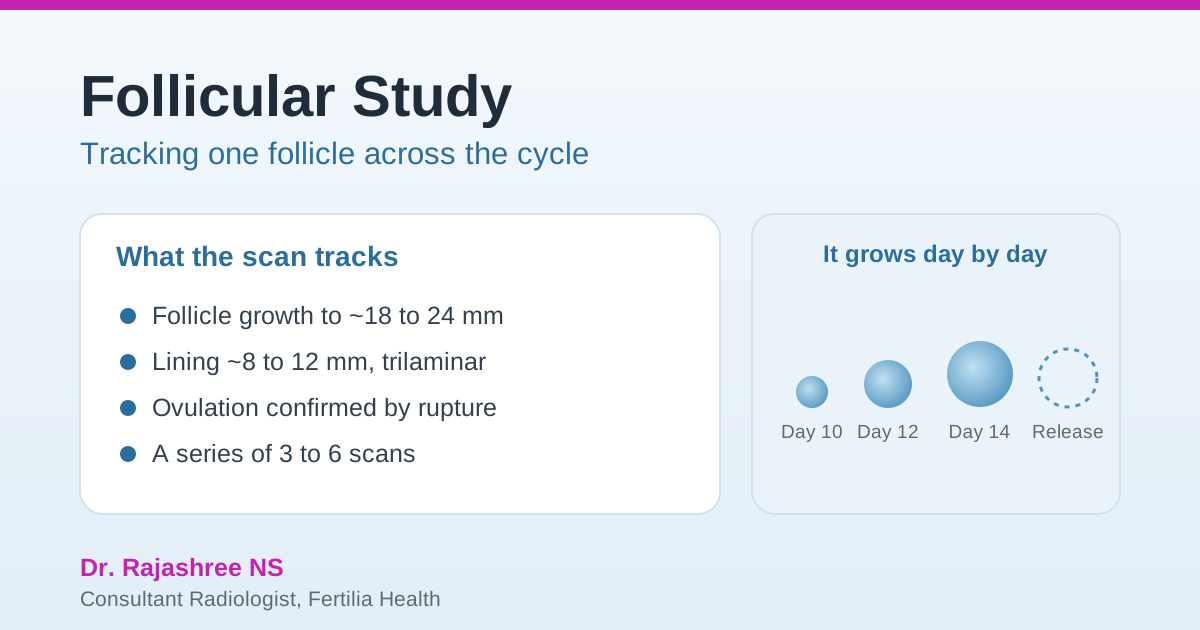
1. The dominant follicle (its size). This is the headline number. A follicle that is preparing to ovulate grows at roughly 1 to 1.5 mm a day in a natural cycle (faster, up to 2 to 3 mm a day, when fertility medicines are used). It becomes the “dominant” follicle as it pulls ahead of the others, and a mature follicle ready to release an egg measures about 18 to 24 mm. So a report showing 12 mm on Day 10, 17 mm on Day 12, and 20 mm on Day 14 is exactly the rising pattern we want to see.
2. The endometrial lining (its thickness and pattern). Alongside the follicle, the scan measures the endometrium, the lining of the uterus where an embryo would implant. Under the influence of oestrogen, it thickens through the follicular phase. Near ovulation, a lining of about 8 to 12 mm with a trilaminar (three-layer) appearance is considered favourable. The follicle and the lining grow in step, and a good study looks at both together.
3. Whether ovulation has happened. This is what the final scan in the series is for. Once a follicle is mature, the next scan checks whether it has released the egg. The signs of ovulation on ultrasound are clear: the follicle suddenly collapses or shrinks, a little free fluid appears in the pelvis (the pouch of Douglas), and a structure called the corpus luteum forms where the follicle was. Seeing these is how we confirm, rather than assume, that ovulation took place.
When the Scans Happen, and How Many
The timing follows the follicle, not a fixed calendar, but the usual rhythm looks like this:
- A baseline scan is sometimes done on Day 2 or 3 to check the ovaries are quiet at the start (and to count antral follicles or check for cysts before starting any medicine).
- Monitoring begins around Day 8 to 11 of the cycle, when a dominant follicle is becoming visible.
- Scans repeat every 1 to 3 days, getting closer together as the follicle nears maturity (around 16 to 18 mm), so the timing of ovulation can be pinned down.
- A final scan after the expected ovulation confirms whether the follicle has ruptured.
In practice this means a series of about 3 to 6 scans in one cycle. The exact number depends on how your follicle grows and what your doctor is planning. Day 1 here is the first day of full menstrual flow, not spotting.
Cost in India (verified June 2026): individual transvaginal scans run roughly Rs 300 to Rs 1,000 each, and a complete follicular study of 3 to 6 scans is around Rs 1,200 to Rs 4,000, depending on the city and the centre. Prices are higher at dedicated fertility centres and in the metros. It is worth asking whether your clinic offers a package rate for the full cycle of monitoring.
For more on this, read our guide on Endometrial Thickness.
Have a follicular study report you would like to understand alongside your full fertility picture? The scan is one piece, and it makes the most sense read together with your cycle history, AMH, and your partner’s side. Message Dr. Suganya’s team at Fertilia on WhatsApp and we will help you put it in context. Your own gynaecologist or fertility doctor orders and times the scan; we help you make sense of what it shows.
How to Read Your Follicular Study Report
Each scan in the series produces a short report. Once you know the structure, you can follow your own follicle across the cycle. A typical set of entries reads like this:
Day 10: Right ovary: dominant follicle 13 x 12 mm. Left ovary: no dominant follicle. Endometrium 7 mm, trilaminar. Day 12: Right ovary: follicle 17 x 16 mm. Endometrium 9 mm, trilaminar. Day 14: Right ovary: follicle 20 x 19 mm. Endometrium 10 mm. Advised repeat scan to confirm rupture. Day 16: Right ovary: follicle not seen (collapsed). Free fluid in pouch of Douglas. Corpus luteum seen. Impression: ovulation has occurred.
Reading it line by line:
- Follicle size is usually given as two measurements (length x width) in millimetres. Track the larger number rising across the visits. The dominant follicle is the one that keeps growing; smaller follicles that stall and fade are normal.
- Which ovary tells you the side ovulation is coming from. It often alternates between cycles, and either side is perfectly normal.
- Endometrium (ET) is the lining thickness in millimetres, often with a note on pattern (“trilaminar” near ovulation is a good sign).
- “Follicle not seen” or “collapsed,” with free fluid and a corpus luteum is the language of confirmed ovulation. This is the line you are working toward.
- “Follicle persists” or “enlarging beyond 25 mm without rupture” points to the follicle not releasing, which I explain below.
If your report uses terms you do not recognise, ask the centre or your doctor to walk you through it. A scan you have paid for and sat through should not be a mystery to you.
Why Your Doctor Orders It
Folliculometry is a planning and confirmation tool. The common reasons it is requested:
- Timing intercourse. When a couple is trying naturally and timing has been tricky, tracking the follicle pinpoints the fertile days for that cycle. For at-home ways to do the same thing without scans, see our guide to tracking ovulation.
- Timing IUI. In intrauterine insemination, the procedure has to be timed precisely to ovulation, so the follicle is tracked and often a trigger injection is given when it is mature, with the IUI done a day or so later.
- Monitoring ovulation-induction medicines. When medicines such as letrozole or clomiphene are used to encourage ovulation, scans check that they are working, that a follicle is responding, and that there is not an excessive response. This is the safe, monitored way to use these medicines, guided by your treating doctor.
- Confirming that ovulation actually happens. A woman can have regular-seeming cycles and still not release an egg every time. The scan, alongside a Day-21 progesterone blood test, confirms ovulation directly.
When the Follicle Grows but Does Not Release
Sometimes a follicle grows to a mature size and then, instead of rupturing, it stays put. The wall thickens, it may keep enlarging, and no free fluid appears. This is called a luteinised unruptured follicle (LUF): the cycle looks ovulatory by hormones and by the calendar, but the egg was not released. Because everything else can appear normal, the only way to catch it is a scan that looks for the rupture.
An occasional LUF cycle happens to many women and means little on its own. What matters is a repeated pattern, which can be one explanation behind difficulty conceiving when other tests look fine. If your follicular study shows this, it is genuinely useful information rather than bad news: it points your doctor toward specific, workable adjustments, and it answers a question that might otherwise have stayed open. Finding the reason is the first step to addressing it.
When You Do Not Need a Follicular Study
It is worth saying plainly: most women who conceive naturally never need folliculometry. If your cycles are regular and you are in the early months of trying, simple at-home tracking of your fertile window is usually enough to start with, and our guides to ovulation symptoms and tracking ovulation cover that well.
A follicular study earns its place when timing has been hard despite trying, when cycles are irregular, when ovulation-induction medicines are being used, when IUI is planned, or when your doctor wants to confirm that ovulation is happening. Your gynaecologist decides whether and when it adds something, and that decision sits within your wider fertility picture, not the scan alone. For how all the pieces fit together, our fertility program and conception guides bring them into one view.
Frequently Asked Questions
What is the difference between a follicular study and an antral follicle count? An antral follicle count (AFC) is a single scan done on Day 2 to 5 that counts your small resting follicles to estimate ovarian reserve. A follicular study is a series of scans done from mid-cycle onward that tracks one follicle as it grows and confirms whether it releases an egg. AFC measures how many eggs you have in reserve; folliculometry follows what this particular cycle’s egg is doing and when.
What follicle size means ovulation is about to happen? A mature follicle ready to release an egg usually measures about 18 to 24 mm. It grows roughly 1 to 1.5 mm a day in a natural cycle, so once it reaches the high teens, ovulation is generally close. Your doctor uses this size, along with the lining and sometimes a hormone test, to time intercourse, a trigger injection, or an IUI.
How many scans are in a follicular study, and when do they start? Usually 3 to 6 scans in one cycle. Monitoring typically begins around Day 8 to 11, then repeats every 1 to 3 days as the follicle matures, with a final scan after the expected ovulation to confirm the follicle has ruptured. The exact number depends on how your follicle grows and what your doctor is planning.
How much does a follicular study cost in India? As of June 2026, individual transvaginal scans cost roughly Rs 300 to Rs 1,000 each, and a complete study of 3 to 6 scans is about Rs 1,200 to Rs 4,000, depending on the city and centre. Dedicated fertility centres and metro locations tend to be at the higher end. Ask whether your clinic offers a package rate for the full cycle.
What does a trilaminar endometrium mean on the scan? Trilaminar means the uterine lining shows a three-layered appearance, which is the expected, favourable pattern near ovulation as oestrogen builds the lining. A thickness of about 8 to 12 mm with this pattern is considered good for that point in the cycle. It is one of the things the scan tracks alongside the follicle.
Can the scan tell if I ovulated? Yes. After a mature follicle is seen, a follow-up scan looks for the signs of ovulation: the follicle collapsing or disappearing, a little free fluid in the pelvis, and a corpus luteum forming where the follicle was. Seeing these confirms ovulation directly. A Day-21 progesterone blood test gives the same answer from the hormone side and is often used together with the scan.
Is a follicular study painful or risky? No. It is a transvaginal ultrasound, the same kind of scan used for many gynaecological checks. It is quick, uses no radiation, and most women find it only mildly uncomfortable. The main demands are practical: several visits in one cycle, timed a few days apart.
A follicular study can feel like a lot of appointments and unfamiliar numbers, but it is really just a week-by-week film of a single follicle: growing, maturing, and releasing an egg, with the lining building alongside. Read in order, your report tells that story clearly. And while it is a genuinely useful tool when timing or ovulation is in question, it is not something every woman trying to conceive needs, which is a decision your doctor makes with you.
Want help reading your follicular study alongside the rest of your fertility picture? Message Dr. Suganya’s team at Fertilia on WhatsApp. We will help you understand what the scan shows and where it fits, working alongside the gynaecologist or fertility doctor who ordered it.
Written by Dr. Rajashree NS, Consultant Radiologist (MD, Radio-diagnosis). This guide is general information and does not replace your own doctor’s interpretation of your scan. A follicular study is ordered, timed, and acted on by your treating gynaecologist or fertility specialist.