A woman in the Fertilia program once told me she planned her entire IVF stimulation around her office’s 11 AM stand-up meeting. Her injection window was 9 to 9:30 PM, so that part was easy. The hard part was the monitoring scans, which her clinic could only schedule between 8 and 10 AM, the exact hours her manager expected her at her desk for a client call. She solved it by booking the earliest slot the clinic had and going to work with her hair still damp. Nobody at the office ever asked why.
Most women doing IVF are not choosing between their career and their treatment. They are managing both, quietly, with a level of logistical precision that has nothing to do with willpower and everything to do with a calendar. This post lays out what that calendar actually looks like: the scans, the injection windows, how to handle medication that needs refrigeration on a working day, what realistic leave planning looks like, and how to tell the difference between a day you can push through and a day you should not.
The Real Shape of an IVF Cycle, Week by Week
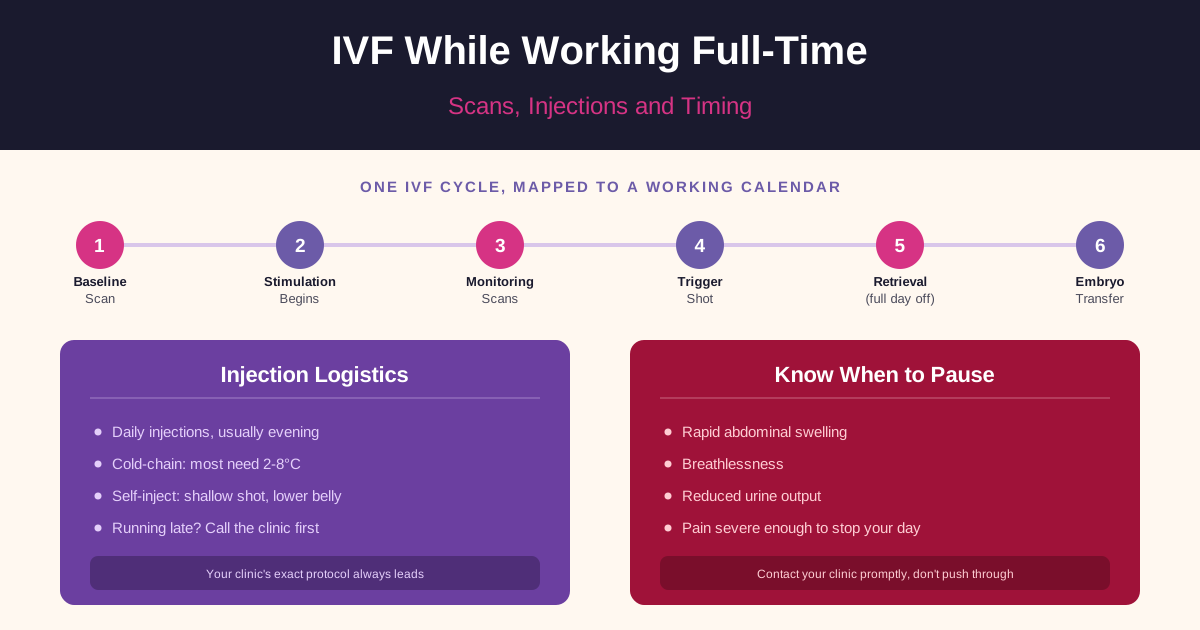
IVF is not one procedure. It is a sequence of appointments spread across roughly three to four weeks, and knowing the shape of it in advance is what makes it possible to plan around a job instead of being ambushed by it.
Baseline scan (cycle day 2 or 3). Before stimulation medication starts, your clinic checks your ovaries are quiet, no cysts left over from the previous cycle, and confirms the starting point. This is usually a single morning visit, ten to fifteen minutes including the wait.
Stimulation begins (roughly days 1 to 8 to 12). Daily injections start, most often in the evening, to grow multiple follicles at once. The exact length of this phase depends entirely on how your ovaries respond, which is why your clinic will not give you a fixed end date on day one. Some women finish stimulation in eight days. Others take twelve or more. This variability is normal and not a sign anything is going wrong.
Monitoring scans (typically two to three visits during stimulation). Your clinic tracks follicle growth with transvaginal ultrasound, usually once around day 5 to 8, and again around day 9 to 12 as the follicles approach maturity. If growth is close but not quite there, a same-week repeat scan is common, sometimes with only a day or two’s notice. This is the part of the cycle that is hardest to plan far in advance, because the schedule is dictated by how your follicles are growing, not by a calendar set in week one.
The trigger shot. Once your leading follicles reach the right size, you take a single injection, timed to a specific hour, that completes the final maturation of the eggs. The interval between this trigger and your retrieval is timed precisely, typically 34 to 36 hours, because triggering too early leaves eggs immature and too late risks ovulation happening before the retrieval can be done (Enatsu et al., F S Rep, 2025, PMID 41473569). Your clinic will give you an exact time, sometimes down to the minute. This is the one point in the whole cycle where there is genuinely no flexibility, and it is worth reading as a scheduling instruction, not a suggestion.
Egg retrieval. A short procedure under sedation, done as a day case. You will need someone to accompany you home and should plan the entire day off, not just the procedure hours, because sedation recovery and mild post-retrieval discomfort make a return to a desk the same afternoon unrealistic for most women.
Embryo transfer. Either a few days later in the same cycle (fresh transfer) or weeks later once embryos are frozen (frozen embryo transfer, FET). This is a shorter procedure than retrieval, no sedation required for most women, and many return to light activity the same day, though a few hours of rest afterward is reasonable. If your clinic recommends a freeze-all approach and a later FET, our frozen embryo transfer guide walks through why that decision gets made and what the FET cycle itself involves.
The two-week wait. The period between transfer and your pregnancy test, which brings its own particular kind of waiting. Our two-week wait guide covers what symptoms during this window actually mean.
Every clinic’s exact protocol varies, and your treating fertility team’s schedule is always the one to follow over any generic timeline, including this one. What stays constant across protocols is the shape: a somewhat flexible stimulation phase, a tightly scheduled trigger and retrieval, and a calmer transfer.
Injection Logistics: Timing, Missed Doses, and Keeping Medication Cool
Daily injections during stimulation are usually scheduled for a consistent time window, often evening, partly for convenience and partly because consistent timing helps your clinic interpret your scan results accurately from day to day.
If you are running late by an hour or two, most protocols tolerate this without consequence, but the right move is to call your clinic and tell them, not to guess. Some medications have more flexibility than others, and your clinic is the only one who can tell you whether a specific delay matters for your specific drug and day of stimulation. Never double up a dose to “catch up,” and never skip a dose because you could not fit it in. Call first.
Self-injecting at work or in transit is entirely learnable. Most stimulation drugs are given as a subcutaneous injection into the lower abdomen, a shallow injection under the skin rather than into muscle, and many women do learn to give these to themselves in a car, a hotel room, or a work washroom when needed. If you have not been shown the technique yet, ask your clinic for a demonstration before you need to rely on it away from home.
Cold-chain handling is the detail that catches working women off guard. Most gonadotropin injections need to be stored at 2 to 8°C, refrigerator temperature, and while many formulations tolerate a limited period at room temperature once first opened, that window varies by exact product and your clinic’s own instructions are the ones to follow, not a general rule. In Indian summer heat, an office desk or a car is not a safe place to leave medication that needs cooling, even briefly. A small insulated pouch with an ice pack, kept in your bag, or an office fridge you have quietly claimed a shelf in, solves this for most of the stimulation phase. If you are ever unsure whether a dose was exposed to heat for longer than it should have been, or you are not sure how long it was left out, call your clinic before injecting it rather than assuming it is still fine.
OHSS: The Days You Should Not Push Through
Most days of stimulation, working normally is entirely reasonable. But a small number of women develop ovarian hyperstimulation syndrome, OHSS, where the ovaries respond more strongly than expected and fluid shifts out of the bloodstream into the abdomen. Recognising when this is happening matters because it changes what your working day should look like.
Mild bloating and abdominal fullness toward the end of stimulation is common and usually not a reason to stay home. What is different is rapid abdominal swelling over a day or two, breathlessness or difficulty taking a full breath, reduced urine output, or pain severe enough that sitting through meetings is genuinely not possible. If any of these show up, this is not a day to push through with a painkiller and a strong cup of chai. Contact your clinic promptly. Our OHSS guide covers the full symptom picture, who is more likely to develop it, and what the grading from mild to severe actually means, worth reading before stimulation starts so you know what you are watching for, not only after symptoms appear.
If you are planning an IVF cycle around a full-time job and want to talk through what your specific protocol will realistically require of your calendar, message Dr. Suganya on WhatsApp for a ₹399 video consultation. It is available online, pan-India.
Planning Leave: What Is Genuinely Immovable vs What Is Flexible
Trying to guess your entire leave calendar on day one of stimulation is usually the wrong approach, because the schedule genuinely cannot be fixed that far in advance. A more realistic way to plan:
Block as flexible, not fixed: the stimulation-phase monitoring scans. You know roughly which week they will fall in, not the exact day, until your clinic sees how your follicles are tracking. Telling a manager “I will need a few early mornings this month, exact dates to follow” is more accurate than committing to specific dates you may need to change.
Block as fixed and non-negotiable: retrieval day and the day after. Sedation recovery is real, and pushing to work the same or next day is not a reasonable plan for most women. Treat this like a scheduled minor procedure, because it is one.
Build in a buffer around the trigger shot. Since the trigger-to-retrieval interval is fixed by the clock, retrieval day itself is usually only known with two to three days’ notice once your clinic confirms your follicles are ready. This is the single hardest part to plan far in advance for anyone with fixed work commitments, and it is worth naming that difficulty to yourself rather than assuming you have done something wrong if it catches you short on notice.
Transfer day is typically a lighter ask, a few hours rather than a full day, though many women prefer to take the whole day regardless, simply for the calm of it.
The Disclosure Question: What to Tell Whom
Whether to tell your employer, and how much, is a personal decision, not a clinical one, and Fertilia does not offer HR or legal advice on this. What is useful clinically is being honest with yourself about what the treatment will actually demand, so you can decide what to disclose with accurate information rather than guessing.
In practical terms: stimulation involves a handful of morning scan appointments spread over one to two weeks, retrieval requires one full day off with sedation recovery, and transfer requires a shorter block of time. Beyond that, most of the cycle, the daily injections, can be managed around a normal working day without anyone needing to know anything changed. Some women tell a manager they have “a medical procedure” without further detail and request flexibility around specific mornings. Others tell a trusted colleague the whole story so there is someone who understands if a day goes sideways. Both are reasonable. What tends to work less well is under-planning: assuming you will simply “figure out” the scan mornings as they come up, and then scrambling with same-day requests that are harder to grant gracefully than ones flagged a week in advance.
The Two-Week Wait, at a Desk
The stretch between transfer and your pregnancy test is its own particular weight, described by women in the Fertilia program as more psychologically demanding than the injections or the procedures themselves, because there is nothing left to actively do. Continuing to work through this period is genuinely fine, and for many women, having somewhere to direct attention during the day is easier than sitting at home with the wait. What helps is lowering the bar for yourself during these two weeks specifically: this is not the fortnight to also take on a major new project or push for a difficult deadline if you have any choice in the matter. Ordinary competence is enough for two weeks.
Putting It Together: A Working Week During Stimulation
Putting the pieces together, a typical stimulation phase for a working woman looks something like this: a baseline scan on a Monday or Tuesday morning, daily evening injections that fit around normal work hours without disruption, a monitoring scan roughly a week later, possibly a second monitoring scan two to four days after that, a trigger shot timed to a specific evening, a full day off for retrieval roughly 36 hours later, and then either a transfer within the same week or a wait of some weeks for a frozen transfer. Total time away from a desk across the whole stimulation-to-retrieval window is usually two to four mornings plus one full day, not the weeks off that many women assume they will need before they start.
At Fertilia, Dr. Suganya Venkat works through this calendar with women before their cycle starts precisely because the anxiety of “how will I manage this at work” is often worse than the actual logistics turn out to be once they are mapped out day by day.
Frequently Asked Questions
Can I work a normal full-time job during IVF stimulation? Yes, for most of the stimulation phase. The daily injections fit around a normal working day for the large majority of women. The parts that need planning are the monitoring scans, which typically happen two to three times during stimulation with limited advance notice, and retrieval day itself, which needs a full day off.
How much notice will I get for the egg retrieval date? Usually two to three days, because the date depends on how your follicles are growing and is confirmed once your clinic sees them approaching maturity on a monitoring scan. This is the hardest part of the cycle to plan far ahead for anyone with fixed work commitments, and it is a genuine feature of how IVF timing works, not a scheduling failure on your clinic’s part.
What happens if I am late giving an injection because of a work commitment? Call your clinic and tell them, rather than guessing whether it matters. Many protocols tolerate a delay of an hour or two without consequence, but your clinic is the only one who can confirm this for your specific medication and stage of stimulation. Never skip a dose or double up to compensate.
How do I keep my injections cool during a full working day? Most gonadotropin injections need refrigeration at 2 to 8°C. A small insulated pouch with an ice pack in your bag works well for a normal commute and working day. If a dose is ever left in Indian summer heat for longer than you are confident is safe, call your clinic before injecting it rather than assuming it is fine.
Do I need to tell my employer I am doing IVF? That is a personal decision, and Fertilia does not offer HR or legal guidance on it. What is useful is knowing accurately what the treatment will demand of your calendar (a few scan mornings, one full retrieval day, a shorter transfer day) so that whatever you choose to say is based on the real logistics, not a guess.
When should I stop pushing through a working day during stimulation? If you notice rapid abdominal swelling over a day or two, breathlessness, reduced urine output, or pain severe enough to interfere with sitting through a normal day, that is a signal to contact your clinic rather than push through, not a normal side effect to manage quietly. This can be a sign of ovarian hyperstimulation syndrome, which needs prompt clinical attention.
How much total time off will I need for one IVF cycle? For most women, roughly two to four scan mornings across the stimulation phase, one full day for retrieval, and a shorter block of time for transfer, rather than the extended leave many women assume they will need going in. Individual protocols vary, and your clinic’s specific plan is the one to follow.
If you are weighing how an IVF cycle will fit around a full-time job, a conversation before your cycle starts can make the calendar far less daunting than it looks from the outside.
Book a ₹399 video consultation on WhatsApp
For the full picture of preparing for and paying for treatment, see the complete guide to getting pregnant and our breakdown of IVF cost in India.