Something about staring at a semen analysis report feels very specific. The numbers are right there. A lab has labelled each one against a reference range. And after all of that, you still have no idea what any of it means for your actual situation.
The report might say “borderline” or “mildly low” next to one or two parameters. The GP who looked at it said something vague about following up with a specialist. Or nobody said anything useful at all, and you are here trying to figure out whether there is a real problem or not.
This guide is for that moment. Not an explanation of what each parameter means (that is in our complete semen analysis guide). This is a decision guide for what to actually do when some numbers fall in the borderline range.
Start Here: What “Borderline” Means
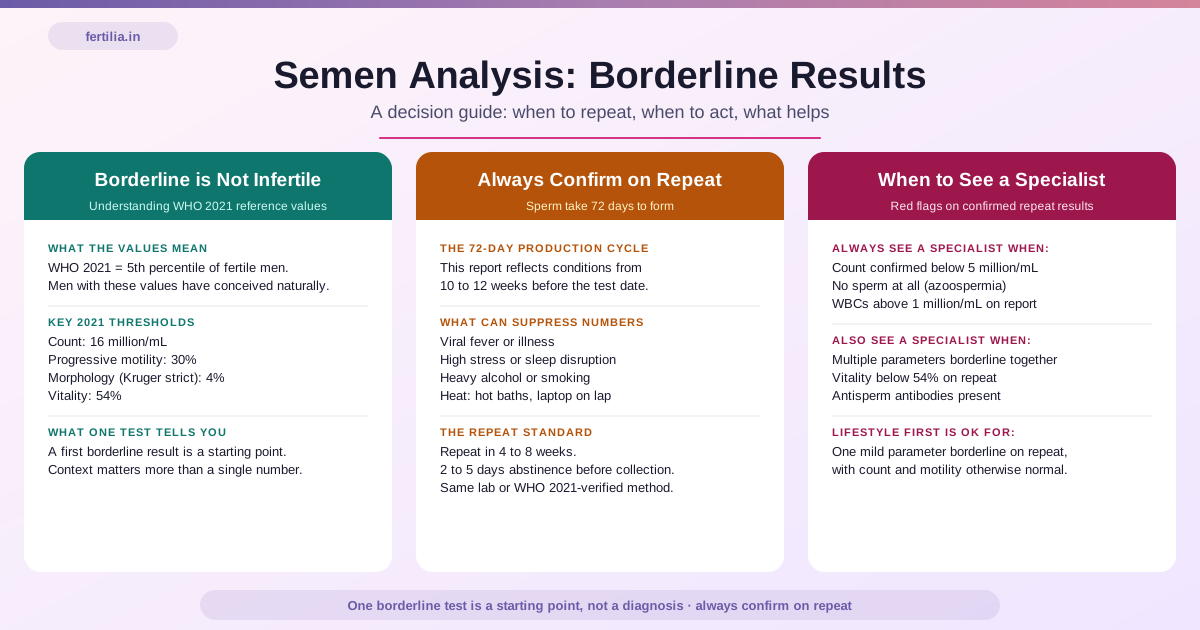
The WHO 2021 lower reference values are not a pass/fail cutoff for fertility. They are the 5th percentile of fertile men: men who had achieved a pregnancy within 12 months and had no known reproductive problems (World Health Organization. WHO Laboratory Manual for the Examination and Processing of Human Semen, 6th ed., 2021).
What that means in practice: men with borderline values in real studies had conceived naturally. A reading just below the reference limit does not define fertility failure. It is a reading that falls outside the range where 95% of fertile men in the study population sat.
For reference, the WHO 2021 lower limits are:
| Parameter | WHO 2021 Lower Reference |
|---|---|
| Semen volume | 1.4 mL |
| Sperm concentration | 16 million/mL |
| Total sperm count | 39 million per ejaculate |
| Total motility (PR + NP) | 42% |
| Progressive motility | 30% |
| Morphology (Kruger strict) | 4% |
| Vitality | 54% |
Being at or slightly below any one of these on a single test is a starting point for attention, not a crisis.
The First and Most Important Question: Is This Confirmed on Repeat?
Before any other decision is made, this question matters most.
Sperm take approximately 72 days to complete their production cycle. The report in front of you reflects conditions in the body from roughly 10 to 12 weeks before the day of collection. A viral fever, a period of significant illness, sustained stress, disrupted sleep, or higher-than-usual alcohol intake in those weeks before collection can all temporarily suppress any of the parameters.
A single borderline result, on a first test, is a starting point, not a conclusion.
Most fertility specialists recommend repeating the test 4 to 8 weeks after the first, with 2 to 5 days of abstinence before collection, at the same lab or a comparable one with verified WHO 2021 methodology. This allows comparison within the same production cycle context, without the acute triggers that may have affected the first sample.
If the repeat comes back within range, the initial borderline finding was likely a transient dip.
If the repeat confirms the borderline numbers, the rest of this guide applies.
Which Parameter Is Borderline, and How Far Below the Reference?
Not all borderline results carry the same clinical weight.
Concentration (sperm count): Mild oligospermia is generally defined as 10 to 15 million/mL, just below the 16 million/mL WHO reference. Moderate oligospermia falls in the 5 to 9 million/mL range. Severe oligospermia is consistently below 5 million/mL. These are meaningfully different situations, with different implications and different responses to lifestyle work.
A confirmed count of 13 million/mL with good motility and morphology tells a very different story from a count of 3 million/mL across the board.
Motility: Borderline progressive motility (25 to 35%) matters more when it is confirmed on repeat and when total motility is also below 42%. Isolated mild reductions in progressive motility with normal concentration often respond to the lifestyle and antioxidant interventions covered later in this guide.
Morphology: This is the most misread parameter in routine male fertility workups in India, and it deserves its own explanation.
For more on this, read our guide on Sperm Freezing Cost India 2026. The WHO 2021 reference limit is 4% using Kruger strict criteria (also called Tygerberg criteria). Many labs in India, particularly those not specifically equipped for fertility evaluation, still use older criteria and report reference ranges of 14% or even higher. If a report says “morphology: 3%, reference: >14%”, it is possible the lab is applying WHO 4th edition criteria or in-house norms rather than the Kruger strict standard. Before acting on a morphology reading, confirm which criteria the lab is using.
Under WHO 2021 Kruger strict criteria, isolated borderline morphology (2 to 3%) with normal concentration and motility is among the least clinically significant borderline findings in a male fertility evaluation. It is worth tracking on a repeat test, but it does not in itself indicate infertility.
Volume: Consistently low volume (under 1.4 mL) on a fully collected sample can point to retrograde ejaculation, ductal obstruction, or incomplete collection. Isolated low volume confirmed on repeat warrants investigation by a urologist. Volume as an isolated borderline finding in a single test is the least informative parameter to act on urgently.
One Parameter or Several?
This distinction shapes what comes next.
When a single parameter is mildly borderline and all others are within range, the clinical picture is quite different from when concentration, motility, and morphology are all low together. When all three are affected, this combination is called OAT syndrome (oligoasthenoteratozoospermia). Confirmed OAT across two tests is a clearer signal to consult a urologist or andrologist sooner rather than working through three months of lifestyle changes alone.
A single mildly borderline result on repeat is the typical starting point for a structured 90-day lifestyle-first period. Multiple confirmed borderline parameters together move the timeline toward specialist evaluation.
Dietary Evidence and Lifestyle Questions to Discuss
A healthier routine should not come with a promise that the next semen report will improve. The dietary evidence below does not establish a 90-day treatment effect.
Salas-Huetos and colleagues reviewed 35 observational studies of diet and male fertility, excluding randomized trials. Healthier dietary patterns were associated with better semen parameters, but the authors explicitly warned that this does not establish causation (2017, Human Reproduction Update, PMID 28333357). This review supports the dietary discussion, not the separate claims below about heat, smoking, sleep or stress.
Heat avoidance: The testes function best at a temperature slightly below core body temperature. Prolonged laptop use balanced on the lap, long hot baths, tight synthetic underwear, and sedentary desk work can raise scrotal temperature enough to suppress parameters over the course of a sperm cycle. This is one of the most consistently supported and immediately actionable changes in the evidence base.
Diet pattern: Mediterranean-pattern eating (vegetables, pulses, nuts, whole grains, lean protein, minimal ultra-processed food) is associated with better sperm parameters in observational studies. For Indian households, this maps naturally to:
- Walnuts (aakhrot): one of the most-studied foods for sperm parameters, with supporting RCT data (Robbins WA et al. Biol Reprod. 2012)
- Pumpkin seeds (kaddu ke beej): zinc and selenium
- Sesame seeds (til): zinc, antioxidants, healthy fats
- Eggs: protein, zinc, Vitamin E
- Dark leafy greens (palak, methi): folate, antioxidants
- Pulses (rajma, chana, moong dal): plant protein, zinc
- Tomatoes: lycopene, one of the most studied antioxidants in male fertility research (Gupta NP, Kumar R. Indian J Urol. 2002)
Antioxidants: Oxidative stress from reactive oxygen species can damage sperm DNA and membrane integrity (Agarwal A, Allamaneni SS. Reprod Biomed Online. 2004;9(3):338-347. PMID 15353087). Vitamin C, Vitamin E, zinc, selenium, and CoQ10 have supporting evidence in men with elevated oxidative stress. The practical note: antioxidant supplements are most useful when oxidative stress is actually elevated, and the appropriate combination and dose are better guided by a fertility specialist than a general supplement protocol.
Smoking: Strongly associated with reduced concentration, motility, and morphology. Stopping smoking ahead of a repeat test is among the highest-yield changes available within the 90-day window.
Alcohol: Heavy intake reduces testosterone and is associated with lower sperm quality across multiple studies. Reducing intake during the 90-day optimisation period before a repeat test is a reasonable clinical recommendation.
Sleep and chronic stress: Both affect the HPG axis and testosterone. Chronic sleep deprivation and elevated cortisol suppress the hormonal cascade needed for healthy sperm production. A consistent sleep schedule and stress management are part of the clinical picture, not optional.
For couples who want a structured plan for this 90-day window, a consultation with Dr. Suganya can map out both partners’ workup and preparation together. The fertility program at Fertilia looks at both sides of the picture as a couple, not in isolation.
When Lifestyle Is Not the Right First Step
A 90-day lifestyle-first period is appropriate for mild, isolated borderline results confirmed on repeat. It is not the right approach in every case.
The following findings on confirmed repeat results generally warrant referral to a urologist or andrologist rather than a lifestyle-first wait:
Severe oligospermia (consistently under 5 million/mL on two tests). This level of reduction is unlikely to resolve substantially with lifestyle alone. Specific underlying causes (varicocele, hormonal imbalance, ductal obstruction, chromosomal variation) are more likely to be contributing and need investigation.
Azoospermia (no sperm visible). This requires a separate evaluation to distinguish obstructive azoospermia (a blockage preventing sperm from appearing in the ejaculate) from non-obstructive azoospermia (production failure). The two have different diagnostic and treatment pathways and cannot be managed with lifestyle changes.
Elevated white blood cell count (above 1 million WBCs per mL). This suggests possible infection or chronic inflammation in the reproductive tract and needs separate assessment before a repeat sperm test gives interpretable data.
Consistently low vitality (under 54% live sperm on repeat). This can point to conditions affecting sperm membrane integrity and requires further investigation rather than a lifestyle wait.
Antisperm antibodies present. When these are flagged in the report at significant levels, they can interfere with fertilisation. Their clinical significance depends on the level and binding site, and requires specialist input to interpret.
Combined factor (both partners have a concern in the workup). When the female partner’s workup also identifies a concern (low ovarian reserve, a tubal issue, a cycle irregularity), even mild male-factor borderline results carry more weight in the overall clinical calculation. The path forward in this situation is mapped by a fertility specialist reviewing both workups together.
If you are in this position, the complete couple’s fertility journey of Vikram and Shwetha is worth reading: a real example of how a combined workup picture was approached, step by step, leading to a natural conception.
When IUI Comes Into the Conversation
IUI (intrauterine insemination) is sometimes recommended for confirmed borderline male factor, and the question comes up often after a borderline semen analysis report.
The standard clinical threshold most often cited for IUI is a total motile count (TMC) after sperm washing of approximately 5 to 10 million. TMC is calculated as: volume × concentration × percentage of total motility. A sample showing 2 mL volume, 12 million/mL concentration, and 35% total motility gives a pre-wash TMC of approximately 8.4 million. What is usable after washing depends on the preparation technique and the lab.
Whether IUI is the right next step for a couple depends on more than TMC alone: how long you have been trying, the female partner’s full workup, age on both sides, and whether the male factor is the primary driver or one part of a wider picture. That decision belongs with the fertility specialist who has reviewed both workups. Fertilia supports couples in the 90-day preparation window before and around IUI and IVF cycles, working alongside the treatment team.
For a broader view of what a complete fertility workup looks like and what to budget for it, the fertility workup cost guide for India covers both the male and female sides of the evaluation together.
[WhatsApp CTA at end]
If you are looking at a borderline semen analysis and want to understand what it means for your situation specifically, reach out to Dr. Suganya directly. An online consultation can map out the next steps for both partners. Those next steps are part of Dr. Suganya’s Fertility program, built around both of you.
Frequently Asked Questions
Can you conceive naturally with a borderline semen analysis?
Yes. WHO 2021 reference limits are the 5th percentile of men who had conceived naturally. Men with values at or just below these thresholds appear in the studies of fertile populations. A single borderline parameter, particularly on a first test, is not a diagnosis of infertility. Confirmed borderline results on multiple parameters warrant more active assessment, but borderline is not the same as infertile.
How long should we wait before repeating a semen analysis?
4 to 8 weeks is the standard recommendation. This gives enough time for the next cohort of sperm to complete a full production cycle, and for any acute trigger from the first test period (illness, alcohol, stress) to have cleared. The repeat should be done with 2 to 5 days of abstinence and, ideally, at the same lab or one using verified WHO 2021 methodology.
What is the difference between mild and severe oligospermia?
Mild oligospermia is a concentration of 10 to 15 million/mL, just below the WHO 2021 reference of 16 million/mL. Severe oligospermia is a concentration consistently below 5 million/mL. These are clinically different situations. Mild oligospermia with normal motility and morphology often responds to lifestyle work over 90 days. Severe oligospermia usually has an underlying cause that a specialist needs to investigate.
Can diet and lifestyle actually improve sperm parameters?
Healthier dietary patterns are associated with better semen parameters in observational studies (Salas-Huetos et al., 2017, Human Reproduction Update, PMID 28333357). This review does not show that changing diet causes improvement, establish a response within 90 days, or test a combined heat-avoidance, sleep and exercise program. A fertility assessment and follow-up results are needed to understand your own situation; this review cannot predict your response.
My morphology came back at 2% on Kruger strict criteria. Does that need treatment?
Isolated borderline morphology (2 to 3% on Kruger strict) with a normal concentration and motility is one of the least clinically significant borderline findings in routine male fertility evaluation. It is worth noting and confirming on a repeat test, but it does not in itself require aggressive intervention. The broader picture of count, motility, and the couple’s overall workup matters far more than morphology alone when planning next steps.
When does a borderline result need a specialist rather than a lifestyle approach?
When confirmed on repeat, and when: the concentration is consistently below 5 million/mL, no sperm are visible at all, WBC count is elevated above 1 million/mL, vitality is consistently low, antisperm antibodies are present, or the female partner’s workup has also identified a concern. Any one of these shifts the picture toward specialist evaluation rather than a lifestyle-first period.
Should we do IUI if the semen analysis is borderline?
IUI is one consideration when the total motile count after washing falls below standard thresholds (commonly cited around 5 to 10 million). Whether it is the right next step depends on both partners’ full workup, how long you have been trying, and age. The fertility specialist reviewing both workups together is the right person to make that call. Fertilia can support the couple’s preparation in the 90 days before and around any IUI or IVF cycle.