Donor sperm usually enters the conversation at an emotional moment. It might follow a semen report that showed no sperm, a sperm retrieval that did not find any, or a decision to become a mother on your own. However you arrived here, it is a real and well-established way to build a family, and you deserve clear, practical information about it.
I’m Dr. Suganya Venkat, an OB-GYN with more than fifteen years of practice. This guide sets out what IUI with donor sperm involves in India: who the law allows to use it, how a cycle runs, what the research shows about success, and what it tends to cost.
What This Post Covers
- Who donor sperm IUI is suited to
- What the ART (Regulation) Act, 2021 says about donor sperm
- The tests to do before you start
- How a donor IUI cycle runs, step by step
- Success rates by age, and when to review the plan
- What a donor IUI cycle costs in India
- Frequently asked questions
Who Donor Sperm IUI Is Suited To
IUI (intrauterine insemination) places washed, prepared sperm directly into the uterus around the time you ovulate. With donor sperm, the sperm comes from a screened donor through a registered sperm bank instead of from a partner. The women and couples who usually consider it:
- Couples where the male partner has no sperm and retrieval is not possible or not chosen. Our guide to azoospermia causes and treatment options explains the workup, and TESA and PESA sperm retrieval covers the procedures that try to find the partner’s own sperm first.
- Couples where the male partner carries a genetic condition they do not want to pass on.
- Single women who want to become mothers.
Donor IUI works well when the woman ovulates and has at least one open fallopian tube, because the sperm still has to meet the egg in the tube. If both tubes are blocked, or there are other factors such as severe endometriosis, IVF with donor sperm is usually the more direct route. Our IUI vs IVF guide walks through that decision.
What the ART Act 2021 Says About Donor Sperm
Donor sperm treatment in India is regulated by the Assisted Reproductive Technology (Regulation) Act, 2021. The section references below are to the Act as published in the Gazette of India on 20 December 2021 (egazette.gov.in), which I read for this post on 27 September 2026. This is a summary for patients, not legal advice.
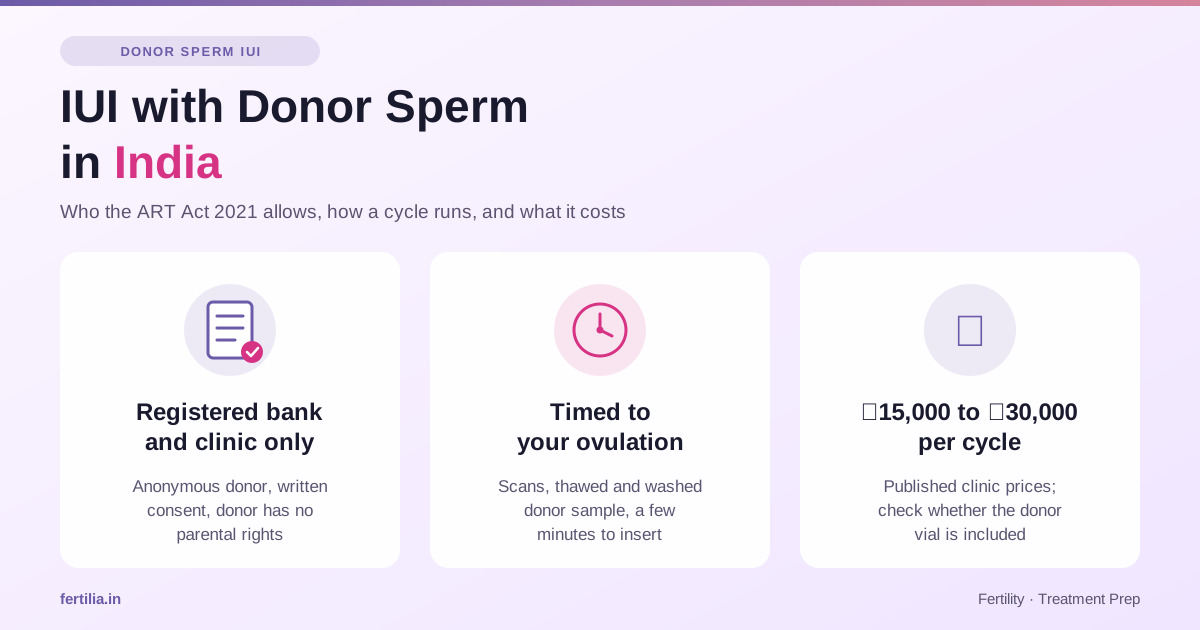
IUI is covered by the Act. The Act defines assisted reproductive technology as any technique that tries to achieve a pregnancy by handling sperm or eggs outside the body and transferring them into a woman’s reproductive system (s.2(1)(a)). Donor IUI therefore has to be done at a registered ART clinic.
Who can use donor sperm. The Act recognises two groups. A “commissioning couple” is an infertile married couple (s.2(1)(e)), where infertility means being unable to conceive after one year of unprotected intercourse, or having a proven medical condition that prevents conception (s.2(1)(j)). A “woman” is any woman above 21 who approaches a clinic or bank (s.2(1)(u)), and the Act describes a gamete donor as someone who provides sperm or eggs to help “an infertile couple or woman” have a child (s.2(1)(h)). Clinics may offer ART services to women above 21 and below 50, and to men above 21 and below 55 (s.21(g)). The Act does not name unmarried couples or same-sex couples. If your situation does not fit these definitions, ask the clinic directly, and take legal advice if needed, before you begin.
Donor sperm must come from a registered ART bank. Screening of donors and the collection, screening and storage of semen can only be done by a bank registered as an independent entity under the Act (s.27(1)). Banks may only take semen from men aged 21 to 55, and must examine donors for the diseases prescribed under the Act’s rules (s.27(2)).
Donors stay anonymous to you. The bank records the donor’s name, Aadhaar number and address, and takes a written confidentiality undertaking from him (s.27(6)). Information about the couple, the woman and the donor must be kept confidential, and can only be disclosed to the National Registry, in a medical emergency at the request of the couple it concerns, or by court order (s.21(e)).
One donor per cycle, and one family per donor. You cannot be treated with sperm from more than one man in a single cycle, and clinics may never mix semen from two people (s.24(c) and (d)). A bank cannot supply one donor’s sperm to more than one commissioning couple (s.27(3)).
Consent is written. No procedure can go ahead without the written informed consent of everyone involved (s.22(1)(a)), and either partner in a couple can withdraw consent at any point before the sperm is placed in the uterus (s.22(4)). The clinic must also counsel you about the chances of success, costs, side effects and the risk of multiple pregnancy before you decide (s.21(c)).
The child is legally yours. A child born through ART is deemed the biological child of the commissioning couple, with all the rights of a natural child, and the donor gives up all parental rights over any child born from his sperm (s.31).
Buying or selling sperm is prohibited. The sale or transfer of gametes to any party is prohibited, except for transferring your own gametes for personal use with the National Board’s permission (s.29). Donor sperm may be stored for a maximum of ten years (s.28(2)).
What this means for a known donor
Some women ask whether a friend or relative can be the donor. Because the Act routes donor screening and semen collection through registered banks, which keep the donor’s identity confidential (s.27), a private arrangement with someone you know does not fit easily within it. Please discuss this with the clinic before making any plans with a known donor.
Donor sperm IUI is governed by a different law from surrogacy. If you are also reading about that route, our guide to surrogacy rules in India covers the Surrogacy (Regulation) Act separately.
Before You Start: The Workup
Because the sperm side is taken care of by a screened donor, the workup focuses on you:
- Ovulation. Regular cycles usually mean regular ovulation. If your cycles are irregular, for example with PCOS, you may need tablets to help you ovulate.
- Your fallopian tubes. A tubal test such as an HSG checks that at least one tube is open. Our guide on how to read your HSG report explains the result.
- Ovarian reserve. An AMH blood test and an antral follicle count scan give a picture of your egg reserve, which helps set expectations and decide how many cycles to plan for.
- Routine pre-pregnancy checks that your doctor advises, such as blood count, thyroid and rubella immunity, plus starting folic acid.
Choosing the bank and the donor
Your clinic will usually work with one or more registered banks. Questions worth asking:
- Is the bank registered under the ART Act, and can I see the registration?
- What non-identifying details are shared about the donor, such as blood group, height and complexion?
- What infection and health screening has the donor completed?
- Can more vials from the same donor be set aside for later cycles, and what does storage cost?
- Is the vial price included in the cycle quote, or billed separately?
How a Donor IUI Cycle Runs, Step by Step
A donor IUI cycle follows the same pattern as any IUI cycle, with one extra lab step to thaw the donor sample.
1. Natural or mildly stimulated cycle. If you ovulate regularly, a natural cycle is a reasonable first choice. In a US cohort of 6,192 donor IUI cycles in ovulatory women, adding clomiphene or letrozole raised the ongoing pregnancy rate only slightly (15.4% vs 14.9%), while ongoing multiple pregnancies rose from 2.4% to 10.8% (Carpinello OJ et al., Fertil Steril, 2021, PMID 33077237). If you do not ovulate regularly, tablets such as letrozole help an egg mature on time.
2. Monitoring scans. Two to four ultrasound scans track the growing follicle and the uterine lining. Some women also use urine ovulation kits to detect the LH surge.
3. Timing the insemination. The insemination is timed to ovulation, either after an hCG trigger injection or after the LH surge is detected. One trial of 351 women found a higher clinical pregnancy rate when donor IUI was done one day after the LH rise than two days after it, although the review that pooled it rated this as low-quality evidence (Kop PA et al., Cochrane Database Syst Rev, 2018, PMID 29368795).
4. Thawing and washing. Donor sperm from a bank arrives frozen. On the day, the lab thaws the vial and prepares the sperm so that the most active sperm are concentrated in a small volume.
5. The insemination. A thin, soft catheter passes through the cervix and the sperm is placed in the uterus. It takes a few minutes, feels similar to a Pap smear, and you can go about your day afterwards.
6. The two-week wait. A pregnancy test is done about two weeks later. Our guide to the two-week wait after IUI covers what you may notice during those days.
Some women ask about intracervical insemination (ICI), where sperm is placed at the cervix instead of inside the uterus. A Cochrane review of six trials found the evidence too limited to choose between IUI and ICI with donor sperm (Kop PA et al., Cochrane Database Syst Rev, 2018, PMID 29368795). This post focuses on IUI.
💜 Considering donor sperm IUI and not sure where to start? Message Dr. Suganya’s team on WhatsApp A ₹399 video consultation reviews your reports and helps you plan the workup and your questions for the fertility clinic, from anywhere in India.
Success Rates by Age
In the large studies below, the woman’s age was the factor that most clearly changed donor IUI success.
In a Belgian cohort of 1,654 women and 6,630 donor insemination cycles, the delivery rate was 14% per cycle. The expected cumulative delivery rate after up to 12 cycles was 87% for women aged 20 to 29, 77% for 30 to 34, 76% for 35 to 37, 66% for 38 to 39 and 52% for 40 to 45. Neither the reason for using donor sperm nor the stimulation protocol made a significant difference (De Brucker M et al., Hum Reprod, 2009, PMID 19369295).
A UK clinic’s data on 3,333 women, 45% of them single, gave a lower delivery rate of 8.9% per cycle. Expected cumulative live birth rates were 66% under 35, 49% at 35 to 37, 54% at 38 to 39 and 28% at 40 to 42. Few additional births came after six cycles, and results did not differ between single women and same-sex couples (Linara-Demakakou E et al., Reprod Biomed Online, 2020, PMID 33046376). A French study of 962 women reached a similar conclusion: once age was accounted for, pregnancy rates after donor IUI were not linked to relationship status (Godinho M et al., J Assist Reprod Genet, 2025, PMID 41083664).
“Expected cumulative” rates are estimates that assume every woman keeps going for all the cycles, so they are higher than the share of women who end up with a baby in real life, where some stop earlier.
A Chinese cohort compared donor IUI with IUI using the husband’s sperm. The cumulative live birth rate with donor sperm was 61.5% under 35 and 48.9% at 35 to 37, compared with 27.6% and 23.0% with the husband’s sperm. Above 38, rates were low in both groups (Zhang D et al., Int J Gynaecol Obstet, 2024, PMID 38623946). These are different groups of women, often with different fertility histories, so the gap does not mean donor sperm is “better”. It does show that donor IUI can work well for younger women.
All of these cohorts come from outside India, and published Indian data on donor IUI outcomes are limited. Ask your clinic for its own donor IUI results by age group.
When to review the plan
The UK authors above found little benefit in going beyond six donor IUI cycles for women up to 40, and suggested about three attempts for women aged 40 to 42. That makes three to six cycles a sensible point to sit down and review, or about three if you are over 40. If pregnancy has not happened by then, IVF with donor sperm is usually the next conversation. Our guides on what to do after a failed IUI and IUI success rates in India go into this in more detail.
What Donor IUI Costs in India (2026)
A donor IUI cycle has two parts: the donor sperm itself, and the IUI cycle around it. Clinics bundle these differently, so two quotes that look different may cover different things.
| Component | Published range |
|---|---|
| Donor sperm vial from a registered bank | ₹5,000 to ₹35,000 per vial |
| Sperm thawing and preparation | ₹2,000 to ₹4,000 |
| Donor screening, processing and storage charges, if billed separately | ₹5,000 to ₹20,000 |
| Donor IUI cycle, as quoted per cycle by clinics | ₹15,000 to ₹30,000 |
| Three donor IUI cycles | ₹45,000 to ₹90,000 |
Sources: published pricing pages of Select IVF (selectivf.com, Chennai), Ferti Health (ferti.health), Ferty9 (ferty9.com) and Cloudnine Fertility (cloudninefertility.com), checked 27 September 2026. Vial prices vary by bank and screening level. Some clinics include the vial in the cycle price and others bill it separately, so an all-in cycle can cost more than the quoted cycle range.
The rest of the cycle (consultations, scans, medicines, trigger and the procedure) is priced like any IUI. Our IUI cost guide breaks those down by city.
When you compare quotes, ask:
- Is the donor vial included, and how many vials does the price cover?
- Are thawing, sperm preparation and GST included?
- What is the yearly storage fee for any extra vials you set aside?
- If the cycle is cancelled before insemination, what is refunded?
The Emotional Side
For couples, choosing donor sperm often comes after a difficult diagnosis for the male partner, and grief can sit alongside hope. It helps to make the decision together and at your own pace. For single women, the decision is often carefully planned, and the practical questions about support at home, work and childcare deserve as much attention as the medical ones.
Whether and how to tell a child about donor conception is a personal decision for each family. The clinic’s counselling session is a good place to start thinking about it, well before you need an answer.
At Fertilia, the role we play is to make sure the ground is ready: that your workup is complete, your cycle is planned sensibly, and your questions for the fertility clinic are clear, working alongside the specialist who performs the IUI.
Practical Takeaways
- Check that you fit the Act’s definitions (married infertile couple, or a woman above 21) and the age limits before you start.
- Use only a registered ART clinic and a registered ART bank. Ask to see registration.
- Complete your workup first, especially a tubal test and AMH.
- If you ovulate regularly, discuss a natural cycle to keep the risk of twins low.
- Get an itemised quote that states whether the donor vial is included.
- Plan a review point after three to six cycles, or about three if you are over 40.
For the wider picture of preparing to conceive, our free guide to getting pregnant is a good place to begin.
Frequently Asked Questions
Is IUI with donor sperm legal in India? Yes. It is regulated under the Assisted Reproductive Technology (Regulation) Act, 2021. Donor sperm must come from a registered ART bank (s.27(1)), treatment must be at a registered ART clinic, and everyone involved must give written informed consent (s.22(1)(a)).
Can a single woman get IUI with donor sperm in India? The ART Act defines a “woman” who may seek ART services as any woman above 21 who approaches a clinic or bank (s.2(1)(u)), and describes donors as helping “an infertile couple or woman” (s.2(1)(h)). Clinics may treat women above 21 and below 50 (s.21(g)). Ask your clinic about its own documentation requirements before you start.
How much does IUI with donor sperm cost in India? Published clinic prices put a donor IUI cycle at about ₹15,000 to ₹30,000, and the donor vial alone at ₹5,000 to ₹35,000 depending on the bank. Some clinics include the vial in the cycle price and others bill it separately, so ask for an itemised quote.
What is the success rate of IUI with donor sperm? Per-cycle delivery rates in large studies range from about 9% to 14%, and depend strongly on your age. In one Belgian cohort, the expected cumulative delivery rate after up to 12 cycles was 87% for women aged 20 to 29 and 52% for women aged 40 to 45 (De Brucker M et al., Hum Reprod, 2009, PMID 19369295).
Can I use a friend or relative as a sperm donor in India? The ART Act routes donor screening and semen collection through registered ART banks, which keep the donor’s identity confidential (s.27). A private known-donor arrangement does not fit easily within that framework, so discuss it with the clinic before making any plans.
Will the donor have any rights over my child? No. Under the ART Act, the donor gives up all parental rights over any child born from his sperm, and a child born through ART is deemed the biological child of the commissioning couple (s.31). The donor’s identity is also kept confidential (s.27(6)).
How many donor IUI cycles should I try before IVF? Most additional births in a large UK study came within six cycles, and the authors suggested about three attempts for women aged 40 to 42 (Linara-Demakakou E et al., Reprod Biomed Online, 2020, PMID 33046376). If your tubes are blocked or your egg reserve is low, IVF may be the better first step.
If you are weighing donor sperm IUI, a calm review of your reports before you begin makes every later step easier. Dr. Suganya offers online video consultations pan-India at ₹399, and the 90-day fertility program is built to prepare your body and your plan for whichever route you choose.
💜 Ready to talk it through? Message Dr. Suganya on WhatsApp Consultations are online, via video call or phone, wherever you are in India.