The scan has confirmed the pregnancy has stopped growing, or the bleeding has started and the doctor says some tissue is still inside. Then comes a sentence that can feel like a second blow on the same day: “We can do a D&C.”
Most women I meet at this point have the same few questions. What exactly will be done? Will it hurt? Will it affect my next pregnancy? And do I have to have it at all?
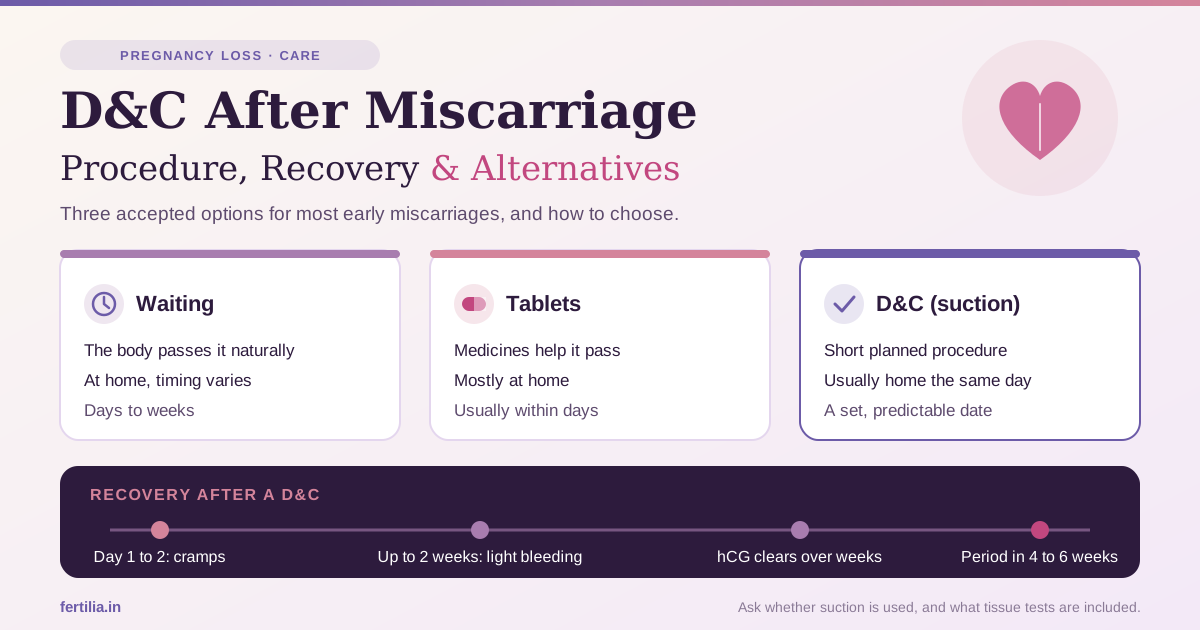
I’m Dr. Suganya Venkat, and in more than fifteen years as an OB-GYN I have walked many women through this decision. The short answer: a D&C (dilatation and curettage) is a short, planned procedure that empties the uterus after a miscarriage. It is one of three accepted options. The other two are waiting for the body to pass the pregnancy on its own, and tablets that help it along. All three are reasonable for most early miscarriages, and the right one depends on your bleeding, your scan, how far along the pregnancy was, and what matters most to you.
Here is what this post covers:
- When a D&C is suggested, and when it is a choice
- What happens on the day, step by step
- Suction (vacuum aspiration) versus scraping, and local versus general anaesthesia
- The risks, explained plainly
- Recovery, week by week, and the signs that need a call
- Testing the tissue
- How a D&C compares with waiting or tablets
If you are still trying to make sense of the scan itself, our guides to missed miscarriage and blighted ovum explain what those findings mean. This post picks up from the point where a procedure is being discussed.
When a D&C Is Suggested
A D&C after miscarriage removes pregnancy tissue that has not passed on its own. You may hear it called by several names on a hospital form or discharge summary:
- D&C (dilatation and curettage)
- ERPC (evacuation of retained products of conception)
- Suction evacuation or vacuum aspiration
- MVA (manual vacuum aspiration), when a hand-held syringe is used for the suction
They all describe the same goal: gently emptying the uterus.
Your doctor will usually recommend going straight to a procedure when:
- Bleeding is heavy, or you are feeling faint or unwell
- There are signs of infection, such as fever or foul-smelling discharge
- Tablets or waiting have not worked and tissue is still seen on the scan
- A molar pregnancy is suspected, where suction evacuation is the standard treatment (our molar pregnancy guide explains why)
Outside these situations, a D&C is usually one choice among three. Some women choose it because they want a clear, planned endpoint and do not want to wait for bleeding to start at home. That is a valid reason, and you can say so.
What Happens on the Day
Hospitals vary, but the sequence is broadly similar across India.
Before the procedure. You will have a few routine checks: blood count, blood group (including your Rh type), and sometimes other tests depending on your health. If you are having general anaesthesia or sedation, you will be asked not to eat or drink for some hours beforehand. Some doctors give a tablet a few hours before the procedure to soften the cervix, so less stretching is needed.
Anaesthesia. Many hospitals in India do the procedure under short general anaesthesia or sedation, so you are asleep. Others offer it under local anaesthesia, with an injection around the cervix while you stay awake. A Japanese study of 322 women having manual vacuum aspiration for first trimester miscarriage found local anaesthesia was as safe and effective as general anaesthesia, with similar pain scores and satisfaction (Kakinuma T et al., Patient Saf Surg, 2022, PMID 35614492). It is worth asking which options your hospital offers.
The procedure itself. The cervix is gently opened with smooth rods of increasing size (the “dilatation” part). The tissue is then removed, most often with a thin tube attached to suction. The emptying itself usually takes only a few minutes. Most of the time in theatre goes into anaesthesia and preparation.
Afterwards. You rest in a recovery area for a few hours. Most women go home the same day once they have eaten, passed urine, and the bleeding is settling. If you were asleep, someone should take you home.
If your blood group is Rh negative, your doctor will discuss an anti-D injection after the procedure. Our guide to the anti-D injection in Rh-negative pregnancy explains why it is given after a miscarriage.
Suction or Scraping: Ask Which Method
“Curettage” originally meant scraping the lining with a sharp metal instrument (a curette). Many hospitals now use suction instead, though both are still in use.
A Cochrane review comparing surgical methods for incomplete miscarriage found that vacuum aspiration was linked to less blood loss, less pain during the procedure and a shorter procedure than sharp metal curettage. The authors noted this rested mainly on a single trial (Tunçalp O et al., Cochrane Database Syst Rev, 2010, PMID 20824830).
This matters for a second reason, covered in the next section: the lining of the uterus is what the next pregnancy implants into, and the gentler the emptying, the better. It is reasonable to ask your doctor before the day, “Will this be done with suction?” Most gynaecologists will be glad you asked.
💜 Been told you need a D&C and want to understand your options first? Message Dr. Suganya on WhatsApp with your scan report, and talk it through over a ₹399 video consultation from anywhere in India or abroad.
The Risks, Explained Plainly
A D&C is one of the most commonly performed procedures in gynaecology, and serious problems are uncommon. Knowing the risks helps you recognise them early, not worry about them in advance.
Infection. In the MIST trial, which randomised 1,200 women in the UK with first trimester miscarriage to waiting, tablets or surgery, confirmed infection within 14 days was low (2 to 3 percent) and did not differ between the three approaches (Trinder J et al., BMJ, 2006, PMID 16707509). So surgery does not carry a noticeably higher infection risk than the alternatives.
Tissue left behind. Occasionally a small amount remains and causes ongoing bleeding. This usually shows on a follow-up scan and can often be managed with tablets or, less often, a repeat procedure.
Adhesions inside the uterus (Asherman’s syndrome). This is the risk most women have read about. A review of studies in which women had a hysteroscopy (a camera look inside the uterus) within a year of a miscarriage found adhesions in 19.1 percent. More than half of these were mild and of unclear clinical importance, and the number of D&C procedures a woman had seemed to be the main driver of the risk (Hooker AB et al., Hum Reprod Update, 2014, PMID 24082042). The same review found that pregnancy outcomes afterwards were similar whether the miscarriage was managed by waiting, tablets or surgery, though the number of studies was limited.
In practice, this is why many doctors prefer suction, use the gentlest technique that empties the uterus, and avoid repeating the procedure unless it is needed. If your periods become very scanty or stop after a D&C, our guide to Asherman’s syndrome explains how it is checked and treated.
Injury to the uterus or cervix. A small tear in the cervix or a perforation of the uterine wall is rare. If your doctor suspects one, you will be observed more closely, and many small injuries heal without further surgery.
Anaesthesia. Your anaesthetist will review your health beforehand and talk you through the plan.
Recovery, Week by Week
Every woman’s recovery is a little different, but this is the usual pattern.
The first day or two. Cramping like period pain, and bleeding similar to a light period. Paracetamol or the pain relief your doctor prescribes usually helps. Rest as you feel you need to. Many women return to desk work within a day or two.
The first one to two weeks. Bleeding gradually becomes lighter and turns brown, then stops. Use sanitary pads rather than tampons or menstrual cups. Most doctors suggest waiting for the bleeding to stop before having sex, to lower the chance of infection.
Weeks two to four. A home pregnancy test may still show positive for a while, because the pregnancy hormone (hCG) takes time to clear. This does not mean anything is wrong. Our guide to beta hCG levels explains what the report numbers mean, including what “not detected” means after a loss. If a test is still positive three to four weeks after the procedure, let your doctor know so they can check.
Weeks four to six. Most women get a period around four to six weeks after the procedure. The first one may be a little heavier or lighter than usual.
Call your doctor promptly if you have:
- Bleeding heavy enough to soak through a pad every hour
- Fever of 38°C or above, or chills
- Foul-smelling discharge
- Pain that is getting worse instead of better
- No period by about eight weeks after the procedure, or periods that are much lighter than before
The emotional recovery often takes longer than the physical one, and it rarely follows a timetable. Our guide to coping after pregnancy loss talks about what grief after an early loss can look like and what helps.
Testing the Tissue
The tissue removed during a D&C is usually sent to the laboratory for histopathology. This confirms that it was pregnancy tissue and checks for a molar pregnancy, which needs its own follow-up.
Chromosome testing of the tissue is a separate test and is not always done routinely. It can be worth asking about, especially after more than one loss. In a Spanish series of over a thousand first trimester miscarriages where the tissue was sampled before evacuation, 70.3 percent had an abnormal chromosome result, most often a single extra chromosome (Soler A et al., Cytogenet Genome Res, 2017, PMID 28662500). For many women, seeing a chromosome result helps, because it shows the loss came from a random event in that pregnancy rather than anything they did.
If you have had two or more losses, our guide to tests after recurrent miscarriage explains the wider workup.
D&C Compared With Waiting or Tablets
For most early miscarriages, you can choose between three approaches. Here is how they compare.
| Waiting (expectant) | Tablets (medical) | D&C (surgical) | |
|---|---|---|---|
| What happens | The body passes the tissue on its own | Tablets bring on cramping and bleeding to pass the tissue | The uterus is emptied in a short planned procedure |
| Where | At home | Mostly at home | Hospital, usually a day stay |
| Timing | Unpredictable, can take days to weeks | Usually within days | Planned for a set day |
| Main trade-off | More chance of unplanned admission or a later procedure | Some women still need a procedure | Anaesthesia, and a small risk of adhesions |
What the research shows. In the MIST trial, infection rates were similar across the three options, but unplanned hospital admissions and unplanned surgical procedures were significantly more common after waiting and after tablets than after planned surgery (Trinder J et al., BMJ, 2006, PMID 16707509). In other words, waiting and tablets avoid a procedure for many women but not all, while a planned D&C gives a more predictable endpoint.
Tablets work better when two medicines are combined. For missed miscarriage, a tablet called mifepristone taken a day or two before misoprostol improves the chance of the tissue passing:
- In a US trial of 300 women, complete expulsion after one dose of misoprostol was 83.8 percent with mifepristone first, compared with 67.1 percent with misoprostol alone (Schreiber CA et al., N Engl J Med, 2018, PMID 29874535).
- In the UK MifeMiso trial of 711 women, 17 percent of those given the combination needed surgery to complete the miscarriage, compared with 25 percent given misoprostol alone (Chu JJ et al., Lancet, 2020, PMID 32853559).
Choosing between them. There is no single right answer. Some questions that help:
- Do you want a planned, predictable day, or would you rather avoid a procedure if you can?
- How far is your home from the hospital if the bleeding becomes heavy at night?
- Do you have support at home for a few days of bleeding?
- Is your bleeding already heavy, or are there signs of infection? (If so, a procedure is usually the safer route.)
Your gynaecologist knows your scan and your health, and this is a decision to make together with them. If you want a second conversation to think it through, that is reasonable too.
What It Is Called in Hindi
Many women in North India hear a D&C described as “safai” (cleaning), or “garbhashay ki safai” (cleaning of the uterus), and may search for “miscarriage ke baad safai”. These everyday words describe the same procedure explained in this post: emptying the uterus of pregnancy tissue after a miscarriage. The word “cleaning” can make it sound as though something was dirty or wrong. It is not. It only means removing the tissue so the uterus can heal and the next cycle can begin.
Trying Again After a D&C
Most women ovulate again within a few weeks. Many doctors suggest waiting for one normal period before trying again, partly to let the lining recover and partly so the next pregnancy can be dated clearly. This is practical advice rather than a strict rule for most women. Our guide on how soon you can conceive after a miscarriage covers the timing in detail.
For many women at Fertilia, the months after a loss are when they want a plan: checking thyroid and sugar levels where needed, getting cycles back on track, and preparing body and mind for the next pregnancy. That is what our fertility program is built around.
Practical Takeaways
- A D&C is one of three accepted ways to manage an early miscarriage. Unless bleeding is heavy or there is infection, you usually have time to choose.
- Ask whether it will be done with suction, and whether local anaesthesia is an option.
- Expect period-like cramps and light bleeding for up to two weeks, and a period in four to six weeks.
- Call your doctor for heavy bleeding, fever, foul discharge, worsening pain, or no period by about eight weeks.
- Ask whether the tissue will be sent for testing, and what tests are included.
- If your blood group is Rh negative, ask about the anti-D injection.
💜 Recovering from a miscarriage and wondering what comes next? Talk to Dr. Suganya on WhatsApp to start with a ₹399 online consultation, or download our free miscarriage support guide.
Frequently Asked Questions
Is a D&C painful?
Under general anaesthesia or sedation you will not feel the procedure. Under local anaesthesia, most women feel pressure and cramping, which the anaesthetic injection reduces. Afterwards, cramps similar to period pain are common for a day or two and usually settle with simple pain relief.
How long does it take to recover from a D&C after a miscarriage?
Most women feel physically back to normal within a few days and return to desk work within a day or two. Light bleeding can continue for up to two weeks, and the first period usually comes four to six weeks after the procedure. Emotional recovery often takes longer, and that is normal.
Will a D&C affect my chances of getting pregnant again?
For most women, no. A review of studies found pregnancy outcomes were similar whether a miscarriage was managed by waiting, tablets or surgery, though the evidence is limited. Adhesions inside the uterus are possible, especially after repeated procedures, which is why a gentle suction method is preferred. If your periods become much lighter or stop afterwards, tell your doctor.
Can I avoid a D&C and take tablets instead?
Often, yes. For most early miscarriages without heavy bleeding or infection, tablets or waiting are reasonable alternatives. For a missed miscarriage, taking mifepristone before misoprostol improves the chance that the tissue passes completely. Some women will still need a procedure later, so it helps to know the plan if that happens.
What is “safai” after a miscarriage?
“Safai” (cleaning) is the everyday Hindi word many women hear for a D&C. It means the same procedure: gently emptying the uterus of pregnancy tissue after a miscarriage. It does not mean anything was unclean.
When can I have sex after a D&C?
Most doctors suggest waiting until the bleeding has stopped, usually within two weeks, to lower the chance of infection. After that, there is no need to wait longer unless your doctor has advised otherwise for a specific reason.
What is the difference between a D&C and MVA?
MVA (manual vacuum aspiration) is a type of surgical emptying that uses a hand-held syringe to create the suction, and it is often done under local anaesthesia. “D&C” is the broader term many people use for any surgical emptying of the uterus. Both aim to remove the tissue gently and completely.
Have questions about a D&C, your recovery, or planning your next pregnancy? Message Dr. Suganya on WhatsApp: wa.me/919940270499