The scan appointment was supposed to be routine. You lay down on the table, the probe moved, and then the room became very quiet. No heartbeat. No movement. The report said something like “missed abortion” or “non-viable pregnancy,” and you were sent home to process it.
If this is where you are right now, the shock of finding out at a scan, with no prior warning at all, read this post. You had no bleeding, no pain, no sign that anything had changed. That is exactly what makes a missed miscarriage different from other types of early pregnancy loss, and it is what I want to explain clearly.
I am Dr. Suganya Venkat, an OB-GYN with over fifteen years of clinical experience. In that time, I have had this exact conversation with many women, not because delivering this information becomes simple, but because what comes after the shock, once you have had time to breathe and ask questions, is navigable. There are clear options. Your body will recover. And in the great majority of cases, a healthy pregnancy follows.
What Is a Missed Miscarriage?
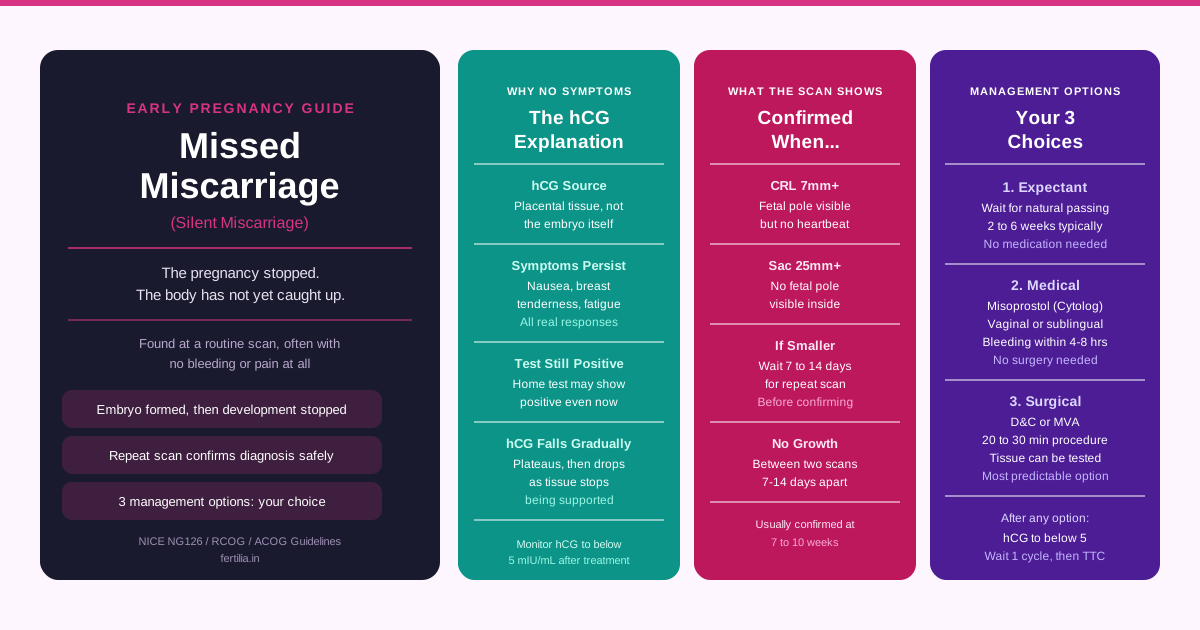
A missed miscarriage (also called a silent miscarriage) is a pregnancy loss in which the embryo has stopped developing or the heartbeat has stopped, but the body has not yet begun to pass the pregnancy tissue. There is no bleeding. No cramping. The pregnancy may still feel real, because early pregnancy symptoms can persist even after development has stopped.
This is different from a general miscarriage, where the body begins the process of loss with cramping and bleeding that alerts the woman that something is happening. In a missed miscarriage, the body has not yet registered the loss, or has not yet initiated the physical process.
It is also different from a blighted ovum, where a gestational sac forms but an embryo never develops inside it. In a missed miscarriage, the embryo did form. There was a fetal pole. In many cases there was a heartbeat on an earlier scan. What changed is that development stopped, or the heart stopped, and the body has not yet caught up.
It is different again from a chemical pregnancy, which is a very early loss that happens before any gestational sac is visible on a scan and is often mistaken for a late or heavy period.
A missed miscarriage sits in the specific window where the embryo was real and developing, and then stopped, and no external signs appeared. That is why it is found at a scan.
The term “missed abortion” appears in many Indian hospital ultrasound reports and scan results. It means the same thing. The word “abortion” in this context is a clinical term for any pregnancy loss before 20 weeks. It does not refer to a termination of pregnancy.
What the Scan Shows and How the Diagnosis Is Made
On an ultrasound, a missed miscarriage may appear in a few ways. The sonographer may see a fetal pole with no visible cardiac activity, meaning the embryo is there but there is no heartbeat. In a slightly earlier presentation, the gestational sac may have grown but the structures inside have not developed as expected. In a later loss, the embryo may appear intact, but there is no fetal movement and no heartbeat.
Because very early pregnancies are difficult to scan precisely, a missed miscarriage cannot be diagnosed from a single scan done too early. The NICE NG126 guidelines, widely followed by obstetricians across India and internationally, specify the criteria that must be met before confirming this diagnosis:
- A crown-rump length (CRL, the length of the fetal pole) of 7mm or more, with no visible fetal heartbeat
- A mean gestational sac diameter of 25mm or more, with no fetal pole visible
- A fetal pole that was visible on an earlier scan showing a heartbeat, but now shows no heartbeat on a repeat scan at least 7 to 14 days later
- A gestational sac or fetal pole that has not grown at all between two scans taken 7 to 14 days apart
If the fetal pole measures less than 7mm, or if the sac was smaller than 25mm with no fetal pole visible, a single scan is not sufficient for a confirmed diagnosis. A repeat scan after 7 to 14 days is the appropriate next step. This waiting period protects against a rare but serious error: acting on what looks like a missed miscarriage at a slightly-too-early scan, when the pregnancy may in fact be viable.
If your doctor told you to come back for a follow-up scan and you were not sure why, this is the reason. The repeat scan is not a formality. It is the diagnostic standard.
Most missed miscarriages are confirmed on scan between seven and ten weeks of pregnancy.
Why You Had No Symptoms
This is the question most women ask first. How could the pregnancy have stopped, and my body not know?
The answer lies in how early pregnancy symptoms work. The nausea, breast tenderness, fatigue, and heightened smell sensitivity you feel in early pregnancy are driven largely by human chorionic gonadotropin (hCG), the hormone that makes a pregnancy test positive. Crucially, hCG is produced by the placental tissue and the trophoblast cells surrounding the developing embryo. These cells do not stop functioning immediately when the embryo stops developing or the heartbeat stops. They continue producing hCG, sometimes for days, sometimes for weeks afterward.
This means your body is still receiving a hormonal signal that says a pregnancy is present, even though the embryo is no longer progressing. Your symptoms persist. Your home pregnancy test may still be positive. Nothing from the outside tells you anything has changed.
The hCG levels will eventually plateau and then begin to fall as the placental tissue stops being supported, but the timing varies. For some women, levels drop within a week of the embryo stopping. For others, it takes longer. This variation is part of why the body’s recognition of the loss is unpredictable.
For more on what hCG trends mean in early pregnancy, see our guide on beta hCG levels by week.
Why This Happens
Most missed miscarriages, like most early pregnancy losses, are caused by a chromosomal abnormality in the embryo. During the division of the fertilised egg, errors in how the chromosomes sort themselves can occur. The resulting embryo carries a genetic makeup that is incompatible with continued development, and the process stops.
These chromosomal errors are almost always random. They are not inherited from either parent in the vast majority of cases. They are not caused by anything you ate, felt, did, or did not do. They happen to women at every age, in every state of health, though the probability increases gradually with maternal age because older eggs have had more time for small sorting errors to accumulate.
The second category of causes is hormonal. Low progesterone levels in the early weeks of pregnancy, thyroid dysfunction that has not been diagnosed or treated, and uncontrolled blood sugar, including insulin resistance in women with PCOS, can all interfere with embryo development and early implantation. These are important because they are identifiable and, in many cases, treatable before a subsequent pregnancy. If you have had a missed miscarriage and you have a history of irregular cycles, PCOS, or thyroid concerns, this is worth raising with your doctor.
The third category is structural. A septum inside the uterus (a band of tissue dividing the cavity), submucosal fibroids in certain positions, or scar tissue from a prior procedure can affect how an embryo develops after it has implanted. These are diagnosable with a scan or a saline sonogram and, in many cases, correctable.
In most cases of a single missed miscarriage, especially in women without any of these background factors, the cause was chromosomal and random. It is not a signal that something is fundamentally wrong with your fertility.
If you have just received this diagnosis and you are not sure what your next steps should be, you can talk it through with Dr. Suganya Venkat over a video call. She works with women across India and can help you understand your options before your next hospital appointment.
Talk to Dr. Suganya on WhatsApp
Your Three Management Options
Once the diagnosis has been confirmed on scan, you do not need to decide immediately. Take the time you need to process what has happened, speak with whoever supports you, and choose the approach that suits your situation. The three options are:
Expectant Management
You wait for your body to recognise that the pregnancy has stopped developing and pass the tissue naturally. This can take anywhere from two to six weeks after the diagnosis. When it begins, you will experience bleeding that is typically heavier than a normal period, along with cramping. Some women describe it as similar to an early miscarriage with cramping.
The main limitation of expectant management is unpredictability. Some women pass the tissue within days of the diagnosis. Others wait several weeks. If nothing has happened after four to six weeks, your doctor will usually recommend moving to one of the other options. Expectant management is a reasonable choice when you want to avoid medication or a procedure and have good access to follow-up care if you need it.
Medical Management with Misoprostol
Your doctor can prescribe misoprostol (available in India as Cytolog, Misoprost, and other brands) to bring on uterine contractions that help pass the pregnancy tissue. It is administered vaginally or sublingually, and cramping and bleeding typically begin within four to eight hours. A second dose is sometimes given if the first is not sufficient.
Medical management is a middle path. It avoids a surgical procedure but gives more control over timing than waiting indefinitely for natural passage. A follow-up scan and a blood test to check that hCG is falling are needed afterward to confirm the process is complete.
Your doctor will confirm that you have no contraindications before prescribing misoprostol.
Surgical Management: D&C or MVA
A dilatation and curettage (D&C) or manual vacuum aspiration (MVA) is a short procedure, usually done under local or general anaesthesia, that removes the pregnancy tissue directly. It takes approximately twenty to thirty minutes. This is the most predictable option in terms of timing and completeness.
Surgical management is preferred when the pregnancy is further along, when earlier options have not worked, or when you want a clear endpoint. The tissue can be sent for chromosomal analysis to identify what error occurred. Not all hospitals offer this routinely, but it is worth asking if knowing the chromosomal cause matters to you.
After Management: What to Expect
Whichever route you choose, your doctor will arrange a follow-up to confirm the uterus has completely emptied, usually with a scan and a blood test to check that hCG has fallen to below five mIU/mL, the point at which it is considered undetectable.
While hCG is still clearing, a home pregnancy test will still show positive. This does not mean you are pregnant again or that the previous pregnancy is somehow continuing. It means the hormone is still leaving your system. Wait until your doctor confirms hCG has returned to below five before using a home pregnancy test as a reliable measure.
A light period usually returns four to six weeks after the pregnancy tissue has passed. The first period may be slightly heavier than usual. Subsequent cycles generally return to their normal pattern within one to two months.
Light spotting after a D&C or MVA is expected. Significant fresh red bleeding, fever above 38 degrees Celsius, or foul-smelling discharge should prompt a call to your doctor.
If you are finding the waiting period emotionally difficult, or the weeks after the loss, that is completely understandable. Our guide to coping after pregnancy loss addresses what grief after early pregnancy loss can look like and what helps.
When You Are Ready to Try Again
Most guidelines, including those from the RCOG and ACOG, suggest waiting for at least one normal menstrual period before trying to conceive again. This allows the uterine lining time to rebuild fully and provides a clear baseline for calculating dates in a new pregnancy. It is a practical recommendation rather than a mandatory physical minimum in every case.
Fertility generally returns quickly. Most women ovulate within four to six weeks of the tissue passing, and many conceive within a few cycles.
Our guide how soon to conceive after a miscarriage covers the timing question in more detail, and our complete guide to getting pregnant covers the essentials for women returning to the conception journey after a loss.
Does It Raise the Risk of Another Loss?
A single missed miscarriage does not substantially raise the risk of another one. The underlying cause was, in all likelihood, a random chromosomal event in one fertilised egg. Random events do not follow a predictable pattern.
If you have had two pregnancy losses, whether missed miscarriages, blighted ova, or a combination, that is the point at which a structured investigation becomes appropriate. Our guide to tests after recurrent pregnancy loss explains what current guidelines recommend: an antiphospholipid antibody panel, parental karyotype, uterine cavity assessment, and thyroid screen, among other tests.
After a single loss, the guidance from every major obstetric body is the same: allow one normal cycle, and then try again. One missed miscarriage alone is not a sign that something is fundamentally wrong with your fertility.
What This Is Called in Hindi
If you searched for this condition in Hindi, you may have come across the term “missed abortion” (which is widely used even in Hindi-language medical contexts in India), or phrases like “khamosh garbhpaat” (silent miscarriage) or “bina dard ke garbhpaat” (miscarriage without pain).
Many scan reports and clinical notes in India use “missed abortion” or “non-viable intrauterine pregnancy” to describe this finding. If you searched for “missed abortion ka matlab” and arrived here, that term refers to exactly what this post describes: a pregnancy that has stopped developing but has not yet passed.
The word “abortion” in all of these clinical phrases is a medical term for pregnancy loss before 20 weeks. It has nothing to do with termination of a pregnancy.
Frequently Asked Questions
Can a missed miscarriage be a misdiagnosis?
Yes, which is why the diagnosis should only be confirmed when the specific criteria are met. If the crown-rump length was less than 7mm, or the gestational sac was smaller than 25mm with no fetal pole, a single scan is not sufficient. A repeat scan after 7 to 14 days is the standard before any management decision is made. If you were given this diagnosis based on one scan without meeting these thresholds, it is reasonable and appropriate to ask for a repeat scan first.
I still feel pregnant. Does that mean the diagnosis is wrong?
No. Feeling pregnant after the diagnosis is common and has a clear explanation. Early pregnancy symptoms are driven by hCG, which is produced by the placental tissue around the embryo, not by the embryo itself. That tissue continues producing hCG for some time after the embryo stops developing, which is why nausea, breast tenderness, and fatigue may still be present. Your symptoms are a real hormonal response. They are not a sign that the scan was wrong.
How long will it take for my period to come back?
Most women have a period four to six weeks after the pregnancy tissue has passed, whether through expectant, medical, or surgical management. The first period may be slightly heavier or longer than usual. Cycles generally return to their normal pattern within one to two months.
Is a missed miscarriage the same as a blighted ovum?
No. They are related but different. A blighted ovum is a specific scenario where the gestational sac forms but an embryo never develops inside it. In a missed miscarriage, the embryo did form and may have had a heartbeat before development stopped. Both are managed the same three ways, but the underlying sequence is different.
Can I try again naturally after this?
Yes. There is no medical reason you cannot conceive naturally after a single missed miscarriage. Most guidelines suggest waiting for one normal period first, for practical dating purposes, but fertility returns quickly. If you want to talk through your situation before trying again, an online video consultation with an OB-GYN can help you build a plan.
What tests should I get after a missed miscarriage?
After a single missed miscarriage in a woman with no background history of thyroid concerns, irregular cycles, or PCOS, no additional testing is generally required before trying again. If you have those background factors, a thyroid function test and a fasting insulin/glucose check are reasonable before your next attempt. A full recurrent miscarriage panel is recommended after two or more losses.
What does “missed abortion” mean on my scan report?
Missed abortion is the older clinical term for a missed miscarriage. It means a pregnancy that has stopped developing but has not yet passed naturally. The word “abortion” is a medical term for any pregnancy loss before 20 weeks and does not refer to a termination procedure. The terms “missed miscarriage,” “missed abortion,” and “non-viable intrauterine pregnancy” all mean the same thing in this context.
If you have questions about what your scan results mean, which management option suits your situation, or how to prepare for a healthy pregnancy after this loss, Dr. Suganya Venkat is available for a video consultation. She works with women across India, and conversations like this are exactly the reason Fertilia exists.