The second line on the test appears, and her chest tightens before she can smile. She counts the weeks on her fingers, works out the exact date she lost the last pregnancy, and starts waiting for that day to pass. She has not told her mother yet. She is not sure she will tell anyone until much later. She checks her underwear every time she goes to the bathroom.
If this is you, you are not being dramatic, ungrateful or “negative”. You are a woman who has learned, from experience, that a positive test does not always end with a baby. Your mind is trying to protect you from being hurt that way again.
I am Dr. Sandhiya Loganathan, a psychiatrist (MD Psychiatry) who works with women at Fertilia over video consultations, and anxiety in a pregnancy that follows a loss is one of the most common things women bring to me. It also has some of the most practical, workable tools in perinatal mental health.
What this post covers:
- Why anxiety in a pregnancy after miscarriage is so common, and what the research shows
- How it differs from ordinary first-pregnancy nerves
- The milestone weeks that tend to be hardest, and what the numbers say about them
- Reassurance scans, home checking and the worry loop
- Coping strategies a psychiatrist uses, week by week
- When to ask for professional support
This post is about the experience of being pregnant again. If you are still deciding when it is medically safe to try, our guide on how soon you can conceive after a miscarriage covers that. If you are still in the early weeks of grief for the loss itself, start with coping after pregnancy loss.
Why a Pregnancy After Loss Feels So Different
A miscarriage changes what pregnancy means to you. Before, a positive test was the finish line. Now it is the start of a long stretch of waiting to see whether this time will be different.
This is well documented. A meta-analysis of nineteen studies, including more than 5,000 women with a previous loss, found that anxiety was significantly higher during the next pregnancy than in women without a loss, and depressive symptoms were modestly higher too (Hunter A et al., J Affect Disord, 2017, PMID 28755623). In a large UK cohort of 13,133 mothers, the number of previous miscarriages or stillbirths predicted symptoms of anxiety and depression in a subsequent pregnancy, even after accounting for other obstetric and social factors (Blackmore ER et al., Br J Psychiatry, 2011, PMID 21372060).
The loss itself often leaves a mark that has not fully faded by the time a new pregnancy begins. In a London study following women after early pregnancy loss, 24% reported moderate to severe anxiety one month afterwards, and 17% still did at nine months; 29% met screening criteria for post-traumatic stress at one month (Farren J et al., Am J Obstet Gynecol, 2020, PMID 31953115). Many women conceive again within that window, so the new pregnancy can start while the old fear is still active.
If this describes you, you are in very large company.
How This Differs From Ordinary Pregnancy Nerves
Every pregnant woman worries sometimes. Anxiety after a loss tends to have a particular shape:
| Ordinary pregnancy nerves | Anxiety in a pregnancy after loss | |
|---|---|---|
| Focus | General: labour, the baby’s health, coping as a parent | Specific: “Will I lose this one too?” |
| Timing | Builds gradually towards the due date | Often strongest early, and spikes around the week of the previous loss |
| Body checking | Occasional | Frequent: checking for blood, pressing on the breasts to see if they are still sore, testing again |
| Response to reassurance | A good scan settles it | A good scan helps for a day or two, then the worry returns |
| Attachment | Bonding grows with time | Holding back: not naming the baby, not buying anything, not telling people |
That last row deserves a word. Many women deliberately keep some emotional distance from a new pregnancy, hoping it will hurt less if something goes wrong. I hear this often in consultations, and I think of it as a protective response. It says nothing about how much she will love this baby, and for many women it loosens as the pregnancy progresses.
The Milestone Weeks
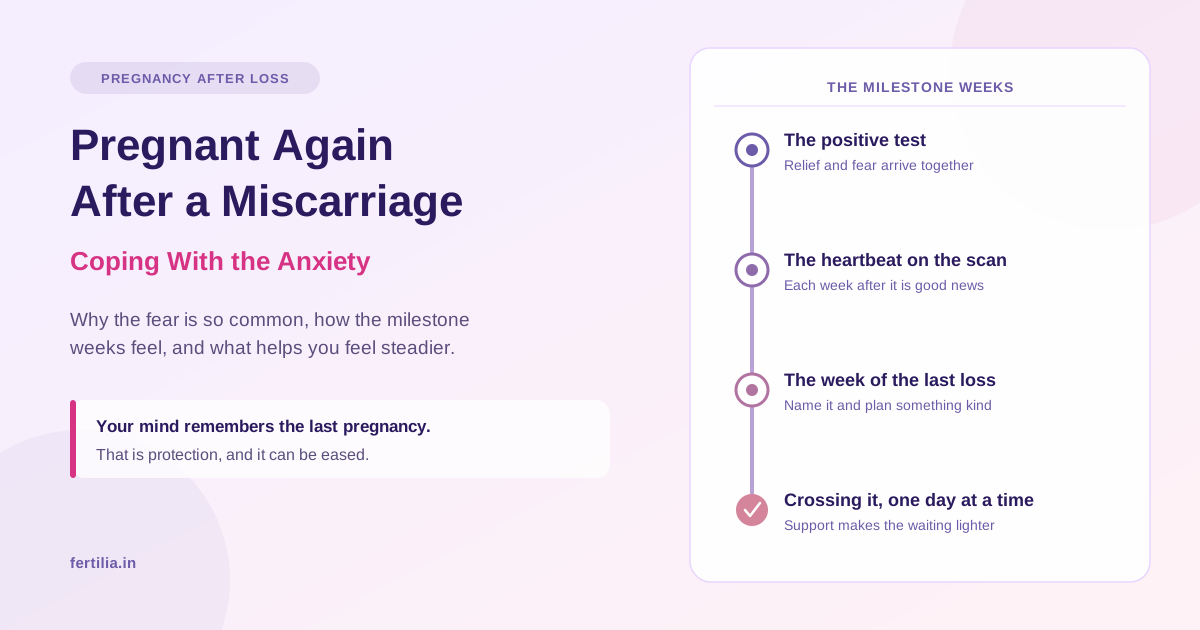
Most women can tell me the exact week they lost the last pregnancy. That week becomes a line the new pregnancy has to cross, and the days leading up to it are often the hardest of the whole first trimester.
Other common pressure points:
- The first scan. Waiting to see a sac, then a fetal pole, then a heartbeat. Our radiologist’s guide to the early pregnancy scan at 6 to 8 weeks explains what is normally visible at each week, which helps if a scan is “too early” to show everything yet.
- The heartbeat. For many women this is the first moment they let themselves breathe.
- The due date of the lost pregnancy. It can arrive in the middle of the new one and bring unexpected grief.
- Telling people. Every announcement can feel like tempting fate.
There is reassuring data about the heartbeat milestone. In a study of 697 women with no symptoms whose first antenatal visit between 6 and 11 weeks showed a heartbeat on ultrasound, only 1.6% went on to miscarry. The risk fell rapidly with advancing gestation: 9.4% when the visit was at 6 weeks, 4.2% at 7 weeks, 1.5% at 8 weeks, and under 1% at both 9 and 10 weeks (Tong S et al., Obstet Gynecol, 2008, PMID 18310375). This was a general antenatal group, not specifically women with a previous loss, so treat the numbers as a guide rather than a personal prediction. The direction, though, is clear: each week that passes with a seen heartbeat is good news.
What the Numbers Say About the Next Pregnancy
Women often carry a vague sense that one loss means the next pregnancy is likely to end the same way. The data are kinder than that fear.
Across all recognised pregnancies, the pooled risk of miscarriage is about 15% (Quenby S et al., Lancet, 2021, PMID 33915094). A large Norwegian registry study of 421,201 pregnancies found that a previous miscarriage does raise the odds of another: an age-adjusted odds ratio of 1.54 after one miscarriage, 2.21 after two and 3.97 after three consecutive losses (Magnus MC et al., BMJ, 2019, PMID 30894356). The authors describe this as a strong pattern of recurrence, and it is real. It also helps to see it from the other side: even with a raised risk after a single loss, most next pregnancies continue. Age matters a great deal too; in the same study, the risk was lowest in women aged 25 to 29.
Most first-trimester miscarriages happen because of a chromosomal error in the embryo, which is explained in our guide to miscarriage causes, signs and recovery. If you have had two or more losses, investigation is worth discussing, ideally before the next pregnancy; Dr. Suganya Venkat’s guide to the tests worth doing after two losses walks through them.
Reassurance Scans, Home Checking and the Worry Loop
When anxiety is high, the urge to check is strong: another pregnancy test to see if the line is darker, another look for spotting, a request for an extra scan, hours of reading other women’s stories online at night.
Each check brings a few minutes or a few days of relief. Then the worry returns, often stronger, because the brain has learned that checking is what makes the fear go away. This is the same loop we see in health anxiety, and it explains why one more scan rarely settles the fear for long.
This does not mean you should refuse scans or ignore your body. A practical middle path:
- Agree a scan and visit plan with your obstetrician early. Tell her about your previous loss and ask when your first scan will be. Knowing the dates in advance replaces “should I ask for another one?” with “my next check is on the 14th”.
- Agree what needs a same-day call. Ask your obstetrician which symptoms (for example, bleeding or significant pain) mean you should call that day. Write the list down. Anything on the list, you call without hesitating. No list can cover everything, so if something new worries you and it is not on the list, call anyway. Heavy bleeding, severe abdominal pain or fainting need to be seen straight away at the nearest hospital, not saved for the next visit.
- Ask before buying a home doppler. Talk it through with your obstetrician first. For some women it becomes another round of checking rather than a source of calm.
- Limit the night-time reading. Many forum stories are written in someone’s hardest moment, which makes them feel more common than they are.
💬 Pregnant again after a loss and finding it hard to settle? You can talk it through with Dr. Sandhiya over a ₹399 online video consultation, from anywhere in India. Message Fertilia on WhatsApp and tell us a little about where you are.
What Helps: Coping Strategies a Psychiatrist Uses
These are the strategies I use most often with women in this situation. Not all of them will suit you. Pick two or three and try them for a couple of weeks.
1. Name the fear and the week. Saying out loud, “I am scared because this is week 8, and week 8 is when I lost the last one,” takes some of the power out of a vague, constant dread. Write the week of your previous loss in your calendar, and plan something kind for yourself on that day.
2. Set a daily worry window. Give the worry 15 minutes at a fixed time each evening. When a fear comes up during the day, jot it down and postpone it to the window. Many women find that by evening the list has shrunk.
3. Notice the “what if” and answer it with “what now”. Anxiety lives in the future. When you catch yourself in a “what if this happens again” spiral, bring yourself back to what is true today: “Today I am pregnant. Today my scan date is set. Today I can eat lunch and rest.”
4. Use your body to calm your body. Slow breathing, with the out-breath longer than the in-breath, for two or three minutes, can help settle the physical surge of panic. Gentle walking helps too, if your obstetrician is happy for you to stay active.
5. Decide who you tell, on your terms. There is no rule about waiting until 12 weeks. Some women want a few trusted people to know early, so that if something happens they are not alone. Others prefer privacy. Choose what supports you, even if the family expects something else.
6. Let attachment grow at its own pace. You do not have to force excitement. It is fine to say “if all goes well” for a while, and it is fine when that phrase quietly drops away.
7. Include your partner. Partners grieve and worry too, often silently. Talk about the milestone weeks together and agree how you will support each other on the hard days.
8. Consider structured therapy. Cognitive behavioural therapy (CBT) has good evidence for anxiety in pregnancy. In a randomised trial of 96 pregnant and postpartum women with anxiety disorders, group CBT reduced anxiety and worry significantly more than a waitlist, and the gains held at three-month follow-up (Green SM et al., Aust N Z J Psychiatry, 2020, PMID 31957479). Support designed specifically for pregnancy after loss may help too: in a small randomised study of a caring, home-visit programme for women pregnant after a perinatal loss, women valued being listened to by someone who knew their story, reported higher satisfaction with social support, and felt better able to manage their own anxiety (Côté-Arsenault D et al., MCN Am J Matern Child Nurs, 2014, PMID 24472794).
Sometimes medication is also appropriate in pregnancy. That decision is made with your psychiatrist and your obstetrician together, weighing your specific situation, and it should never be started or stopped on your own.
“Will My Worry Harm the Baby?”
Almost every woman I see asks this, usually quietly, near the end of the consultation.
Large reviews do list stress among the factors associated with miscarriage in population data (Quenby S et al., Lancet, 2021, PMID 33915094). That kind of association cannot tell us that feeling anxious ends a pregnancy, and the commonest cause of early loss remains a chromosomal error in the embryo, which no thought or feeling of yours creates.
Please do not add guilt about worrying to the worry itself. The reason to treat this anxiety is simpler: you deserve to feel steadier during these months. That is reason enough.
When to Ask for Professional Support
Reach out to a psychiatrist or mental health professional if:
- The anxiety is present most of the day, most days, for two weeks or more
- You are not sleeping, or not eating well, because of it
- Panic attacks are happening
- You are avoiding antenatal appointments because they feel unbearable
- You have flashbacks or nightmares about the previous loss
- Low mood, hopelessness or tearfulness are taking over alongside the worry
You do not need to wait until it is severe. Support is usually easier to start, and to benefit from, earlier rather than later.
If you have thoughts of harming yourself, or feel unable to stay safe, call India’s emergency number 112 or go to the nearest emergency department, and ask someone you trust to stay with you. For mental health support at any hour, Tele-MANAS, the government’s national mental health helpline, can be reached free on 14416 or 1800-89-14416 (dghs.mohfw.gov.in).
After the Birth
For some women the anxiety melts away once the baby is in their arms. For others it continues, or changes shape. The ALSPAC cohort study found that anxiety and depression linked to a previous loss did not fade significantly after the birth of a healthy child (Blackmore ER et al., Br J Psychiatry, 2011, PMID 21372060). If you notice that you cannot stop checking on the baby, or the “something will go wrong” feeling has simply moved from the pregnancy to the newborn, read our guide to postpartum anxiety and mention it at your postnatal check. It is common, and it is treatable.
Frequently Asked Questions
1. Is it normal to feel anxious when pregnant again after a miscarriage?
Yes. A meta-analysis of nineteen studies found anxiety is significantly higher in pregnancies following a perinatal loss than in pregnancies without one. Feeling scared, holding back excitement and counting the weeks are common responses, not signs that something is wrong with you.
2. When does the anxiety usually ease?
For many women it eases in steps: after the heartbeat is seen, after the week of the previous loss has passed, after the end of the first trimester, and again once fetal movements are felt regularly. For some it continues throughout the pregnancy or into the postpartum period. If it is not easing, support helps.
3. Can anxiety or stress cause another miscarriage?
Most early miscarriages happen because of a chromosomal error in the embryo. Stress appears among the factors associated with miscarriage in population studies, but that does not mean your worry can end a pregnancy. The reason to treat the anxiety is that you deserve to feel better.
4. What are the chances of a healthy pregnancy after one miscarriage?
Good. Around 15% of recognised pregnancies end in miscarriage overall. A previous loss does raise the odds of another (an age-adjusted odds ratio of 1.54 after one miscarriage in a Norwegian study of 421,201 pregnancies), but most pregnancies after one loss still continue. Your age matters too. After two or more losses, investigation is worth discussing with your gynaecologist.
5. Should I ask for extra scans to feel reassured?
Ask your obstetrician when your first scan will be and why. Beyond that, agreeing a scan schedule in advance usually helps more than adding scans whenever anxiety peaks, because the relief from an unplanned extra scan tends to fade within days.
6. I feel guilty for not being excited. Is something wrong with me?
No. Holding back emotionally in a pregnancy after loss, sometimes described as guarded attachment, is a common protective response. It does not mean you love this baby less, and for many women it softens as the pregnancy progresses. You do not have to force happiness.
7. Is a “rainbow baby” pregnancy treated differently by doctors?
“Rainbow baby” is the popular term for a baby born after a loss. Medically, your obstetric care depends on the cause and number of previous losses. After a single miscarriage, antenatal care is often routine. Your emotional history matters too, so tell your obstetrician how you are feeling so the plan can include support.
You Do Not Have to Hold This Alone
A pregnancy after a loss asks you to hope and to protect yourself at the same time. That is exhausting, and you do not have to manage it by yourself.
If you would like to talk through what you are feeling, message Fertilia on WhatsApp to book a ₹399 online video consultation with Dr. Sandhiya. You can tell us your story in your own words, and we will take it from there.