The report says “right tube not visualised” or “bilateral tubal block,” and suddenly a word you had never thought about sits at the centre of your fertility plan. Many women who message me after an HSG ask the same two things: is this certain, and does this mean IVF straight away?
I’m Dr. Suganya Venkat, an OB-GYN with more than fifteen years of practice, and tubal results come up in Fertilia’s online consultations almost every week. The good news is that “tubal factor” is not one diagnosis with one answer. It is a group of findings, and the right next step depends on which tube, where the block is, how sure the test is, and what else is going on in your workup.
Here is what this post covers:
- What tubal factor infertility means, and what usually causes it
- How it is diagnosed, and why one test is rarely the final word
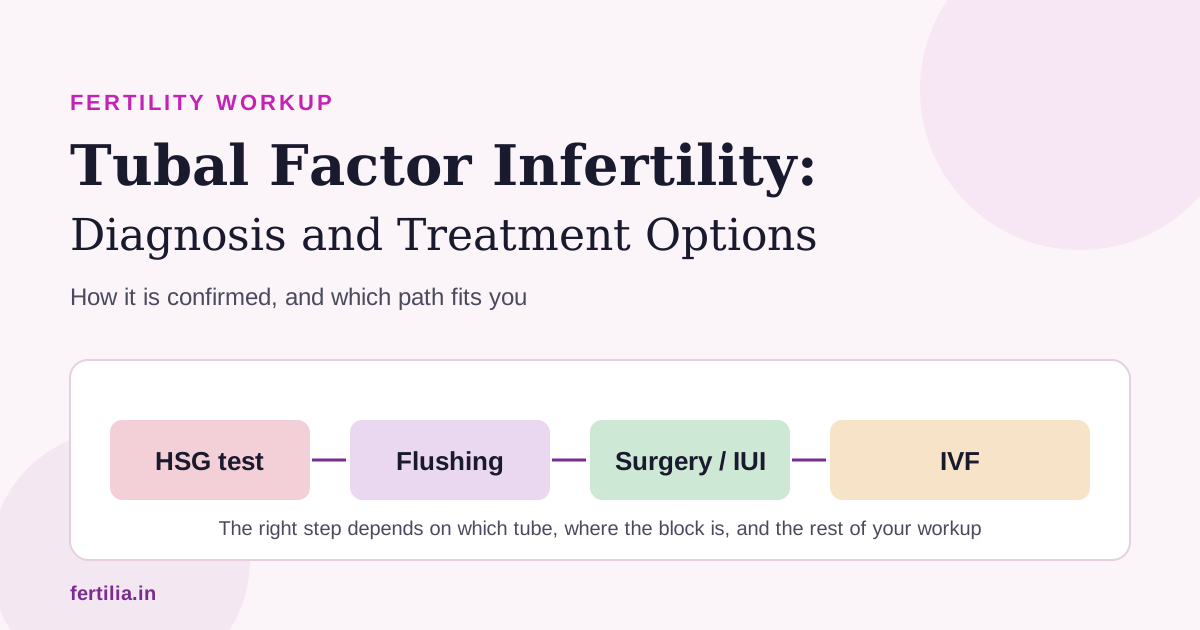
- The treatment options: tubal flushing, surgery, IUI and IVF
- How to match the option to your situation
- What you can do this month
What Tubal Factor Infertility Means
The fallopian tubes do three jobs. Their fringed ends (the fimbriae) pick up the egg after ovulation, the inside of the tube is where sperm meet the egg, and the tube then carries the early embryo to the uterus over a few days. If a tube is blocked, scarred, stuck down by adhesions, or filled with fluid, any of those steps can fail.
Tubal disease is common in a fertility workup. A 2020 Cochrane review states that it accounts for about 20% of infertility cases (Melo P et al., Cochrane Database Syst Rev, 2020, PMID 33091963).
Doctors usually describe the problem by its location:
- Proximal block: near the uterus, where the tube enters it. Sometimes this is a true block from scarring, and sometimes it is a temporary spasm of the tube muscle or a small plug of mucus during the test.
- Distal block: at the far, fringed end. When the end seals and fluid collects behind it, the tube swells into a hydrosalpinx. This is the form that most often changes a treatment plan, and our hydrosalpinx guide covers it in depth.
- Peritubal adhesions: the tube may be open inside but tethered by bands of scar tissue on the outside, which stops it from moving freely to catch the egg.
Common causes
- Past pelvic infection, including chlamydia or gonorrhoea, which can heal with scarring and often caused no symptoms at the time. Our guide to pelvic inflammatory disease explains this pathway.
- Genital tuberculosis, which is particularly relevant in India and is often silent. See our post on genital TB and infertility.
- Endometriosis, which can cause adhesions around the tubes and ovaries.
- Previous abdominal or pelvic surgery, such as an appendix operation, a caesarean, or surgery for an ectopic pregnancy.
- A previous tubal ligation (tubectomy), which is a deliberate block.
Most women with tubal disease feel nothing unusual. Periods are regular, ovulation is normal, and the only sign is that pregnancy has not happened. For more on causes and signs, read our overview of blocked fallopian tubes.
How Tubal Factor Is Diagnosed
There is no blood test that shows the tubes are open. Tubal assessment needs a test that pushes fluid through the uterus and watches where it goes.
HSG (hysterosalpingography)
An HSG is an X-ray test. Contrast dye is passed gently through the cervix, and images show whether it fills the uterus, flows along each tube, and spills out at the ends. It is usually scheduled after your period ends and before ovulation, to lower the chance of an early pregnancy, and your doctor may ask for a pregnancy test first if there is any doubt. If you are anxious about it, our guide on what an HSG feels like walks you through the day, and our HSG report walkthrough explains the wording you will see.
HyCoSy and HyFoSy
These are ultrasound versions of the same idea, using a foam or contrast solution instead of X-ray dye. There is no radiation, and the scan can look at the ovaries and uterus at the same time. Dr. Rajashree NS, our consultant radiologist, compares the two in HyCoSy vs HSG.
Laparoscopy with dye test
A diagnostic laparoscopy is a keyhole procedure under anaesthesia. Blue dye is passed through the cervix while the surgeon looks directly at the tubes, so it shows not only whether the tubes are open but also adhesions and endometriosis that an X-ray cannot see. Because it is surgery, it is usually kept for women whose history or scan suggests something needs to be seen and treated in the same sitting. Our diagnostic laparoscopy guide explains when it is offered.
Why one blocked result often needs a second look
A tube that does not fill on HSG is not always a blocked tube. A common reason for a false “block” is spasm at the point where the tube joins the uterus, and this usually affects the proximal end on one side. A result that shows one tube open and the other “not visualised near the uterus” is therefore different from one showing a swollen, fluid-filled tube at the far end. Your doctor will usually weigh the HSG against your history, your scan, and sometimes a second test before deciding the tube is truly closed.
Got an HSG report you are not sure how to read? You can go through it with Dr. Suganya Venkat over a video consultation, from anywhere in India. WhatsApp Dr. Suganya to book a ₹399 online consultation (US $20 if you are consulting from outside India).
Treatment Option 1: Tubal Flushing
Doctors noticed long ago that some women conceived in the months right after an HSG, as if the test itself had helped. This has now been studied properly.
In a Dutch trial of 1,119 infertile women having HSG, 39.7% of those whose test used oil-based contrast had an ongoing pregnancy within six months, compared with 29.1% of those given water-based contrast (Dreyer K et al., N Engl J Med, 2017, PMID 28520519). A 2020 Cochrane review of 15 trials and 3,864 women found that flushing with oil-based contrast may increase live birth compared with no flushing, while rating the evidence as low quality (Wang R et al., Cochrane Database Syst Rev, 2020, PMID 33053612).
What this means for you in practice:
- If your HSG showed open tubes, the few months after the test are a reasonable time to keep trying naturally or with simple treatment.
- Flushing is a test that may also help. It is not a treatment for a tube that is truly scarred shut.
- The choice of contrast is a decision for your radiologist and gynaecologist, based on what is available and suitable for you.
Treatment Option 2: Surgery on the Tubes
Surgery for tubal disease has two quite different purposes.
Surgery to open or repair the tube
For a proximal block, a fine catheter can sometimes be passed into the tube under X-ray or hysteroscopic guidance to clear it. For adhesions around the tube, they can be released at laparoscopy. For a sealed distal end, a surgeon can try to open it. These approaches can help selected women, especially when the damage is mild and the rest of the fertility workup is normal. The evidence on how well they work comes mostly from smaller studies, and tubes repaired after severe damage carry a higher chance of ectopic pregnancy, so a surgeon will talk through your specific findings before advising it.
Surgery before IVF, when a hydrosalpinx is present
This is where the evidence is strongest. Fluid from a hydrosalpinx can leak back into the uterus and lower the chance that an IVF embryo implants. A 2020 Cochrane review found moderate-quality evidence that removing the affected tube (salpingectomy) before IVF probably increases the clinical pregnancy rate compared with no surgery in women with hydrosalpinges, and that blocking the tube near the uterus may also help (Melo P et al., Cochrane Database Syst Rev, 2020, PMID 33091963). The same review notes that none of the included trials reported long-term fertility outcomes and that better trials are still needed. Your IVF specialist will discuss whether this applies to you, and which procedure suits your situation.
Treatment Option 3: IUI When at Least One Tube Is Open
IUI (intrauterine insemination) places washed sperm in the uterus around ovulation. The sperm still have to travel up a tube to meet the egg, so IUI only makes sense if at least one tube is open and healthy.
IUI can be a reasonable option when:
- One tube is open and the other is blocked near the uterus, with no hydrosalpinx
- Ovulation can be timed or supported on the open side
- Sperm count is adequate for IUI
- You are younger and egg reserve is good
When one tube is open, many women conceive naturally or with simple support first. Our post on conceiving with one blocked tube covers the realistic timelines, and our IUI success rate guide explains what to expect from each cycle.
IUI is generally not useful when both tubes are blocked, because the sperm have nowhere to go.
Treatment Option 4: IVF
IVF bypasses the tubes completely. Eggs are collected from the ovaries, fertilised in the laboratory, and the embryo is placed directly in the uterus. For this reason IVF is the main treatment when:
- Both tubes are confirmed blocked or badly damaged
- Tubal disease is combined with other factors, such as low egg reserve, older age, or a low sperm count
- Tubal surgery has been done and pregnancy has not followed after a reasonable time
- There has been a previous ectopic pregnancy and the remaining tube is damaged
If a hydrosalpinx is present, it is usually dealt with before embryo transfer, as described above. Our guide to IVF costs in India can help you plan.
Matching the Option to Your Situation
Every plan is individual, but this is roughly how the decision tends to look in practice:
| Your finding | Usual first discussion |
|---|---|
| Both tubes open on HSG, other tests normal | Keep trying for a few months after the test, then review |
| One tube blocked near the uterus, other open | Recheck if spasm is likely; natural attempts or IUI on the open side |
| One hydrosalpinx, other tube open | Discuss surgery for the swollen tube, then natural attempts or IVF |
| Both tubes blocked near the uterus | Confirm with a second test; consider tubal cannulation or IVF |
| Both tubes damaged at the far ends, or hydrosalpinges | IVF, usually after treating the hydrosalpinges |
| Tubal finding plus low egg reserve or age over 37 | Move to IVF sooner rather than spending time on surgery |
Two other things shape every plan. Age and egg reserve decide how much time it is sensible to spend on less intensive options. And if genital TB or an active infection is suspected, that is treated first, before any fertility procedure.
What You Can Do This Month
- Gather your reports. The HSG images and the written report, any scans, your AMH and thyroid results, and your partner’s semen analysis. The decision is much clearer when everything is seen together.
- Ask where the block is. Near the uterus, at the far end, or with fluid in the tube are three different conversations.
- Ask whether a second test makes sense if only one tube failed to fill and the rest looked normal.
- Check your partner’s semen analysis is recent. It decides whether IUI is even an option.
- Look after the basics. Regular, balanced Indian meals, steady sleep, and not smoking support your overall reproductive health while you plan, alongside whatever treatment your doctor advises.
If you are working with an IVF centre or a gynaecologist already, these are good questions to take to them. Getting a second opinion is not a judgement on anyone’s care; it simply helps you feel sure of the next step.
What It Is Called in Tamil and Hindi
Many women in Tamil Nadu simply say “tube block” when talking about this, and the English words appear on almost every report. In Hindi-speaking homes, you may hear “nali band hona” or “fallopian tube band” (the tube being closed). These are everyday Roman transliterations; whichever words you use, the tests and options above are the same.
Frequently Asked Questions
Can tubal factor infertility be treated without IVF?
Often, yes. If one tube is open, many women conceive naturally or with IUI. A proximal block may be caused by spasm, or may be cleared with a catheter, and adhesions can sometimes be released at laparoscopy. IVF becomes the main option when both tubes are confirmed blocked or badly damaged, or when other fertility factors are also present.
Tube block hai to pregnancy ho sakti hai? (Can I get pregnant with a tube block?)
If one tube is open and healthy, natural pregnancy is possible, because an open tube can pick up an egg from either ovary. If both tubes are blocked, the egg and sperm cannot meet naturally, and IVF is usually the treatment.
Is an HSG result always accurate?
HSG is a good screening test, but a tube near the uterus can look blocked because of a temporary spasm. When only one tube fails to fill near the uterus and everything else looks normal, your doctor may suggest a second test such as HyCoSy or a laparoscopy before treating it as a true block.
Does an HSG improve the chance of pregnancy?
It may. In a large trial, women whose HSG used oil-based contrast had higher ongoing pregnancy rates in the following six months than those given water-based contrast. This applies to women whose tubes are open; flushing does not open a tube that is scarred shut.
Do I need my tube removed before IVF?
Usually only if there is a hydrosalpinx, a tube swollen with fluid, which is the most common reason to consider it; any other reason needs an individual assessment by your IVF specialist. In women with hydrosalpinges, a Cochrane review found that removing the affected tube before IVF probably increases the clinical pregnancy rate compared with no surgery, and that blocking the tube near the uterus may increase it, based on low-quality evidence. No trial in the review reported live birth for either procedure compared with no surgery (Melo P et al., Cochrane Database Syst Rev, 2020, PMID 33091963). A tube that is simply blocked without fluid usually does not need surgery before IVF.
Can IUI work with one blocked tube?
Yes, if the other tube is open and healthy and there is no hydrosalpinx. IUI places sperm in the uterus, and they still need a working tube to meet the egg, so it is timed to ovulation. It is not useful if both tubes are blocked.
What causes blocked fallopian tubes in India?
The common causes are past pelvic infections such as chlamydia, genital tuberculosis, endometriosis, and previous pelvic or abdominal surgery. Many of these leave no symptoms, which is why tubal problems are usually found during a fertility workup rather than earlier.
Talk to Dr. Suganya
If you have a tubal finding on your report and you are not sure whether the next step is another test, surgery, IUI or IVF, one consultation can help you see the whole picture. Dr. Suganya Venkat consults online, by video call, with women across India and abroad, and works alongside your gynaecologist or IVF centre.
WhatsApp Dr. Suganya to book a ₹399 online consultation (US $20 from outside India).
You can also download our free guide to getting pregnant for the full preconception checklist.