You have been trying to conceive for a while, the first blood tests and scans are done, and now the prescription says “tubal patency test.” One friend had an HSG and remembers the cramping. A cousin had something called a HyCoSy at a scan centre and says it was easier. Your doctor mentions both and asks whether you have a preference. How are you supposed to choose between two tests you had never heard of last month?
I’m Dr. Rajashree NS, a consultant radiologist, and this is a question I hear from women on the scan table almost every week. Both tests answer the same core question: are your fallopian tubes open? They get there in different ways, and those differences matter for comfort, for what else the test can show, and for what happens next. This guide lays the two side by side so you can have a clearer conversation with your gynaecologist.
What this post covers:
- What HSG and HyCoSy are, in plain language
- How accurate each one is for detecting blocked tubes
- Pain, radiation, contrast and the time each test takes
- What each test can miss, and when one suits you better
- What to ask before booking, and what a tubal result changes
Two Tests, One Question
The fallopian tubes carry the egg from the ovary towards the uterus, and they are where sperm and egg usually meet. A blocked tube cannot be seen on an ordinary pelvic scan, so testing means pushing a fluid gently through the cervix into the uterus and watching whether it flows out through the ends of the tubes.
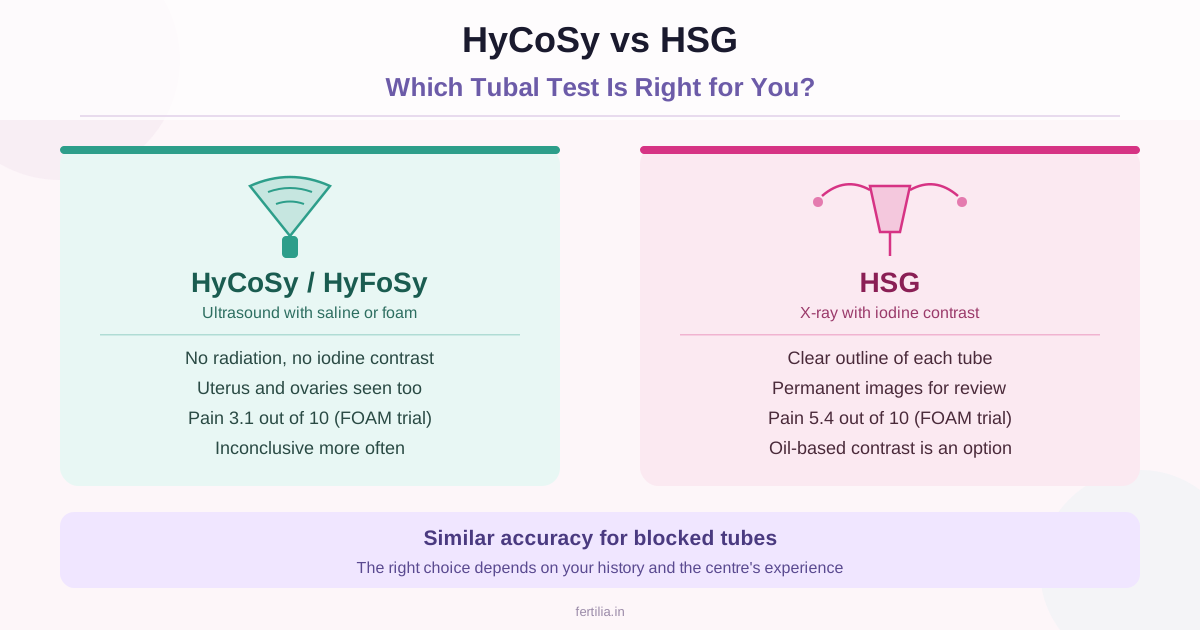
HSG (hysterosalpingography) is an X-ray test. A thin catheter is placed in the cervix, an iodine-based contrast dye is injected, and a few X-ray images are taken as the dye fills the uterine cavity and travels along each tube. If the dye spills freely from the far end of a tube, that tube is open. Our guide on how to read your HSG report explains each phrase you will see on the result.
HyCoSy (hystero-salpingo contrast sonography) uses ultrasound instead of X-ray. After a routine transvaginal scan, a thin catheter is placed in the cervix and an ultrasound-visible fluid is infused while the radiologist follows its path through each tube on the screen. When the fluid used is a gel foam, the test is called HyFoSy (hystero-salpingo foam sonography). In many Indian centres you will also see the older name sonosalpingography (SSG), which usually refers to a saline-based version of the same idea.
Neither test needs anaesthesia, both are done as outpatient procedures, and both are usually scheduled in the same part of the cycle (more on that below).
How Accurate Is Each Test?
This is the first thing most women ask, and the research is reassuring.
A systematic review compared ultrasound tubal testing against laparoscopy with dye (the surgical reference standard) across 28 studies covering 1,551 women. Ultrasound testing correctly identified 92 percent of blocked tubes and correctly cleared 95 percent of open ones. In the nine studies where the same women had both tests, the two performed almost identically: 95 and 93 percent for the ultrasound test, 94 and 92 percent for HSG (Maheux-Lacroix S et al., Hum Reprod, 2014, PMID 24578476). The same review found that using Doppler during the ultrasound test improved its accuracy, which is a useful detail to ask about when you book.
The largest head-to-head trial is the Dutch FOAM study. More than 1,000 women had both HyFoSy and HSG in random order. The results agreed in 73 percent of women. When the two disagreed, women were assigned to treatment based on one test or the other, and the overall live birth estimate within 12 months was 46 percent with HyFoSy-based management against 47 percent with HSG-based management (van Welie N et al., Hum Reprod, 2022, PMID 35220432). The trial was designed to prove HyFoSy was no worse within a strict 2 percent margin and fell just short of proving that statistically, so the fair summary is that outcomes were similar, without one test clearly ahead.
One difference from the same trial is worth knowing: HyFoSy was inconclusive in 9.5 percent of women, compared with 2.9 percent for HSG. An inconclusive test is not a bad result; it simply means the images did not answer the question clearly, and a second test may be needed.
Pain, Radiation and Time
Pain. This is where HyCoSy has the clearest advantage. In the FOAM trial, women rated HyFoSy at an average of 3.1 out of 10 for pain, against 5.4 out of 10 for HSG. An earlier, smaller randomised trial found the same direction, with HyFoSy also taking a median of 5 minutes against 12.5 minutes for HSG (Dreyer K et al., Fertil Steril, 2014, PMID 24996498). Most women describe both tests as period-like cramping that settles soon after the fluid stops, and experiences vary a lot from person to person. Your clinic may suggest a simple pain reliever beforehand; confirm this with whoever ordered the test.
Radiation. HSG uses a small dose of X-ray radiation, kept low by taking only the images needed. HyCoSy uses no radiation at all, because ultrasound is sound waves. For most women the HSG dose is not a reason to avoid it, but some prefer a radiation-free option, and that is a reasonable preference to share with your doctor.
Contrast. HSG uses iodine-based contrast. If you have had a reaction to iodine contrast before (for example during a CT scan), tell your doctor, because this makes an ultrasound-based test the simpler choice. HyCoSy uses saline, a foam gel or an ultrasound contrast agent, none of which contain iodine.
Setting. HSG needs an X-ray room with fluoroscopy, usually in a hospital radiology department or a large diagnostic centre. HyCoSy is done in an ultrasound room and is increasingly offered at fertility clinics and scan centres, though the experience of the person doing it varies more from centre to centre.
If you are weighing these two tests right now and would like someone to look at your history and earlier reports with you, a short consultation can help you walk into the test with a clear plan.
Dr. Suganya Venkat is available online, pan-India, for a Rs. 399 video consultation at Fertilia. You can share your scan reports directly in the conversation.
What Each Test Can See That the Other Cannot
HyCoSy shows more of the pelvis in the same sitting. Because it begins with a full transvaginal scan, the same appointment looks at the uterus, the ovaries and the lining as well as the tubes. Fibroids, ovarian cysts and the shape of the cavity can all be assessed without a separate visit. For a woman early in her workup, that is a practical advantage.
HSG gives a clearer picture of the tube’s outline. The X-ray image traces the full length of each tube, so it can show where along the tube a blockage sits, whether the far end is swollen with fluid (a hydrosalpinx), and irregularities in the tube wall. The images are also a permanent record that another doctor can review later. HyCoSy shows flow in real time, and its accuracy depends more heavily on the skill of the operator.
Both can mistake a temporary spasm for a block. The muscle where the tube meets the uterus can tighten during the test and stop the fluid passing, which looks like a blockage at the uterine end. This is why a single “proximal block” result is often rechecked before any decision is made, as our HSG report guide explains in its section on spasm versus true block.
Neither test shows endometriosis or pelvic adhesions. Endometriosis on the surface of the pelvis and adhesions around the tubes and ovaries cannot be seen on HSG or HyCoSy. When your history points that way, a diagnostic laparoscopy is the test that looks directly.
Does the Contrast Itself Help Fertility?
You may read that some women conceive soon after an HSG. There is good trial evidence behind this, but it depends on the type of contrast. In the H2Oil trial of 1,119 infertile women, those whose HSG used an oil-based contrast had an ongoing pregnancy rate of 39.7 percent within six months, against 29.1 percent with water-based contrast, and rates of adverse events were low and similar in both groups (Dreyer K et al., N Engl J Med, 2017, PMID 28520519).
This finding applies to oil-based contrast during HSG specifically. The trial compared oil with water-based contrast; it did not test the foam or saline used for HyCoSy, so it tells us nothing either way about them. If this matters to you, ask the centre which contrast they use and whether oil-based contrast is suitable for you; your gynaecologist will weigh it against your history.
Which Test May Suit You
There is no single right answer for every woman. These are the situations where one test tends to fit better, to discuss with your doctor.
HyCoSy may suit you if:
- You want to avoid radiation or have a history of reaction to iodine contrast
- You would like the uterus and ovaries checked in the same appointment
- You are anxious about pain and the centre has an experienced HyCoSy operator
- This is your first tubal test and nothing in your history suggests tubal damage
HSG may suit you if:
- A HyCoSy was inconclusive, or a previous result needs a clearer picture
- Your doctor suspects a hydrosalpinx or wants to see the shape of the tubes, for example after a pelvic infection or earlier tubal surgery
- Your doctor wants to consider oil-based contrast
- There is no centre near you with experience in HyCoSy
A laparoscopy may be discussed instead if your symptoms suggest endometriosis, you have had significant pelvic surgery or infection, or you are already planning surgery for another reason, so the tubes can be checked at the same time.
At Fertilia, Dr. Rajashree NS, consultant radiologist, reads tubal test reports alongside the rest of a woman’s scans, so the tubal result is never interpreted on its own.
Before You Book: Questions to Ask
Which exact test is it? “Sonosalpingography” can mean different things at different centres. Ask whether the report will comment on each tube separately. A saline scan that only checks whether fluid collects behind the uterus can show that at least one tube is open, without saying which.
Will Doppler be used? For an ultrasound-based tubal test, Doppler improves accuracy, so it is a fair question.
What does the price include? HyCoSy pricing varies widely between centres, depending on the contrast or foam used and whether a consultation is bundled. For HSG, our HSG cost guide breaks down government, diagnostic centre and fertility clinic prices. In both cases, confirm whether the radiologist’s written report is included.
When in my cycle? Both tests are usually done after your period has fully stopped and before ovulation, roughly day 6 to day 11 of the cycle. This keeps the lining thin for clearer images and avoids testing when an early pregnancy could be present.
When is the test postponed? If pregnancy is possible, if you have signs of a pelvic infection such as fever or unusual discharge, or during heavy bleeding. Contact the centre if you develop fever, worsening pain or foul-smelling discharge in the days afterwards, though this is uncommon.
What a Tubal Result Changes
Both tubes open. Your doctor moves on to the other parts of the workup, such as ovulation, the semen analysis and the uterine cavity. For many couples, this result supports continuing to try naturally or with simpler treatments first.
One tube blocked. This often still leaves room to conceive naturally, depending on your age, the cause of the block and the rest of your workup. Our guide on conceiving naturally with one blocked tube covers how that decision is made.
Both tubes appear blocked. A first result like this is usually confirmed, either by repeating the test, using the other test, or with laparoscopy, before any decision about IVF is made. Our guide to blocked fallopian tubes explains causes and treatment options.
Inconclusive. The test did not answer the question clearly. This is common enough with ultrasound-based testing that it should not alarm you; the usual next step is the other test.
If your report has already come back and the wording is unclear, you do not have to wait for your next clinic appointment to understand it.
Talk to Dr. Suganya Venkat over a video consultation, pan-India, at Fertilia.
Frequently Asked Questions
Is HyCoSy better than HSG?
For detecting blocked tubes, the two are similarly accurate. HyCoSy is less painful on average, uses no radiation or iodine contrast, and checks the uterus and ovaries in the same sitting. HSG gives a clearer outline of the tubes, is less often inconclusive, and can be done with oil-based contrast. Which is better for you depends on your history and the experience of the centre.
Is HyCoSy painful?
Most women feel period-like cramping during the fluid infusion that settles quickly. In a large Dutch trial, women rated HyFoSy at an average of 3.1 out of 10 for pain, compared with 5.4 out of 10 for HSG.
What is the difference between HyCoSy, HyFoSy and SSG?
All three are ultrasound-based tubal tests. HyCoSy is the general name, HyFoSy is the version that uses a foam gel, and SSG (sonosalpingography) is a term widely used in India, often for a saline-based version. Ask whether your report will describe each tube separately.
Does HSG involve radiation?
Yes, a small dose of X-ray radiation, kept low by taking only the images needed. HyCoSy uses ultrasound and involves no radiation. HSG also uses iodine-based contrast, so mention any previous contrast reaction before booking.
Can I get pregnant after an HSG or HyCoSy?
Many women do conceive in the months after a tubal test. In one large trial, HSG with oil-based contrast was followed by a higher pregnancy rate than HSG with water-based contrast. That trial did not test the foam or saline used in HyCoSy.
When in my cycle should the tubal test be done?
Usually after your period has fully stopped and before ovulation, roughly day 6 to day 11 of the cycle. Your clinic will confirm the exact day.
What happens if my HyCoSy result is inconclusive?
The images did not answer the question clearly, which happened in about one in ten women in the largest trial. The usual next step is an HSG or a repeat test, and an inconclusive result does not mean your tubes are blocked.
Choosing between HyCoSy and HSG is easier when you know what each test does and what your own history points towards. If you would like help with that decision or with a report you already have, Dr. Suganya Venkat is available online for a Rs. 399 video consultation, pan-India, at Fertilia. Start the conversation on WhatsApp.
For the complete guide to fertility testing and getting pregnant, download the free Getting Pregnant guide.
Dr. Rajashree NS is a Consultant Radiologist with an MD in Radio-diagnosis from Sree Mookambika Institute of Medical Sciences. She interprets pelvic and fertility ultrasound reports as part of the Fertilia Health team.