You have been told you need an HSG, and the first thing you typed into your phone was “is HSG painful?” That is one of the most common questions I am asked before this test, and it is a fair one. Many women walk in having heard a friend’s story and expecting the worst.
The short answer:
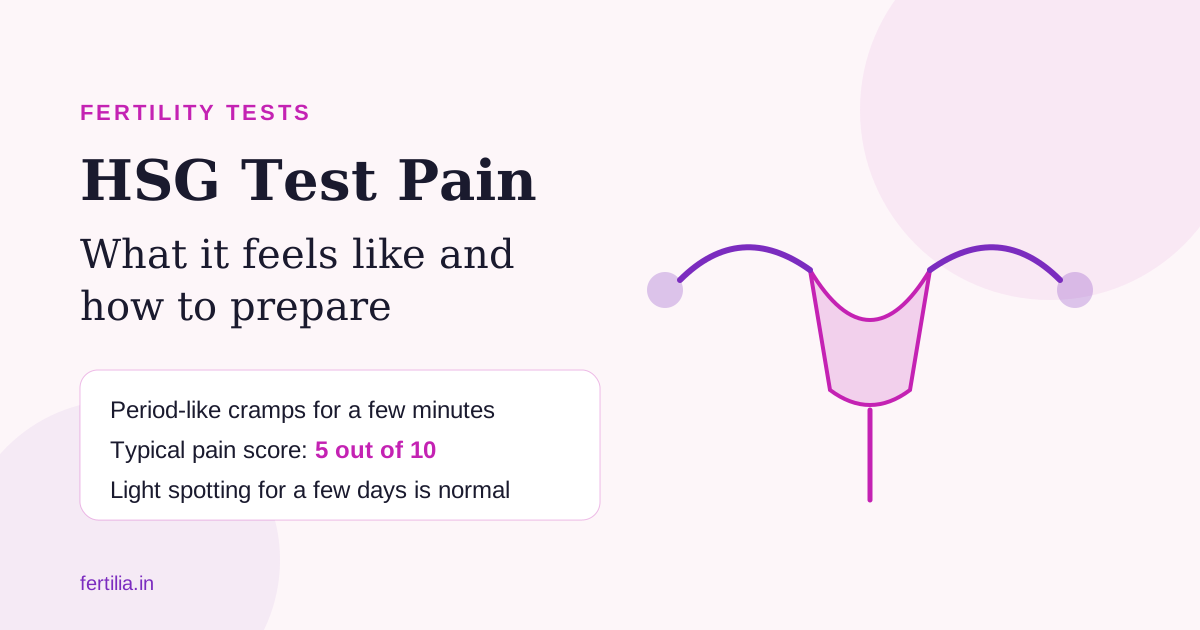
- Most women describe an HSG as cramping, like a strong period pain, that builds while the dye goes in and settles within minutes.
- The uncomfortable part is short. The dye injection itself usually takes only a few minutes of a test that runs about 30 minutes in total.
- In a large Dutch trial, the middle pain score was 5 out of 10, so half of women rated it 5 or lower.
- Light spotting and mild cramps for a day or two afterwards are normal.
- A few simple steps (timing, a calm explanation, asking about local anaesthetic) can make the experience easier.
I’m Dr. Suganya Venkat, an OB-GYN with 15+ years of experience helping women through fertility workups. This guide covers what the pain feels like, why it happens, how to prepare, and how to look after yourself afterwards. If you already have your result, my HSG report walkthrough explains each finding.
What Happens During an HSG
An HSG (hysterosalpingogram) is an X-ray test that checks two things: the shape of the inside of your womb, and whether your fallopian tubes are open. It is usually done in the radiology department of a hospital or a scan centre.
Here is the sequence, step by step:
- You lie on the X-ray table with your knees bent, much like a routine pelvic examination.
- A speculum is placed in the vagina so the doctor can see the cervix. This feels the same as a Pap smear.
- The cervix is cleaned, and a thin, soft catheter is passed through it into the womb. Some centres use a small balloon at the tip to hold it in place.
- Contrast dye is injected slowly while X-ray images are taken on a screen. You may be asked to shift position slightly.
- The catheter is removed, and you rest for a few minutes before getting up.
RadiologyInfo’s HSG patient guide (radiologyinfo.org, last reviewed August 2024) notes that the exam usually takes about 30 minutes and describes it as causing slight discomfort and cramping when the catheter is placed and the contrast is injected.
If you are still deciding between tests, the HyCoSy vs HSG comparison explains how the two differ.
What HSG Pain Feels Like
Women describe the sensation in a few consistent ways:
- A pinch or tug when the catheter or balloon is positioned at the cervix.
- Period-like cramping as the dye fills the womb. This is the main sensation for most women.
- A dull ache low in the tummy or on one side as dye spills out of the tubes into the pelvis. The lining of the abdomen (the peritoneum) can feel briefly irritated by it.
- Light-headedness or mild nausea for a minute or two in some women. This is a reflex response and passes when you lie still.
How strong is it? The best numbers we have come from the H2Oil trial in the Netherlands. In 400 women who recorded pain scores, the median score was 5.0 on a 0 to 10 scale, with the middle half of scores between 3.0 and 6.8 (van Welie N et al., Hum Reprod, 2019, PMID 31887222). Put simply, it was moderate for the typical woman, mild for some and stronger for others.
Why some women feel more pain than others
The cramping comes from the womb stretching as fluid enters, and from the cervix being held. A few things can change how strongly you feel it:
- A tube that is blocked. When dye cannot flow out, pressure inside the womb builds and the cramp can be stronger. This is information for your doctor, not a sign that something went wrong.
- A cervix that is tight or hard to pass, for example in women who have not had a vaginal birth.
- Anxiety and muscle tension. When we brace, the pelvic floor and tummy muscles tighten, and every sensation feels sharper. This is the part you have the most control over.
- Painful periods. Women who usually have strong period cramps sometimes find the HSG cramp feels familiar.
How to Prepare for an HSG
Preparation is mostly about timing, a few practical choices, and asking the right questions in advance.
1. Get the timing right
The HSG is usually booked after your period has stopped and before you ovulate, in the first half of the cycle. Your centre will give you the exact days. This timing avoids the test during a possible early pregnancy. Most centres also ask for a pregnancy test or ask you to avoid unprotected sex from the start of that cycle until the test. Follow the instructions your centre gives you.
2. Tell the team about these before the day
RadiologyInfo advises telling the doctor in advance if you:
- think you could be pregnant,
- have signs of a pelvic infection, or an untreated sexually transmitted infection,
- are allergic to iodine contrast (dye).
Also mention any medicines you take regularly. Some doctors prescribe an antibiotic before or after the procedure, and this depends on your history.
3. Ask about pain relief, and know what the research shows
This is where it helps to have realistic expectations. A Cochrane review of 23 randomised trials including 1,272 women compared different medicines for pain relief during HSG (Hindocha A et al., Cochrane Database Syst Rev, 2015, PMID 26387564). Its findings, in plain terms:
| Option | What the review found |
|---|---|
| Local anaesthetic injected near the cervix | Reduced pain during the procedure (very low quality evidence, 2 trials) |
| Local anaesthetic gel or spray at the cervix | May reduce pain during the procedure (low quality evidence, 9 trials) |
| Oral painkillers such as paracetamol or ibuprofen-type tablets | No clear evidence that they reduced pain during the procedure |
| Intravenous opioid medicine | Reduced pain in one trial, which also reported a breathing side effect in 1 of 32 women given remifentanil |
So what do I tell women? Many centres still suggest a simple painkiller about an hour before the test, and RadiologyInfo mentions over-the-counter medicine such as acetaminophen (paracetamol) for this. It is safe for most women and may ease the after-cramps, but do not rely on it alone to make the test painless. It is worth asking your centre beforehand whether they use a local anaesthetic gel or spray at the cervix. Check with your doctor before taking any painkiller if you have stomach ulcers, asthma triggered by painkillers, or kidney problems.
4. Practical things that help on the day
- Eat a light meal beforehand unless you have been told otherwise. Going in hungry makes light-headedness more likely.
- Wear loose, comfortable clothing and carry a sanitary pad for the spotting afterwards.
- Bring someone with you if you can. Having company on the drive home and a hand to hold in the waiting room helps more than people expect.
- Ask the doctor to talk you through each step. Knowing “now the speculum, now the catheter, now the dye” removes the surprise, and surprise is what makes us tense.
- Breathe slowly out through your mouth while the dye goes in. A long, slow exhale relaxes the pelvic floor. Try to keep your shoulders and bottom heavy on the table rather than lifting away.
- Say so if it hurts. The doctor can slow the injection or pause for a moment. You are allowed to ask.
💜 Have your HSG booked and feeling nervous about it? Message Dr. Suganya’s team on WhatsApp and we can talk through your timing, your questions for the centre, and what comes next in your fertility workup. Consultations are online, over a video call, at ₹399.
After the HSG: What Is Normal
Most women get up, rest for a short while, and go home the same day. Here is what to expect in the next day or two:
- Mild cramping for a few hours. A hot water bag on the lower tummy and rest help.
- Spotting or a sticky, slightly coloured discharge for a few days as the dye and a little blood come out. RadiologyInfo describes this as normal for most women. Use pads rather than tampons for this.
- Feeling tired or a little emotional. A fertility test can stir up a lot. It is fine to take the rest of the day easy.
Ask your centre about any specific instructions they give, such as when to resume intercourse.
When to call your doctor
Contact the centre or your doctor promptly if you notice:
- fever or chills,
- pain that keeps getting stronger instead of settling,
- heavy bleeding (soaking a pad in an hour),
- a foul-smelling discharge,
- feeling faint or unwell once you are home.
These are uncommon, and they are easy to treat when picked up early. Knowing them simply means you will not have to wonder.
Is the HSG Worth the Discomfort?
For many women, yes. Open tubes are one of the basic things a fertility workup needs to confirm, and the HSG answers that question in one short visit. A blocked tube changes the plan, and open tubes rule out one important cause and let you and your doctor focus elsewhere.
In Fertilia’s online fertility program, Dr. Suganya Venkat usually places the tubal test after the basic hormone and semen tests, so that every result is read together and no one goes through a procedure that will not change the plan. If cost is part of your planning, the HSG cost breakdown by city gives current price ranges.
If you are earlier in the journey and want the full picture of conceiving, our free Guide to Getting Pregnant walks through the steps in order.
Frequently Asked Questions
Is an HSG test very painful?
For most women it is not severe. It feels like strong period cramps for a few minutes while the dye goes in. In the H2Oil trial the median pain score was 5 out of 10, so half of women rated it 5 or less. A small number find it more painful, especially if a tube is blocked.
How long does HSG pain last?
The strongest cramp usually lasts only while the dye is being injected and settles within minutes of the catheter coming out. Mild cramping can continue for a few hours, and light spotting for a few days.
Should I take a painkiller before an HSG?
Many centres suggest a simple painkiller like paracetamol about an hour before, and that is reasonable for most women. Research has not shown clearly that tablets reduce pain during the procedure, so also ask whether your centre uses a local anaesthetic gel or spray at the cervix. Check with your doctor first if you have stomach, kidney or asthma concerns.
Can I go to work after an HSG?
Ask your centre for its own advice. If you can, plan a lighter day and avoid heavy exercise until the cramping settles.
Is HSG done under anaesthesia?
Usually not. It is a short outpatient test done while you are awake. Some centres apply a local anaesthetic to the cervix. General anaesthesia is not routine for an HSG.
Which day of the cycle is the HSG done?
It is usually scheduled after your period has ended and before ovulation, in the first half of the cycle. Your centre will confirm the exact days for your cycle.
Is bleeding normal after an HSG?
Yes, light spotting or a coloured discharge for a few days is normal as the dye passes out. Heavy bleeding, fever or worsening pain are reasons to call your doctor.
Getting Ready, Step by Step
An HSG is a short, manageable test, and preparation makes a real difference to how it feels. Book it in the right window, tell the team about allergies or infection, ask about cervical numbing, eat lightly, bring company, and breathe slowly through the dye.
💜 Want help planning your fertility tests in the right order? Talk to Dr. Suganya’s team on WhatsApp to book a ₹399 video consultation. We will look at what you have done so far and what each next step is for.