A woman sends me a photo of her blood report on WhatsApp. TSH 3.6 mIU/L, and next to it, in small print, the lab’s range: 0.4 to 4.5. “It says normal,” she writes, “but my friend told me it should be under 2.5 if I want to get pregnant. Which one is right?”
Both numbers are on her side of the table for a reason, and neither is wrong. They answer different questions. I’m Dr. Suganya Venkat, an OB-GYN with more than fifteen years of practice, and reading a TSH value for a woman who is planning a pregnancy is something I do almost every week in Fertilia’s online consultations. This post walks you through how to read your own result.
Here is what we will cover:
- What TSH measures, and where the lab’s “normal range” comes from
- Why 2.5 keeps coming up, and who it applies to
- A simple way to place your own number
- The other values that change what TSH means
- Small things that shift a TSH result on the day of the test
- What to ask at your next appointment
If you want the full picture of how the thyroid affects ovulation, periods and egg quality, our guide on the thyroid and fertility connection covers that ground. This post stays on one thing: the number on your report.
What TSH Measures
TSH stands for thyroid-stimulating hormone. It is made by the pituitary gland in the brain, not by the thyroid itself. Think of it as the brain’s request to the thyroid: “make more hormone.”
When the thyroid is producing enough, the brain asks quietly and TSH stays in the lower-middle part of the range. When the thyroid starts to slow down, the brain asks louder, and TSH rises. That is why a high TSH points towards an underactive thyroid (hypothyroidism) and a low TSH points towards an overactive one (hyperthyroidism). It feels backwards at first, and most women I speak to are surprised by it.
TSH is a sensitive early signal. It often moves before the actual thyroid hormone, free T4, leaves its own range. That makes it a good first test, and it is also why a single TSH value is a starting point rather than a full diagnosis.
Where the Lab’s “Normal Range” Comes From
The range printed on your report is a reference interval. A lab measures TSH in a large group of healthy adults and takes the middle 95 percent of results as “normal.” It describes where most healthy people sit, using that lab’s machine and method.
That has three practical consequences:
- Ranges differ between labs. One report may say 0.4 to 4.5, another 0.27 to 4.2, another 0.35 to 5.5. Always read your number against the range printed on your own report.
- The range is built for the general adult population, not specifically for women planning a pregnancy.
- Indian ranges can differ from Western ones. A study of Indian women in an iodine-sufficient population found a non-pregnant TSH reference range of 0.79 to 4.29 μIU/mL (Pramanik S et al., Indian J Endocrinol Metab, 2020, PMID 32699783). Its upper limit is very close to the 4.5 that most Indian lab reports print.
So when your report says “normal,” it means your thyroid is behaving like most healthy adults. That is useful information. It is not the end of the conversation if you are trying to conceive.
Why 2.5 Keeps Coming Up
The figure your friend mentioned comes from guidance on thyroid care around pregnancy. The American Thyroid Association’s 2017 guideline on thyroid disease in pregnancy and the postpartum (Alexander EK et al., Thyroid, 2017, PMID 28056690) includes a section on preconception and infertility. Two of its recommendations use 2.5 mIU/L:
- Women who already have hypothyroidism and take levothyroxine should have their dose adjusted before conception so TSH sits below 2.5 mIU/L. The reason is practical: thyroid hormone needs rise early in pregnancy, so starting from a comfortable position gives more room.
- Women with subclinical hypothyroidism who are going into IVF or ICSI are advised to be treated so TSH is below 2.5 mIU/L.
What the guideline does not say is that every woman with a TSH between 2.5 and the lab’s upper limit needs medicine. For a woman who is not on thyroid treatment, has a normal free T4, and is trying naturally, a TSH of 3.0 is usually something to understand and recheck, not something to treat on sight. The evidence on treating mildly raised TSH in women trying naturally is mixed, which is why the American Society for Reproductive Medicine published a full guideline in 2024 reviewing the risks and benefits of treating subclinical hypothyroidism in women with infertility and miscarriage (Practice Committee of the American Society for Reproductive Medicine, Fertil Steril, 2024, PMID 38163620).
That is the real reason two numbers keep showing up on Indian WhatsApp groups. One is a population range. The other is a target for specific situations. Our post on whether you can conceive with hypothyroidism covers the treated-hypothyroidism side in detail.
How to Place Your Own Number
Here is how I usually explain the bands to a woman holding her preconception report. These are rough bands to guide a conversation with your doctor, not cut-offs to self-treat with.
| Your TSH (mIU/L) | What it usually means before pregnancy | A sensible next step |
|---|---|---|
| Below the lab’s lower limit | Possible overactive thyroid, or recent illness or medication effect | Free T4 (and often T3) to clarify, then review |
| Lower limit up to 2.5 | Comfortable range for conception | No thyroid action needed for now |
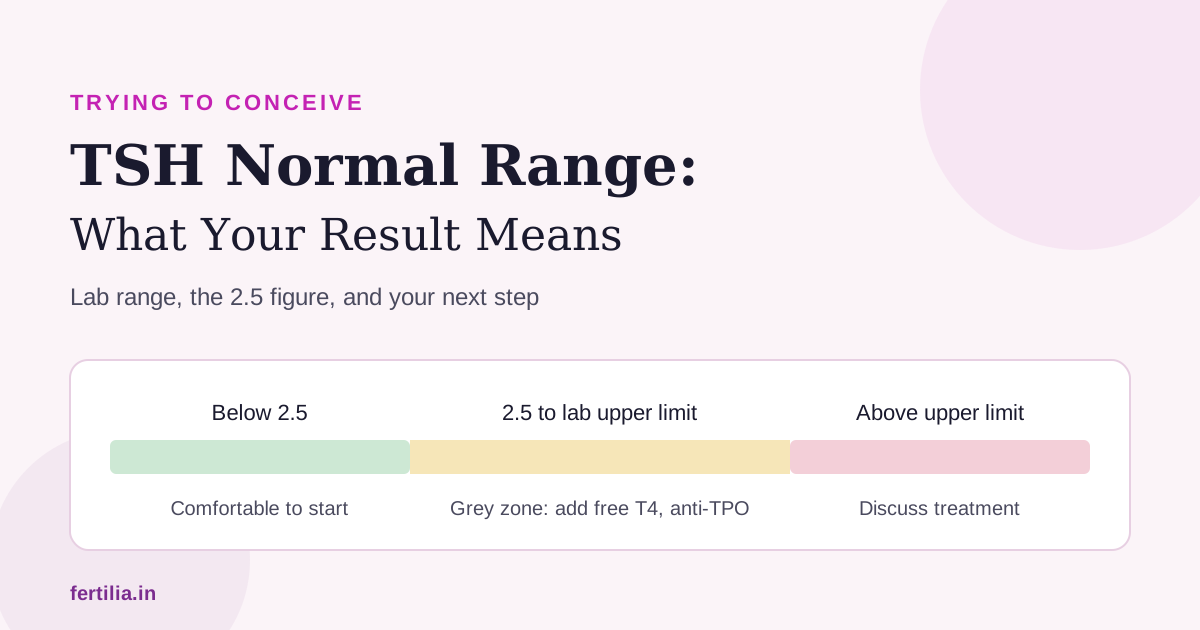
| 2.5 up to the lab’s upper limit (about 4.0 to 4.5) | Within normal; a grey zone if you are planning a pregnancy | Free T4 and anti-TPO antibodies, then decide with your doctor |
| Above the lab’s upper limit, free T4 normal | Subclinical hypothyroidism | Treatment is usually discussed, especially before IVF or if antibodies are positive |
| Above the upper limit, free T4 low | Overt hypothyroidism | Treatment before conception |
| Already on levothyroxine | Different rules apply | Aim for below 2.5 before conceiving, with your doctor adjusting the dose |
Two things to notice in that table. First, the grey zone is not a red zone. A TSH of 3.2 with a normal free T4 and negative antibodies is, for most women, simply a number to recheck. Second, what moves you from “recheck” to “treat” is almost always the other values on the report, not TSH alone.
Have a thyroid report and not sure which row you fall into? You can share it with Dr. Suganya Venkat over a video consultation, from anywhere in India. WhatsApp Dr. Suganya to book a ₹399 online consultation (US $20 if you are consulting from outside India).
The Other Values That Change What TSH Means
Free T4
Free T4 is the active thyroid hormone circulating in your blood. TSH tells you how hard the brain is asking; free T4 tells you how well the thyroid is answering. A raised TSH with a normal free T4 is called subclinical hypothyroidism. A raised TSH with a low free T4 is overt hypothyroidism, which is treated before pregnancy.
If your report shows only TSH, adding free T4 is the single most useful next test.
Anti-TPO antibodies
Anti-TPO (thyroid peroxidase) antibodies show whether the immune system is targeting the thyroid. This is the commonest cause of hypothyroidism in women. A positive result with a TSH in the grey zone tells your doctor the thyroid may be under gentle, ongoing strain, and it often tips the decision towards treatment or closer follow-up. A negative result with the same TSH usually supports simply rechecking.
Anti-TPO is not part of every routine thyroid panel in India, so you may need to ask for it.
T3
T3 is the other thyroid hormone. It is useful when TSH is low and an overactive thyroid is being considered. For a raised TSH, it adds little, and many women end up paying for it without needing it. The price of each of these tests is covered in our thyroid test cost guide.
Small Things That Shift a TSH Result
TSH is a steady test, but a few everyday things can move it enough to change which row of the table you land in:
- Time of day. TSH follows a daily rhythm and tends to be higher in the early morning. If you are comparing two results, try to test at a similar time.
- Recent illness. A fever, a bad viral infection or a hospital stay can push TSH up or down for a few weeks. A borderline value taken during or just after an illness is worth repeating.
- Biotin supplements. Hair and nail supplements often contain high-dose biotin, which can interfere with the lab method and give a falsely low or high reading. Tell the lab, and ask your doctor how many days to stop it before testing.
- Levothyroxine timing. If you already take it, take your blood sample before your morning dose, so the result reflects your usual level.
- Recent pregnancy or miscarriage. Thyroid values shift during and after a pregnancy. A result taken within a few months of either is read with that in mind.
Because of these, I rarely make a decision on one borderline TSH. A repeat test in four to six weeks, with free T4 and anti-TPO added, gives a much clearer answer than reacting to a single number.
What Your Diet Can and Cannot Do
Women often ask whether food can bring TSH down. Food supports a healthy thyroid; it does not replace levothyroxine when it is needed.
- Use iodised salt in everyday cooking. India’s iodine programme is one of the reasons goitre is much less common than it once was.
- Do not add iodine or kelp supplements on your own. Too much iodine can also upset the thyroid.
- Keep your iron up. Low iron is very common in Indian women and also makes you feel tired. Ragi, drumstick leaves, rajma and green leafy vegetables, eaten with amla or lemon, are good everyday sources.
- You do not need to give up cabbage, cauliflower or soya. In normal cooked portions, as part of a sambar, poriyal or dal, they are fine.
If you are still putting together your wider list of pre-pregnancy tests, our preconception check-up guide shows where TSH fits with the rest.
What It Is Called When You Search
Many women search for this in a mix of English and their own language. In Tamil, it is often typed as “thyroid test normal alavu” (normal level). In Hindi, a common search is “TSH kitna hona chahiye pregnancy ke liye” (how much should TSH be for pregnancy). The answer is the same in any language: read your number against your own lab’s range first, and if you are planning a pregnancy, look at the 2.5 figure alongside your free T4 and antibodies.
Practical Takeaways
- The “normal range” on your report describes healthy adults in general. Read your number against your own lab’s range.
- A TSH below 2.5 is a comfortable place to start trying.
- A TSH between 2.5 and the lab’s upper limit is a grey zone, not a diagnosis. Add free T4 and anti-TPO antibodies and recheck.
- If you already take levothyroxine, aim for below 2.5 before conceiving, with your doctor adjusting the dose.
- If you are heading into IVF or ICSI with a raised TSH, treatment to bring it below 2.5 is usually advised.
- Avoid deciding on one borderline result. Repeat it, at a similar time of day, after stopping biotin.
Frequently Asked Questions
What is the normal TSH range for a woman?
Most Indian labs print a range of roughly 0.4 to 4.5 mIU/L, though each lab’s range is slightly different. Always use the range printed on your own report. For women who are trying to conceive, a value below 2.5 is a comfortable place to be, and a value between 2.5 and the upper limit is worth a closer look with free T4 and anti-TPO antibodies.
TSH kitna hona chahiye pregnancy ke liye? (What should TSH be for pregnancy planning?)
For women already on thyroid medicine, the American Thyroid Association’s 2017 guideline advises bringing TSH below 2.5 mIU/L before conceiving. For women not on treatment, a result within the lab’s normal range with a normal free T4 is usually acceptable, and a value above 2.5 is a reason to check antibodies and repeat the test rather than start medicine straight away.
My TSH is 3.5 and the report says normal. Should I start thyroid tablets?
Not automatically. A TSH of 3.5 with a normal free T4 is within the usual lab range. Ask for free T4 and anti-TPO antibodies if they were not done. If antibodies are positive, if you are preparing for IVF or ICSI, or if you have had pregnancy losses, your doctor may suggest treatment. Otherwise, a repeat test in four to six weeks is a reasonable plan.
Is a low TSH a problem when trying to conceive?
A TSH below the lab’s lower limit can suggest an overactive thyroid, and it should be checked with free T4 and T3 before pregnancy. A low reading can also come from a recent illness, biotin supplements, or too high a dose of levothyroxine, so the context matters. Our guide on hyperthyroidism in pregnancy explains what happens if it is confirmed.
Does TSH change once I become pregnant?
Yes. In early pregnancy, the pregnancy hormone hCG gently stimulates the thyroid, and TSH often dips in the first trimester. The targets for each trimester are different from the preconception figures in this post. Our post on subclinical hypothyroidism and TSH targets in pregnancy covers those trimester ranges.
How often should I check TSH while trying to conceive?
If your first result is comfortably in range, once before you start trying is usually enough. If it is in the grey zone, a repeat in four to six weeks with free T4 and antibodies is sensible. If you take levothyroxine, your doctor will usually recheck four to six weeks after any dose change, and again as soon as you have a positive pregnancy test.
Can my husband’s thyroid affect our chances?
Thyroid problems are less common in men, but a man with symptoms such as tiredness, weight change or low libido can have a TSH test as part of his own check-up. A routine thyroid test is not usually needed for him unless there is a reason to suspect a problem.
Reading Your Report Together
A TSH value on its own rarely tells the whole story, and the good news is that thyroid results are among the most correctable findings on a preconception report. If yours sits in the grey zone or you are already on treatment and planning a pregnancy, Dr. Suganya Venkat can go through your report with you over a video call and tell you clearly whether anything needs to change before you start trying.
WhatsApp Dr. Suganya to book a ₹399 online consultation (US $20 from outside India).