Lower abdominal pain that feels like period cramps, but lasts a little longer. A vaginal discharge that looks or smells slightly different from usual. A low-grade fever that comes and goes over a few days. Some pain during sex.
Each of these, on its own, is easy to dismiss. But together, they can point to pelvic inflammatory disease (PID), an infection of the upper reproductive tract that, when missed or under-treated, is one of the most preventable causes of tubal-factor infertility in women.
I want to say something clearly before we go further: a PID diagnosis is not a reason to panic. Most women who receive timely, complete treatment go on to conceive without difficulty. The concern arises when PID goes unrecognised, is only partially treated, or recurs. That is when damage to the fallopian tubes accumulates over time, and when fertility is genuinely affected.
This post covers how PID develops, what it feels like (including when it causes no symptoms at all), how it is diagnosed, what it does to fertility, and how it is treated.
What is PID?
PID is not a single infection but a spectrum of infections affecting the upper female reproductive tract. Depending on how far the infection spreads, it can involve the uterus (endometritis), the fallopian tubes (salpingitis), the ovaries (oophoritis), and in more severe cases the surrounding peritoneal tissues.
The infection reaches the upper tract through ascending spread. Bacteria from the vagina and cervix travel upward into the uterus and beyond. The cervix normally acts as a protective barrier. When that barrier is breached by an existing infection, disrupted by an intrauterine procedure, or compromised during childbirth, bacteria can ascend more easily.
The organisms involved are most commonly:
- Sexually transmitted bacteria: Chlamydia trachomatis and Neisseria gonorrhoeae
- Organisms associated with bacterial vaginosis: Gardnerella vaginalis, Prevotella species, anaerobic bacteria
- Gut organisms: Escherichia coli and related bacteria
This mix is important for treatment because PID is not exclusively a sexually transmitted infection. Bacterial vaginosis-associated organisms and E. coli are significant contributors in Indian clinical practice, which means antibiotic treatment must cover multiple types of bacteria, not just STI organisms.
Who is at risk?
PID can affect any woman with a uterus and fallopian tubes. Risk is higher in:
- Women under 25 years (higher rates of chlamydia acquisition; the cervix has more ectopic columnar cells in younger women, making it more susceptible to infection)
- Women with a history of an STI, particularly chlamydia or gonorrhoea
- Women with bacterial vaginosis, which disrupts protective vaginal flora
- Women who have recently had an intrauterine procedure: IUD insertion, hysteroscopy, uterine biopsy, termination of pregnancy, or a complicated delivery
- Women with a previous episode of PID (recurrent episodes carry a progressively higher fertility risk)
What does PID feel like?
The textbook presentation includes:
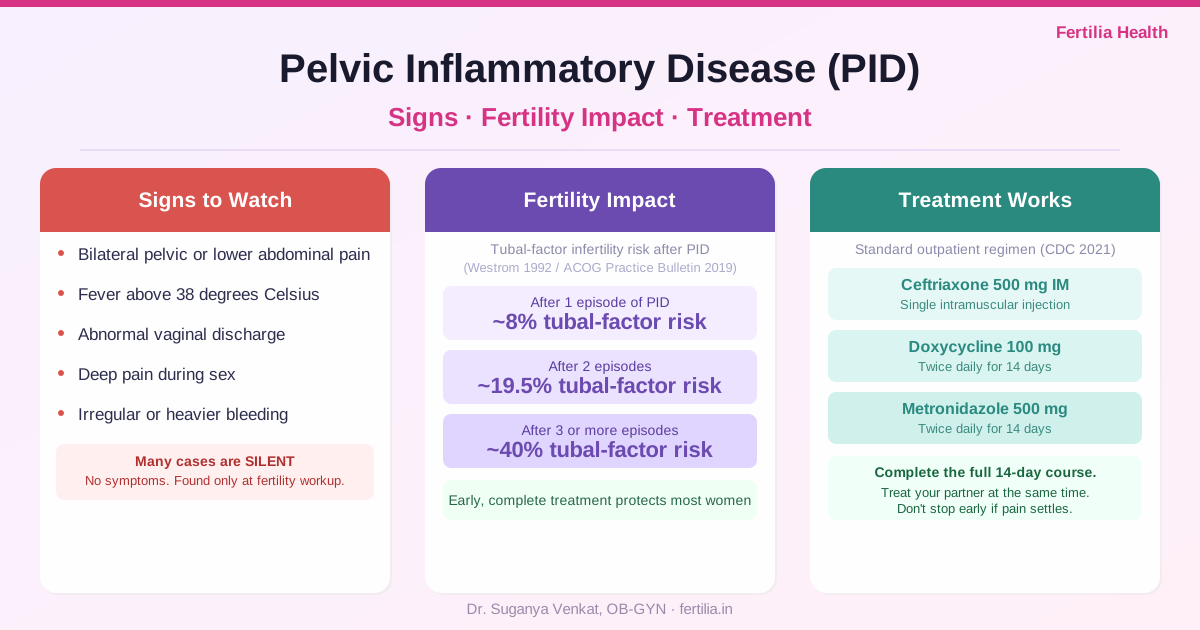
- Bilateral lower abdominal or pelvic pain, usually dull and constant rather than crampy
- Abnormal vaginal discharge: heavier, yellow-green, or with an unusual smell
- Pain during deep penetration during sex
- Bleeding between periods, or heavier or irregular periods
- Fever above 38 degrees Celsius
- Pain when the cervix is moved during a pelvic examination (cervical motion tenderness)
In practice, very few women have all of these at once. PID frequently presents with mild, overlapping symptoms that look like a bad period, a urinary tract infection, or muscle strain.
One of the most important things to understand: a significant number of PID cases are sub-clinical, meaning they cause minimal or no symptoms. This is called silent PID. Women with silent PID have the same risk of tubal scarring as women with symptomatic PID. For many women, the first indication that PID occurred in the past is difficulty conceiving, an abnormal HSG result showing a blocked tube, or an ectopic pregnancy.
How is PID diagnosed?
PID is a clinical diagnosis. There is no single blood test or scan that confirms it definitively.
The CDC 2021 STI Treatment Guidelines, which align with standard clinical practice in India, define the minimum criteria: at least one of the following on pelvic examination:
- Uterine tenderness
- Adnexal tenderness (pain on palpating the area of the tubes and ovaries)
- Cervical motion tenderness
Supporting findings that strengthen the diagnosis:
- Fever above 38.3 degrees Celsius
- Mucopurulent (yellow-green) cervical discharge
- White blood cells on wet-mount microscopy of vaginal discharge
- Elevated CRP or ESR on blood tests
- A positive swab for Chlamydia trachomatis or Neisseria gonorrhoeae
An ultrasound scan is not useful for diagnosing mild to moderate PID. Its role is to identify a tubo-ovarian abscess (TOA), a collection of pus in or around the ovary that indicates severe infection. A TOA usually requires hospitalisation and possibly surgery.
A diagnostic laparoscopy (keyhole surgery) is the only way to definitively confirm PID, but it is reserved for cases where the diagnosis is uncertain and a surgical emergency such as appendicitis, ectopic pregnancy, or ovarian cyst rupture needs to be excluded.
If you have lower abdominal pain and tenderness, a pelvic examination is essential. PID cannot be ruled out without one.
If you have been told you have PID, or if you are worried about a past infection and what it might mean for your chances of conceiving, I am happy to talk through your situation. WhatsApp Dr. Suganya and we can work through what a fertility assessment should include.
How PID affects fertility
The main fertility risk from PID is permanent scarring of the fallopian tubes. Each time bacteria pass through the tubes and the immune response mounts against them, inflammation occurs. When the inflammation resolves, scar tissue can form inside and around the tube. This scar tissue can narrow or block the tube, or create adhesions that prevent the fimbriated end (the fringe-like opening that picks up the egg) from functioning properly.
The most widely cited evidence comes from Weström et al. (Sex Transm Dis, 1992), a cohort study of 1,844 women with laparoscopically confirmed PID. ACOG Practice Bulletin 2019 summarises these findings:
- After one episode of PID: approximately 8% risk of tubal-factor infertility
- After two episodes: approximately 19.5% risk
- After three or more episodes: approximately 40% risk
For comparison, women without PID had less than 1% risk of tubal-factor infertility.
What this means in practical terms: most women who have one episode of PID and receive complete treatment retain full tubal function. The risk rises meaningfully with each recurrence, which is why preventing re-infection and completing treatment the first time are so important.
Ectopic pregnancy risk is also elevated after PID. Tubal scarring can allow sperm to fertilise an egg, but prevent the resulting embryo from travelling back into the uterus. The ectopic pregnancy risk after PID is approximately 6 to 10 times higher than in women who have not had PID (Weström 1992). If you have a history of PID and a positive pregnancy test, an early ultrasound at 6 to 7 weeks to confirm intrauterine location is essential. You can read more about what to watch for in Ectopic Pregnancy: Warning Signs & Future Fertility.
For women with confirmed tubal damage from PID, the relevant questions in a fertility workup are: which tubes are affected (one or both), where the blockage is along the tube, and whether any function is preserved. An HSG or diagnostic laparoscopy provides this information. Blocked Fallopian Tubes: Causes, Signs & Fertility Impact covers what tubal damage looks like on investigation and what the options are.
If both tubes are severely damaged, IVF bypasses the tubes entirely and is the most effective path to conception. If one tube has partial function, natural conception and IUI remain possible. The approach depends on what the workup finds, not on the fact of having had PID.
Treatment for PID
PID is treated with antibiotics. Always more than one type, because the bacteria involved span multiple organisms. A single antibiotic or a short course does not adequately cover the infection and raises the risk of recurrence.
Outpatient regimen (recommended by CDC 2021 and ACOG 2019 for mild to moderate PID):
- Ceftriaxone 500 mg, single intramuscular injection
- Doxycycline 100 mg, twice daily for 14 days
- Metronidazole 500 mg, twice daily for 14 days
Doxycycline covers Chlamydia trachomatis and contributes to gonorrhoea coverage. Metronidazole covers anaerobic bacteria and BV-associated organisms. Ceftriaxone provides broad-spectrum coverage including gonorrhoea. All three medications are available in India. The oral portion of the course (doxycycline and metronidazole for 14 days) typically costs Rs 200 to 400 through a pharmacy; generic availability is good in most cities and smaller towns.
Inpatient treatment is needed when:
- Symptoms are severe: high fever (above 38.5 degrees), significant abdominal pain
- A tubo-ovarian abscess is present or suspected
- The woman cannot tolerate oral medication due to vomiting
- A surgical emergency cannot be ruled out
- The woman is pregnant
- There is no improvement after 72 hours on outpatient antibiotics
Treating the partner is essential when the infection involves Chlamydia trachomatis or Neisseria gonorrhoeae. Treating one partner while the other remains untreated leads to re-infection, which is one of the main reasons PID recurs. A positive STI test or a PID diagnosis warrants presumptive treatment of the partner and testing where possible.
Complete the full 14-day course. Symptoms typically improve within 3 to 5 days. Stopping antibiotics early because pain has settled is a common mistake, and the infection frequently returns. The full course is the one that clears the infection and reduces the risk of tubal damage.
What PID is called in Tamil and Hindi
In clinical settings across Tamil Nadu, PID is typically referred to in English or by the surgical term salpingitis. The Tamil descriptive term is iduppu alarchi (pelvic inflammation) or more specifically karpappai alarchi (uterine/reproductive-tract inflammation). These are Roman transliterations; the Tamil script versions require verification with a native speaker and will be confirmed separately.
Women searching from Hindi-speaking regions may use terms like pelvik sankraman (pelvic infection) or describe symptoms as “pet ke nichle hisse mein dard” (lower abdominal pain) with discharge and fever as the accompanying details.
After treatment: what comes next for fertility
A follow-up appointment 3 to 5 days after starting antibiotics confirms the infection is responding. At 3 months, re-testing for chlamydia and gonorrhoea is standard practice.
For women who were trying to conceive before the PID episode, the timing of returning to active conception attempts depends on:
- How severe the episode was
- Whether the tubes were formally assessed (HSG or laparoscopy)
- Healing time after treatment completion (at minimum 4 to 6 weeks)
If tubal damage is a concern, a formal fertility assessment including hormone tests, antral follicle count ultrasound, and tubal evaluation maps the right next step. The guide to getting pregnant covers what this workup typically involves and how to read the results.
Ruling out PID: when the symptoms point elsewhere
PID shares its presenting symptoms with several conditions that need to be considered before or alongside it:
- Appendicitis: right-sided pain, nausea, fever. An ultrasound can usually distinguish this, and appendicitis is a surgical emergency that needs same-day assessment.
- Ectopic pregnancy: any woman of reproductive age with pelvic pain should have a pregnancy test first. An ectopic pregnancy can rupture without warning. Read Ectopic Pregnancy: Warning Signs & Future Fertility.
- Ovarian cyst rupture or torsion: sudden, often one-sided pain. Ultrasound usually identifies this.
- Endometriosis: chronic pelvic pain, pain with sex, and irregular bleeding overlap with PID but endometriosis does not cause fever or the discharge pattern typical of PID. Read more about endometriosis and its effect on fertility.
- Bacterial vaginosis or vaginal infection: discharge and discomfort, but without fever or upper-tract involvement. Vaginal Discharge: What’s Normal and When to Worry walks through what to look for.
Getting the diagnosis right depends on a proper examination. Self-diagnosing or self-treating on the basis of symptoms alone carries real risk of missing one of these other conditions.
PID is treatable, and with complete treatment most women protect their fertility. If you have received a PID diagnosis recently, or you are concerned about a past infection and what it may mean for conceiving, I am glad to talk through your specific situation. WhatsApp me here and we can take it from there.
Frequently Asked Questions
Can PID come back after treatment? Yes. Recurrent PID is more common when a partner was not treated (STI re-exposure), when antibiotics were stopped early, or when underlying bacterial vaginosis was not addressed. Each episode of PID adds to the cumulative risk of tubal scarring, so treating the infection fully the first time and preventing recurrence matter as much as the antibiotic choice itself.
How do I know if PID has caused tubal damage? The only way to assess tubal function is through a formal test. A hysterosalpingogram (HSG) shows whether the tubes are open or blocked. A diagnostic laparoscopy is more detailed and can also identify adhesions around the tubes and ovaries. These are done as part of a fertility workup, not routinely after every PID episode. If you were trying to conceive before the PID diagnosis, discuss the timing of a fertility assessment with your doctor.
Can I get pregnant after PID? Most women who have one episode of PID and receive complete treatment go on to conceive. The evidence (ACOG 2019, citing Weström 1992) shows approximately 8% tubal-factor infertility after one episode, meaning roughly 92 out of 100 women do not develop tubal-factor infertility after a single treated episode. The risk rises with recurrent episodes. If you have concerns, a fertility workup gives you specific information about your situation.
Does PID always cause symptoms? No. Sub-clinical PID produces no or very mild symptoms but can cause the same degree of tubal scarring as symptomatic PID. Many women discover they had a past PID episode only when an HSG or laparoscopy shows a blocked tube during a fertility investigation.
Is PID only caused by a sexually transmitted infection? No. While chlamydia and gonorrhoea are well-recognised causes, PID also results from organisms associated with bacterial vaginosis, E. coli, and other vaginal bacteria. This means PID can occur in women who have had one partner or no recent change in sexual history, particularly if bacterial vaginosis is present or after a uterine procedure.
Can PID affect my periods? PID itself does not disrupt the hormonal cycle that drives ovulation and periods. However, during the acute episode, inflammation of the endometrium can cause irregular or heavier bleeding in that cycle. If irregular periods continue after PID treatment, an assessment for other conditions including PCOS or endometriosis is appropriate, since the PID is unlikely to be the ongoing cause. See irregular periods: causes and solutions for more on what to consider.
Can having an IUD cause PID? There is a small, short-term elevated risk of ascending infection in the 20 days following IUD insertion, because insertion briefly opens the cervical canal. After that initial window, IUD use does not independently increase PID risk in women who are not exposed to STIs. If PID is diagnosed in a woman who has an IUD in place, the IUD may need to be removed depending on the severity of the infection and the clinical response to antibiotics.