The test is positive. You are 40, or 41, or 43, and after the first rush of happiness comes a second feeling that is harder to name. Then the first scan report arrives, and somewhere near the top it says “elderly gravida” or “elderly primi”. Nobody explains the phrase. A relative mentions a story she heard. You start searching at midnight.
I’m Dr. Suganya Venkat, an OB-GYN with more than 15 years of experience, and women in their 40s come to Fertilia’s online Pregnancy Care program with this exact worry every month. The short version: most pregnancies at 40 and beyond go well. What changes is the care around them. There are a few more checks, a closer eye in the last weeks, and some decisions that come up earlier than they would at 28.
This post is about what happens once you are already pregnant. If you are still trying to conceive, our guide to natural conception chances after 40 covers that side.
What This Post Covers
- What “elderly gravida” and “advanced maternal age” mean on your report
- The risks that rise at 40, in proportion
- What changes in antenatal care, trimester by trimester
- Delivery: timing, induction and the chance of a normal birth
- What you can do from this week
- Terms in Hindi and Tamil, and a short FAQ
What “Elderly Gravida” Means on Your Report
“Elderly gravida” is an old obstetric label for a pregnant woman aged 35 or over. “Elderly primi” (or “elderly primigravida”) means it is her first pregnancy. Research papers use “advanced maternal age” for the same group, and some studies separately look at women aged 40 or more, or 45 or more.
The label is a flag for your care team. It says “offer this woman a few extra checks”. It does not say anything about your own health, your baby, or how your pregnancy will go. Many Indian scan centres print it automatically from your date of birth.
Age is also one factor among several. Your blood pressure, blood sugar, thyroid, weight, past pregnancies and how you conceived all feed into your real risk. A healthy 41-year-old with normal blood pressure is in a very different position from a 41-year-old with long-standing diabetes. Your obstetrician looks at all of these together.
The Risks That Rise at 40, in Proportion
The clearest single source for women aged 40 and over is a UK study of 76,158 singleton pregnancies, all with a live baby on the 11 to 13 week scan. After adjusting for other maternal characteristics and obstetric history, women aged 40 or more had higher odds of these outcomes than younger women (Khalil A et al., Ultrasound Obstet Gynecol, 2013, PMID 23630102):
| Outcome | Odds at 40+ compared with younger women |
|---|---|
| Gestational diabetes | about 1.9 times |
| Pre-eclampsia | about 1.5 times |
| Baby smaller than expected for dates | about 1.5 times |
| Caesarean section | about 2 times |
| Miscarriage after the 11 to 13 week scan | about 2.3 times |
The same study did not find a higher risk of gestational hypertension or spontaneous preterm birth at 40 and over once those other factors were taken into account.
A few things help when you read a table like this.
A higher odds ratio of an uncommon event still leaves most women unaffected. Pre-eclampsia and gestational diabetes are common enough that they are checked for routinely in antenatal care. At 40 you are somewhat more likely to be in the group that needs treatment. Both are very manageable when they are picked up early, which is exactly why the checks exist.
Chromosomal conditions become more common with maternal age. This includes Down syndrome, and it is part of why screening is discussed early (Frick AP, Best Pract Res Clin Obstet Gynaecol, 2021, PMID 32741623). Screening is a choice, covered below.
Stillbirth risk is a little higher, mainly near term. A meta-analysis of 75 studies found that mothers aged 35 or over had a higher risk of stillbirth, and this was not fully explained by other health conditions or by IVF (Lean SC et al., PLoS One, 2017, PMID 29040334). In a US analysis of more than five million pregnancies, the risk for women aged 40 or over between 37 and 41 weeks was about 1 in 267 ongoing pregnancies, so 266 in 267 did not have a stillbirth. The highest-risk window was those last weeks of pregnancy (Reddy UM et al., Am J Obstet Gynecol, 2006, PMID 16949411). This is the main reason care gets more watchful towards the end, and the reason delivery timing is discussed earlier for you.
Miscarriage risk is highest in the first trimester and is discussed in detail in our guide to pregnancy after 40. Once you have seen a healthy heartbeat and passed the first trimester, the picture becomes steadily more reassuring.
What Changes in Your Care, Trimester by Trimester
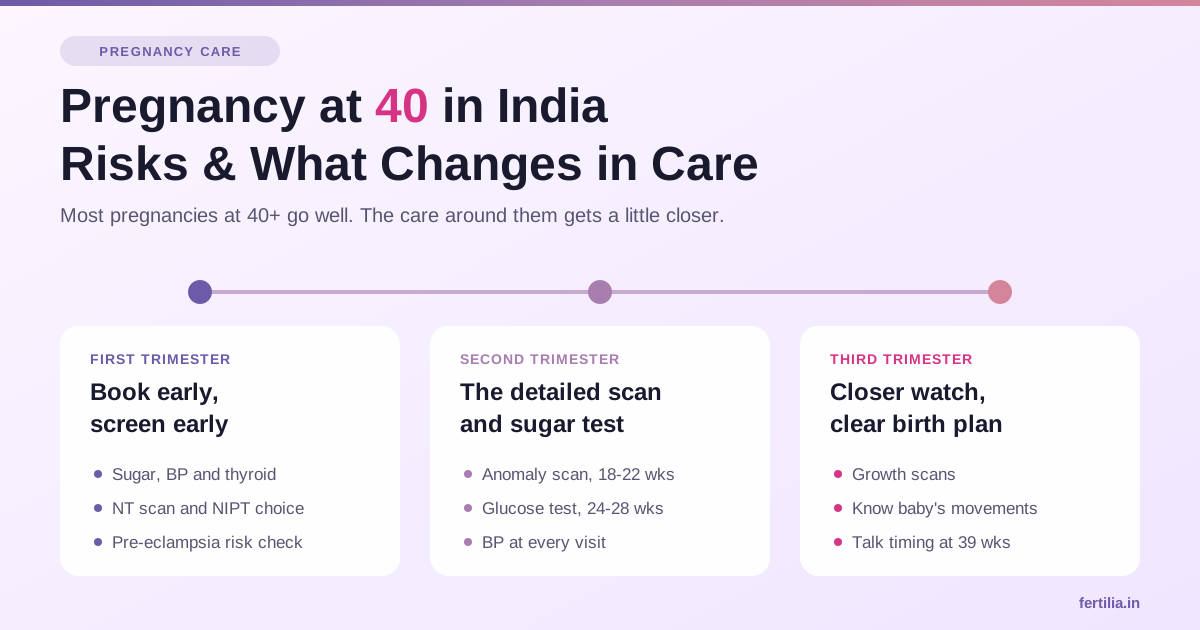
Most of your antenatal care looks like anyone else’s. The visits, the iron and calcium, the weight and blood pressure checks are the same. The differences are mostly about earlier screening, a few extra scans, and closer watching near the end. Being called high-risk simply means this extra attention. Our explainer on what a high-risk pregnancy means and how care works covers the label in more depth.
First trimester: book early, screen early
- Book your first antenatal visit as soon as the test is positive. Early booking gives time for a dating scan, baseline blood pressure and blood tests before any decisions are due.
- Folic acid should continue through the first trimester. If you have not started, start now. Our post on when to start folic acid and how much to take has the details, and your doctor will confirm your dose.
- Blood sugar and thyroid are often checked at the first visit for women over 40, alongside the usual blood count and blood group.
- First-trimester screening for chromosomal conditions. Between 11 and 14 weeks, the NT scan and the double marker blood test are combined with your age to give a risk figure. Many women over 40 are also offered NIPT, a blood test that looks at the baby’s DNA fragments in your blood. In a meta-analysis of 35 studies, NIPT picked up more than 99% of babies with Down syndrome in single pregnancies, with a very low false-positive rate (Gil MM et al., Ultrasound Obstet Gynecol, 2017, PMID 28397325). It is still a screening test, so a high-risk result needs a diagnostic test to confirm it. Our NIPT guide explains accuracy, cost and who it suits.
- Diagnostic testing is your choice. Some women go straight to CVS or amniocentesis for a definite answer, and others prefer screening first. Neither is the “right” path for everyone. Talk it through with your obstetrician and decide what fits your family.
- Aspirin for pre-eclampsia prevention. Your obstetrician may assess your pre-eclampsia risk in the first trimester. In a large trial of women at high risk of preterm pre-eclampsia, low-dose aspirin started at 11 to 14 weeks lowered preterm pre-eclampsia from 4.3% to 1.6% (Rolnik DL et al., N Engl J Med, 2017, PMID 28657417). Whether you need it, the dose and when to start are your obstetrician’s call. Please do not start aspirin on your own.
Second trimester: the detailed scan and the sugar test
- The anomaly scan at around 18 to 22 weeks checks the baby’s organs and growth in detail. Our guide to the TIFFA or Level 2 scan walks through the report.
- Glucose testing is usually repeated at around 24 to 28 weeks, even if the first test was normal. If gestational diabetes is found, most women manage it with food changes, walking and sugar monitoring, and some need medicine.
- Blood pressure at every visit. Keep a note of your readings. If your obstetrician suggests a home BP machine, use it at the same time each day and bring the log.
Third trimester: growth, movements and a delivery plan
- Growth scans. Because babies of women over 40 are slightly more likely to be small for dates, many obstetricians add one or more growth scans in the third trimester, sometimes with a Doppler study of blood flow. Our post on reading a growth scan and Doppler report makes those numbers easier to follow.
- Knowing your baby’s movement pattern. From around 28 weeks, get to know how your baby usually moves. If your baby is moving less than usual, or the usual pattern changes, contact your maternity unit immediately, day or night, rather than waiting until later in the day. Our guide to fetal movements and kick counts explains what is normal.
- More frequent visits near term. Expect closer review in the last few weeks. That is where the extra attention does the most good.
💜 Pregnant at 40 or over and want someone to walk you through your reports and next steps? Message Dr. Suganya’s team on WhatsApp A ₹399 video consultation goes through your scans, blood tests and questions with you, working alongside your obstetrician, from anywhere in India.
Delivery at 40: Timing, Induction and Normal Birth
Will I need a C-section?
Not necessarily. Caesarean rates are higher in women over 40, as the table above shows, but many women in this age group give birth vaginally. In a randomised trial of first-time mothers aged 35 or over, about one in three had a caesarean and the rest gave birth vaginally, many with forceps or vacuum help (Walker KF et al., N Engl J Med, 2016, PMID 26962902). Your own chances depend on your baby’s position and size, your health, and how labour progresses. If a caesarean is advised, our guide on what to expect during a C-section delivery helps you prepare.
Why is induction at 39 weeks being discussed?
Because the slightly higher stillbirth risk is concentrated in the final weeks, many obstetricians discuss planned induction of labour around 39 weeks for women over 40. A common worry is that induction leads to a caesarean. In the same trial, the caesarean rate was 32% in women induced at 39 weeks and 33% in women whose pregnancy was managed expectantly, meaning they waited for labour to start unless a medical problem called for induction. The trial found no significant differences between the two groups in caesarean rates, in the women’s experience of childbirth, or in short-term problems for mother or baby (Walker KF et al., N Engl J Med, 2016, PMID 26962902). The trial was not designed to show whether induction prevents stillbirth.
Induction is an option to weigh with your obstetrician. Your health, your cervix and your preferences all shape the plan.
What You Can Do, Starting This Week
Many of the factors that sit alongside age respond to everyday steps.
- Book early and keep every visit. The extra checks only help if they happen on time.
- Keep a simple folder. Every scan report, blood test and BP reading in one place, on paper or on your phone. It makes each visit faster and helps any second-opinion doctor see the full picture.
- Eat for steady sugars. Build meals around dal, sambar, vegetables, curd and whole grains like ragi or millets, with protein at each meal. Keep white rice portions smaller and fill more of the plate with vegetables. Keep sweets and fried snacks occasional.
- Move daily, if your doctor agrees. A 20 to 30 minute walk after meals helps blood sugar and mood. Our free pregnancy guide has safe routines.
- Look after sleep and stress. A short afternoon rest, a fixed bedtime, and someone to share the worry with all help. Tell your doctor if anxiety is taking over your days; it is common and very treatable.
- Know when to contact your maternity unit immediately, day or night: a severe headache that does not settle, blurred vision or flashing lights, sudden swelling of the face or hands, pain under the ribs, bleeding, leaking fluid, or your baby moving less than usual. Do not wait to see whether it passes or until your next visit. Call straight away and go in for assessment if they advise it. Knowing these signs lets you act early, which is what keeps most problems small.
If you conceived through IVF, with donor eggs, or are carrying twins, tell your obstetrician at the first visit. It can change which checks are offered and how often.
What It’s Called in Hindi and Tamil
Many women search for this in their own language. If one of these brought you here, you are in the right place.
| Language | Common search term | Notes |
|---|---|---|
| Hindi | 40 ki umar mein pregnancy (40 की उम्र में प्रेगनेंसी) | Also “40 ke baad pregnancy” |
| Tamil | 40 vayathil karppam (கர்ப்பம் = pregnancy) | Often typed in English letters |
| English (report term) | Elderly gravida / elderly primi | Printed on many Indian scan reports for women 35+ |
| English (research term) | Advanced maternal age (AMA) | Used in studies and guidelines |
Key Takeaways
- Most pregnancies at 40 and beyond go well, with care planned around a few known risks.
- Gestational diabetes, pre-eclampsia, a smaller baby and caesarean birth are more likely, and all are watched for closely.
- Screening for chromosomal conditions is offered early. Diagnostic testing is a personal choice.
- Care becomes more watchful in the last weeks, and induction around 39 weeks is often discussed.
- Your blood pressure, sugars, weight and daily habits matter alongside your age.
Frequently Asked Questions
Is pregnancy at 40 safe? For most women, yes. The risk of some complications is higher than in your 20s, mainly gestational diabetes, pre-eclampsia, a smaller baby and caesarean delivery. These are the conditions antenatal care is built to find early. With regular checks and a clear delivery plan, most women over 40 have a healthy pregnancy and baby.
What does “elderly gravida” mean on my scan report? It is an older medical label for a pregnant woman aged 35 or over. “Elderly primi” means it is her first pregnancy. It is printed from your age and simply tells your care team to offer a few extra checks. It is not a diagnosis.
Is a 40+ pregnancy automatically high-risk? Many obstetricians in India classify it that way, because age adds some risk on its own. In practice, “high-risk” means closer monitoring: earlier screening, extra growth scans and more frequent visits near term. A healthy woman over 40 often has an uneventful pregnancy that is simply watched more carefully.
Do I need NIPT if I am over 40? You do not have to have it, but it is commonly offered at this age because it is a highly accurate screening test for Down syndrome. A high-risk NIPT result needs a diagnostic test, such as CVS or amniocentesis, to confirm it. Whether you screen, test directly, or do neither is your decision.
Can I have a normal delivery at 40? Yes, many women do. Caesarean rates are higher after 40, but in a trial of first-time mothers aged 35 or over, about two in three gave birth vaginally. Your baby’s position and size, your health and how labour progresses decide the final route.
Why does my doctor want to induce me at 39 weeks? Stillbirth risk for women over 40, while still low, rises a little in the final weeks of pregnancy. A planned induction around 39 weeks is one way to avoid those weeks. In a trial of women aged 35 or over, induction at 39 weeks did not raise the caesarean rate. It is a decision to make with your obstetrician.
How many extra scans will I need after 40? It varies by hospital and by how your pregnancy is going. Most women have the standard dating, NT and anomaly scans, plus one or more growth scans in the third trimester. Extra scans are added only if something needs a closer look.
💜 Over 40, pregnant, and want a calm second pair of eyes on your care plan? Talk to Dr. Suganya’s team on WhatsApp A ₹399 video consultation covers your screening choices, sugar and BP plan, and delivery questions, alongside your obstetrician, wherever you are in India.