The message a lot of women receive at 40 goes something like this: your ovarian reserve is declining, your eggs are not getting younger, and time is not on your side. Start IVF soon.
That message is sometimes the right one. But it is often delivered without the numbers that would help a woman make a grounded decision, and it tends to produce more anxiety than clarity.
I am Dr. Suganya Venkat, an OB-GYN with over fifteen years of clinical experience, and the question I hear most from women between 40 and 44 is not what their AMH reading means but something more direct: do I still have a real chance? And if I do, what should I be doing?
This post goes through the data on natural conception at 40, what your test results mean in context, what is genuinely modifiable, and a practical framework for how long to try before reassessing.
What the Data Says About Natural Conception at 40
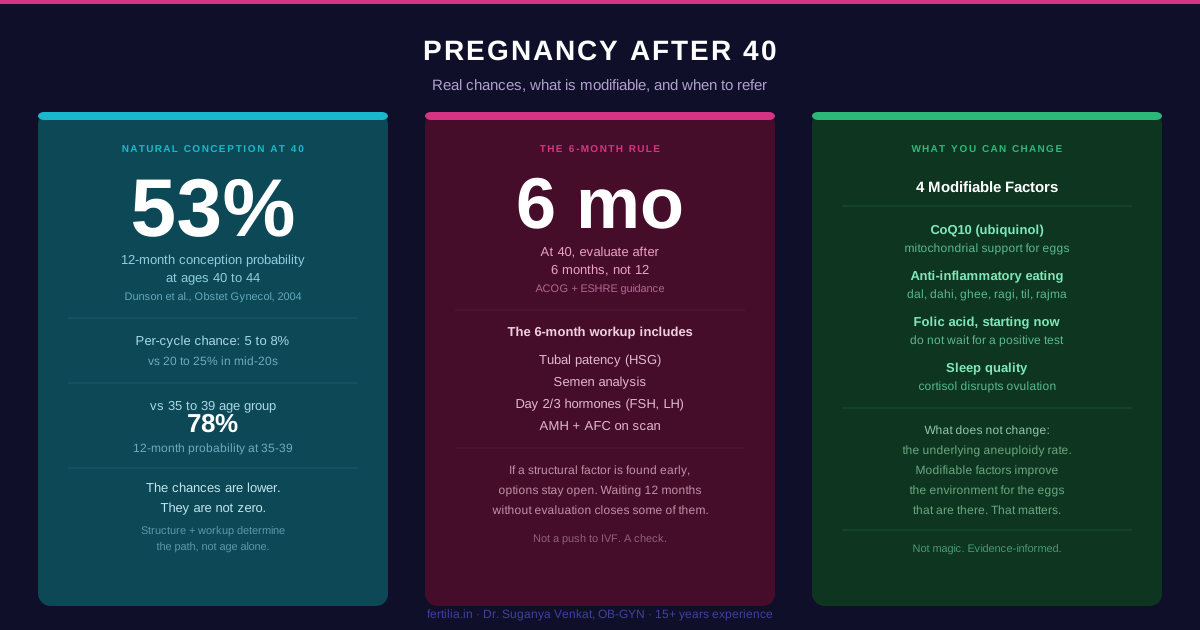
Natural conception after 40 remains possible, but no single percentage can predict an individual woman’s chance. Age, ovulation, tubal health, semen parameters, and how often intercourse falls in the fertile window all matter. The often-cited Dunson study (Obstetrics & Gynecology, 2004; PMID 14704244) enrolled women aged 18 to 40, so it cannot support a conception estimate for ages 40 to 44. Its relevant finding was that infertility increased with age among outwardly healthy couples.
The decline is real, but it is not a closed door.
Two things explain most of the fertility change at 40, and understanding them helps separate what you can influence from what you cannot.
Per-cycle fecundability drops. The probability of conception in each cycle declines with age. This means it may take more cycles to conceive, while the value of a prompt assessment increases because it can identify factors that are treatable now.
Aneuploidy in eggs rises with age. By the early 40s, a substantial proportion of eggs that ovulate will carry chromosomal errors. These eggs may fertilise normally but are less likely to result in a continuing pregnancy. This is the underlying mechanism behind both the lower per-cycle rate and the higher miscarriage rate in this age group.
For a comparison of how fertility numbers change across the late 30s, and the clinical decision framework for that age group, read Can I Conceive After 35 Without IVF?.
What AMH and AFC Mean at 40
AMH is probably the most misread fertility test for women over 40.
At 40, a low AMH is expected. Ovarian reserve declines continuously through the reproductive years, and the reference ranges used on most reports are built across all age groups. A number of 0.4 or 0.5 ng/mL at 40 is not unexpected. It does not, by itself, mean conception is not possible.
What AMH tells us is how many eggs are likely remaining in the ovaries. It does not tell us whether those eggs are chromosomally normal. A woman at 40 with a higher AMH has more eggs remaining, but a higher quantity of eggs at 40 does not guarantee a higher proportion of chromosomally normal ones. Egg quality at 40 is partly a function of age, which AMH does not measure.
The test that gives more immediately clinically useful information is the antral follicle count (AFC), measured on an early-cycle transvaginal scan. AFC is a count of the follicles visible on the ovaries in a given cycle. It is the best single indicator of how many eggs are being recruited each month, and it is the number that most directly informs how a woman would respond if she moved to IVF.
AFC helps estimate likely response to ovarian stimulation, but neither AFC nor AMH can confirm or rule out spontaneous conception. Your doctor interprets them alongside age, cycle pattern, tubal health, and semen testing.
For a full breakdown of AMH reference ranges by age and what the numbers mean at different life stages, the AMH normal range guide covers this in detail. For the difference between AMH and AFC and which test to prioritise in your evaluation, read AMH vs AFC: Which Test and What Each Costs.
Miscarriage Risk at 40: What to Know
The miscarriage rate at 40 is higher than at 35. This is worth being clear about because it affects how you plan your timeline and what to monitor in early pregnancy.
Miscarriage risk rises with maternal age, largely because chromosomal abnormalities become more common in embryos. The exact risk varies by age, how pregnancy was identified, and the population studied, so your own obstetric history matters more than a broad internet percentage.
The mechanism is the same one that reduces per-cycle fecundability: as the proportion of chromosomally abnormal eggs rises, a higher proportion of embryos that form will carry errors that prevent the pregnancy from continuing. This typically presents as a loss in the first six to eight weeks.
Two points about this deserve emphasis.
A higher miscarriage risk does not mean a continuing pregnancy is unlikely. A miscarriage also does not determine what the next pregnancy will do. After two or more losses, a clinician may assess uterine anatomy, antiphospholipid syndrome, thyroid function, and genetic factors according to the history. Broad inherited-thrombophilia or immune testing is not routine for everyone. The guide to tests after recurrent miscarriage explains what may be considered after two losses.
What You Can Change
Not everything about fertility at 40 is fixed. There is a real modifiable layer, and taking it seriously matters.
Egg quality and the mitochondrial environment. The energy demands of early cell division after fertilisation fall primarily on the mitochondria in the egg. CoQ10 has been studied mainly in IVF settings, but evidence that it improves natural-conception or live-birth rates is uncertain. Discuss whether any supplement is appropriate with your doctor rather than treating it as a substitute for evaluation.
Diet and inflammation. An anti-inflammatory eating pattern supports the follicular environment in a general sense. In an Indian kitchen, this maps naturally onto foods that are already there: dal and sabzi, dahi with meals, ragi as a grain, til seeds, rajma and other legumes, fruit, and a handful of nuts. The pattern that supports egg health is not a special Western regime. It is closer to traditional South Indian and North Indian home cooking, with reduced refined flour and sugar.
Folic acid, starting now. If you are planning to conceive, take folic acid before a positive test arrives, using the dose your doctor recommends. Neural tube development begins before most women know they are pregnant.
Sleep and general health. Regular sleep supports wellbeing and makes a demanding fertility process easier to navigate. It is helpful self-care, not a promise that better sleep can reverse age-related egg changes.
What does not change with supplements or lifestyle is the underlying rate of chromosomal errors in eggs. The modifiable layer improves the environment for the eggs that are there. That matters, and it is not magic.
For a detailed breakdown of what is and is not supported by evidence for egg quality, the egg quality guide goes through each supplement and lifestyle factor specifically.
If you would like to understand what your AMH, AFC, and cycle pattern mean for your specific situation, you can speak with Dr. Suganya Venkat over a video consultation at Fertilia. The consultation covers your test results, your history, and a practical next step.
Book a consultation via WhatsApp
How Long to Try Naturally at 40
The timeline for evaluation is one of the clearest differences between trying at 35 and trying at 40.
ACOG and the American Society for Reproductive Medicine advise that women older than 40 may benefit from more immediate fertility evaluation rather than waiting six or twelve months (Committee Opinion No. 589, 2014). Evaluation is not a commitment to IVF. It is a way to understand the available options promptly.
This is not a rush to treatment. It is a recognition that at 40, twelve months is a long time to let pass before identifying whether there is a structural or hormonal factor that has been quietly reducing your chances. If both fallopian tubes are blocked, or if a uterine polyp is sitting at the site of implantation, waiting another six months does not improve the probability. Finding out sooner keeps options open.
The initial evaluation is usually straightforward. It includes an HSG or ultrasound to assess tubal patency, a semen analysis for your partner (male factor accounts for roughly half of all infertility diagnoses, and it is not age-related in the same way female factor is), hormone testing on Day 2 or 3 of your cycle (FSH, LH, estradiol), and an updated AMH and AFC if not recently done.
The timing and exact tests are individualised, and the results inform a shared treatment decision.
For the full sequence of tests in a standard fertility evaluation, what each one tells you, and what each costs at Indian labs and hospitals, read our fertility workup guide.
When Referral Is the Right Next Step
There is a version of this conversation that is not about waiting, and it is worth being direct about when that is.
If you are over 40 and hoping to conceive, arrange a fertility assessment promptly, even if your cycles are regular. Regular cycles do not show whether the tubes are open or whether there is a semen factor. PGT-A can screen sampled cells from IVF embryos for chromosome-number differences, but it has limitations and does not test the quality of every egg.
If your ovarian-reserve markers are low, natural conception may still occur. These tests are more useful for anticipating response to stimulation than for predicting spontaneous pregnancy, so discuss the full picture with a fertility specialist.
If there is a structural factor found during the workup (blocked tubes, a significant submucosal fibroid, or a uterine septum), the clinical path changes regardless of age. Some of these are treatable and improve outcomes substantially.
For a structured framework on when IVF is genuinely the better option versus when natural conception is still a reasonable first path, read the OB-GYN guide to the IVF decision.
On donor eggs: this option is not a defeat. For some women at 42 or 43, particularly those with very low AFC and a history of repeated early loss, donor-egg IVF offers the highest probability of carrying a healthy pregnancy. The ovarian reserve is a constraint on the supply of eggs; it does not affect the capacity to carry a pregnancy. A woman who carries and delivers using a donor egg is not less of a mother for the path taken.
For a realistic picture of what IVF at 40 looks like when everything comes together, the story of Savithri, who conceived twins through IVF at 40 after a failed earlier cycle, is worth reading. You can find her full story here.
If you are preparing for IVF, the Guide to Getting Pregnant covers IVF preparation, what to expect at each stage, and how to support your cycle through the process.
What This Is Called in Tamil and Hindi
Women searching for this topic often use regional terms. If you arrived here through one of these searches, you are in the right place.
| Language | Common search term | Script |
|---|---|---|
| Hindi | 40 saal mein pregnancy / 40 ke baad pregnancy | 40 साल में प्रेगनेंसी |
| Tamil (Roman) | 40 vayadhil pregnancy / 40 vayadhil kuzhandhai | Common query phrasing |
| English | pregnancy at 40, natural conception at 40 | International standard |
FAQ: Pregnancy After 40
Can a woman get pregnant naturally at 40 or 41?
Yes. Natural conception can happen at 40 or 41, but the chance varies considerably between women and declines with age. The Dunson 2004 study often cited online did not study a 40 to 44 age band, so it should not be used to promise a 12-month percentage for that group.
How low does AMH have to be before natural conception is no longer possible?
There is no AMH number below which natural conception is impossible. AMH at 40 is almost always low by standard chart values, because those charts aggregate across all ages. AFC adds useful information about ovarian reserve and likely response to fertility medication, but there is no AFC cut-off that proves or excludes natural conception.
How long should a 40-year-old try before seeing a fertility specialist?
Women over 40 should discuss fertility evaluation promptly rather than automatically waiting six months. A basic assessment may include ovulation and ovarian-reserve review, tubal patency, and semen analysis. This is not about rushing into IVF. It is about identifying any treatable issue before more time passes.
40 saal mein pregnancy ke chances kya hain? (What are the chances of getting pregnant at 40?)
Natural pregnancy remains possible after 40, but a reliable single percentage cannot be applied to every woman. Because age-related decline continues, speak with a fertility specialist promptly while you continue trying, rather than waiting for a fixed review point.
Is the miscarriage risk at 40 too high to justify trying naturally?
No. Miscarriage risk is higher than at younger ages, but many pregnancies continue normally. The exact estimate depends on the study population and how early pregnancies are counted. A single loss does not determine the outcome of the next pregnancy.
Should I go straight to IVF at 40, or try naturally first?
This depends on your individual picture, not your age alone. If your tubes are open, your partner’s semen analysis is normal, you ovulate, and you have no history of multiple losses, natural trying may remain part of the plan while you complete a prompt specialist assessment. IVF becomes the clearer recommendation when there are additional factors: tubal blockage, very low AFC, or a structural uterine issue.
What does the miscarriage risk at 40 tell us about egg quality?
The higher miscarriage rate at 40 reflects the increased proportion of chromosomally abnormal eggs in the ovulated pool. A miscarriage in this context is most often a chromosomally abnormal embryo that the body cannot sustain, rather than a sign of a problem with the uterus or implantation. If losses are recurring (two or more), further testing is worthwhile to rule out additional causes.
If you would like to look at your numbers together, Dr. Suganya Venkat is available for online fertility consultations at Fertilia, working with women across India over video call.