Your double marker test or NIPT came back screen-positive, or your NT scan showed a raised measurement, or you are 36 and your obstetrician has mentioned “the option of amniocentesis” in passing. Now you are looking up the word at 11pm, and the search results are full of old numbers about needles and miscarriage risk that sound frightening and, as it turns out, are mostly out of date.
This guide walks through what amniocentesis actually involves, what it can and cannot tell you, the real modern miscarriage risk (not the one still circulating from decades-old studies), who it is typically offered to, and how to think about the decision if it is offered to you.
What this post covers:
- What amniocentesis is and how the procedure works
- What it definitively tests for, and what it does not
- The real current miscarriage risk, verified against the latest evidence
- Amniocentesis versus CVS
- Who is typically offered it, and who is not obligated to have it
- How to make this decision alongside your doctor or a genetic counsellor
- Amniocentesis cost in India
What Amniocentesis Is
Amniocentesis is a diagnostic procedure, not a screening test. That distinction matters more than almost anything else in this guide, so it is worth sitting with for a moment. A screening test, like the double marker test, the NT scan, or NIPT, estimates a probability. It tells you your pregnancy falls into a higher-chance or lower-chance category for certain conditions. Amniocentesis is different: it examines the baby’s own chromosomes directly and gives you a definitive answer for the conditions it tests.
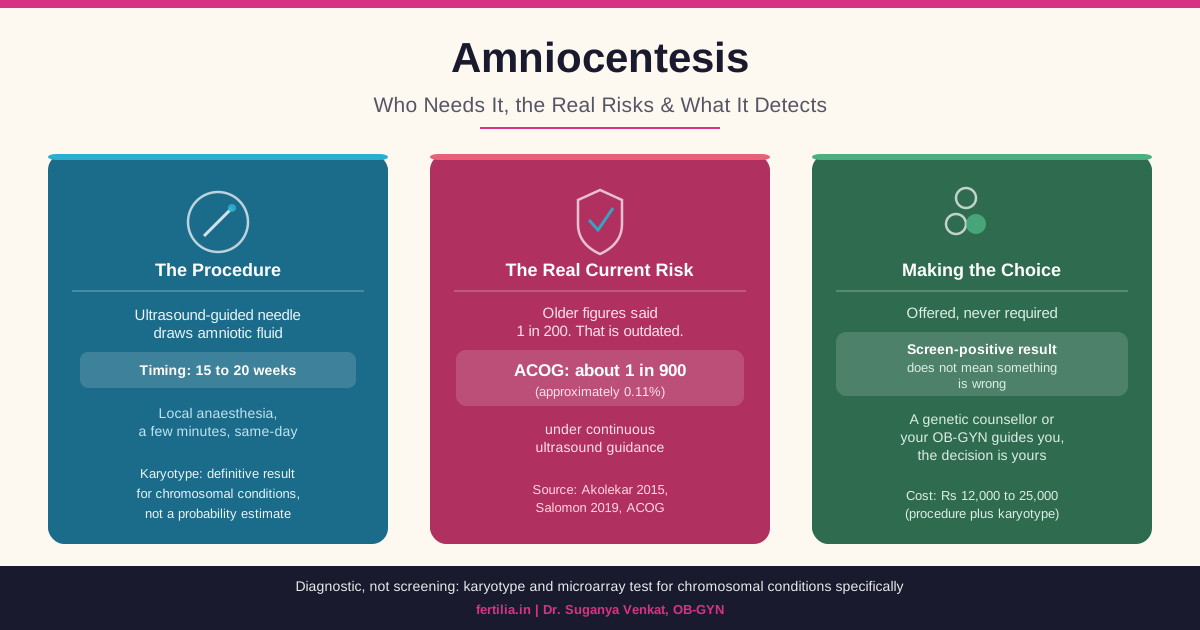
The procedure itself is simple to describe, even if it does not feel simple to go through. Under continuous ultrasound guidance, a fine needle is passed through the abdomen into the amniotic sac, and a small amount of amniotic fluid, usually around 15 to 20 ml, is withdrawn. That fluid contains cells the baby has shed, and a laboratory grows and analyses those cells. It is typically done between 15 and 20 weeks of pregnancy, most commonly around 16 weeks. Local anaesthesia is used at the injection site, though many women describe the sensation as more like a firm cramp than a sharp pain. The procedure itself takes only a few minutes. Most women rest for a short while afterward and then go home the same day.
Results for a standard karyotype typically take 10 to 14 days, since the cells need time to grow in culture. A faster preliminary result for the most common chromosomal conditions (trisomy 21, 18, 13, and the sex chromosomes) is often available within 24 to 48 hours through a rapid technique called FISH or QF-PCR, with the full karyotype following later to confirm.
What Amniocentesis Tests For, and What It Does Not
This is where a lot of confusion sits, because “genetic testing” sounds like it should answer every question a worried parent has. It does not.
What a standard karyotype detects:
- Extra or missing whole chromosomes, including Down syndrome (trisomy 21), Edwards syndrome (trisomy 18), and Patau syndrome (trisomy 13)
- Sex chromosome differences, such as Turner syndrome or Klinefelter syndrome
- Large chromosomal deletions, duplications, or structural rearrangements visible under a microscope
What chromosomal microarray (CMA), a more detailed test available on the same fluid sample, additionally detects:
- Smaller deletions and duplications too small for a standard karyotype to see
- Certain specific genetic syndromes caused by these smaller changes, such as 22q11.2 deletion syndrome
What amniocentesis does not tell you, no matter which test is run:
- It cannot predict autism, intellectual capacity, personality, or any trait that is not caused by a chromosomal or specific genetic difference
- It does not diagnose every possible genetic condition. Single-gene conditions need to be specifically tested for if there is a known family history; a routine karyotype or microarray will not catch them
- A normal result is reassuring for the conditions tested, but it is not a guarantee of a healthy baby in every respect. It answers the specific question it was designed to answer
If a genetic counsellor or your obstetrician recommends a targeted test beyond the standard panel, for example because a specific condition runs in the family, that is a different conversation from the routine karyotype most women are offered.
The Real Current Miscarriage Risk
This is the number every woman searches for, and it is also the number most out of date online. Many older sources still quote a miscarriage risk of “1 in 200” or “1 in 100” for amniocentesis. That figure comes from studies done before routine continuous ultrasound guidance became standard practice, and it has not reflected current care for years.
The two most recent, largest systematic reviews give a clearer picture:
A 2015 meta-analysis pooling controlled studies (Akolekar R et al., Ultrasound in Obstetrics and Gynecology, 2015) found a pooled procedure-related excess risk of miscarriage of approximately 0.1%, or about 1 in 1,000, above the background risk that exists in every pregnancy regardless of testing.
A larger 2019 update (Salomon LJ et al., Ultrasound in Obstetrics and Gynecology, 2019, PMID 31124209) reviewed over 63,000 amniocenteses. The overall observed pregnancy loss rate before 24 weeks was 0.91%, but critically, when the comparison was restricted to studies matching women by their baseline risk profile (since women referred for invasive testing often already carry a higher-than-average background risk before the needle ever goes in), the additional risk attributable to the procedure itself narrowed to close to zero.
The American College of Obstetricians and Gynecologists’ current patient-facing guidance states the miscarriage risk associated with amniocentesis is approximately 1 in 900 procedures, or about 0.11%. For comparison, CVS carries a slightly higher quoted risk, approximately 1 in 455, or about 0.22%.
What this means in plain terms: out of every 900 women who have an amniocentesis today, under ultrasound guidance and in experienced hands, roughly 899 will not experience a procedure-related loss. The risk is real and it is the reason this decision deserves care, but it is a fraction of what circulates in older material online, and it continues to fall as ultrasound technology and operator experience improve.
Operator experience genuinely matters here. A centre or specialist who performs these procedures regularly, with continuous real-time ultrasound guidance throughout, is associated with the lower end of the risk range. This is a reasonable thing to ask about before the procedure: how often does this centre do this, and is it done under continuous ultrasound visualisation.
If you have a screening result that has raised the question of amniocentesis and want to talk through what it means for you specifically, WhatsApp me at +91 99402 70499 and we can go through your report together over a video consultation.
Amniocentesis Versus CVS
Both are diagnostic tests that give a definitive chromosomal result. They are not interchangeable options for the same moment in pregnancy; the difference is mainly timing and sample source.
CVS (Chorionic Villus Sampling): Done earlier, typically 11 to 14 weeks, and samples a small piece of placental tissue rather than amniotic fluid, either through the cervix or through the abdomen depending on placental position. Because it is done earlier, it gives an earlier answer, which some families value if they are weighing time-sensitive decisions. The trade-off is a marginally higher quoted procedural risk, and very rarely, a result described as “confined placental mosaicism,” where the placenta and the baby’s own cells do not perfectly match, which occasionally requires a follow-up amniocentesis to confirm.
Amniocentesis: Done later, from 15 weeks onward, and samples fluid rather than tissue. It carries the lower quoted procedural risk of the two and does not have the placental mosaicism complication, since it samples the baby’s own shed cells directly.
Neither is universally “better.” Your obstetrician or a fetal medicine specialist will typically recommend one over the other based on your gestational age at the time the question arises, your specific screening result, and your medical history. A woman who is already at 17 weeks when a screening result prompts the conversation would not be offered CVS, since that window has closed; amniocentesis becomes the applicable option.
Who Is Typically Offered Amniocentesis
Amniocentesis is offered, not mandated, in these situations:
A screen-positive result on the double marker test, triple marker test, or NIPT. If your combined screening risk crosses the threshold your lab uses, your obstetrician will usually discuss NIPT first if you have not already had it, and amniocentesis or CVS if NIPT is also high risk, inconclusive, or if you and your doctor decide to move straight to a diagnostic answer.
A significantly raised NT measurement on the first-trimester scan, generally above 3.5 to 4.5 mm depending on the specific reading and the rest of the combined risk picture.
A structural finding on the anomaly scan (TIFFA) at 18 to 20 weeks that your radiologist or obstetrician feels warrants a chromosomal check, even if earlier first-trimester screening was normal.
A personal or family history of a chromosomal condition or specific genetic disorder in a previous pregnancy or in a close relative.
Advanced maternal age (typically 35 and above) alone used to be listed as an automatic indication for invasive testing in older guidelines. Current practice has moved away from age alone as a trigger; ACOG and most contemporary guidelines now recommend that all pregnant women, regardless of age, be offered the choice between screening and diagnostic testing, with age factored into the background risk calculation that screening tests already use rather than serving as its own separate cutoff.
Anxiety alone, without a screening indication, is a valid reason to discuss it with your doctor. Some women, particularly after a previous loss or a difficult pregnancy history, want the certainty a diagnostic test provides even when their screening results are reassuring. That conversation with your obstetrician should cover what the test would and would not resolve for you emotionally, since amniocentesis carries its own procedural risk that a woman with low-risk screening results is choosing to accept in exchange for certainty.
Making the Decision: This Is a Choice, Not an Instruction
Nobody is required to have this test. If your obstetrician mentions it, that is an offer of information and options, not a directive. A woman with a screen-positive result who decides she does not want a diagnostic test, for any reason, including that the result would not change her decisions about the pregnancy, is making a legitimate choice.
A few things help this decision feel less overwhelming:
Separate the screening result from the diagnosis. A screen-positive double marker or NT result means “worth a closer look,” not “something is wrong.” Most women who are screen-positive on the combined first-trimester test go on to have chromosomally normal babies.
Ask what NIPT would add before jumping to an invasive test, if you have not already had it. NIPT, a blood test with no procedural risk, has a very high detection rate for the common trisomies and can often clarify the picture without a needle at all. It is usually offered as the intermediate step, not skipped.
A genetic counsellor’s role is to lay out the numbers neutrally, not to steer you toward testing or against it. If your centre has one available, that conversation before the procedure is worth having. If a formal genetic counsellor is not available where you are, this conversation with your treating obstetrician or a fetal medicine specialist serves the same purpose.
There is no wrong choice here. Some families want every available answer before 20 weeks. Others decide the procedural risk, small as it is, is not worth it when the result would not change how they proceed with the pregnancy. Both are complete, reasonable responses to genuinely difficult information.
I have sat across from many women at exactly this point in a screening pathway. The women who feel most at peace with their decision afterward, whichever way they decided, are usually the ones who understood clearly what each test could and could not tell them before they chose. That clarity, more than the decision itself, is what this guide is trying to give you.
Amniocentesis Cost in India
The figures below are representative at the time of writing (August 2026). Confirm current pricing directly with the specific hospital or fetal medicine centre before booking, as costs vary by city and by which tests are bundled with the procedure.
Procedure with ultrasound guidance alone: approximately Rs 8,000 to Rs 15,000 at a private centre.
Procedure plus standard karyotype: approximately Rs 12,000 to Rs 25,000, the most common combination requested.
Procedure plus rapid FISH or QF-PCR (faster preliminary result for the common trisomies): approximately Rs 15,000 to Rs 30,000.
Procedure plus chromosomal microarray (CMA), for higher-resolution screening: approximately Rs 30,000 to Rs 60,000 or more, depending on the laboratory.
At major private chains (Apollo, Fortis, Manipal, and similar), the fetal medicine procedure and the genetics laboratory work are often billed separately, so ask for an itemised estimate covering both before scheduling. Confirm whether your insurance or corporate health scheme covers diagnostic prenatal testing, as coverage is inconsistent across providers.
Frequently Asked Questions
Is amniocentesis painful?
Most women describe the sensation as a firm cramp or pressure rather than sharp pain. A local anaesthetic is used at the needle site. The procedure itself takes only a few minutes, and any cramping typically settles within a day.
What is the real miscarriage risk from amniocentesis?
Current evidence puts the procedure-related risk at approximately 1 in 900 (about 0.11%) according to ACOG’s current patient guidance, consistent with recent large systematic reviews (Akolekar 2015, Salomon 2019). This is substantially lower than the older “1 in 200” figure still commonly quoted online, which predates routine continuous ultrasound guidance.
When is amniocentesis done in pregnancy?
Typically between 15 and 20 weeks, most commonly around 16 weeks. It cannot be done earlier than 15 weeks because there is not yet enough amniotic fluid for a safe, accurate sample.
What is the difference between amniocentesis and CVS?
CVS is done earlier, 11 to 14 weeks, and samples placental tissue. Amniocentesis is done from 15 weeks onward and samples amniotic fluid. Both give a definitive chromosomal result. Amniocentesis carries a slightly lower quoted procedural risk and avoids the rare placental-mosaicism complication that CVS occasionally shows.
Does amniocentesis detect all birth defects or genetic conditions?
No. A standard karyotype detects chromosomal number and large structural changes, such as Down syndrome, Edwards syndrome, and Patau syndrome. A chromosomal microarray detects smaller deletions and duplications. Neither routinely tests for single-gene conditions unless specifically requested based on family history, and neither can predict traits like intellectual capacity, personality, or autism.
Do I have to have amniocentesis if my screening test is high risk?
No. It is offered as an option, not required. Many women choose to have NIPT first if they have not already, since it is a blood test with no procedural risk and a high detection rate for the common chromosomal conditions. Some women decide not to pursue any diagnostic test at all. The decision belongs to you, made alongside your obstetrician or a genetic counsellor.
How long do amniocentesis results take?
A rapid preliminary result for the common trisomies (FISH or QF-PCR) is often available within 24 to 48 hours. The full standard karyotype typically takes 10 to 14 days, since the cells need time to grow in laboratory culture before analysis.
Amniocentesis often comes up at one of the more anxious points in a pregnancy, usually right after a screening result that felt bigger and scarier than the numbers behind it actually are. If you are trying to make sense of a result and decide what, if anything, comes next, Dr. Suganya Venkat’s team at Fertilia works with women through exactly this kind of decision, online, pan-India, by video call. Message us on WhatsApp to start the conversation, whenever you are ready.
For related reading, see our guides to the double marker test, the NT scan, the anomaly scan (TIFFA), and what to do after two pregnancy losses.
Dr. Suganya Venkat, OB-GYN (DNB, GKNM Hospital, Coimbatore), consults online via video call across India.