Is ovulation spotting normal? (Quick answer)
A small amount of light pink or brown spotting around the middle of your cycle, lasting a day or two and needing no more than a panty liner, is usually a harmless sign that ovulation is happening. It tends to appear roughly two weeks before your next period, often alongside clear, stretchy cervical mucus. It is uncommon: in a careful study of regularly menstruating women, fewer than 1 in 20 reported midcycle bleeding. So seeing it is not a problem, and not seeing it is normal too. Bleeding that is heavy, lasts more than a couple of days, comes after sex, or appears every cycle without explanation deserves a check with your doctor.
You are halfway through your cycle. Your period ended ten days ago and the next one is not due for two weeks. Then you notice a faint pink streak when you wipe, or a brownish mark on your underwear. If you are trying to conceive, your mind races. Is something wrong? Is it implantation? Is it an early period?
I’m Dr. Suganya Venkat, and over fifteen years as an OB-GYN, this is one of the questions women message me about most often, usually with a photo and a worried “Is this normal?” Most of the time, the answer is reassuring. In this guide I’ll explain what ovulation spotting is, why it happens, how to tell it apart from other kinds of spotting, how to use it when you’re trying for a baby, and when it’s worth getting checked.
What is ovulation spotting?
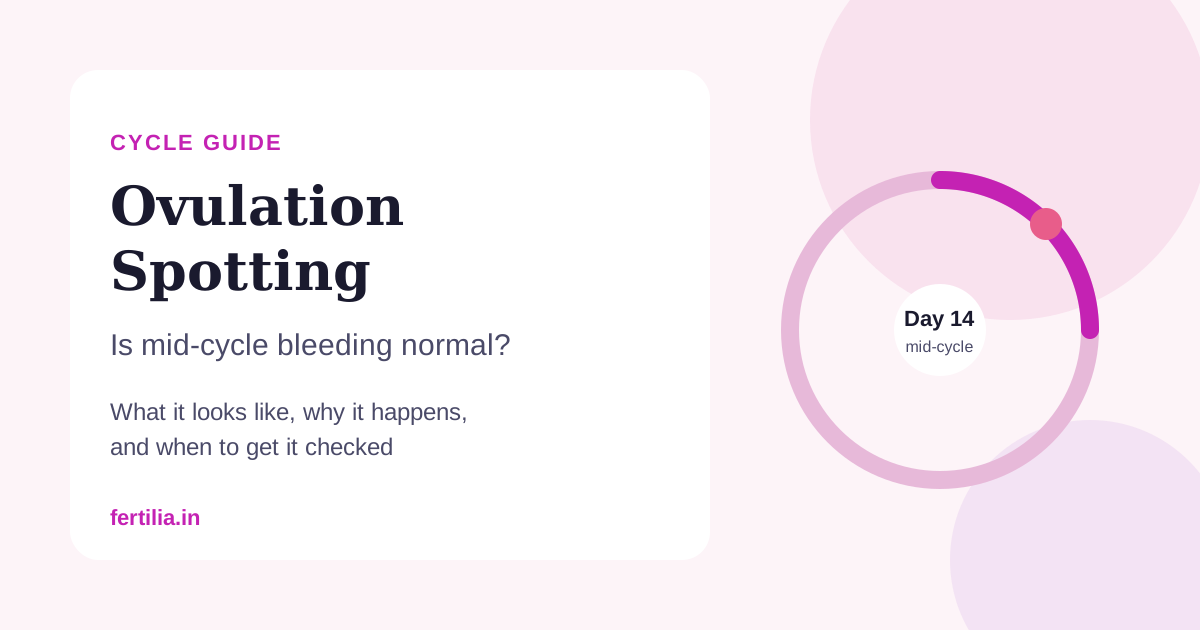
Ovulation spotting is light bleeding that happens around the time your ovary releases an egg. In a 28-day cycle, that is typically around day 13 to 15, but the timing moves with your cycle length. Ovulation usually happens about 14 days before your next period, so in a 32-day cycle it would be closer to day 18.
What it typically looks like:
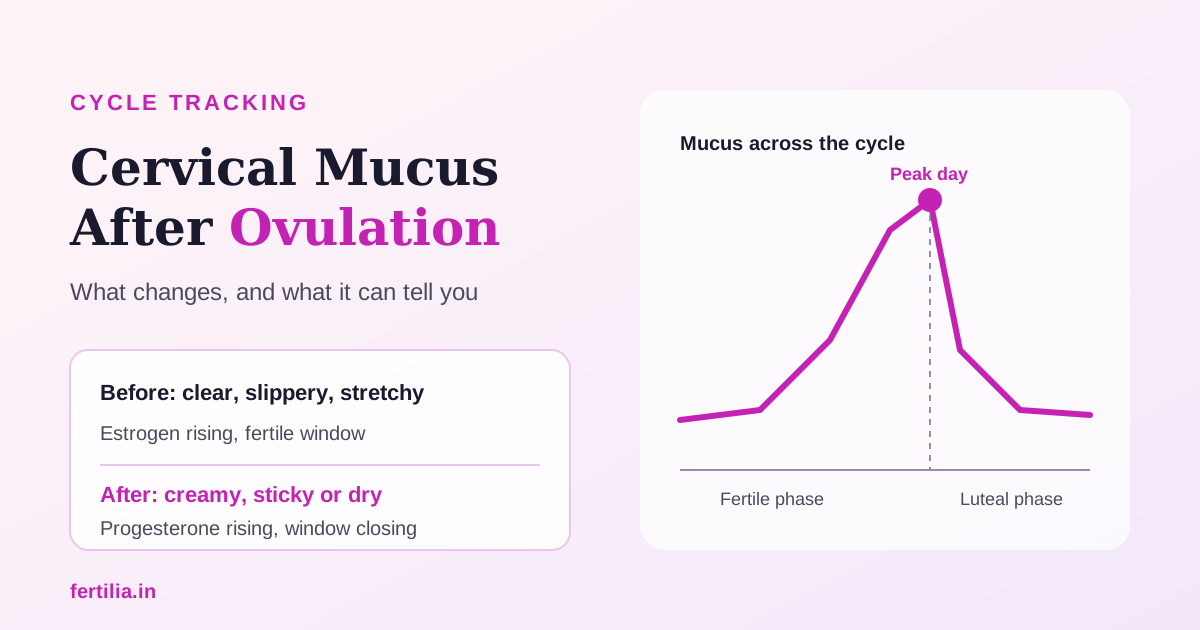
- Colour: light pink, or light brown if the blood is older. Pink often appears because a small amount of blood mixes with the clear, watery cervical mucus of the fertile phase.
- Amount: a few spots when you wipe, or a faint stain. It should not soak a pad.
- Duration: a few hours to one or two days.
- Timing: mid-cycle, roughly 10 to 16 days before the next period.
You may also notice other signs of ovulation at the same time: egg-white mucus, a mild one-sided ache, breast tenderness, or a slight increase in libido.
How common is mid-cycle bleeding?
Less common than the internet suggests. The BioCycle Study followed 201 regularly menstruating women through two cycles using daily diaries, and found that only 4.8% of women experienced midcycle bleeding (Dasharathy SS et al., Am J Epidemiol, 2012, PMID 22350580).
This matters for two reasons. First, if you never see ovulation spotting, that does not mean you are not ovulating. Most women who ovulate every month never spot. Second, because it is relatively uncommon, if you start spotting mid-cycle and you never did before, it’s reasonable to watch it for a couple of cycles and mention it to your doctor if it keeps happening.
Why does ovulation spotting happen?
The explanation most often given is hormonal. In the days before ovulation, oestrogen rises steadily as the dominant follicle grows, and this oestrogen supports the uterine lining. Around the LH surge and ovulation, oestrogen levels dip briefly before progesterone rises from the corpus luteum. That short dip may leave a small part of the lining less supported for a moment, and a little of it sheds.
Some women also link it to the follicle itself releasing the egg, but the hormonal dip is the more commonly cited mechanism. Either way, the result is small, brief, and self-limiting.
What ovulation spotting is not: it is not a sign of low fertility, and on its own it is not a sign of a hormone problem.
Ovulation spotting vs other kinds of spotting
Spotting at different points in the cycle means different things. This is the table I go through with women on video calls:
| Type | When it happens | What it looks like | What it usually means |
|---|---|---|---|
| Ovulation spotting | Mid-cycle, about 2 weeks before the period | Light pink or brown, 1 to 2 days, often mixed with clear stretchy mucus | Ovulation is happening |
| Implantation bleeding | 6 to 12 days after ovulation, a few days before the period is due | Light pink or brown, very light | Possible early pregnancy (test on the day of the missed period) |
| Pre-period spotting | 1 to 3 days before the period | Brown, then turns into the period | Often normal; sometimes discussed with progesterone levels |
| Bleeding after sex | Within hours of intercourse | Fresh red or pink | Often the cervix; worth a check if it repeats |
| Irregular spotting | Any time, no pattern | Varies | Needs a look for a cause |
If you are trying to work out whether spotting a few days before your period might be pregnancy, see the implantation bleeding guide. For spotting at other times of the month, the broader spotting between periods guide covers the full list of causes.
💗 Not sure what your mid-cycle spotting means? Dr. Suganya Venkat consults online across India over video call. Message us on WhatsApp and the team will help you book a consultation (₹399 in India, US $20 from outside India).
Can ovulation spotting help you get pregnant?
It can be a helpful clue. Pregnancy is possible only on the days leading up to and including ovulation. In a landmark study of women trying to conceive, conception occurred only when intercourse took place in the six-day window ending on the day of ovulation (Wilcox AJ et al., N Engl J Med, 1995, PMID 7477165).
So if you tend to spot mid-cycle, it can tell you that you are around your most fertile days. A few practical points:
- Don’t wait for the spotting. By the time you see it, ovulation may already be happening or have just happened. Having sex every 2 to 3 days across the cycle, or more often across the days of fertile mucus, covers the window without timing stress.
- Watch your mucus first. Clear, slippery, egg-white cervical mucus usually appears a day or more before ovulation, which makes it a more useful early signal than spotting.
- Use it with a calendar. Write down the day you spot for two or three cycles. If it lands in the same place, you have a personal marker for your fertile window.
- Ovulation kits can confirm it. An LH test turning positive a day or so before the spotting supports the idea that it’s ovulation-related.
A little blood in the mucus does not stop sperm from getting through, so there is no need to avoid sex on a spotting day if you’re trying.
Does mid-cycle pain come with it?
Some women notice a mild ache low on one side around the same time. This is ovulation pain, also called mittelschmerz, and it often sits on the side that is ovulating that month. It usually lasts minutes to a day. If you want the details on it, read the ovulation pain guide. Severe pain, pain that keeps building, or pain with fever or fainting is different and needs prompt medical attention.
When mid-cycle bleeding is worth checking
Most mid-cycle spotting is harmless, but a few patterns are worth showing to a doctor. None of these mean something is seriously wrong; they simply mean the cause is worth finding:
- The bleeding is heavier than spotting, enough to need a pad, or it lasts more than 2 to 3 days.
- It happens every cycle and is new for you, or it is getting heavier over time.
- It follows sex. Repeated post-coital bleeding needs a cervical check. See the bleeding after sex guide.
- It comes with pain, an unusual discharge, or a bad smell.
- You are on a hormonal pill, a patch, or another hormonal method, since breakthrough bleeding on these has its own causes and fixes.
- Your cycles are irregular, so you can’t be sure the bleeding is mid-cycle at all.
- You could be pregnant. Take a home pregnancy test if your period is late.
- You have not had a cervical screening test in the recommended interval.
Common, very treatable causes doctors look for include endometrial polyps, cervical changes (such as an ectropion), infections, thyroid imbalance, and hormonal contraceptive effects. An endometrial polyp, for example, can cause spotting between periods and is often removed with a short procedure.
What your doctor may check
If your spotting needs a closer look, the workup is usually simple:
- A cycle history. Bring your notes: day of spotting, colour, amount, how long it lasted, and any mucus or pain.
- A pregnancy test, if there’s any chance.
- A pelvic examination and cervical screening, if due.
- A pelvic ultrasound, ideally timed in the first half of the cycle, to look at the lining and check for polyps or fibroids.
- Blood tests if the pattern points that way, such as thyroid (TSH) or a mid-luteal progesterone.
This is work your local gynaecologist can do, and at Fertilia we often work alongside that care, helping women make sense of the results and plan the next step if they’re trying to conceive.
What you can do this month
- Track it. A simple notes app or calendar is enough. Write the cycle day, the colour, and how much.
- Note your mucus each day for a cycle. It turns a single spot into a pattern you can read.
- Use a panty liner if you want; there’s no need for anything heavier.
- Keep trying as usual if you’re trying to conceive. Spotting days are fertile days.
- Get it checked if any of the patterns in the list above apply.
FAQ
Is spotting during ovulation a good sign?
It is a sign that ovulation is likely happening, which is useful if you’re trying to conceive. It isn’t a sign of better or worse fertility. Most women who ovulate regularly never spot at all.
How long does ovulation spotting last?
Usually a few hours to one or two days. Spotting that lasts longer than about three days, or gets heavier, should be discussed with a doctor.
What colour is ovulation spotting?
Light pink or light brown. Pink is common because the small amount of blood mixes with clear fertile mucus. Bright red, heavy bleeding with clots is not typical of ovulation spotting.
Can I get pregnant if I have ovulation spotting?
Yes. Spotting happens around your most fertile days. Pregnancy is possible when sex happens in the days leading up to and including ovulation, and a little blood does not block sperm.
How do I know if it’s ovulation spotting or implantation bleeding?
Timing is the main clue. Ovulation spotting comes mid-cycle, about two weeks before your period. Implantation bleeding, if it happens, comes about 6 to 12 days after ovulation, a few days before your period is due. If your period is late, take a pregnancy test.
Is mid-cycle spotting a sign of PCOS?
Not on its own. PCOS usually shows up as irregular or missed periods rather than tidy mid-cycle spotting. If your cycles are irregular and you’re spotting at unpredictable times, it’s worth a review that includes PCOS among other causes; the PCOS guide explains the usual signs.
Should I see a doctor for spotting between periods?
If it’s light, brief, and mid-cycle, you can simply track it. See a doctor if it’s heavy, lasts several days, follows sex, comes with pain, keeps recurring as a new pattern, or if you might be pregnant.
Talk it through with Dr. Suganya
Spotting you don’t understand can sit at the back of your mind all month. A few minutes with a doctor who looks at your whole cycle, your notes and your plans for a baby often settles it. If you’re trying to conceive, her Fertility program supports you through every step, and our free guide to getting pregnant is a good place to start.
Questions about your cycle? WhatsApp Dr. Suganya to book an online video consultation, ₹399 in India and US $20 from outside India.