You notice a twinge on one side of your lower abdomen, somewhere around day 12 or 14 of your cycle. It lasts a few hours and then disappears. The next cycle it is on the other side.
You search online and find both “completely normal” and “could be something serious” in the same results page.
That tension is exactly what I want to sort out here. Ovulation pain, called mittelschmerz in clinical medicine, is one of the most common mid-cycle symptoms I hear about from patients across India. For most women, it is a reliable physiological signal with no medical significance. For a small number, it can be the body’s way of flagging something that deserves attention.
This guide explains what causes it, what normal looks like, how to use it when you are trying to conceive, and what changes in the pattern warrant a closer look.
What does mittelschmerz mean?
The word is German for “middle pain,” which describes exactly when it happens: in the middle of the menstrual cycle, around the time of ovulation.
In a typical 28-day cycle, ovulation happens near day 14. In cycles that run longer or shorter, the timing shifts. The pain is not tied to a calendar date but to the moment a follicle ruptures on one of the ovaries and releases an egg.
Why does it happen?
Two mechanisms are involved, and both are part of normal ovulation:
Follicle stretching before rupture. In the days leading up to ovulation, a dominant follicle grows on one ovary. This growth stretches the outer layer of the ovary, which can produce a dull ache or pressure on the side where that follicle is developing.
Peritoneal irritation after rupture. When the follicle ruptures, it releases follicular fluid into the pelvis. This fluid, along with a small amount of blood, can briefly irritate the peritoneum, the lining of the abdominal cavity. The peritoneum is sensitive to contact, and that irritation produces the pain you feel.
Both processes resolve once the fluid is reabsorbed, which is why the pain is self-limiting.
How common is it?
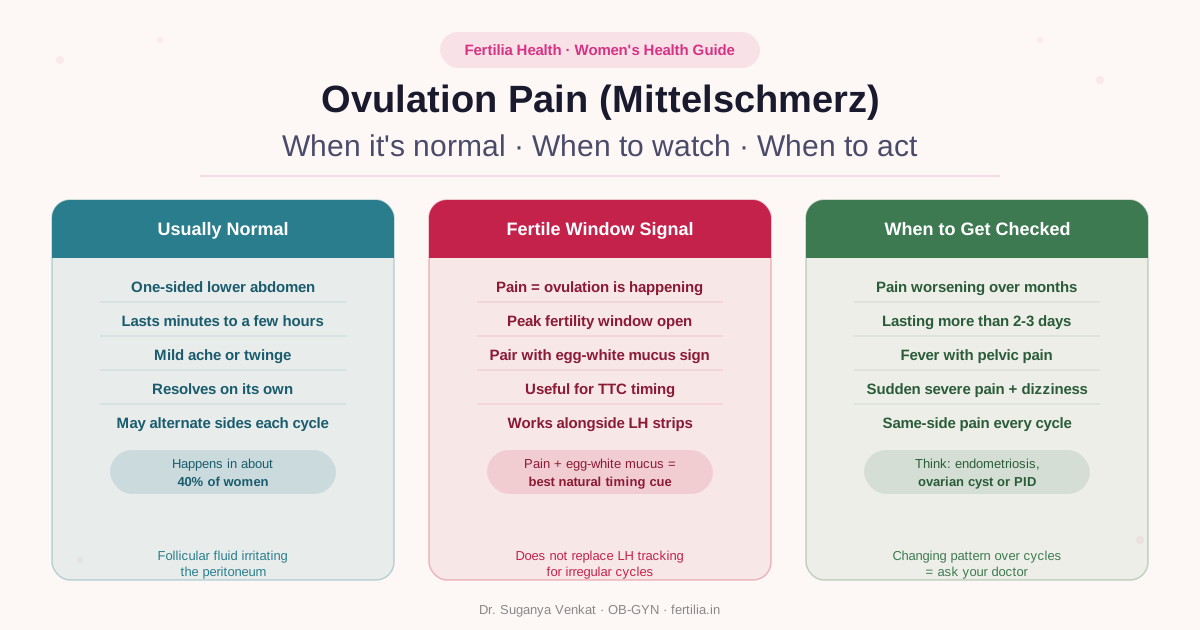
About 40% of women notice some form of ovulation pain during their cycles. It is one of the most frequently reported cycle symptoms, just after period pain and pre-period bloating.
It does not mean anything is wrong. It means you are ovulating, and your body is doing what it is meant to do.
What normal mittelschmerz feels like
There is a recognisable pattern to typical ovulation pain. Not every cycle will feel identical, but these characteristics are reassuring:
Location: One side of the lower abdomen, roughly where the ovary sits. Right side in some cycles, left side in others. The side can switch because ovaries tend to alternate, though some women consistently ovulate on one side more often.
Duration: Minutes to a few hours. Occasionally up to 24 hours. Rarely, mild discomfort can linger for two days, but it should ease noticeably with time rather than worsen.
Character: A dull ache, cramp, or twinge. Some women describe it as a brief sharp sensation at the moment of rupture, followed by a duller ache. It is usually mild enough to manage without stopping what you are doing.
What is not present: No fever. No foul-smelling discharge. No vomiting. No pain that worsens over several hours instead of fading. No spreading to both sides at once. No fainting or dizziness.
If the experience fits this description, you are almost certainly looking at normal ovulation physiology.
Using ovulation pain as a fertile window signal
This is particularly useful for women who are trying to conceive.
Mittelschmerz happens at or very near the moment of ovulation, which places it at the edge of your fertile window. The fertile window spans roughly the five days before ovulation and the day of ovulation itself. The 24 to 48 hours before and immediately after ovulation are when conception is most likely (read more on timing in the fertile window guide).
If you notice ovulation pain alongside egg-white cervical mucus (the clear, stretchy discharge that typically peaks at ovulation), you have two body signals pointing to the same window. That alignment is a reliable natural indicator, even without a urine LH test.
One practical note: ovulation pain tells you that ovulation has happened or is happening. It does not predict ovulation 24 to 48 hours ahead the way an LH surge does. So if you want advance notice of your fertile window, pairing body signs with an LH tracking method gives you a wider preparation window. The ovulation tracking guide walks through how to combine these signals.
For women with regular cycles, mittelschmerz is a genuine addition to your cycle-reading toolkit. For women with irregular cycles or PCOS, where ovulation timing is less predictable, relying on pain alone is less reliable. Tracking alongside cervical mucus and LH strips gives a clearer picture, and that is where a conversation with your gynecologist can help shape a practical plan.
If you have questions about ovulation, cycle patterns, or what your symptoms mean for your chances of conceiving, you are welcome to message me directly. I work with women across India over a video call, and I am happy to look at your full picture.
When to watch the pattern more closely
The following changes in your ovulation pain are worth tracking and mentioning to your doctor at the next visit. None of them are emergencies on their own, but they are signals that something else may be contributing.
Pain that is getting worse over months. Mild ovulation discomfort that gradually becomes more intense, or that starts extending later into the second half of your cycle, is a pattern associated with endometriosis. Endometriosis involves tissue similar to the uterine lining growing outside the uterus, and the ovaries are one of the most common sites. When endometrial deposits on or near an ovary are disturbed by ovulation, they can cause significantly more pain than normal mittelschmerz. If ovulation pain has become something you dread rather than notice, that shift is worth investigating (read more about endometriosis and fertility).
Pain that lasts longer than two to three days every cycle. Normal ovulation pain resolves within a day. Pain that lingers through the second half of the cycle, or that seems to connect one cycle’s ovulation pain to the start of the next period, is not typical.
Pain coming from an ovarian cyst. Sometimes what feels like ovulation pain is actually pressure or irritation from a cyst on the ovary. Functional cysts (follicles that did not fully rupture or corpus luteum cysts) are common and usually resolve on their own, but they can cause pain that is difficult to distinguish from mittelschmerz without an ultrasound. If you have been told you have cysts on your ovaries, it is worth mentioning recurring mid-cycle pain at your next scan. The post on ovarian cysts: when to worry covers what different cyst findings mean.
Pain alongside unusual vaginal discharge. If mid-cycle pain comes with discharge that has an odour, or if it is accompanied by a low-grade fever, those two symptoms together raise the possibility of pelvic inflammatory disease (PID), an infection of the reproductive tract. This combination needs a clinical review rather than watchful waiting.
Red flags that need prompt attention
These situations call for same-day medical evaluation rather than observation at home:
Sudden, severe one-sided pain with dizziness or faintness. This pattern, especially if it comes on quickly and feels different from anything you have had before, needs to be assessed urgently. A large ovarian cyst rupturing with internal bleeding, or in rare cases an ectopic pregnancy, can present this way. If there is any possibility of pregnancy, seek care immediately (the ectopic pregnancy guide has more on the warning signs).
Fever with pelvic pain. Fever and lower abdominal pain together, regardless of where you are in your cycle, should be evaluated by a doctor the same day.
Progressive pain over several hours that is not easing. Normal ovulation pain fades. Pain that continues to intensify over a few hours without relief is not typical and deserves assessment.
What helps with ovulation pain
For women with normal mittelschmerz who simply want to be more comfortable:
Warmth. A warm compress or heat pad on the lower abdomen is one of the simplest and most effective ways to ease the dull ache of ovulation pain. Use it for 20 minutes at a time.
Rest when needed. The pain is brief. If you can take a short break during the worst of it, that is enough for most women.
Food-based anti-inflammatory support. This does not eliminate ovulation pain, but a diet that supports lower inflammation is generally helpful for hormonal symptoms. Flaxseeds, fish, haldi (turmeric) in warm milk, and foods rich in omega-3 fatty acids are useful additions to an everyday routine. These are not a treatment for ovulation pain but part of a supportive pattern.
Over-the-counter pain relief if needed. A standard dose of ibuprofen or paracetamol is safe for occasional use. If you find yourself needing pain relief every single cycle, that is a cue to discuss whether the pain is truly typical mittelschmerz or whether something else needs evaluating.
What does not help: Waiting months to mention worsening pain because you assume it is “just ovulation.” Pain that changes in character or intensity over time is always worth discussing with a doctor who knows your cycle history.
What to discuss at your next appointment
If you have not mentioned ovulation pain to your gynecologist, here is a simple framework for that conversation:
- Which side the pain is on (or whether it alternates)
- How long it typically lasts
- Whether the intensity has changed over the past few cycles
- Whether it is accompanied by any other symptoms, such as discharge, spotting, or bloating
- Whether it is happening in the context of trying to conceive
This gives your doctor a starting point and helps distinguish whether this is a benign physiological pattern or something that warrants an ultrasound.
FAQ: Ovulation pain (mittelschmerz)
Q: Is ovulation pain the same as period cramps?
No. Period cramps (dysmenorrhoea) happen when the uterus contracts to shed its lining at the start of your period. They are usually felt in the centre of the lower abdomen or radiating to the lower back. Ovulation pain (mittelschmerz) happens mid-cycle, is one-sided, and lasts a much shorter time. The period pain post covers the distinction in detail for women whose cramps are severe.
Q: Can I get pregnant if I have ovulation pain?
Yes. Ovulation pain means ovulation is occurring, which is the essential step for natural conception. Noticing mid-cycle pain is actually useful information when you are trying to conceive, because it helps you identify your fertile window. Many women use it alongside cervical mucus changes as a practical timing guide.
For more on this, read our guide on Ovulation Pain. Q: What does ovulation pain in Tamil look like as a search term?
Women in Tamil Nadu often search for this as “ovulation vali” or “karumuttai vali” (கருமுட்டை வலி in Tamil script). In Hindi, common search terms include “andotsarg mein dard” and “ovulation dard.” If you have been searching these terms and landed here, the guide above applies fully to your situation.
Q: I feel pain on the same side every cycle. Is that normal?
Most women do not feel pain on a perfectly alternating schedule. Some consistently feel it on the right, some on the left, some alternately. If the pain is always on the same side and is getting progressively worse over cycles, it is worth an ultrasound to check whether there is a persistent cyst or other finding on that ovary.
Q: How do I tell the difference between ovulation pain and appendix pain?
Appendix pain (appendicitis) typically starts near the navel and moves to the lower right. It worsens over hours, is accompanied by nausea, and does not resolve without treatment. Ovulation pain on the right side at mid-cycle can mimic this briefly, but it tends to be milder, does not progress in the same way, and resolves on its own. If you are unsure, trust your instincts: pain that is getting worse rather than better, or that comes with vomiting or fever, should be evaluated by a doctor.
Q: Can ovulation pain indicate endometriosis?
Occasional mild ovulation pain does not by itself indicate endometriosis. But if your ovulation pain has intensified over time, if it now lasts several days, or if you also have very painful periods and pain during or after intercourse, those patterns together are worth investigating. Endometriosis often shows itself through a cluster of symptoms rather than any single one. See the endometriosis and fertility post for more on how it presents and what evaluation involves.
Q: What ovulation symptoms should I be tracking alongside pain?
The most useful combination is: mid-cycle pain + cervical mucus (watch for egg-white consistency) + position in your cycle (count from the first day of your last period). If you use an LH strip, a positive result typically appears one to two days before ovulation pain. The ovulation symptoms guide covers all the body signs that tend to appear together during the fertile phase.
Ovulation pain is something I hear about from patients every week. For the large majority, it is exactly what it appears to be: a normal part of the cycle that gets more noticeable in some months than others. The skill is learning to read the pattern over time rather than reacting to any single episode in isolation.
If your ovulation pain has changed, if it is affecting your daily life, or if you are trying to conceive and want to understand how your symptoms fit into the timing picture, I am happy to talk it through. A single consultation is enough to make sense of what your body is telling you.