Many women who track their cycles know the slippery, stretchy, egg-white mucus that comes before ovulation. Fewer know what to expect after it. Then the discharge changes, sometimes within a day, and the questions start. Is thick white discharge normal now? Does creamy discharge mean I am pregnant? Why did it suddenly go dry?
I’m Dr. Suganya Venkat, an OB-GYN with more than 15 years of practice, and these are some of the most common questions women bring to our online consultations at Fertilia during the second half of the cycle. The short version: a change after ovulation is expected, and it is usually a sign that your body has moved into the next phase, not that something has gone wrong.
What this post covers:
- What happens to cervical mucus once ovulation has passed
- The “peak day” and why the change after it matters
- What post-ovulation discharge can and cannot tell you about pregnancy
- What is normal in the luteal phase, and what is worth checking
- How to use this sign alongside other cycle-tracking tools
If you want the full picture of mucus in the fertile window (the days before ovulation), our cervical mucus guide for trying to conceive covers each type in detail. This post picks up where that one stops.
What changes in your cervical mucus after ovulation
Your cervix makes mucus throughout the cycle, and two hormones mostly decide what it is like.
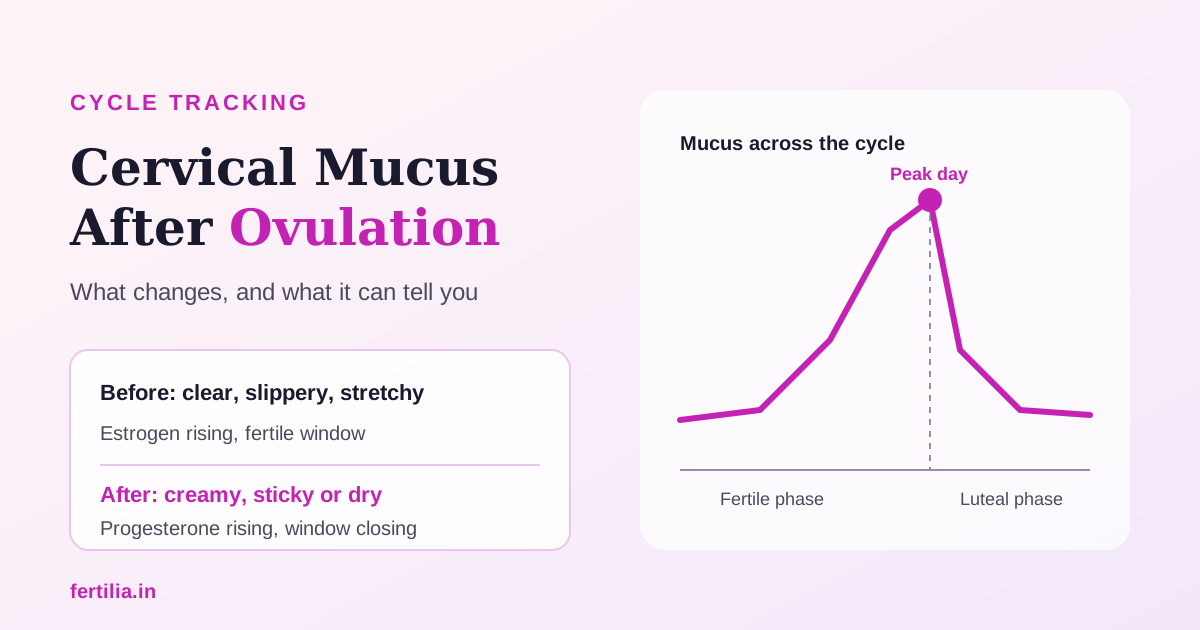
Before ovulation, rising estrogen makes the cervix produce more mucus that is watery, clear and stretchy. This mucus helps sperm travel and survive, which is why it appears in the days leading up to ovulation.
After ovulation, the empty follicle in the ovary becomes the corpus luteum and starts producing progesterone. Progesterone has close to the opposite effect on the cervix. The mucus usually becomes:
- Thicker and less in quantity
- Creamy, white, cloudy or pale yellow rather than clear
- Sticky, tacky or pasty rather than stretchy (it breaks when you pull it between two fingers)
- Sometimes almost absent, so the vulva feels dry for several days
This thicker mucus is much harder for sperm to pass through. In practical terms, the fertile window is closing.
The shift can be quick. Many women notice it within a day or two of their last slippery day. For others it is gradual, with a mix of creamy and slightly wet days before things settle. Both are normal patterns.
The “peak day” and why the change matters
In fertility-awareness methods, the peak day is the last day you notice the most fertile-type mucus (clear, slippery or stretchy) or a slippery, wet sensation. You only recognise it in hindsight, when the next day the mucus has turned thicker or drier.
Peak mucus is a useful signal because it lines up closely with ovulation. In a study of 107 women who recorded their mucus every day while having daily ovarian ultrasound, peak-type mucus (clear, slippery or stretchy) identified the two-day ovulation window with 88% sensitivity, and identified the six-day biological fertile window with 96% sensitivity (Ecochard R et al., Fertil Steril, 2015, PMID 25724738).
So when your mucus turns from slippery to sticky or dry, it is reasonable to read that as “ovulation has very likely just happened.” It is a helpful sign, not a guarantee, and it works best when you have watched your pattern for a few cycles.
Two practical points follow from this:
- The best days for intercourse are before the change, not after it. Conception is most likely from intercourse in the six days ending on the day of ovulation (Wilcox AJ et al., N Engl J Med, 1995, PMID 7477165). Once the mucus has clearly dried up for a few days, the chance of conceiving in that cycle is low.
- The quality of mucus on a given day carries real information. In a large analysis of cycle charts, the type of mucus observed on a day predicted the chance of conception better than the timing of intercourse relative to ovulation alone (Bigelow JL et al., Hum Reprod, 2004, PMID 14990542).
If you are trying to conceive, this means the slippery days are your signal to try, and the change afterwards is simply confirmation that the window has passed for this cycle.
Discharge after ovulation: what is normal in the second half of the cycle
The luteal phase (from ovulation until your next period) usually lasts about 12 to 14 days. Across those days, discharge commonly looks like this:
| Time after ovulation | What many women notice |
|---|---|
| First 1 to 3 days | Mucus thickens quickly, turns cloudy or creamy, may feel sticky |
| Middle of the luteal phase | Little or no mucus, or a small amount of thick white or creamy discharge |
| Last few days before the period | Some women notice more white, creamy or slightly wet discharge again |
All of these are within the normal range. Some women also see a brief wetter patch in the middle of the luteal phase. This happens, and on its own it is not a second ovulation or a problem.
Normal post-ovulation discharge is:
- White, off-white, cream or pale yellow on underwear (it can dry slightly yellowish on fabric)
- Mild in smell or without smell
- Not itchy, not burning, not frothy
For a fuller picture of what healthy discharge looks like across the whole cycle, see our guide to normal vaginal discharge and when to worry. If the white discharge you are noticing appears in the last few days before your period, our post on white discharge before a period explains that phase in more detail.
💜 Tracking your cycle and unsure what your mucus pattern is telling you? Message Dr. Suganya’s team on WhatsApp and we can go through your chart with you. Consultations are online, ₹399 in India.
Can discharge after ovulation tell you if you are pregnant?
This is the question I am asked most often, especially in the two-week wait.
Creamy white discharge after ovulation is driven by progesterone. Progesterone is high in the second half of every ovulatory cycle, whether or not an egg has been fertilised. In early pregnancy, progesterone stays high, so discharge often stays creamy too. The two situations look very similar, because the same hormone is behind both.
That means:
- Creamy or white discharge after ovulation does not mean you are pregnant. It is what most cycles look like at this stage.
- Dry days after ovulation do not mean you are not pregnant. Many women who go on to have a positive test noticed very little discharge.
- More discharge than usual before a missed period is not a reliable sign either way.
The clear answer comes from a missed period and a pregnancy test. Testing around the day your period is due, or a few days after, gives the most reliable result. Our guide on when to take a home pregnancy test and how to read it explains the timing.
I know the waiting is the hard part. If it helps, give yourself permission to stop checking your underwear for clues during these days. Your discharge in the luteal phase is telling you that you ovulated, which is good information on its own. It is not trying to tell you whether you have conceived.
What post-ovulation mucus can tell you
While it cannot answer the pregnancy question, the change after ovulation is still useful:
It is a sign you probably ovulated. A clear shift from slippery mucus to thick or dry mucus suggests progesterone has risen, which happens after ovulation. If you never see a slippery phase or a clear change across several cycles, that is worth discussing with a doctor, because it can sometimes reflect cycles where ovulation is not happening regularly. Our post on signs of ovulation lists the other clues to look for.
It helps you time things next cycle. Once you know roughly which cycle day your peak day falls on, you can plan to have intercourse every one to two days in the days leading up to it.
It helps you estimate your luteal phase. Counting from the day after your peak day to the day before your next period gives a rough idea of the length of your luteal phase. If this is repeatedly very short, say well under 10 days, it is a reasonable thing to raise with your doctor. Our guide on luteal phase defect explains what that term means and how it is assessed.
When a woman needs firmer confirmation than mucus alone, a blood progesterone test about seven days after ovulation is the usual next step. Our explainer on day-21 progesterone covers why the timing matters more than the name.
When discharge after ovulation is worth checking
Most changes after ovulation are normal. A few features point to something other than your cycle, usually an infection that is simple to treat. It is worth speaking to a doctor if you notice:
- A strong or fishy smell, especially after intercourse
- Itching, burning or soreness of the vulva
- Thick, curd-like white discharge with itching
- Grey, green or frothy discharge
- Pain in the lower abdomen with fever, or pain during sex that is new for you
- Bleeding between periods that keeps recurring
These signs are common, usually easy to sort out, and nothing to feel embarrassed about. A short consultation is usually enough to work out what is going on.
Light spotting a few days after ovulation, or around the time a period would be expected, has several possible explanations. If you are in the two-week wait, our guide on implantation bleeding explains what it typically looks like.
Things that can change your mucus pattern
Your pattern may look different from a textbook chart, and that is common. Some things that can affect it:
- Hormonal medicines. Contraceptive pills and other hormonal methods change mucus, and so can some ovulation-induction tablets. Some women taking clomiphene in fertility treatment notice less fertile-type mucus than usual.
- Vaginal products. Lubricants, vaginal gels and pessaries (including progesterone used in treatment cycles) add their own discharge, which can make mucus hard to read.
- Infections, which change colour, smell and texture.
- Breastfeeding, PCOS and other conditions that affect ovulation, which can give long stretches without a clear pattern.
- Arousal fluid and semen, which are easy to mistake for fertile mucus. Checking at the same time each day, away from intercourse, helps.
If you are in a medicated IUI or IVF cycle, treat mucus as background information only and follow your treatment team’s plan. Our guide to the two-week wait after IUI or IVF covers that situation.
Using this sign well: a simple approach
- Check once or twice a day, at the same times, by noticing the sensation at the vulva and wiping with tissue before passing urine.
- Write down two things: how it feels (dry, sticky, creamy, wet, slippery) and how it looks.
- Mark your peak day the day after you notice the change.
- Track for at least two or three cycles before drawing conclusions. One cycle is a snapshot.
- Pair it with another sign if you want more certainty, such as LH strips or basal body temperature. Our guide on how to track ovulation compares the options.
This is exactly the kind of chart Dr. Suganya Venkat likes women to bring to a first consultation in Fertilia’s fertility program, because a few cycles of notes often answer questions that a single blood test cannot.
What it is called in Tamil and Hindi
Many women search for this in their own language. In Tamil, white discharge is commonly called vellai padudhal, and in Hindi it is often called safed paani. Searches such as “ovulation ke baad safed paani” (white discharge after ovulation) usually describe the normal, progesterone-driven change explained above. The same rule applies whichever words you use: thick, creamy, odourless discharge after ovulation is expected, while itching, a strong smell or a colour change is worth showing a doctor.
Frequently asked questions
What does cervical mucus look like after ovulation?
After ovulation, cervical mucus usually becomes thicker, creamy, white or cloudy, and sticky rather than stretchy. Many women also notice several dry days. This change is caused by progesterone, which rises after ovulation.
How soon after ovulation does cervical mucus dry up?
For many women the change is noticeable within one to two days after the last slippery, stretchy day (the peak day). For some it is more gradual. Both patterns are normal.
Is creamy discharge after ovulation a sign of pregnancy?
Not on its own. Creamy discharge after ovulation happens in most ovulatory cycles because progesterone is high whether or not you conceived. A missed period followed by a pregnancy test is the reliable way to know.
Is it normal to have no discharge after ovulation?
Yes. Little or no discharge for several days after ovulation is common and normal. It does not mean you have not conceived.
Can I still get pregnant once my mucus has gone sticky or dry?
The chance is low. Conception is most likely from intercourse in the six days ending on ovulation day, which is when slippery, fertile-type mucus is usually present. Once mucus has been clearly thick or dry for a few days, ovulation has very likely passed for that cycle.
Is watery discharge after ovulation normal?
A short, wetter patch in the second half of the cycle can happen and is usually normal. If watery discharge comes with itching, a strong smell, or a colour change, or if it is persistent and you are pregnant, speak to a doctor.
When should I see a doctor about discharge after ovulation?
See a doctor if discharge has a strong or fishy smell, is itchy, curd-like, grey, green or frothy, or comes with pain, fever or repeated bleeding between periods. Also speak to a doctor if you never see a clear change in mucus across several cycles while trying to conceive.
Your cycle is giving you useful information
The thick, creamy or dry days after ovulation are your body moving into the second half of its cycle, usually right on schedule. You do not need to read pregnancy into them, or worry when they look different from last month. A few cycles of simple notes can tell you a great deal about when you ovulate and how long your luteal phase is.
💜 Want help reading your cycle chart, or trying to conceive and not sure where to start? Talk to Dr. Suganya on WhatsApp to book an online consultation (₹399 in India). We work with women across India, over a video call.