The report says FSH 11.2, and next to it, in small grey print, a range that covers almost everything from 2 to 130. One number, three different reference ranges, and no line telling you which one applies to you. That is how most women arrive at my consultations with an FSH result: not worried about the hormone, but worried about not knowing whether 11 is good, bad or nothing at all.
I’m Dr. Suganya Venkat, an OB-GYN with more than fifteen years of practice, and reading FSH reports is a large part of the fertility conversations I have at Fertilia. This post is about one number only: what a normal FSH looks like, what yours says about your ovarian reserve, and what it cannot tell you.
Here is what this post covers:
- What FSH does, and why the range on your report is so wide
- The FSH range that matters for fertility (early in the cycle)
- What a raised FSH means, and why one result is never the whole story
- What a low FSH means
- Why FSH is read with estradiol and AMH
- What to do with your number
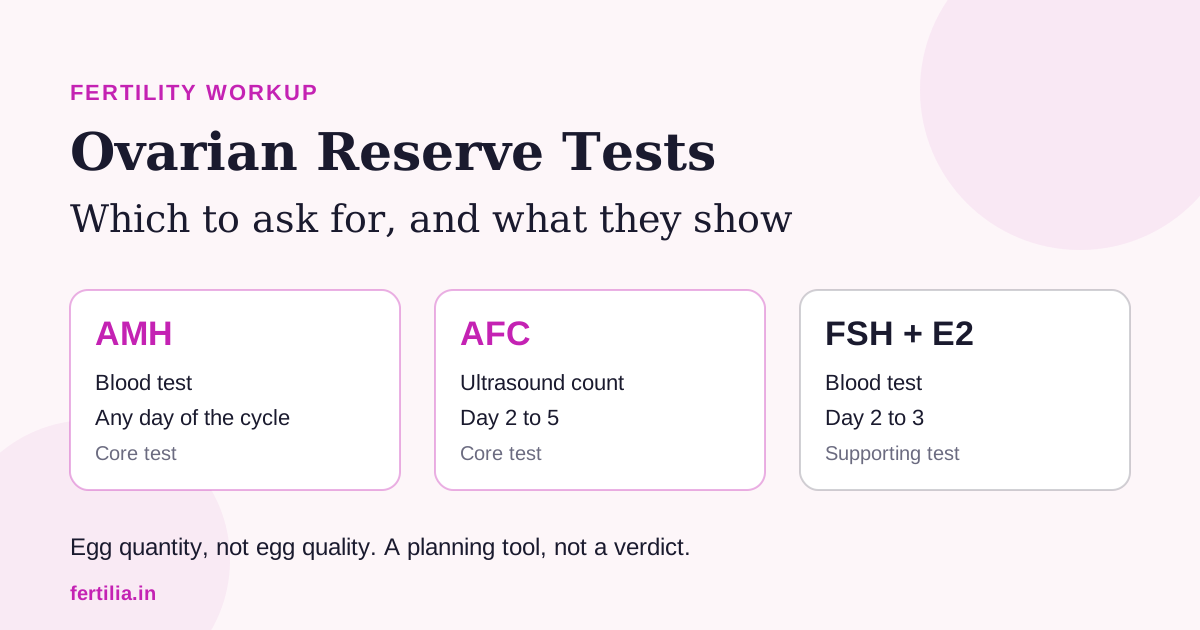
If you are still deciding which tests to do at all, start with our guide to which ovarian reserve tests to ask for. This post picks up once you have the FSH number in your hand.
What FSH Does
FSH (follicle-stimulating hormone) is made by the pituitary gland at the base of the brain. At the start of each cycle it signals the ovaries to grow a group of follicles, the small fluid sacs that each hold an egg. As those follicles grow, they release estradiol and other hormones that travel back to the brain and tell it to ease off.
That feedback loop is why FSH is used as a marker of ovarian reserve. When plenty of follicles are responding, the ovaries “answer” the signal easily and FSH stays low. When fewer follicles are left, the brain has to call louder to get the same response, and FSH rises.
Ovarian reserve itself means one thing: the number of eggs left in your ovaries. The American Society for Reproductive Medicine’s committee opinion defines it as oocyte quantity, and notes that reserve markers help predict how many eggs will be collected in IVF but are poor predictors of reproductive potential independent of age (ASRM Practice Committee, Fertil Steril, 2020, PMID 33280722). Keep that sentence in mind as you read the rest of this post: FSH tells you something about how many eggs are left, and much less about whether you will get pregnant.
Why the Range on Your Report Is So Wide
Most lab reports in India print FSH reference ranges for several phases of the cycle and for menopause, side by side. That is because FSH moves through the month: it is moderate at the start, surges briefly with LH just before ovulation, falls in the second half, and climbs to much higher levels after menopause, when the ovaries no longer answer it.
So the only range on your report that matters for an ovarian reserve question is the early follicular range, and only if your blood was drawn early in the cycle. An FSH drawn on Day 14 or Day 21 cannot be compared to it.
Two other practical points:
- Units. FSH is reported in mIU/mL or IU/L. For FSH these are the same number, so 8 mIU/mL and 8 IU/L mean the same thing.
- Labs differ. Different analysers are calibrated differently, so the exact cut-offs vary between labs. Compare your result with your own lab’s printed early follicular range, and if you repeat the test, try to use the same lab.
The FSH Range That Matters for Fertility
FSH for fertility is drawn on Day 2 to 3 of your cycle, counting the first day of full flow as Day 1. Most labs accept Day 2 to 4. At this point the previous cycle has ended and the hormones are at their quietest, so FSH reflects the brain’s resting signal to the ovaries.
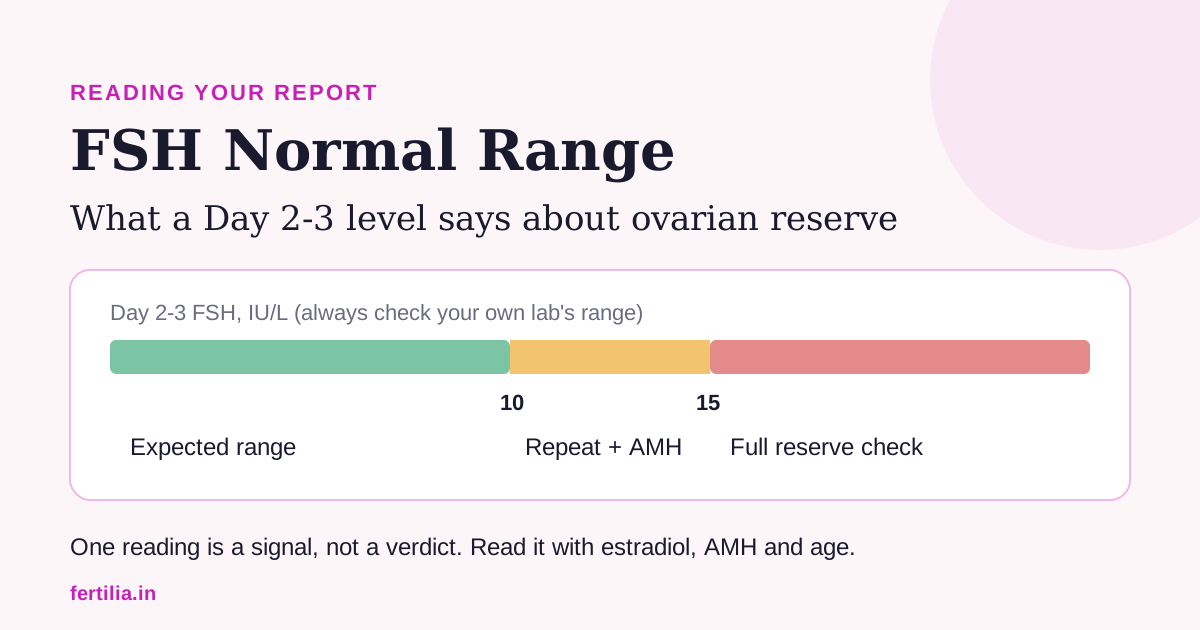
In practice, this is how I read an early-cycle FSH, always against the lab’s own range:
| Day 2-3 FSH | How it is usually read |
|---|---|
| Below about 10 IU/L | Within the expected range for this phase |
| About 10 to 15 IU/L | Mildly raised; repeat it and add AMH or an antral follicle count |
| Above about 15 IU/L | Clearly raised; a full ovarian reserve assessment is the next step |
| Above 25 IU/L, with missed or irregular periods, under 40 | A pattern doctors check for premature ovarian insufficiency |
The 10 IU/L line is not arbitrary. It is the cut-off researchers commonly use for a “high” FSH, including the JAMA study described further down. But it is a line on a continuum, not a cliff. An FSH of 9.8 and one of 10.4 describe almost the same ovaries.
What a normal FSH does not mean: it does not promise that you will conceive, and it says nothing about egg quality. Quality is mainly linked to age. A 41-year-old can have a perfectly normal FSH and still have fewer good-quality eggs than she did at 30.
For how FSH sits with LH and estradiol on the same Day 3 draw, including the LH:FSH pattern seen in PCOS, see our Day 3 FSH, LH and estradiol guide.
A Raised FSH: Why One Result Is Never the Whole Story
FSH changes from one cycle to the next, sometimes by a lot. A study of 81 women who had each had three or more IVF attempts found that FSH from cycle to cycle varied by about 2.6 mIU/mL on average in women whose mean FSH was below 15, and by about 7.3 mIU/mL in women whose mean was 15 or above (Scott RT et al., Fertil Steril, 1990, PMID 2116330). In other words, the higher the FSH, the more it jumps around.
This is why I never act on a single raised value. A woman with an FSH of 13 this month may have 9 next month, and the lower result does not cancel the higher one either. What I look for is the pattern across two or three readings, and how it fits with AMH and the scan.
The same study also found that a lucky “low month” did not change how the ovaries responded to IVF stimulation, so waiting for a better FSH cycle before treatment is not a strategy the evidence supports.
What a raised FSH can mean
- Lower ovarian reserve than expected for age. The most common reason, and the reason the test is done.
- Approaching menopause. In the forties, a rising FSH with changing cycles is part of the normal transition.
- Premature ovarian insufficiency (POI). In a woman under 40 whose periods have been missing or irregular for at least four months, an FSH above 25 IU/L is the laboratory marker doctors look for, and the diagnosis is made only after a clinical assessment, never on one missed or irregular period. The 2024 ESHRE guideline update changed the blood-test part so that only one elevated FSH above 25 IU/L is required for diagnosis, with AMH testing or a repeat FSH measurement possibly needed where there is diagnostic uncertainty (Panay N et al., Hum Reprod Open, 2024, PMID 39660328). If this applies to you, our guide to premature ovarian insufficiency explains the full picture, including fertility.
- Timing. A sample drawn late in the cycle, or around ovulation, can read high simply because it caught the mid-cycle rise.
What a raised FSH does not mean
It does not mean you cannot conceive naturally. The clearest evidence comes from a prospective study of 750 women aged 30 to 44 with no history of infertility who had been trying for three months or less. After adjusting for age and other factors, women with a high FSH (above 10 mIU/mL) did not have a significantly different chance of conceiving within 6 or 12 cycles than women with normal FSH, and the same held for low AMH. The authors concluded their findings do not support using FSH or AMH to assess natural fertility in women like these (Steiner AZ et al., JAMA, 2017, PMID 29049585).
Where a raised FSH matters most is in planning: how a woman is likely to respond to IVF stimulation, how many eggs an egg-freezing cycle might give, and whether it makes sense to start trying sooner rather than later.
Got an FSH result and not sure how to read it? WhatsApp Dr. Suganya to book a ₹399 online consultation (US $20 from outside India). Video call, pan-India and abroad.
A Low FSH: When the Signal Itself Is Quiet
A low FSH gets less attention, but it matters too. If FSH is low and periods are missing or irregular, the question is not the ovaries but the signal from the brain.
The most common reason in young women is functional hypothalamic amenorrhea, where the brain turns down its signal to the ovaries. An Endocrine Society guideline describes it as a form of chronic anovulation often associated with stress, weight loss, excessive exercise or a combination of these, and stresses that it is a diagnosis made only after other causes are ruled out (Gordon CM et al., J Clin Endocrinol Metab, 2017, PMID 28368518). Other causes, such as a raised prolactin or a thyroid problem, are checked with simple blood tests.
A few everyday situations also lower FSH and should be mentioned to your doctor before the result is read:
- You are on the combined pill or another hormonal contraceptive
- You are breastfeeding
- You are pregnant (check this first if a period is late)
A low FSH with regular periods, drawn on the right day, is usually reassuring, but it is still read alongside the estradiol from the same draw, because a high early-cycle estradiol can push FSH down and hide lower reserve (more on this below).
Why FSH Is Read With Estradiol and AMH
FSH on its own can mislead, in both directions.
Estradiol from the same draw. Estradiol pushes FSH down. If estradiol is already high on Day 3, often because a follicle got a head start, it can hold FSH in the normal range even when reserve is lower. A normal FSH with a high estradiol is not fully reassuring, which is why the two are always read together.
AMH and the antral follicle count. These are steadier measures of reserve. AMH is a blood test that can be done on any day, and the antral follicle count is a Day 2 to 5 scan. When FSH and AMH disagree, AMH and the scan usually carry more weight, because FSH moves so much from cycle to cycle. Our guide to AMH levels by age explains how to read that number, and the antral follicle count guide covers the scan.
Your age. Age is the single most useful piece of context. An FSH of 11 at 29 and an FSH of 11 at 42 lead to different conversations, even though the number is identical.
What to Do With Your FSH Number
Normal Day 2-3 FSH: good, but one piece. If you have been trying for a year (or six months at 35 and above), carry on with the rest of the workup: ovulation, tubes, thyroid and a semen analysis for your partner.
FSH between 10 and 15: repeat it next cycle on Day 2 to 3, at the same lab, with estradiol. Add AMH or an antral follicle count if you have not had one. Do not change your plans on a single number.
FSH above 15: ask for a full reserve assessment (AMH plus an antral follicle count) and a conversation about timing. This is a reason to plan, not a reason to rush into IVF. Many women with a raised FSH still conceive, naturally or with treatment.
FSH above 25 with missed or irregular periods, under 40: see your gynaecologist for a POI assessment. It is a diagnosis with real options for health and fertility, and the earlier it is understood, the better the plan.
Low FSH with missed periods: ask about prolactin, thyroid, weight, food intake, exercise and stress before anything else.
In every case, the best person to read the number is the doctor who knows your history. At Fertilia, Dr. Suganya Venkat, who has seen more than 1,000 pregnancies in her care, works alongside your gynaecologist or IVF specialist to put the FSH result into the context of your age, your cycles and your plans.
Practical tips for the test itself:
- Book for Day 2 or 3 of your period (Day 1 = first day of full flow).
- Ask for FSH, LH and estradiol together, not FSH alone.
- Tell the lab and your doctor if you are on the pill or any hormone tablets.
- Fasting is not needed.
- Keep your old reports, so the next result can be compared with them.
Frequently Asked Questions
What is the normal FSH range for a woman trying to conceive?
On Day 2 to 3 of the cycle, an FSH below about 10 IU/L is generally read as within the expected range. Labs use slightly different cut-offs, so compare your result with your lab’s early follicular range. A normal FSH does not guarantee pregnancy, and a mildly raised one does not rule it out.
FSH test kab karna chahiye? (When should the FSH test be done?)
For an ovarian reserve question, the FSH test should be done on Day 2 or 3 of your period, counting the first day of full bleeding as Day 1. Most labs accept Day 2 to 4. A test drawn at another point in the cycle cannot be compared with the fertility range.
Can I get pregnant with high FSH?
Yes, many women do. In a study of 750 women aged 30 to 44 who had recently started trying, a high FSH (above 10 mIU/mL) was not linked to a significantly lower chance of conceiving within 6 or 12 cycles. A raised FSH matters most for planning IVF or egg freezing.
Can FSH come down?
FSH naturally varies from cycle to cycle, so a repeat test can be lower. That lower reading does not mean your reserve has improved; the pattern across readings is what counts. There is no supplement shown to raise ovarian reserve by lowering FSH.
Is FSH or AMH a better test for ovarian reserve?
AMH is generally the steadier test because it changes little through the cycle and can be done on any day. FSH varies more from month to month. Most doctors use AMH or an antral follicle count as the main measure and FSH with estradiol as a supporting test.
What FSH level means menopause?
There is no single cut-off for natural menopause. Menopause is diagnosed after 12 months without a period in a woman in her forties or fifties, and a high FSH supports it. In a woman under 40 with missed periods, an FSH above 25 IU/L points to premature ovarian insufficiency.
Does the pill affect my FSH result?
Yes. The combined pill suppresses FSH, so a result taken while you are on it is not a reliable guide to ovarian reserve. Tell your doctor before the test is ordered.
Talk It Through With a Doctor
An FSH number makes sense only next to your age, your cycles and your other results. If you have a report in hand and want it read properly, a short conversation usually settles it.
WhatsApp Dr. Suganya to book a ₹399 online consultation (US $20 from outside India). Consultations are over video call, from anywhere in India or abroad.