You blow your nose in the morning and the tissue comes away red. Or you are sitting at your desk and feel something warm run down your lip. A nosebleed is startling at the best of times, and when you are pregnant the first thought is often whether something is wrong with the baby.
I’m Dr. Suganya Venkat, an OB-GYN with more than fifteen years in obstetrics, and nosebleeds are one of the small surprises of pregnancy that women mention almost apologetically at their check-ups. For most women a nosebleed in pregnancy comes from the tiny blood vessels at the front of the nose, which become fuller and more fragile while you are pregnant, and it stops with ten to fifteen minutes of firm pressure. A few simple habits make them less likely. A smaller number of women have frequent or heavy bleeds that are worth a blood pressure reading or a blood test, and a few situations need help straight away. This post helps you tell them apart.
Here is what this post covers:
- Why pregnancy makes nosebleeds more likely
- How to stop a nosebleed at home, step by step
- Everyday steps that help, including for dry weather, AC rooms and a blocked nose
- When frequent nosebleeds are worth a blood pressure, haemoglobin or platelet check
- The signs that mean you should go to hospital
How Common Nosebleeds Are in Pregnancy
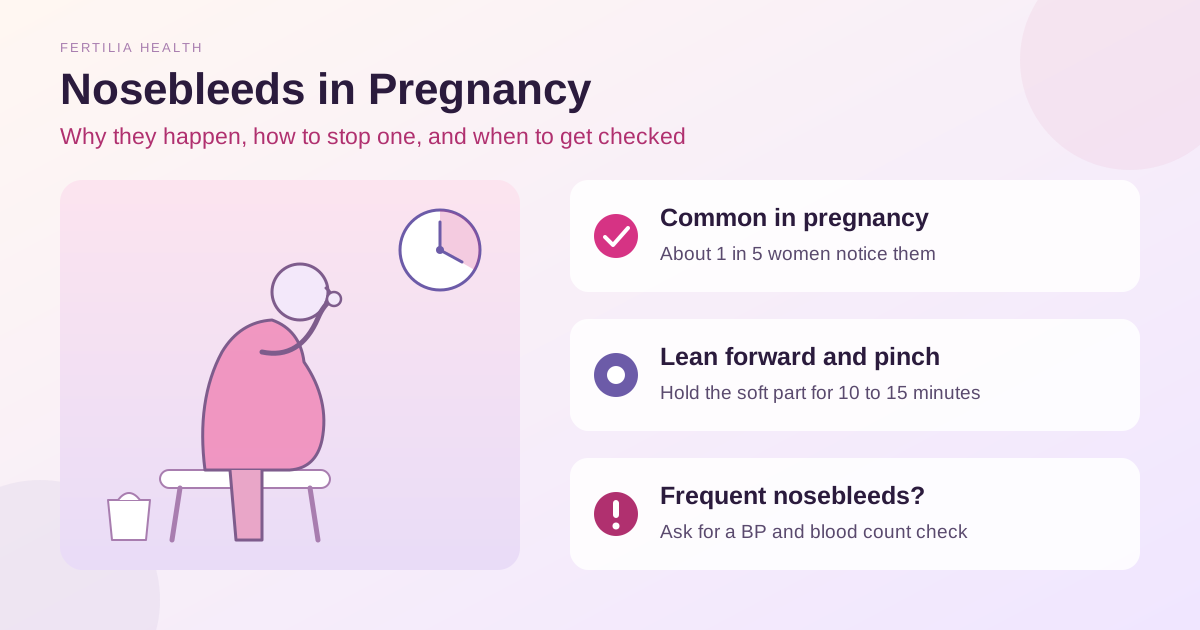
You are far from alone if this is happening to you. In a study from Chicago, 1,470 women arriving to give birth at term were asked about nosebleeds and other bleeding symptoms, and the answers were compared with 275 women who were not pregnant. 20.3% of the pregnant women reported nosebleeds, compared with 6.2% of the women who were not pregnant (Dugan-Kim M et al., Obstet Gynecol, 2009, PMID 19935036). The NHS also lists pregnant women among the groups more likely to get nosebleeds (nhs.uk, nosebleed, reviewed December 2023).
So roughly one woman in five notices at least one nosebleed at some point in her pregnancy. Most of these are small, short and one-sided.
Why Pregnancy Makes Your Nose Bleed
More blood, fuller vessels
Your body makes a lot more blood plasma while you are pregnant. A review that pooled ten studies of healthy pregnancies found that plasma volume was about 18% higher than in the nonpregnant state at 14 to 20 weeks, and about 48% higher by 35 to 38 weeks (Aguree S et al., BMC Pregnancy Childbirth, 2019, PMID 31856759). That extra volume runs through every small vessel in the body, including the ones that sit just under the thin lining inside your nose.
Hormones change the lining of the nose
Pregnancy hormones also act on the lining of the nose itself. A review of ear, nose and throat changes in pregnancy described how rising levels of sex hormones influence the nasal lining and can bring on both nosebleeds and a stuffy, blocked nose (Kumar R et al., Otolaryngol Head Neck Surg, 2011, PMID 21555777). In practice, a lining that is fuller and more congested than usual bleeds more readily when it is rubbed, dried out or blown hard.
A blocked nose that will not clear
Many women also have a congested nose for weeks at a time in pregnancy, without a cold or an allergy behind it. Doctors call this pregnancy rhinitis. In a Swedish study of 599 pregnant women, 22% developed it at some stage, and it could start in any week of pregnancy (Ellegård E et al., Gynecol Obstet Invest, 2000, PMID 10671815). A blocked nose leads to more blowing, more rubbing and more mouth-breathing at night, all of which dry and irritate the lining and make a bleed more likely.
Dry air, dust and small knocks
The everyday triggers are the same as for anyone. The NHS lists picking the nose, blowing it too hard, and the inside of the nose becoming too dry as common causes (nhs.uk, nosebleed, reviewed December 2023). Cleveland Clinic names dry air as the most common cause and lists hot, low-humidity weather among the conditions that dry the lining out (my.clevelandclinic.org, nosebleed, updated December 2024). In India that covers a lot of ground: the dry heat of April and May, a dusty commute, a north Indian winter with a heater running, or an AC left on all night in the bedroom.
What a Typical Pregnancy Nosebleed Looks Like
The bleeds most women describe to me share a few features:
- They come from one nostril, usually from the front of the nose
- They often follow blowing your nose, sneezing, or waking up with a dry nose
- They stop with pressure within ten to fifteen minutes
- There may be a little crusting or a streak of blood when you blow your nose for a day or two afterwards
Most nosebleeds start at the front of the wall between your nostrils, which carries small blood vessels that are easily damaged (enthealth.org, nosebleeds, reviewed December 2019). Bleeding from this area is the kind you can usually stop at home.
Bleeding that starts high and deep inside the nose is rarer. It can flow down the back of the throat whether you are sitting or standing, pressure on the outside of the nose does not stop it, and the same source notes that it almost always needs a doctor’s care.
How to Stop a Nosebleed at Home
The NHS steps work just as well in pregnancy (nhs.uk, nosebleed, reviewed December 2023):
- Sit down and lean forward, with your head tilted forward and your mouth open. Do not tip your head back. Leaning forward stops blood running down your throat, which can make you feel sick.
- Pinch the soft part of your nose, just above the nostrils, firmly between your thumb and finger.
- Hold it for 10 to 15 minutes without letting go, and breathe through your mouth. Use a clock. Releasing every minute to check restarts the bleeding.
- A cold pack on the bridge of your nose may help, such as a bag of frozen peas wrapped in a cloth. The NHS notes that the evidence for this is not strong, so treat it as an extra, not a replacement for the pinch.
- Spit out any blood that reaches your mouth, rather than swallowing it.
Once the bleeding stops, the NHS advises that for the next 24 hours you try not to blow or pick your nose, drink hot drinks, lift anything heavy, do strenuous exercise, pick at scabs, or lie down flat. For the rest of that day, a lukewarm cup of tea is a better choice than a steaming one, and leave the heavy shopping bags to someone else.
If you start to feel light-headed during a nosebleed, stay sitting, and lie on your side if the feeling does not pass. Our guide to dizziness in pregnancy explains what to do in the moment and when dizziness needs to be checked.
💜 Getting nosebleeds often and not sure if it needs a check? Message Dr. Suganya on WhatsApp to book a ₹399 video consultation. Share how many weeks pregnant you are, how often the bleeds happen and how long they last, and your latest blood pressure and blood count reports. If a bleed will not stop, go to your nearest hospital first.
Everyday Steps That Help Prevent Nosebleeds
- Blow gently, one nostril at a time, and only when you need to.
- Keep the inside of your nose moist. MedlinePlus suggests a saline nasal spray and a water-based gel to keep the lining from drying out, and adding moisture to the air with a vaporiser (medlineplus.gov, nosebleed, reviewed July 2025). Plain saline drops or sprays from the chemist are a gentle option in pregnancy.
- Add moisture to dry air. If you sleep with the AC or a heater on, a humidifier, a bowl of water in the room, or a timer that switches the AC off in the early morning all help. Drying clothes on a stand in the bedroom on a dry winter night does the same job.
- Drink through the day. Water, buttermilk, tender coconut water and rasam all count, especially in summer.
- Treat a blocked nose gently. A review of pregnancy rhinitis describes nasal saline washes as a safe way to ease the congestion (Ellegård EK, Clin Rev Allergy Immunol, 2004, PMID 15208461). Sleeping with your head and shoulders raised on an extra pillow can also help you breathe through your nose at night.
- Be careful with medicated decongestant sprays. The same review warns that these give quick relief but that women with pregnancy rhinitis tend to overuse them, which leads to a rebound blocked nose. Ask your doctor before using any medicated spray in pregnancy, and use it only for the few days they advise.
- Trim your nails and try not to rub or pick at crusts.
- Wear a cotton mask or a dupatta over your nose on dusty roads or two-wheeler rides if dust sets off sneezing.
When Nosebleeds Are Worth a Check
Most pregnant women with nosebleeds need nothing more than the steps above. The NHS advises seeing a doctor if you get regular nosebleeds, if you have symptoms of anaemia such as a racing heartbeat, breathlessness or paler skin than usual, if you take a medicine that prevents blood clots, or if you have a condition that affects clotting (nhs.uk, nosebleed, reviewed December 2023). Here is what your doctor may look at.
Your blood pressure
The NHS lists people with high blood pressure among those more likely to get nosebleeds (nhs.uk, nosebleed, reviewed December 2023). If you are having frequent bleeds, a blood pressure reading is a quick and sensible check, and you can ask for it at any antenatal visit. If you already check your own blood pressure at home, note the readings and bring them. Our guide to high blood pressure in pregnancy explains the numbers and how it is monitored.
Your haemoglobin
Frequent bleeds add up, and anaemia is already very common in pregnancy in India. If you are tired, breathless on small effort, or notice your heart racing, a haemoglobin test is worth doing. Our guide to haemoglobin in pregnancy shows the normal range for each trimester and what happens when it is low.
Your platelets and clotting
If nosebleeds come with easy bruising, bleeding gums that are worse than usual, tiny red spots on the skin, or very heavy periods before pregnancy, your doctor may check your platelet count and sometimes your clotting. Our post on low platelets in pregnancy explains why the count often dips a little in pregnancy and which numbers need a closer look.
Your medicines
If you take low-dose aspirin or heparin injections, tell your doctor about any nosebleeds, and do not stop or change these medicines on your own. Our guide to blood thinners in pregnancy explains who is prescribed them and why they matter.
A bleed that keeps coming from the same spot
Rarely, a benign (non-cancerous) growth of blood vessels called a pyogenic granuloma forms inside the nose during pregnancy and can cause repeated nosebleeds (Basiari L et al., Maedica, 2024, PMID 38736920). If your nosebleeds always come from one nostril and you can see or feel a lump, your doctor may suggest an ENT (ear, nose and throat) specialist look inside the nose.
Why it helps to mention nosebleeds before delivery
In the Chicago study, women who had nosebleeds during pregnancy had slightly higher rates of heavy bleeding after delivery, 10.7% compared with 6.7%, and the authors suggest that asking about nosebleeds may help pick out women whose clotting deserves a closer look (Dugan-Kim M et al., Obstet Gynecol, 2009, PMID 19935036). Most women with nosebleeds in that study did not have heavy bleeding after the birth. Mentioning frequent nosebleeds simply gives your obstetrician one more piece of your history to plan with, in the same way as a previous heavy bleed or anaemia. Our guide to postpartum haemorrhage explains how hospitals prepare for and prevent it at every delivery.
When to Get Help
Most nosebleeds in pregnancy stop with pressure and need nothing more. This list is here so that if one of these happens, you know where to go without losing time.
Go to your nearest hospital emergency department if
The NHS advises going to A&E if you have a nosebleed and (nhs.uk, nosebleed, reviewed December 2023):
- It lasts longer than 10 to 15 minutes despite firm, continuous pressure
- The bleeding seems excessive
- You are swallowing so much blood that it makes you vomit
- It started after a blow to your head
- You feel weak or dizzy
- You are having difficulty breathing
Do not drive yourself. Ask someone to take you, or call 108 or 112 for an ambulance, and bring any medicines you take.
Go to your hospital or labour ward straight away if
- A nosebleed comes with a severe headache, blurred vision or flashing lights, or sudden swelling of your face, hands or feet. The NHS lists a severe headache, sudden vision problems and sudden swelling as possible signs of pre-eclampsia that need to be checked immediately (nhs.uk, pregnancy symptoms you need to get help for, reviewed June 2026). Our guide to pre-eclampsia explains the signs and what happens in hospital.
- You have or recently had a fever, and now have a nosebleed or bleeding gums, especially during the monsoon months. WHO lists bleeding gums or nose among the signs of severe dengue, which often come after the fever has gone away, and advises seeking care immediately (who.int, dengue fact sheet, checked October 2026). Our guide to fever in pregnancy covers dengue and the other warning signs.
- You also have vaginal bleeding, or you notice a change in your baby’s movements.
Mention it at your next antenatal visit if
- You get nosebleeds more than now and then, even if they stop easily
- You feel tired or breathless, or look paler than usual
- You bruise easily or your gums bleed more than before
- You take low-dose aspirin or heparin
What It Is Called in Tamil, Hindi and Telugu
Many women search for this in their own language, often typed in Roman letters:
| Language | Common words and search terms |
|---|---|
| Hindi | Naak se khoon aana (नाक से खून आना); nakseer (नकसीर); pregnancy me naak se khoon aana |
| Tamil | Mookil ratham varuthal (மூக்கில் ரத்தம் வருதல்); pregnancy la mookil ratham |
| Telugu | Mukku nundi raktam; pregnancy lo mukku nundi raktam |
| English (search) | Nosebleed in pregnancy; nose bleeding during pregnancy; epistaxis in pregnancy |
When you call your doctor, saying “I am pregnant, I have a nosebleed, and it has been going for 15 minutes” (or “it keeps coming back every few days”) gives them most of what they need.
Practical Takeaways
- Nosebleeds are common in pregnancy, affecting about one woman in five, because of extra blood volume and hormone changes in the lining of the nose.
- To stop one, sit, lean forward, and pinch the soft part of your nose for 10 to 15 minutes without letting go. Do not tip your head back.
- For the next day, avoid blowing your nose, hot drinks, heavy lifting and lying flat.
- Keep your nose moist with saline spray or drops, add moisture to dry or air-conditioned rooms, and drink through the day.
- Ask your doctor before using a medicated decongestant spray.
- If nosebleeds are frequent, ask for a blood pressure reading and a haemoglobin test, and mention them to your obstetrician before delivery.
- Go to hospital if a bleed lasts beyond 15 minutes of pressure, is heavy, follows a head injury, or leaves you dizzy or breathless, and go straight away if it comes with a severe headache, vision changes, sudden swelling, or after a fever.
For the wider picture of the nine months, see our pregnancy week-by-week guide.
Frequently Asked Questions
Is nose bleeding normal in pregnancy? (Pregnancy me naak se khoon aana normal hai?)
Yes, it is common. In one study about 20% of women reported nosebleeds during pregnancy, compared with about 6% of women who were not pregnant. The extra blood volume of pregnancy and hormone changes make the small vessels inside the nose fuller and quicker to bleed. A nosebleed that stops with ten to fifteen minutes of pressure is usually nothing to worry about. If they happen often, ask for a blood pressure check and a haemoglobin test.
How do I stop a nosebleed when I am pregnant?
Sit down, lean forward with your mouth open, and pinch the soft part of your nose just above the nostrils for 10 to 15 minutes without letting go, breathing through your mouth. Do not tilt your head back. A cold pack on the bridge of the nose may help a little. If the bleeding has not stopped after 10 to 15 minutes of continuous pressure, go to your nearest hospital.
Can a nosebleed harm my baby?
An ordinary nosebleed comes from small vessels in the lining of your nose, and the amount of blood lost is usually small. On its own, it is not usually a sign of a problem with the pregnancy. A heavy bleed that does not stop, or a nosebleed that comes with a severe headache, vision changes, sudden swelling or after a fever, needs a doctor straight away so the cause can be found.
Is a nosebleed a sign of high blood pressure in pregnancy?
Most pregnancy nosebleeds are caused by the normal changes in the lining of the nose, not by blood pressure. People with high blood pressure are more likely to get nosebleeds, though, so if yours are frequent, a blood pressure reading is a sensible check. If a nosebleed comes with a severe headache, blurred vision or sudden swelling, go to hospital straight away, because these can be signs of pre-eclampsia.
Why is my nose always blocked in pregnancy, and is it linked to the nosebleeds?
A blocked nose without a cold is common in pregnancy and is called pregnancy rhinitis. In one study it affected 22% of pregnant women. It usually settles after the baby is born. Constant blowing and mouth-breathing dry out the lining of the nose, which makes nosebleeds more likely. Saline washes or sprays and sleeping with your head raised help both problems. Ask your doctor before using a medicated decongestant spray.
Will the nosebleeds stop after delivery?
For most women, yes. Pregnancy rhinitis is defined as a blocked nose that disappears completely within two weeks of delivery (Ellegård EK, Clin Rev Allergy Immunol, 2004, PMID 15208461), so the blowing and dryness that set off many bleeds usually ease after the birth too. If you keep getting nosebleeds well after delivery, mention it at your postnatal check.
Are nosebleeds an early sign of pregnancy?
Nosebleeds can happen at any stage of pregnancy, but they are not a reliable way to tell whether you are pregnant. If your period is late, a home pregnancy test is the way to find out.
Talking It Through
Most nosebleeds in pregnancy are a nuisance more than a worry, and they ease once you keep the inside of your nose moist and know how to stop a bleed. When they keep coming back, a blood pressure reading and a simple blood test usually settle the question. In her video consultations at Fertilia, Dr. Suganya Venkat goes through how often the bleeds happen, your readings and your blood reports with you, so you know exactly what to keep an eye on for the rest of your pregnancy.
💜 Want a doctor to look at your nosebleeds with you? Message Dr. Suganya on WhatsApp to book a ₹399 video consultation, available online across India. You can also download our free pregnancy guide for week-by-week support through each trimester.