Your routine blood report comes back, and next to “Platelet count” there is a small “L”. The number says 1.32 lakh, and the reference range beside it starts at 1.5 lakh. You did not feel unwell, you have not been bleeding, and now you are wondering whether this is something to worry about before the baby comes.
I’m Dr. Suganya Venkat, an OB-GYN, and over fifteen years in obstetrics a slightly low platelet count has been one of the most common findings women ask me about in the second half of pregnancy. In most women it is a mild, harmless dip called gestational thrombocytopenia, which needs no treatment and settles after delivery. A smaller number have a low count for another reason, such as pre-eclampsia, a condition called immune thrombocytopenia (ITP), or an infection like dengue. This post explains how doctors tell these apart, which numbers matter, and what it means for your delivery.
Here is what this post covers:
- What platelets do, and why the count usually falls a little in pregnancy
- Gestational thrombocytopenia, the most common reason for a low count
- Other causes that need follow-up: pre-eclampsia, ITP, dengue and a few rarer ones
- The platelet numbers that matter for delivery and for an epidural
- What repeat counts usually look like, and when to get help quickly
What Platelets Do, and How They Are Reported
Platelets are tiny cells in your blood that gather at a cut or a torn blood vessel and help the blood clot. A normal count outside pregnancy usually runs from about 1.5 to 4.5 lakh per microlitre, although each laboratory prints its own range.
Indian reports write the same number in different ways, which confuses many women. 1.5 lakh, 150,000, 150 × 10³/µL and 150 × 10⁹/L all mean the same count. When this post says “100,000”, your report may say 1 lakh or 100.
A count below 150,000 is called thrombocytopenia, which simply means “low platelets”. It describes the number; finding the reason for it is the next step.
Why Platelets Usually Fall a Little in Pregnancy
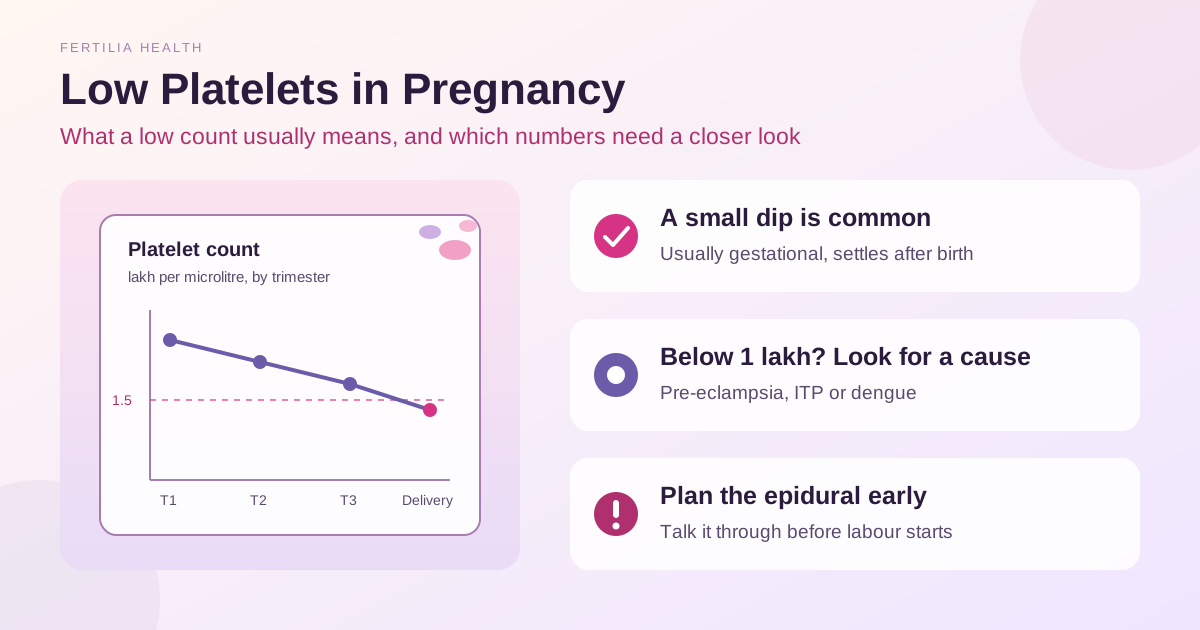
A large study followed platelet counts through pregnancy in 7,351 women at one American hospital and compared them with nearly 8,900 women who were not pregnant. In the 4,568 women whose pregnancies were uncomplicated, the average count was already lower in the first trimester (251,000, against 273,000 in women who were not pregnant) and kept drifting down until delivery. At delivery, 9.9% of these healthy women had a count below 150,000, and only 1.0% had a count below 100,000 at any point (Reese JA et al., N Engl J Med, 2018, PMID 29972751). On average, platelet counts fell during pregnancy, beginning in the first trimester.
Part of the reason is dilution. Your blood volume rises a lot in pregnancy, so the same number of platelets is spread through more fluid. The spleen and the placenta also hold on to some platelets. This is the same reason your haemoglobin dips a little in pregnancy, which our guide to haemoglobin levels by trimester explains.
Across all pregnancies, a low count is common. Reviews in the journal Blood put it at about 5 to 10% of women during pregnancy or just after (Cines DB et al., Blood, 2017, PMID 28637667) and at about 10% of pregnancies (Fogerty AE et al., Blood, 2024, PMID 37992219). The same 2024 review describes the causes as ranging from benign conditions that need no treatment to serious ones that need prompt care, which is why your doctor looks at the whole picture and not the number alone.
Gestational Thrombocytopenia: The Most Common Reason
Gestational thrombocytopenia is the name for a mild drop in platelets that comes from pregnancy itself, when no other cause is found. Its usual pattern:
- It is mild. The count usually stays above 100,000.
- It appears in the second half of pregnancy, most often in the third trimester, and is lowest around delivery.
- You feel well. There is no bruising or bleeding, and your blood pressure is normal.
- The rest of the blood count looks as expected for pregnancy.
- It needs no treatment and recovers after delivery.
What it means for your baby. A study that checked platelet counts in 15,471 mothers and the cord blood of 15,932 newborns found that 6.6% of the mothers had a count below 150,000. Moderate to severe low platelets in the babies were rare, and the only babies who had serious problems from low platelets were born to mothers carrying antibodies against the baby’s platelets, a different and uncommon condition (Burrows RF et al., N Engl J Med, 1993, PMID 8413457). In other words, a mild low count from gestational thrombocytopenia very rarely affects your baby’s platelets.
Gestational thrombocytopenia is, in practice, a diagnosis your doctor makes after checking that nothing else explains the count. That is why the follow-up tests below are a routine part of care.
When a Low Count Needs a Closer Look
The same 2018 study is useful here too. Among healthy pregnancies, a count below 80,000 with no other cause was found in only 5 women out of 4,568 (0.1%), and the authors advised that when the count is below 100,000, a cause other than pregnancy should be considered (Reese JA et al., N Engl J Med, 2018, PMID 29972751). Timing helps as well: a low count found early in pregnancy, or one that was low before you were pregnant, points away from gestational thrombocytopenia.
Pre-eclampsia and HELLP syndrome
Pre-eclampsia is a pregnancy condition that raises blood pressure and can affect the kidneys, liver and blood. It is most likely from 20 weeks onwards and can also develop in the days or weeks after birth (nhs.uk, pre-eclampsia, reviewed March 2026). A platelet count below 100,000 is one of the features doctors use to class pre-eclampsia as severe. HELLP syndrome is a related condition in which the platelets fall along with signs of liver strain and the breakdown of red blood cells.
The pattern here is different from gestational thrombocytopenia: the count often falls over days or weeks rather than drifting slowly, and it usually comes with raised blood pressure, protein in the urine, or abnormal liver tests. Our guides to pre-eclampsia and HELLP syndrome explain the signs and what happens in hospital.
Immune thrombocytopenia (ITP)
In ITP, the immune system makes antibodies that clear platelets from the blood too quickly. It can start before pregnancy or be found for the first time during it, and it is more likely when the count is low in the first trimester or falls below 100,000.
Many women with ITP go through pregnancy without needing medicine. In a study of 235 pregnancies in women with ITP, 58% needed no treatment at all, and in those who did, steroids and intravenous immunoglobulin (IVIg) worked about equally well. None of the mothers had a fatal or severe bleed, and there were no newborn deaths (Sun D et al., Blood, 2016, PMID 27402971).
Because the antibodies can cross the placenta, some babies of mothers with ITP are born with a low count. In that same study, 28% of the babies had a count below 150,000 at birth and 9% below 50,000, and in some babies the lowest count came up to 6 days after birth (Sun D et al., Blood, 2016, PMID 27402971). So if you have ITP, your baby’s platelet count is usually checked after birth, and the paediatric team knows to watch for this.
If you have ITP, your obstetrician will usually plan your care with a haematologist (a blood specialist), and the timing of any treatment is often planned around delivery.
Dengue and other infections
In India, dengue is a common reason for platelets to fall, especially during and after the monsoon. A study from a tertiary referral centre in South India found low platelets in 24.7% of pregnant women with fever who had dengue, against 14.6% of those whose fever had another cause (Sagili H et al., Indian J Med Res, 2022, PMID 36926778).
Dengue is managed by your medical team with fluids, rest, paracetamol and close monitoring of the platelet count. WHO advises avoiding ibuprofen and aspirin in dengue because they can increase the risk of bleeding, and notes that the warning signs of severe dengue often appear after the fever has gone away (who.int, dengue fact sheet). Our guide to fever in pregnancy lists those warning signs. Please do not try papaya leaf juice to raise your platelets while pregnant; there is no established safety data for it in pregnancy, as our post on papaya in pregnancy explains.
Less common causes
Depending on your history and other results, your doctor may consider a few other causes: some medicines, other infections, autoimmune conditions such as lupus or antiphospholipid syndrome, inherited low platelets, and rare blood disorders. These are uncommon, and most women never need to think about them.
A falsely low reading
Sometimes the platelets are normal in your body but clump together in the sample tube, so the machine undercounts them. Your doctor or the laboratory may look at a blood smear under the microscope, or repeat the test in a different type of tube, to rule this out (Yan L et al., Clin Lab, 2024, PMID 38213226). It is one reason a single low number is usually rechecked before anything else is decided.
💜 Worried about a platelet number on your report? Message Dr. Suganya on WhatsApp to book a ₹399 video consultation. Share how many weeks pregnant you are, your platelet counts so far with dates, and your latest blood pressure reading. If you have any of the urgent signs listed further down, go to your hospital first.
What Your Doctor Checks
When a count comes back low, the next steps are usually simple:
- A repeat count, sometimes with a blood smear, to confirm the number is real
- Your earlier counts, including any from before pregnancy or a previous pregnancy, if you have them
- Your blood pressure and a urine test for protein, to look for pre-eclampsia
- Liver tests, if the count is falling or you are in the second half of pregnancy
- A dengue test or other infection tests, if you have had a fever
- Questions about bruising, nosebleeds, bleeding gums or heavy periods, and about your medicines
Bring every earlier report you have. A count that has sat at 1.3 lakh for two months tells a very different story from one that has dropped from 2.2 lakh to 1.1 lakh in two weeks.
What Repeat Counts Usually Look Like
Gestational thrombocytopenia: the count stays fairly steady or drifts down slowly over weeks, usually stays above 100,000, is lowest around delivery, and goes back to its usual level in the weeks after the birth.
Pre-eclampsia or HELLP: the count falls over days, often alongside rising blood pressure or abnormal liver tests. This pattern is why your doctor may ask for a repeat test sooner than your next routine visit.
ITP: the count is often low from early pregnancy and may stay low throughout. Whether you need treatment depends on whether you have any bleeding, on how low the count is and on the plan for delivery. Many women with a steady count and no bleeding need none until close to delivery, but a very low count may need treatment earlier even without any bleeding. Your doctor will usually plan your care with a haematologist.
Dengue: the count falls during the illness, is checked often, and recovers as you get better.
How often your count is repeated depends on the number, the trend and the cause. For a mild, steady count with normal blood pressure, it is usually rechecked at your routine visits and again close to delivery.
The Numbers That Matter for Delivery
Women with low platelets often ask two questions: “Can I have a normal delivery?” and “Can I have an epidural?” The answers depend on the count, the cause and your hospital, so this is something your obstetrician and anaesthesiologist decide together, ideally before labour starts.
Epidural and spinal anaesthesia. A 2021 consensus statement from obstetric anaesthesia, obstetric and haematology specialists reviewed the evidence and concluded that the risk of a bleed around the spine from an epidural or spinal is likely to be very low when the platelet count is 70,000 or more, in women whose low count is from gestational thrombocytopenia, ITP or a hypertensive disorder of pregnancy, and who have no other risk factors (Bauer ME et al., Anesth Analg, 2021, PMID 33861047). The same statement stresses that the final decision is made case by case, and that the bleeding history and the cause of the low count should be worked out before you are admitted for delivery. Some hospitals use a higher cut-off, so ask your hospital about its practice in advance. Our guides to pain relief in labour and what to expect at a C-section explain the procedures themselves.
Vaginal birth or caesarean. A caesarean is an operation, so it generally needs a higher platelet count than a vaginal birth, and a count that is acceptable for a vaginal birth may not be enough for a caesarean. If your count is very low, your obstetrician, anaesthesiologist and haematologist will plan together, ideally well before labour, what count to aim for and whether treatment is needed to raise it. The type of delivery itself is decided by the usual obstetric reasons. A low platelet count is not, by itself, a reason for a caesarean.
For most women with gestational thrombocytopenia, whose count is above 100,000, none of this changes the delivery plan at all.
If you take low-dose aspirin or heparin injections, tell your doctor your latest platelet count, and do not stop or start any medicine on your own. Our guide to blood thinners in pregnancy explains who is prescribed them and why.
When to Get Help
Most low platelet counts in pregnancy are found on a routine test in a woman who feels well. These signs mean you should not wait for the next appointment.
Go to your hospital or labour ward straight away if
- You have a severe headache, blurred vision or flashing lights, pain under the ribs (especially on the right), or sudden swelling of your face, hands or feet
- You have vaginal bleeding, or bleeding from the nose or gums that does not stop
- You have a fever with severe tummy pain, persistent vomiting, bleeding, or you feel very weak or faint, even if the fever has settled
- You notice a change in your baby’s movements
Call your doctor the same day if
- You notice new bruises you cannot explain, or tiny red or purple dots on your skin that do not fade when pressed
- You have a fever, especially during dengue season
- A repeat count is lower than the last one, or your report shows a count below 1 lakh
Mention it at your next antenatal visit if
- Your count is a little below 1.5 lakh, you feel well, and your blood pressure is normal
- You had a low count in a previous pregnancy, or have ever been told you have low platelets
What It Is Called in Hindi, Tamil and Telugu
Many women search for this in their own language, often typed in Roman letters:
| Language | Common words and search terms |
|---|---|
| Hindi | Platelets kam hona (प्लेटलेट्स कम होना); pregnancy me platelets kam |
| Tamil | Platelet count kuraivu (குறைவு means “low”); pregnancy la platelet kuraivu |
| Telugu | Platelets takkuva (తక్కువ means “low”); pregnancy lo platelets takkuva |
| English (search) | Low platelets in pregnancy; thrombocytopenia in pregnancy; platelet count 1 lakh in pregnancy |
When you speak to your doctor, saying “I am 34 weeks pregnant, my platelets were 1.4 lakh last month and 1.2 lakh now, and my blood pressure is normal” gives them most of what they need.
Practical Takeaways
- A slightly low platelet count is common in pregnancy, especially in the third trimester, and in most women it is gestational thrombocytopenia, which needs no treatment.
- The trend matters as much as the number. Keep every report and bring them to each visit.
- A count below 1 lakh, a count low from early pregnancy, or a fast fall needs a search for another cause, such as pre-eclampsia, ITP or dengue.
- Blood pressure, urine protein and liver tests are the usual companion checks.
- Ask about the epidural before labour, so the plan is clear in advance. A low count alone does not mean a caesarean.
- Use paracetamol for fever or pain and avoid ibuprofen and aspirin for pain unless your own doctor has prescribed them.
For the wider picture of the nine months, see our pregnancy week-by-week guide.
Frequently Asked Questions
Is a low platelet count normal in pregnancy? (Pregnancy me platelets kam hona normal hai?)
A small dip is very common. Platelet counts usually fall a little in pregnancy, and about 1 in 10 healthy women has a count below 1.5 lakh at delivery. If your count is above 1 lakh, you feel well and your blood pressure is normal, it is most often gestational thrombocytopenia, which needs only monitoring. Your doctor will still recheck it and look at your other results.
What platelet count is dangerous in pregnancy?
There is no single number, because the cause and the trend matter. A count below 1 lakh is a signal to look for a cause other than pregnancy, and a quickly falling count, especially with high blood pressure or a fever, needs prompt review. Bleeding that does not stop, a severe headache or vision changes need a hospital check straight away, whatever the count.
Will low platelets affect my baby?
With gestational thrombocytopenia, very rarely. In a large study of more than 15,000 mothers, moderate to severe low platelets in newborns were rare, and the babies who had serious problems were born to mothers carrying antibodies against the baby’s platelets, a different condition. With ITP, some babies are born with a low count because the antibodies cross the placenta, so the baby’s count is checked after birth. Serious bleeding in these babies is rare.
Can I have an epidural with low platelets?
Often, yes. A 2021 consensus of anaesthesia, obstetric and blood specialists found that the risk of a spinal bleed is likely to be very low at a count of 70,000 or more in women with gestational thrombocytopenia, ITP or a blood pressure disorder of pregnancy who have no other risk factors. Each hospital has its own policy, so discuss it with your obstetrician and anaesthesiologist before labour.
How can I increase my platelet count during pregnancy?
For gestational thrombocytopenia, nothing needs to be done; the count recovers after delivery. No food or home remedy has been shown to raise it, and papaya leaf juice should be avoided in pregnancy. If the low count has another cause, such as ITP, your doctor treats that cause, sometimes with steroids or IVIg near delivery. Keep eating well and taking the iron and folic acid your doctor has prescribed.
Will my platelets go back to normal after delivery?
With gestational thrombocytopenia, yes. The count usually goes back to its usual level in the weeks after the birth. After pre-eclampsia or HELLP, your count is followed with repeat tests in hospital until it is recovering. Your doctor may recheck your count at your postnatal visit, particularly if it was very low.
Will it happen again in my next pregnancy?
Gestational thrombocytopenia can come back in a later pregnancy. Tell your doctor about it at your first visit next time, and keep your old reports. A count that stays low between pregnancies is worth checking with a haematologist, because it points to a cause other than pregnancy.
Talking It Through
A low platelet count on a pregnancy report is usually your body adjusting to pregnancy, and the main job is to confirm that, keep an eye on the trend, and plan delivery calmly. At Fertilia, Dr. Suganya Venkat goes through your counts, your blood pressure readings and your other results with you over a video consultation, explains what the pattern suggests, and helps you prepare the questions to ask your obstetrician and anaesthesiologist before labour.
💜 Want a doctor to look at your platelet reports with you? Message Dr. Suganya on WhatsApp to book a ₹399 video consultation, available online across India. You can also download our free pregnancy guide for week-by-week support through each trimester.