The protocol sheet usually arrives as a printout or a WhatsApp photo. A column of dates, a list of drug names you have never heard of, and a word at the top: long, short, or antagonist. Most women I speak to have already searched each drug name at least once, late at night, and come away with more questions than they started with. Why am I on this one when my cousin was on the other? Is the long protocol the stronger one? Did the clinic pick the cheaper option?
Those are reasonable questions, and the answers are more reassuring than the search results suggest. The protocol is not a ranking of how serious your case is. It is a choice about how to control your cycle while your ovaries are stimulated, and the choice depends on things your clinic can measure: your ovarian reserve, whether you have PCOS (now also called PMOS), your history in any earlier cycle, and your risk of overstimulation.
This post walks through the three main protocols, what each one feels like from day to day, what the large trials show when they are compared, and the logic a clinic follows when it picks one for you.
What This Post Covers
- The two jobs every IVF stimulation protocol has to do
- How the long agonist, short (flare) agonist, and antagonist protocols work, and what each means for your calendar
- A side-by-side comparison
- What the Cochrane review and other large analyses found on live birth and OHSS
- How your clinic matches a protocol to your situation, including PCOS, low reserve, and endometriosis
- Questions worth asking before your first injection
- Frequently asked questions
Every Protocol Does The Same Two Jobs
In a natural cycle, your body grows one dominant follicle and then releases a surge of luteinising hormone (LH) that makes you ovulate. IVF changes both halves of that.
Job one: grow several follicles at once. This is done with daily gonadotrophin injections (FSH, sometimes with LH activity), usually for around ten days, adjusted to how your follicles respond on the scans.
Job two: stop your own LH surge from arriving early. If your body ovulated on its own before the retrieval, the eggs could not be collected. So every protocol includes a second medicine whose only purpose is to hold back that surge until your clinic decides the eggs are ready and gives the trigger shot.
The three protocols differ almost entirely in job two: which drug holds back the surge, and when it is started. The stimulation injections themselves are broadly similar across all of them.
The Long Agonist Protocol
A GnRH agonist (leuprolide, triptorelin, or buserelin, depending on the clinic) works in a way that sounds backwards at first. When you start it, it briefly stimulates your pituitary gland, and then, with daily use, the pituitary stops responding. This is called down-regulation. Once your pituitary is quiet, your own LH surge cannot happen, and your clinic has full control of the cycle.
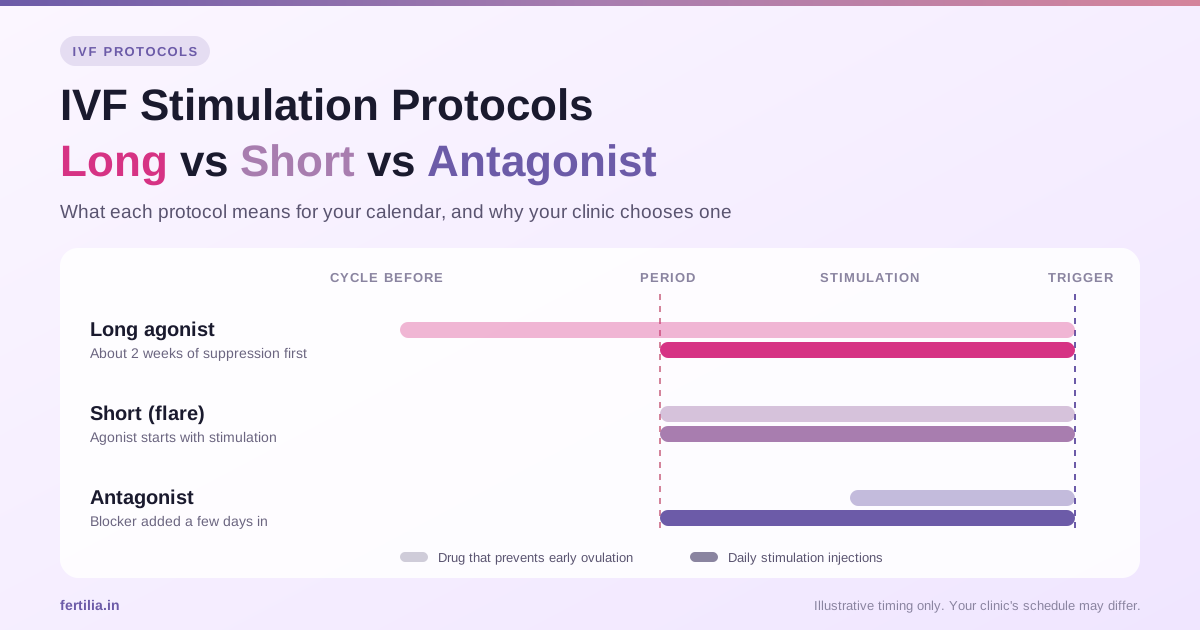
What it looks like in practice. The agonist is commonly started in the second half of the cycle before your IVF cycle, roughly a week before your period is due. You take it for about two weeks, your period comes, and your clinic confirms with a scan and often a blood test that your ovaries are quiet. Only then do the stimulation injections begin, and the agonist continues alongside them until the trigger. The Cochrane review of agonist protocols includes trials comparing two versus three weeks of agonist before stimulation, and trials comparing a luteal versus a follicular start, which gives you a sense of how much variation exists even within “long” (Siristatidis CS et al., Cochrane Database Syst Rev, 2025, PMID 39783453).
What it can feel like. Because the down-regulation phase lowers your oestrogen for a while, some women notice hot flushes, headaches, or low mood in those weeks. They settle once stimulation starts and oestrogen rises again. The long protocol also means more injection days overall and an extra monitoring visit before stimulation.
Why clinics still use it. It gives very predictable control, it lets the clinic schedule a batch of cycles to start at similar times, and some specialists prefer it in particular situations, which we come to below.
The Short (Flare) Agonist Protocol
The short protocol uses the same agonist drug, but uses its first effect deliberately. The agonist is started at the beginning of your period together with the stimulation injections, so that the initial burst of FSH and LH it causes adds to the stimulation. By the time follicles are growing, the pituitary has quietened and the early surge is prevented.
It is shorter than the long protocol because there is no two-week wait for down-regulation. It has historically been used for women expected to respond less to stimulation. When the Cochrane review pooled the lower-risk-of-bias trials comparing long and short agonist protocols, there was little or no difference in live birth or ongoing pregnancy, although the long protocol may give a somewhat higher clinical pregnancy rate; the certainty of all of this evidence was low (Siristatidis CS et al., Cochrane Database Syst Rev, 2025, PMID 39783453).
A naming trap worth knowing about. The word “short” is used loosely. Some clinics also call the antagonist protocol the “short protocol” because it, too, is shorter than the long one, and even a large Danish trial described it as a “short GnRH-antagonist” protocol (Toftager M et al., Hum Reprod, 2017, PMID 28130435). If your sheet says “short”, it is worth asking which drug is holding back your LH surge: an agonist started on day two, or an antagonist added a few days into stimulation. They are different protocols.
The Antagonist Protocol
A GnRH antagonist (cetrorelix or ganirelix) blocks the pituitary directly. It works within hours and does not cause an initial flare, so there is no need for a down-regulation phase.
What it looks like in practice. Stimulation injections begin on day two or three of your period. A few days later, the antagonist is added as a second daily injection. The Cochrane review describes the main ways of timing it: a fixed start on day six or seven of stimulation, or a flexible start once the leading follicle reaches around 14 to 15 mm (Al-Inany HG et al., Cochrane Database Syst Rev, 2016, PMID 27126581). Both injections continue until the trigger. For practical tips on managing two injections a day, our guide to doing IVF injections at home covers timing, storage, and what to do if a dose runs late.
What it can feel like. Fewer injection days in total, no weeks of low-oestrogen symptoms beforehand, and a cycle that starts with your period rather than the month before. The same Cochrane review notes that antagonists avoid the low-oestrogen side effects, the flare, and the long down-regulation period that come with agonists (Al-Inany HG et al., Cochrane Database Syst Rev, 2016, PMID 27126581).
The extra option it opens up. Because your pituitary is not switched off, an antagonist cycle can be triggered with a GnRH agonist instead of hCG. That produces a short burst of your own LH, which matures the eggs and markedly lowers the risk of ovarian hyperstimulation syndrome (OHSS). In the Cochrane review of 17 trials, agonist triggering lowered OHSS in fresh cycles but was also linked to a lower live birth rate when a fresh transfer followed, and the review authors noted it could be useful for women who choose to avoid a fresh transfer (Youssef MA et al., Cochrane Database Syst Rev, 2014, PMID 25358904). In practice, that is why clinics often pair an agonist trigger with freezing all the embryos for a later transfer. This option does not exist in a long agonist cycle, where the pituitary has been down-regulated and cannot produce that burst.
Side By Side
| Long agonist | Short (flare) agonist | Antagonist | |
|---|---|---|---|
| Drug that prevents early ovulation | Agonist (leuprolide, triptorelin, buserelin) | Same agonist | Antagonist (cetrorelix, ganirelix) |
| When it starts | About a week before your period, in the previous cycle | Day 2 of your period, with stimulation | A few days into stimulation |
| Rough length | About two weeks of suppression, then stimulation | Stimulation only | Stimulation only |
| Low-oestrogen symptoms beforehand | Possible | Unlikely | No |
| Agonist trigger possible | No | No | Yes |
| Typical reason chosen | Tight cycle control, clinic preference in selected cases | Historically, lower expected response | Most IVF cycles; higher OHSS risk |
What The Large Trials Show
The most complete comparison is the Cochrane review of 73 randomised trials with 12,212 women, comparing antagonist protocols with the long agonist protocol (Al-Inany HG et al., Cochrane Database Syst Rev, 2016, PMID 27126581). Three findings are worth knowing:
- Live birth: no conclusive difference. If the chance of live birth with the long agonist protocol is 29%, the chance with an antagonist would be between 25% and 33%.
- OHSS: lower with antagonists. If the risk of any grade of OHSS with the long protocol is 11%, the risk with an antagonist would be between 6% and 9%.
- Cancellation: antagonist cycles were less often cancelled for OHSS risk, but somewhat more often cancelled for a poor response. If a cycle is ever stopped partway, our explainer on why IVF cycles get cancelled covers what that means and what usually changes next time.
A second meta-analysis split women by type (Lambalk CB et al., Hum Reprod Update, 2017, PMID 28903472). In the general IVF population, ongoing pregnancy was slightly lower with antagonists but OHSS was also lower: roughly one case of OHSS prevented for every 40 women treated, at the cost of one fewer ongoing pregnancy for every 28. In women with PCOS and in poor responders, there was no evidence of a difference in ongoing pregnancy, and in PCOS the antagonist protocol significantly lowered OHSS.
Those analyses mostly measured the outcome of the fresh transfer. When a Danish trial of 1,050 women counted every fresh and frozen transfer from the first egg retrieval, followed for at least two years, the cumulative live birth rate was 34.1% with the antagonist protocol and 31.2% with the long agonist protocol, a difference that was not statistically significant (Toftager M et al., Hum Reprod, 2017, PMID 28130435).
Putting this evidence together, the European Society of Human Reproduction and Embryology’s 2020 guideline on ovarian stimulation made a strong recommendation for the antagonist protocol over agonist protocols in the general IVF population, on the basis of comparable efficacy and higher safety, and recommended antagonists and agonists equally for predicted poor responders (ESHRE Guideline Group on Ovarian Stimulation, Bosch E et al., Hum Reprod Open, 2020, PMID 32395637). ESHRE published an updated version of this guideline in 2025.
What this means for you: none of these protocols is the “strong” one. They reach broadly similar chances of a baby by different routes, and the main difference between them is safety and convenience.
💜 Got your protocol sheet and not sure what it means for you? Message Dr. Suganya’s team on WhatsApp A ₹399 video consultation walks you through your plan alongside your IVF clinic’s care, pan-India over video call.
How Your Clinic Chooses A Protocol For You
The starting point is your predicted response. The ESHRE guideline makes a strong recommendation for using either antral follicle count or AMH to predict high and poor response (ESHRE Guideline Group on Ovarian Stimulation, Bosch E et al., Hum Reprod Open, 2020, PMID 32395637). If you have had both tests, our comparison of AMH and AFC explains what each number contributes. From there, the reasoning usually follows your situation.
If you are expected to respond normally. An antagonist protocol is the usual choice, in line with the guideline above. It is the default because it is as effective as the alternatives with less OHSS, not because it is a lighter treatment.
If you have PCOS or a high AFC. Women with PCOS tend to grow many follicles, and that raises OHSS risk. An antagonist protocol, often with a lower starting dose, the option of an agonist trigger, and freezing all embryos if the response is strong, is the usual way clinics plan for this from the start. Our guide to OHSS symptoms and prevention goes through each of these safeguards and the signs to watch for after retrieval.
If your reserve is low or an earlier cycle gave few eggs. Here the evidence gives no clear winner. ESHRE recommends antagonists and agonists equally for predicted poor responders, and the Lambalk analysis found no difference in ongoing pregnancy between them in this group. Clinics may switch protocols after a disappointing cycle, adjust doses, or discuss a milder approach. Our post on poor ovarian response covers what can realistically be changed, and the one on natural and mini IVF explains the lower-stimulation options and who they suit.
If you have endometriosis. Some specialists use several months of agonist suppression before IVF (sometimes called an ultra-long protocol). The most recent Cochrane review of eight trials found the evidence too low in quality to say whether this pretreatment changes the live birth rate compared with no pretreatment (Georgiou EX et al., Cochrane Database Syst Rev, 2019, PMID 31747470). So whether to use it is a judgement your specialist makes for your particular disease, and it is not a fixed rule.
If you ovulated early in a previous cycle. A clinic may start the antagonist earlier, monitor more closely, or move to a long agonist protocol for firmer control.
If your clinic mentions tablets instead of antagonist injections. Some clinics now use an oral progestogen to prevent the LH surge, known as progestin-primed ovarian stimulation (PPOS). The Cochrane review of 14 trials noted that oral progestogens could be cheaper than GnRH analogues, and found little or no difference in outcomes in several comparisons, but most of the evidence was of low or very low certainty (Glujovsky D et al., Cochrane Database Syst Rev, 2023, PMID 38032057). Because the progestogen also affects the uterine lining, these cycles are planned as freeze-all, with the embryos transferred in a later cycle. If you are heading that way, our guide to frozen embryo transfer explains what the transfer cycle involves.
The choice is individual, and it can change between cycles. A protocol that suited your first attempt may be adjusted for the second once your clinic has seen how your ovaries respond.
Questions Worth Asking Before You Start
- Which protocol am I on, and which drug is preventing early ovulation? This removes the long-versus-short confusion in one question.
- Why this protocol for me? A good answer names something specific: your AMH or AFC, PCOS, an earlier cycle, or OHSS risk.
- What is my expected response, and what is the plan if it is higher or lower than expected? Ask whether a freeze-all is likely.
- Which trigger will I have? An hCG trigger and an agonist trigger lead to different next steps.
- Are my stimulation doses fixed, or will they change with the scans? Most clinics adjust as they go, so expect a few dose changes rather than seeing them as a sign of trouble.
- What side effects should I expect in the weeks before stimulation? This matters mostly for the long protocol.
I am Dr. Suganya Venkat, an OB-GYN with more than 15 years in practice, and the women I see on video consultations at Fertilia almost always feel calmer once they can say in one sentence why their clinic chose their protocol. Our IVF Support programme works alongside your fertility clinic rather than in place of it: your specialist chooses and runs the protocol, and we help with understanding the plan and with the health picture around the cycle.
Frequently Asked Questions
Which IVF protocol has the highest success rate? No single protocol wins for everyone. The Cochrane review of 73 trials found no conclusive difference in live birth between the antagonist and long agonist protocols, with lower OHSS on the antagonist side (Al-Inany HG et al., Cochrane Database Syst Rev, 2016, PMID 27126581). One meta-analysis found slightly lower ongoing pregnancy with antagonists in the general IVF population (Lambalk CB et al., Hum Reprod Update, 2017, PMID 28903472), but when all fresh and frozen transfers from one retrieval were counted, cumulative live birth was similar (Toftager M et al., Hum Reprod, 2017, PMID 28130435). The better protocol is the one matched to your response and risk.
Is the long protocol better than the antagonist protocol? Not in general. It gives firm control of the cycle and some specialists prefer it in particular situations, but for most women the antagonist protocol reaches similar outcomes with less OHSS, which is why the 2020 ESHRE guideline strongly recommends it for the general IVF population (ESHRE Guideline Group on Ovarian Stimulation, Bosch E et al., Hum Reprod Open, 2020, PMID 32395637).
What is the difference between the short protocol and the antagonist protocol? A true short protocol uses a GnRH agonist started on day two alongside stimulation, using its initial flare. The antagonist protocol uses cetrorelix or ganirelix, added a few days into stimulation. Because both are shorter than the long protocol, the word “short” is often used for either, so ask your clinic which drug you are on.
Which protocol is used for PCOS? An antagonist protocol is commonly chosen for women with PCOS, because in trials it lowered OHSS risk without reducing ongoing pregnancy rates in this group (Lambalk CB et al., Hum Reprod Update, 2017, PMID 28903472). It also allows an agonist trigger and a freeze-all plan if the response is strong.
Why did my clinic change my protocol for the second cycle? Usually because the first cycle showed something useful: fewer eggs than expected, a very strong response, or an early LH surge. Changing the protocol in response to that information is careful practice, not a sign that the first choice was wrong.
Does the long protocol have more side effects? It involves more injection days, and the down-regulation phase can bring hot flushes, headaches, or low mood for a couple of weeks before stimulation. These settle once stimulation starts. The antagonist protocol avoids that phase entirely.
How many days of injections are there in each protocol? Stimulation itself usually runs around ten days in any protocol, adjusted to your response. The long protocol adds roughly two weeks of agonist beforehand. In the antagonist protocol, the second daily injection covers only the last several days before the trigger.
💜 Want to understand your IVF plan before the injections start? Talk it through with Dr. Suganya over WhatsApp A ₹399 video consultation gives you an unhurried explanation of your protocol and what to ask your clinic, wherever you are in India.