The question almost never arrives in the first appointment. It arrives after a cycle that did not work, usually a week or two later, once the initial disappointment has settled into something quieter. A woman sits down, often with her husband beside her, and asks some version of the same thing: how many times are we supposed to do this?
It is one of the most reasonable questions in fertility care, and one of the least well answered. Clinics quote per-cycle success rates. Insurance and budgets tend to think in units of one. Families ask when you will “stop all this”. Meanwhile, the number that would genuinely help you plan, what your chances look like across several attempts rather than within one, rarely makes it into the conversation.
This post is about that number, and about the decision that sits on top of it. Not a rule about when to stop, because that is yours to make, but a clear view of what the evidence shows about repeat cycles, what a clinic should be reviewing between attempts, and how to tell the difference between a cycle worth repeating and a picture that is asking you to change direction.
What This Post Covers
- Where the idea of “three cycles” came from, and what the larger datasets show
- Cumulative success across multiple cycles, and why one negative result reads differently in that light
- What your clinic should review after an unsuccessful cycle
- The three genuinely different options after a failed cycle: repeat, adjust, or change approach
- How cost, time, and emotional bandwidth belong in the decision rather than outside it
- Frequently asked questions
Where “Three Or Four Cycles” Came From
If you have heard that IVF is worth three attempts, you have absorbed a real convention. It shows up in funding policies, in clinic counselling, and in how couples budget. It is also, in the research literature, explicitly named as a limit that was not built on cumulative outcome data. The large UK analysis of repeat cycles opens by noting that the likelihood of a live birth with repeat IVF was unclear, “yet treatment is commonly limited to 3 or 4 embryo transfers” (Smith ADAC et al., JAMA, 2015, PMID 26717030).
What that tells us is narrow but useful: the three-or-four limit was already common practice at a point when the live birth probability of repeat cycles had not been established. It was a practical ceiling used in funding and counselling rather than a biological cut-off, and it was never a statement that a fifth cycle does not work.
When researchers did follow that population, the picture looked different from the convention.
What The Cumulative Data Shows
Two large UK registry studies are worth understanding. Both count a cycle the same way, as one episode of ovarian stimulation plus every fresh and frozen transfer arising from it, so their numbers can be read alongside each other. They cover different time periods and populations and handle women who stopped treatment differently, which is why the headline figures are not identical.
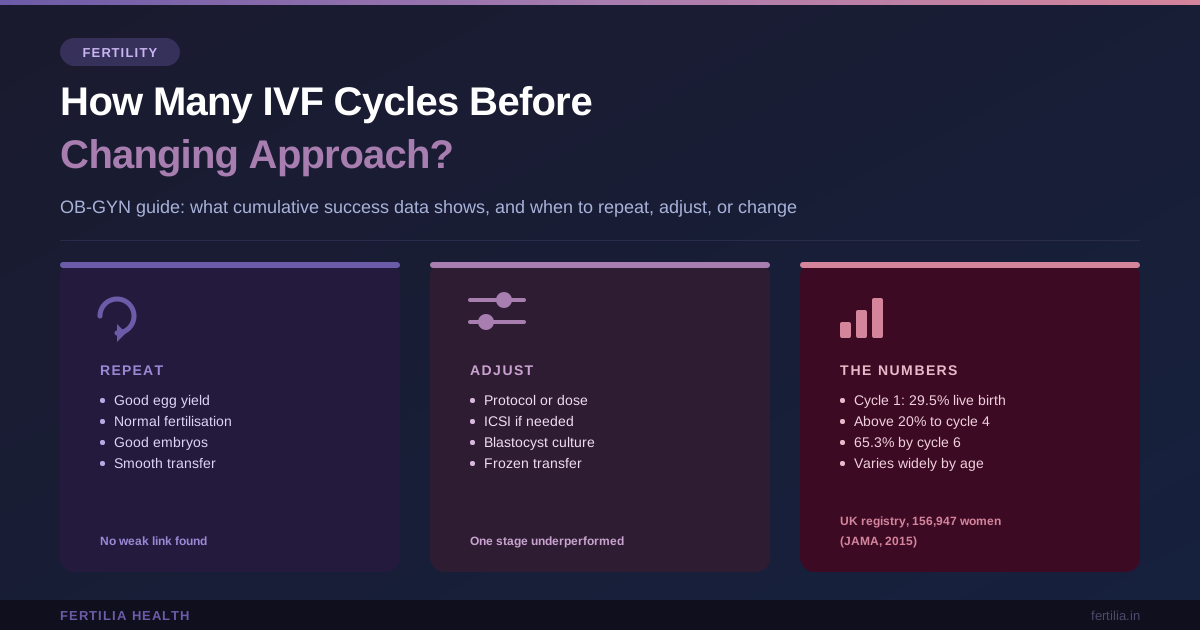
The first study. Smith and colleagues followed 156,947 UK women through 257,398 ovarian stimulation cycles between 2003 and 2010 (Smith ADAC et al., JAMA, 2015, PMID 26717030). The live birth rate for the first cycle was 29.5%. Importantly, it stayed above 20% up to and including the fourth cycle. The cumulative rate kept rising up to the ninth cycle, and 65.3% of women had a live birth by the sixth cycle on the prognosis-adjusted estimate.
That last figure needs a careful reading, and I would rather explain it than quote it flatly. “Prognosis-adjusted” means the researchers made an assumption about the women who stopped treatment: they assumed 30% of those who discontinued for poor prognosis would have had no chance of a live birth had they continued. The same paper reports a more conservative estimate assuming all such women had no chance, and a more optimistic one assuming none of them were in that position. So the headline number is one estimate among several, and all of them describe a population rather than a person. Your own prognosis depends on your age, the cause of infertility, how you respond to stimulation, and what the embryology shows, and it can sit above or below any of these population figures.
The second study. McLernon and colleagues analysed 113,873 women across 184,269 complete cycles, treating each complete cycle as all fresh and frozen-thawed transfers arising from one episode of ovarian stimulation (McLernon DJ et al., The BMJ, 2016, PMID 27852632). Of these women, 29.1% had a live birth after the first complete cycle and 43.0% after six complete cycles. This figure sits below the 65.3% above, and the two are not directly comparable: the studies covered different periods and eligibility criteria, and they treat women who stopped treatment differently. This model was later tested in an independent Dutch cohort of 1,515 women, where it predicted cumulative live birth reasonably well after a minor recalibration, and did so more accurately once information from the first cycle was added (Leijdekkers JA et al., Hum Reprod, 2018, PMID 30085143).
Two things follow from putting these side by side.
The first is that an unsuccessful first cycle is a common outcome rather than an unusual one. At a first-cycle live birth rate near 29%, roughly seven in ten women did not have a live birth from their first cycle. That group includes cycles with no transfer, failed implantation, and pregnancies lost later, so it is not one single outcome. The negative result on its own does not tell you much. What the cycle showed along the way, the egg yield, the fertilisation rate, and the embryo development, carries far more information, which is why the review below matters more than the result itself.
The second is that the cumulative total keeps climbing across cycles. In that dataset the per-cycle live birth rate started at 29.5% and stayed above 20% through the fourth cycle, while the cumulative figure kept rising as far as the ninth. So later cycles still carry a real chance, even though the per-cycle rate is not as high as the first. Knowing this lets you plan a course of treatment rather than a series of isolated attempts, which is a different and much less exhausting way to live through it.
One caveat matters for anyone reading this in India: these are UK registry figures, and they reflect UK practice, populations, and reporting standards. They are the best large-scale cumulative data available, which is why I use them, but your clinic’s numbers and the Indian picture are not identical. For what per-cycle success looks like closer to home, see our breakdown of IVF success rates in India by age.
Age Changes The Shape Of The Curve
The same UK dataset separates outcomes by age, and the differences are substantial enough that a general answer to “how many cycles” is not very useful without yours (Smith ADAC et al., JAMA, 2015, PMID 26717030):
- Under 40, using her own eggs: 32.3% live birth in the first cycle, and 68.4% cumulatively by the sixth cycle on the prognosis-adjusted estimate.
- Aged 40 to 42: 12.3% in the first cycle, and 31.5% by the sixth cycle.
- Over 42, using her own eggs: all per-cycle rates were below 4%.
- Using donor eggs: no age differential was observed.
Read those as planning information, not as a verdict. A woman of 41 looking at a 12.3% first-cycle figure is not being told to stop. She is being told that her cumulative curve rises more gradually, which is exactly the information she needs to decide how many attempts she wants to budget for, in money, in leave from work, and in the emotional reserve she has.
What Your Clinic Should Review Between Cycles
The most useful thing that happens after an unsuccessful cycle is not the next cycle. It is the review. When a woman tells me she is going straight into attempt two with nothing changed and nothing discussed, that is usually the point at which I suggest a conversation with her clinic first.
A thorough review looks at where the cycle stopped, because each stage points somewhere different:
- Response to stimulation. How many follicles developed, and how many eggs were retrieved relative to what your AMH and antral follicle count predicted. A response well below prediction is a protocol question. If this is your situation, our guide on poor ovarian response in IVF covers what can and cannot be adjusted.
- Fertilisation. What proportion of mature eggs fertilised, and whether conventional insemination or ICSI was used.
- Embryo development. How many embryos reached day 3 and day 5, and their grades. A cycle that stalls consistently at day 3 raises different questions from one with good blastocysts that did not implant.
- The transfer itself. Endometrial thickness and pattern, whether the transfer was straightforward, and whether it was a fresh or frozen transfer.
- Relevant health factors outside the cycle. Depending on your history, this can include thyroid function, blood sugar, weight, sleep, and smoking or alcohol in both partners. These are not a standard panel that every woman needs after an unsuccessful cycle, and which of them are worth checking is a decision for your specialist based on your own history. They rarely explain a failed cycle on their own, and they are frequently the part of the picture nobody has looked at.
If your cycle was stopped before retrieval or transfer, that is a separate situation with its own logic, and we have covered it in why IVF cycles get cancelled.
You are entitled to this review in plain language. A reasonable question to ask your fertility specialist is simply: at which stage did this cycle stop, and what specifically will be different next time?
💜 Unsure whether to repeat your cycle or change something first? Message Dr. Suganya’s team on WhatsApp A ₹399 video consultation reviews your full picture alongside whatever your IVF clinic is already doing, pan-India over video call.
Repeat, Adjust, Or Change Direction
After an unsuccessful cycle there are three genuinely different paths, and clinics do not always name them separately.
Repeat the same protocol. This is appropriate when the cycle went broadly as expected: a reasonable egg yield, normal fertilisation, good embryo development, a smooth transfer, and a negative result. Nothing identified itself as the weak link. Given that implantation carries real randomness, repeating a cycle that worked well mechanically is a sound decision, not a lack of imagination.
Adjust something specific. This is appropriate when the review found a stage that underperformed. Adjustments might include a different stimulation protocol or dose, ICSI where conventional fertilisation was poor, culturing to blastocyst, a frozen rather than fresh transfer, genetic testing of embryos in selected situations, or correcting a hormonal or metabolic factor before starting again. The test of a good adjustment is that it names the stage it is meant to improve.
Change direction. This is the conversation about a different route to a baby, and the options within it have separate indications rather than one shared trigger. Donor eggs follow from an egg quantity or quality picture that is not going to improve, which is often established over repeated cycles but can be clear earlier. Donor sperm follows from a sperm-related or genetic indication. Surrogacy follows from a uterine or medical reason and is tightly governed by Indian law. Stopping treatment is a legitimate choice on its own terms. Our guide to donor egg IVF in India covers who that particular route genuinely applies to.
If you are earlier in the pathway and still weighing IUI against IVF, the reasoning there is different again, and our post on what happens after a failed IUI sets out that decision separately.
Cost, Time, And Bandwidth Belong In This Decision
There is a version of fertility counselling that treats money and exhaustion as distractions from the clinical question. I do not think that holds up. For most families in India, IVF is self-funded, and the number of cycles you can attempt is a real constraint that deserves to sit inside the plan rather than outside it.
A few things worth doing deliberately:
- Decide your horizon before you start, and revisit it on purpose. Couples who decide in advance that they are planning for, say, three complete cycles and will reassess afterwards tend to find each individual result less destabilising than couples deciding again from scratch every month.
- Count complete cycles, not attempts. One stimulation with three frozen transfers arising from it is one complete cycle, and it carries a higher chance than a single fresh transfer alone. Budget in those units. The current cost picture for IVF in India is a reasonable starting point.
- Give bandwidth its own line. Injections, scans, and leave from work are all finite. Choosing to take a break between cycles is a legitimate decision rather than a loss of nerve. How much a delay costs you clinically depends on your own situation, and it is a real consideration where age or a falling ovarian reserve makes time a factor, so it is worth asking your specialist what a pause of a few months would mean specifically for you.
- Ask your clinic to put your estimate in writing. Given your age, reserve, and first-cycle information, what does the clinic estimate over the next two or three complete cycles? An estimate that takes your own embryology into account is more useful to you than a registry average. Validated prediction models exist for this, and it is reasonable to ask whether your clinic uses one.
I am Dr. Suganya Venkat, an OB-GYN with over fifteen years in practice, and in more than a thousand pregnancies I have been part of, the couples who cope best with IVF are rarely the ones with the best prognosis. They are the ones who knew what they were deciding and when they would revisit it. At Fertilia our IVF Support programme sits alongside your fertility clinic rather than replacing it: your clinic runs the protocol, and we work on the health picture around it and on the thinking between cycles.
Practical Takeaways
- One unsuccessful cycle is a weak signal. At a first-cycle live birth rate near 29%, most women do not have a live birth from attempt one.
- “Three cycles” was a funding and counselling convention, not a biological limit. Cumulative rates in large datasets continued rising past that point.
- Ask where the cycle stopped. Stimulation, fertilisation, embryo development, and implantation each point to different next steps.
- Name which of the three paths you are on: repeating a sound cycle, adjusting a specific stage, or changing direction.
- Plan in complete cycles. One retrieval plus all its transfers is the unit that matters for both odds and budget.
- Put your own age numbers in front of you. The cumulative curve differs substantially between a woman of 34 and a woman of 41.
- A break between cycles is a legitimate choice. Ask your specialist what a pause would mean for your age and reserve, and let your horizon change as you learn more.
Frequently Asked Questions
How many IVF cycles should I try before changing approach? There is no single correct number, and any clinic that gives you one without looking at your cycle details is guessing. What the large datasets support is that cumulative live birth rates continue to rise past the commonly quoted three or four attempts (Smith ADAC et al., JAMA, 2015, PMID 26717030). That evidence does not set a recommended course length, so the number of cycles to plan for is an individual decision. Many couples find it workable to plan an initial two or three complete cycles, review thoroughly after each, and decide about a change of direction based on what those reviews show rather than on a fixed count, but that horizon should be agreed with your own specialist.
Does IVF success go down with each failed cycle? Not in the way most people fear. In the UK data, the per-cycle live birth rate stayed above 20% through the fourth cycle, and the cumulative rate continued rising to the ninth (Smith ADAC et al., JAMA, 2015, PMID 26717030). What does change is what your clinic has learned. Repeated cycles that produce very few eggs or consistently poor embryo quality carry real information, and that information, rather than the cycle count itself, is what should drive a change of plan.
What is a “complete cycle” and why does it matter? A complete cycle is one episode of ovarian stimulation plus every fresh and frozen embryo transfer arising from it. It matters because it is the unit that reflects your full chance from one stimulation. Counting a fresh transfer as a whole attempt understates your odds when you have embryos in storage, and it also distorts your budgeting.
Should I change clinics after a failed IVF cycle? Not reflexively. A negative cycle is often the expected statistical outcome rather than a reflection of the clinic’s work. What is worth doing is asking your current clinic for a specific review: which stage underperformed, and what they propose to change. If that conversation is rushed or generic, a second opinion is reasonable, and it is about the quality of the plan rather than loyalty to a clinic.
Is it safe to do IVF cycles back to back? Many clinics will proceed with a frozen transfer or a further stimulation after one menstrual cycle, and this is common practice. Whether it suits you depends on how you responded, whether there was any hyperstimulation risk, and your own recovery. This is a decision for the specialist who ran your cycle. If you want a longer break for financial or emotional reasons, that is a reasonable thing to ask for, and the right length of pause depends on your age and ovarian reserve, so discuss the timing with your specialist rather than assuming a delay is either free or costly.
At what point do doctors suggest donor eggs? Often after repeated cycles in which adjusted protocols still yield very few eggs or consistently poor-quality embryos. It can also come up earlier, without a series of cycles first, where there is advanced reproductive age, primary ovarian insufficiency, or a genetic reason to avoid using your own eggs. Low yield by itself does not settle it, since reserve markers speak to egg quantity and response rather than embryo quality, and what the embryology shows matters as much as the numbers before stimulation. It is a significant decision and deserves an unhurried conversation. Our guide to donor egg IVF in India covers candidacy, process, and costs.
How do I know when to stop IVF treatment altogether? This is a personal decision rather than a clinical formula, and it rightly takes account of finances, physical toll, your relationship, and what you want your life to look like alongside the medical odds. What helps is having an honest estimate of your remaining chances from the specialist who has seen your embryology, deciding in a calm week rather than the week of a negative result, and knowing that choosing to stop, to pause, or to pursue another route to parenthood are all legitimate outcomes rather than failures.
💜 Trying to decide whether to do another cycle? Talk it through with Dr. Suganya over WhatsApp A ₹399 video consultation gives you an unhurried second opinion on your cycle history and what the realistic next step looks like, wherever you are in India.