A patient came to see me after getting her fertility tests done at a private lab. She had asked for everything on the list her friend had sent her. AMH: 1.8 ng/mL. FSH: 7.2. LH: 4.5. Estradiol: 45.
She had not asked for an antral follicle count.
When I suggested we add a Day 2 scan to get the AFC, she looked confused. She had assumed that AMH and AFC were the same test, or that one replaced the other. “Do I really need both?” she asked. “They both check egg reserve, right?”
The answer is: they both give information about ovarian reserve, yes. But they are not the same test, and they do not give the same information. Understanding the difference changes how you interpret your own results and which test to prioritise when.
Two Tests, One Question, Different Angles
The question both tests are trying to answer is the same: how many eggs do you have in reserve?
But each test approaches that question from a different angle.
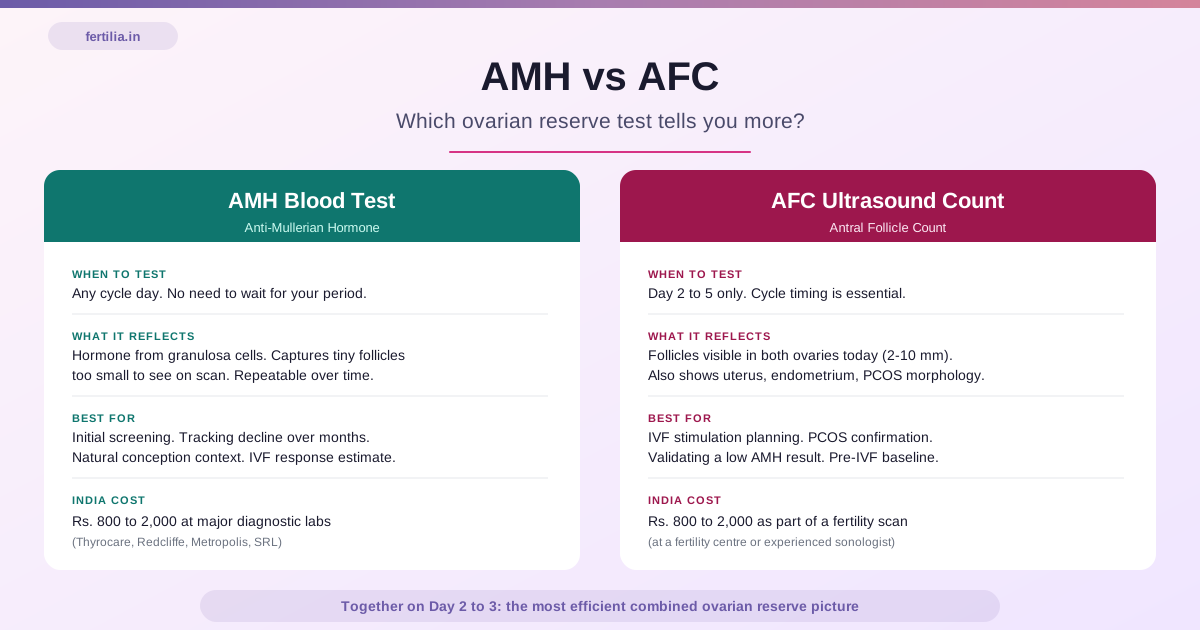
AMH (Anti-Mullerian Hormone) is a blood test. It measures the level of a hormone produced by the granulosa cells surrounding the small follicles in your ovaries. A higher AMH level reflects a larger pool of these early-stage follicles. It gives you a hormonal proxy for your ovarian reserve.
AFC (Antral Follicle Count) is an ultrasound count. A transvaginal scan done between Day 2 and Day 5 of your cycle counts the small resting follicles visible in both ovaries at that moment. It gives you a direct visual count.
One is hormonal. One is structural. Together, they look at the same underlying biology from two different directions.
For the complete breakdown of how to read your AMH number by age, see AMH Normal Range by Age: What Indian Women Should Know. For how to read your AFC scan report, see Antral Follicle Count: How to Read Your Ultrasound.
This post is about the comparison: what each test tells you that the other does not, and how to decide which to start with.
The Core Differences
| AMH | AFC | |
|---|---|---|
| Type of test | Blood test | Transvaginal ultrasound |
| When to test | Any cycle day | Day 2 to 5 only |
| What it reflects | Hormone from tiny follicles (including ones too small to see on scan) | Follicles visible right now in the 2 to 10 mm range |
| Operator skill needed | Lab-standardised, low variability | Varies with radiologist experience |
| What else it shows | Reserve trend over time | Uterus, endometrium, PCOS morphology |
| Typical India cost | Rs. 800 to 2,000 | Rs. 800 to 2,000 as part of a fertility scan |
| Predicts well | Reserve trajectory, IVF stimulation response | IVF egg retrieval numbers, PCOS pattern |
What AMH Tells You That AFC Does Not
Flexibility of timing. AMH can be drawn on any cycle day. You do not need to wait for Day 2. You do not need to be menstruating. This makes it easier to organise and easier to repeat.
Reserve at the cellular level. AMH reflects follicles at a very early stage of development, before they are large enough to appear on an ultrasound. These are the tiny primordial-to-antral transition follicles. AFC counts the follicles that have already grown to a visible size. AMH captures a slightly earlier and broader picture.
A repeatable trend marker. Because the test is a blood draw without cycle-day restriction, you can repeat AMH at intervals to track whether reserve is declining, holding steady, or responding to treatment. Tracking AFC over months is more complex because of cycle-day and operator variation.
Natural conception context. A landmark study by Steiner et al. published in JAMA in 2017 (PMID 29049585) followed 750 healthy women aged 30 to 44 who were trying to conceive naturally. The finding: AMH did not predict how quickly women with normal fecundity conceived. Women with low AMH conceived at similar rates to women with high AMH over a 12-month period, as long as everything else was working. This is important because many women come to me convinced their low AMH means they cannot conceive. The evidence in the natural conception setting does not support that conclusion.
For what low AMH means for natural conception, see Low AMH and Pregnancy: Can You Still Conceive Naturally?.
What AFC Tells You That AMH Does Not
The follicles visible today. AFC is a direct count, not a hormone level. You are not inferring the number of follicles from a blood result. You are seeing them on screen. When AFC and AMH agree, the count on the scan validates what the blood test suggested.
PCOS morphology. If one or both ovaries show more than 12 follicles arranged peripherally, or the follicle count in a single ovary exceeds 20 (the updated ESHRE 2018 threshold), that pattern is part of the Rotterdam PCOS diagnosis. AMH cannot confirm morphology. Only the scan can. For women with irregular cycles, AMH alone cannot complete the picture.
The uterus and endometrium at the same scan. A fertility scan done to count follicles simultaneously gives you the uterine size, endometrial thickness on Day 2 to 3 (typically 4 to 6 mm at this point), and an assessment for fibroids, polyps, or adenomyosis features. You get two layers of information from one appointment.
Less affected by lab variability. AMH immunoassay results vary between labs. Older assays used at some Indian centres read systematically lower than newer-generation platforms. A woman whose AMH comes back at 0.9 on one assay might read 1.2 on a standardised platform at Thyrocare or Redcliffe. AFC, being a physical count, does not have this assay-variation problem. Its limitation is operator variability instead, which is a different challenge.
For more on this, read our guide on AMH Testing in the US for Indian Women. Reliability for IVF planning. Research by Broer et al. (Fertil Steril 2009, PMID 18321493) found AFC predicted poor ovarian response to IVF stimulation as well as AMH and, in some analyses, slightly better for estimating the actual egg retrieval number. IVF clinics use AFC as one of the primary inputs when designing a stimulation protocol, because it tells them directly how many follicles are available to recruit.
Which Test to Start With
For most women beginning a fertility workup, AMH is the practical starting point. You do not need to wait for your period. You can get it done at a diagnostic centre alongside a standard blood panel. The result is available within 24 hours at major Indian labs. It gives you a baseline that stays relevant across multiple cycles.
From there, once you know where AMH sits and have identified the right cycle window, a Day 2 to 5 scan to confirm AFC is the natural next step.
There are situations where AFC takes priority:
If you have irregular cycles. For women with PCOS or irregular periods, confirming ovarian morphology is part of the diagnostic picture. The AFC scan also helps assess the antral follicle pool when periods are infrequent and cycle days are harder to time.
If you are planning IVF soon. IVF clinics typically want both AMH and AFC before your first stimulation protocol discussion. The AFC tells the reproductive endocrinologist what the ovaries look like right now, while AMH gives the hormonal context. Running them close together gives the clearest pre-IVF baseline.
If your AMH came back surprisingly low. A low AMH number, particularly from a general diagnostic lab, warrants validation. A Day 2 to 5 scan at a specialist fertility centre can confirm whether the AFC matches what the AMH suggested, or whether the AMH reading may reflect assay variation.
💜 Have your AMH or AFC results and want to understand what they mean for your specific situation? Message Dr. Suganya’s team on WhatsApp and we will look at the full picture with you.
Why You Ideally Want Both
AMH and AFC agree most of the time. When they do, you have a consistent picture of your ovarian reserve from two independent methods. When they disagree, the reason for the disagreement usually tells you something important.
Low AMH but normal AFC: The AFC is typically the more reliable reading in this case. AMH can fluctuate by 15 to 30 percent between draws, and older assay platforms at some Indian labs read lower than current-generation tests. If your AFC is normal for your age but your AMH came back low, consider repeating the AMH at a standardised lab during the early follicular phase.
Normal AMH but low AFC: Most often a scan done outside the Day 2 to 5 window, or a count by a general radiology centre where the radiologist has less fertility-specific experience. A 2 to 4 mm follicle is small and easy to miss. The solution is a repeat Day 2 to 5 scan at a dedicated fertility centre, not a clinical decision based on the first count alone.
Both low: The clearest signal of genuinely reduced ovarian reserve. Warrants a complete workup including Day 3 FSH and a direct clinical conversation about what the picture means for your specific situation.
Both high in a woman with irregular cycles: Raises the question of a PCOS pattern rather than exceptionally high reserve. Cycle regularity, androgen markers, and symptoms will clarify.
For a detailed walkthrough of what each combination means, the AFC post covers When AFC and AMH Disagree in full.
Practical Notes for Getting Both in India
AMH: Major diagnostic labs including Thyrocare, Redcliffe, Metropolis, and SRL run AMH on their standard platforms. Current costs range from Rs. 800 to Rs. 2,000 depending on the city and lab. For a full cost comparison and how to read your report, see AMH Test Cost in India: Complete Guide.
AFC scan: A transvaginal ultrasound done specifically for follicle counting needs to be done at a fertility centre or a sonologist with fertility experience, not a general radiology centre handling non-fertility scans. The follicles being counted are 2 to 10 mm. A 3 mm follicle in a busy general scan environment will frequently not be counted. Cost for a fertility-specific scan ranges from Rs. 800 to Rs. 2,000 at most centres.
Timing both tests together: The most efficient approach is to book the AMH blood draw and the AFC scan for Day 2 or Day 3 of your cycle, at the same visit if possible. You get the hormone level and the visual count from the same cycle phase, at the same time, for the same cost as doing each separately on different days.
The Bigger Picture
AMH and AFC together give you one important layer of your fertility picture: ovarian reserve. But reserve is not the full picture.
Egg quality is primarily driven by age, not count. A 38-year-old with AMH 2.5 does not have the egg quality of a 28-year-old with AMH 1.2. The number of eggs available says nothing about the chromosomal integrity of those eggs. For what supports egg quality alongside reserve, see How to Improve Egg Quality: Diet, Supplements and Lifestyle.
Ovulation, tubal patency, and partner semen quality each carry weight equal to or greater than reserve in determining natural conception probability. A woman with AMH 0.9 and open tubes, confirmed ovulation, and a normal partner semen analysis is in a very different situation from one with AMH 0.9 and anovulation.
For more on this, read our guide on Semen Analysis. Reserve numbers are the start of a clinical conversation, not the end of one. For the full workup that puts AMH and AFC in the context of every other fertility variable, see The Honest Fertility Workup: An OB-GYN’s Indian Guide.
And for the companion baseline blood panel that is typically run alongside AFC on Day 2 or 3, see Day 3 FSH, LH and Estradiol: What Your Baseline Test Shows.
💜 Ready to understand your full fertility picture, AMH, AFC, and everything beyond the numbers? Message Dr. Suganya’s team on WhatsApp The ₹399 consultation covers your entire picture, not just one test result. That full-picture work continues in Dr. Suganya’s Fertility program.
Frequently Asked Questions
Can I do AMH any time of the month? Yes. AMH does not require cycle-day timing. Unlike FSH and LH, which fluctuate significantly across the cycle, AMH remains relatively stable. You can draw it on Day 3 alongside other hormone tests, or on any other day that is convenient. This flexibility is one of AMH’s main practical advantages over AFC.
If I can only afford one test right now, which should I prioritise? AMH first. It is accessible without cycle timing, available at most major Indian diagnostic labs, and gives you a starting picture of reserve. Once you have that result, you can plan the AFC scan to coincide with the next Day 2 to 5 window. Getting them close together, within one to two cycles, gives a more reliable combined picture than getting one test months before the other.
For more on this, read our guide on Missed Period, Negative Pregnancy Test. My AFC came back low but my AMH is normal. Which result should I trust? When AMH is normal and AFC is low, the most common explanation is a scan done outside the Day 2 to 5 window, or a count done by a general radiology centre without fertility-specific experience. A 2 to 4 mm follicle is easy to miss under time pressure. Request a repeat Day 2 to 5 scan at a dedicated fertility centre before drawing clinical conclusions from the first count.
My AMH is low but my AFC seems fine. Does that mean I’m okay? When AFC looks normal but AMH is low, consider whether the AMH result may reflect assay variation at that particular lab. AMH can read 15 to 30 percent lower on older immunoassay platforms compared to current-generation tests. Repeating the AMH at a standardised lab such as Thyrocare, Redcliffe, or Metropolis during the early follicular phase is a reasonable next step. If the second AMH also comes back low but AFC stays normal, a full workup conversation is warranted.
Do I need both AMH and AFC before starting IVF? Yes. Most IVF clinics will want both before designing your stimulation protocol. AMH helps estimate your likely response to gonadotropin stimulation. AFC confirms the actual follicle pool available to recruit. Using both together reduces the risk of under-stimulating (too few eggs retrieved) or over-stimulating (hyperstimulation risk). If you are already at an IVF clinic, they will typically order both as part of the pre-cycle assessment.
How often should I repeat these tests? For women actively trying to conceive who are not yet undergoing treatment, repeating AMH every 6 to 12 months gives a sense of how reserve is trending. AFC at the same interval gives a visual confirmation. More frequent testing rarely changes the clinical picture and can increase anxiety without adding information. If you have just had one set of results, the most useful thing is to complete the full workup and have a clinical discussion about what the combined picture means, rather than repeat the same tests in two months.
Can AMH or AFC tell me whether my eggs are good quality? No. Neither AMH nor AFC tells you anything about egg quality. Quantity and quality are separate. A high AFC does not mean chromosomally normal eggs. A low AMH does not mean poor quality eggs. Egg quality is primarily age-driven: the same woman with AMH 1.5 has better egg quality at 29 than at 39. If egg quality is the concern in your workup, that conversation sits alongside the reserve picture, not inside it.