You have been on the injections for six or eight days. The scans have become routine, the clinic visits blocked into your calendar, your family already knows to expect the retrieval date. Then, at a scan that was supposed to be just another check-in, the doctor’s tone changes. She wants to talk about stopping the cycle.
If this has happened to you, or you are reading this because you are frightened it might, I want to walk you through what a cancelled or paused IVF cycle actually means. Not the version that spirals in your head at 2 a.m., the clinical one.
I’m Dr. Suganya Venkat, an OB-GYN with over fifteen years of experience, and I see this moment often in the women I work with at Fertilia alongside their IVF clinics. A cancelled cycle is one of the most distressing points in a fertility journey precisely because it feels like a wasted attempt after weeks of injections, blood draws, and hope rearranged around a single outcome. It is rarely explained well in the moment it happens, because the clinical team is usually focused on managing whatever risk triggered the decision, not on sitting with you afterward.
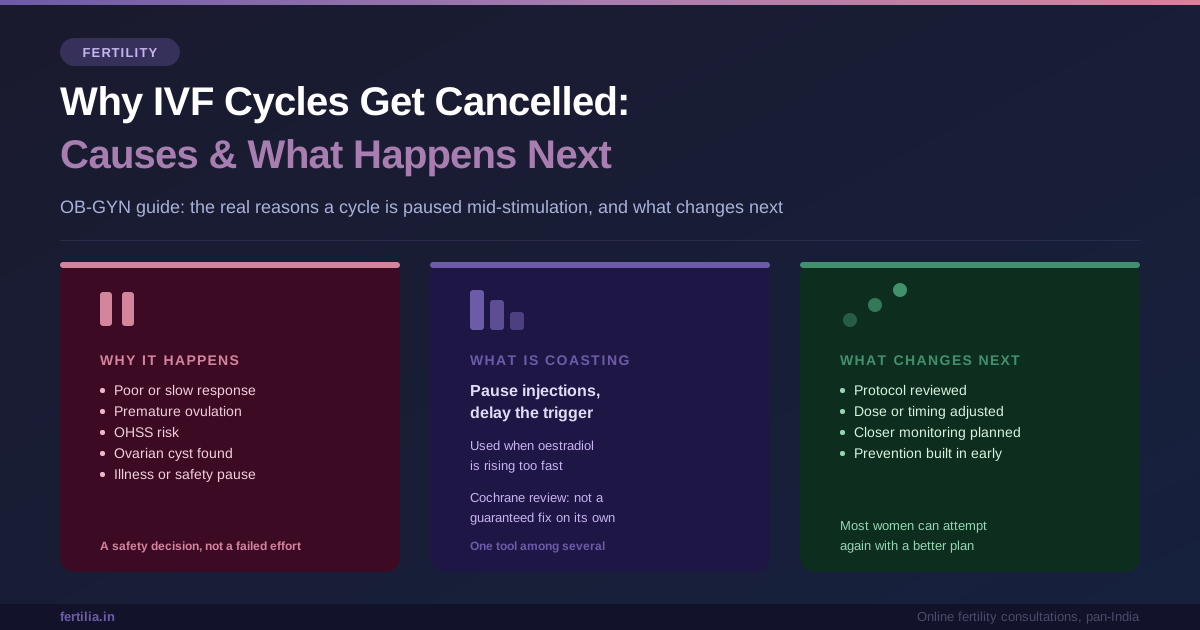
This guide covers the real reasons a cycle gets stopped or paused, including poor response, premature ovulation, OHSS risk, an unexpected ovarian cyst, and illness, what “coasting” actually is when your clinic mentions it, what changes for your next attempt, and how to think about the disappointment without adding a layer of guilt that does not belong to you.
What “Cancelled” Means, and Why It Is Rarely All-or-Nothing
The word “cancelled” gets used loosely, and that looseness is part of what makes this so confusing. A cycle can be stopped before a single injection goes ahead, if a baseline scan finds something unexpected. It can be stopped partway through stimulation, before the trigger shot, which is the scenario most women mean when they say their cycle was cancelled. Or the stimulation and retrieval can go ahead exactly as planned, and it is only the fresh embryo transfer that gets deferred, with every embryo frozen for later. These are very different situations that get flattened into the same upsetting word.
There is no single published rate for how often IVF cycles are cancelled, because clinics, countries, and studies define cancellation differently, and outcomes vary enormously by age, protocol, and starting ovarian reserve. What clinical guidance is consistent about is this: a low or high response mid-cycle is a decision point that calls for individualised judgement, not an automatic stop. The current ESHRE guideline on ovarian stimulation for IVF, an update published in 2025, is explicit that a lower-than-expected response by itself is not automatically a reason to cancel a cycle (ESHRE Guideline Group on Ovarian Stimulation, Human Reproduction, 2026). The decision should weigh your specific follicle numbers, hormone trend, age, and what a retrieval is still likely to yield, not a single number in isolation.
The Real Reasons a Cycle Gets Stopped
Poor or slower-than-expected response. If your ovaries are recruiting very few follicles despite the stimulation medication, your clinic may raise the possibility of stopping this attempt rather than continuing toward a retrieval that is unlikely to yield usable eggs. This is closely related to what we call poor ovarian response, and I have written a full guide on that specific picture: Poor Ovarian Response in IVF: Causes & Next Steps. The important thing to know here is that a slow start is not automatically a stop sign. Current guidance is against reflexively cancelling for a low response alone; your clinic should be discussing your individual prognosis, not applying a blanket rule.
Premature ovulation or a premature LH surge. Normally, the eggs are meant to stay inside their follicles until the trigger shot matures them for a scheduled retrieval. Occasionally, your body’s own hormones surge early and trigger ovulation on their own timeline, before the retrieval can be planned around it. If this happens, the eggs may release into the pelvis before they can be collected, and the cycle has to be abandoned for that attempt. In a retrospective study of nearly 700 antagonist-protocol IVF cycles, premature ovulation leading to cancellation occurred in about 2% of cycles, and the women affected tended to be older, with lower AMH and antral follicle counts and higher baseline FSH than those who did not have a surge (Kochhar & Ghosh, Journal of Human Reproductive Sciences, 2020, PMID 33311904). This is one of the reasons diminished ovarian reserve and a premature surge tend to travel together, and it is a useful thing to mention if this has happened to you before starting your next cycle.
Risk of ovarian hyperstimulation syndrome (OHSS). At the other extreme, some women respond more strongly than expected, recruiting a large number of follicles with rapidly rising oestradiol. Continuing straight to the usual trigger shot in that situation raises the risk of OHSS, a complication where fluid shifts out of the bloodstream into the abdomen. I have written in detail about what OHSS feels like and how it is graded here: OHSS After IVF: Symptoms, Prevention & When to Act. When the risk looks high, your clinic has options well short of abandoning the cycle entirely, which I cover in the next section.
A cyst or unexpected finding on a baseline or monitoring scan. A functional ovarian cyst found at the start of a cycle, or an unusual finding partway through stimulation, can delay or pause a cycle while your doctor assesses whether it is hormonally active or likely to interfere with a clean stimulation. A cyst by itself is not automatically a reason to stop. Clinics weigh its size, whether it is producing its own hormones that would distort your bloodwork, and whether it is likely to resolve on its own within days. Many cysts are monitored rather than acted on.
Illness or a physical reason unrelated to your ovaries. A fever, an infection, or an unrelated medical issue that makes an anaesthetic or a retrieval procedure unsafe can also mean a cycle is paused, even when your ovarian response itself has been perfectly on track. This is a safety decision, not a fertility one, and it usually means the cycle can be reattempted once you have recovered.
💜 Been told your IVF cycle might need to stop, or trying to understand a cancellation that already happened? Message Dr. Suganya’s team on WhatsApp and we will help you make sense of your specific scan and hormone picture, alongside whatever your IVF clinic has already told you.
“Coasting”: What It Means When Your Clinic Mentions It
If you are at risk of OHSS, cancelling the whole cycle is not always the only option your clinic has. One approach you may hear called “coasting” involves temporarily stopping the daily stimulation injections while continuing to monitor you closely, and delaying the trigger shot until your oestradiol level falls or levels off to a safer range. The idea is to let the highest-risk hormone surge settle before triggering final egg maturation, rather than abandoning the attempt outright.
The evidence for coasting is weaker than the early enthusiasm for the technique suggested. A Cochrane systematic review of coasting found no statistically clear evidence that it reduced moderate-to-severe OHSS compared with no coasting or other prevention strategies (D’Angelo, Brown & Amso, Cochrane Database of Systematic Reviews, 2011, PMID 21678336). That does not mean coasting never helps an individual case; it means it is not a guaranteed fix, and current OHSS-prevention practice has largely shifted toward more consistently supported strategies instead, including a GnRH agonist trigger in an antagonist protocol and freezing all embryos rather than proceeding to a fresh transfer, which I have detailed in the OHSS guide above (Devroey, Polyzos & Blockeel, Human Reproduction, 2011, PMID 21828116). If your clinic mentions coasting, it is reasonable to ask what specific prevention plan they have alongside it, and why.
What Happens Next After a Cancelled or Paused Cycle
This is the part that gets rushed in the appointment where the cancellation happens, because everyone in the room is dealing with the immediate decision. Here is what a next attempt usually looks like, depending on why this one stopped.
After poor response: your clinic will typically review your protocol, sometimes switching between an antagonist and agonist approach, adjusting the starting dose, or considering a milder stimulation approach if higher doses have not meaningfully changed your yield in the past. This is exactly the same territory covered in the poor ovarian response guide linked above, since the two situations overlap closely.
After premature ovulation: your clinic may adjust the timing of when the antagonist medication is introduced in your protocol, monitor you more frequently in the days leading up to when a surge previously occurred, or consider starting the antagonist earlier in future cycles.
After OHSS risk: your protocol for the next attempt is often built around prevention from the start rather than reacting partway through, which can include a lower starting dose, a GnRH antagonist protocol with a GnRH agonist trigger, and a planned freeze-all approach so that a fresh transfer is never on the table if your response looks likely to be strong again.
After a cyst or illness: once the cyst has resolved or you have recovered, most clinics simply restart the same protocol that was originally planned, since the pause was about timing and safety rather than anything about how your ovaries actually respond to stimulation.
On the practical and financial side, a cancelled cycle before retrieval typically means the medication costs already incurred are not recoverable, but the clinic and procedure fees tied specifically to retrieval and embryo work are usually not charged, since those steps did not happen. Ask your clinic directly what applies in your case, since billing structures vary. For a fuller picture of how IVF costs break down by stage in India, see IVF Cost in India 2026: Honest Breakdown.
Sitting With the Disappointment
I want to say this as plainly as I can: a cancelled cycle is a clinical safety decision, not a failed effort on your part, and it is not a sign your body did something wrong. The injections, the early mornings for blood draws, the way you rearranged work and family life around this cycle, none of that was wasted. It gave your clinic real information about how your body responds, information that is now used to plan the next attempt more precisely than the first one could have been planned.
It is also completely reasonable to grieve this, even while understanding the medical reasoning behind it. Many women describe a cancelled cycle as feeling harder in some ways than a failed transfer, because there is no clear ending to point to, just a pause with an uncertain next date. Give yourself the space to feel that before jumping straight to planning the next attempt.
At Fertilia, when a woman’s cycle has been paused or stopped by her IVF clinic, my role and the role of our Fertility and IVF Support programs is the layer around that decision: making sure the rest of your health, thyroid function, vitamin D, sleep, and stress load, is not adding an avoidable obstacle heading into the next attempt, and helping you process the disappointment without carrying blame that was never yours to carry. Your IVF clinic manages the protocol and the procedure; I work alongside that relationship, not instead of it.
💜 Trying to make sense of a cancelled cycle, or planning ahead for your next attempt? Message Dr. Suganya’s team on WhatsApp A ₹399 online video consultation covers your full picture, alongside whatever your IVF clinic is already doing.
Frequently Asked Questions
Does a cancelled IVF cycle mean IVF will not work for me? No. A cancelled cycle usually reflects how your body responded under one specific protocol, at one point in time. It gives your clinic real information they did not have before, which is used to adjust the next attempt, whether that means a different dose, a different protocol type, or closer monitoring at the point where the last cycle needed to stop. Many women go on to have a successful cycle after an earlier one was cancelled.
What is coasting in IVF and does it always work? Coasting means temporarily stopping the stimulation injections while continuing to monitor you, and delaying the trigger shot until your oestradiol level falls to a safer range, done to reduce the risk of OHSS. A Cochrane review found no statistically clear evidence that it reliably reduces moderate-to-severe OHSS compared with other approaches, so it is not a guaranteed fix, and many clinics now lean on other prevention strategies alongside or instead of it, such as a different trigger medication or freezing all embryos.
Why did my IVF cycle get cancelled if my follicles looked fine on the last scan? Response can change quickly over a few days, particularly with premature ovulation, where a spontaneous hormone surge can occur even when follicles have been growing well. A cyst found on a later scan, or a sudden jump in oestradiol suggesting an OHSS risk, can also change the picture between two consecutive visits. Ask your clinic for the specific hormone or ultrasound finding that changed, so you understand what to watch for next time.
Will I be charged for a cycle that gets cancelled partway through? This depends on your clinic’s billing structure. Medication already used is typically not refundable, but fees specifically tied to egg retrieval or embryo culture are usually not charged if those steps never happened, since the cycle stopped before them. Ask your clinic directly what applies to a cancelled cycle at your stage of stimulation, ideally before you start, so there are no surprises if it happens.
Is a cyst found before starting IVF always a reason to delay? Not always. Many ovarian cysts found on a baseline scan are simple and functional, and resolve on their own within a cycle or two without any treatment. Your clinic will look at the cyst’s size, whether it appears to be producing hormones that would distort your baseline bloodwork, and whether it is likely to interfere with clean follicle recruitment. A cyst that is small, simple, and hormonally inactive is often just monitored rather than acted on.
How soon can I start another IVF cycle after one is cancelled? This varies by why the cycle stopped and what your clinic’s protocol changes involve. A cycle paused for a cyst or illness often restarts once that issue has resolved, sometimes within the same month or two. A cycle stopped for a poor or an excessive response usually involves a full protocol review first, which can take a full menstrual cycle or more to plan properly. Your clinic is best placed to give you a specific timeline based on what changed for your protocol.
Can I do anything myself to reduce the chance of my next cycle being cancelled? There is no guaranteed way to prevent every reason a cycle might stop, since some, like a premature surge, relate to your underlying hormone patterns. What is within your control is making sure conditions like thyroid function, vitamin D levels, and overall metabolic health are optimised heading into a cycle, since these can affect how predictably your body responds to stimulation. This is exactly the layer Dr. Suganya Venkat and the team at Fertilia work on alongside your IVF clinic’s protocol.
कैंसिल हुआ IVF साइकिल दोबारा कब शुरू कर सकते हैं? (When can a cancelled IVF cycle be restarted?) यह इस बात पर निर्भर करता है कि साइकिल क्यों रुकी थी। यदि सिस्ट या बीमारी की वजह से रुकी थी, तो ठीक होने के बाद जल्द ही दोबारा शुरू की जा सकती है। यदि कम या अधिक रिस्पॉन्स की वजह से रुकी थी, तो डॉक्टर पूरे प्रोटोकॉल की समीक्षा करेंगे, जिसमें एक पूरा मासिक धर्म चक्र या उससे अधिक समय लग सकता है।
(This depends on why the cycle stopped. If it was paused for a cyst or illness, it can often restart soon after recovery. If it stopped due to a low or high response, your doctor will review the whole protocol first, which can take a full menstrual cycle or longer.)