There is a particular phone call in every IVF stimulation cycle that women remember afterwards. The scan is done, the clinic has looked at the follicle sizes, and someone calls in the evening and says: take the trigger tonight at 9:45 pm exactly, and come in on Thursday morning. Not “sometime tonight”. Not “before bed”. A specific minute, said twice, sometimes followed by a request to repeat it back.
I’m Dr. Suganya Venkat, an OB-GYN with over fifteen years of clinical experience, and in the video consultations I run at Fertilia, this is one of the moments women ask me about most often. The precision feels alarming, as though something enormous rests on a single injection, which is roughly true, but not in the frightening way it sounds. This post covers what the trigger shot actually does, why the clock matters so much, the different trigger medications used in India and why your clinic may have chosen one over another, what the injection feels like in the hours after, and what happens if something about the timing goes wrong.
What the Trigger Shot Is Doing That the Other Injections Are Not
For the eight to twelve days before it, the daily stimulation injections have one job: persuading a group of follicles to grow together instead of letting one take over, which is what happens in a natural cycle. Those injections build the follicles. They do not finish the eggs inside them.
Inside a growing follicle, the egg is held in an immature state, paused partway through the division that has to complete before it can be fertilised. In a natural cycle, a surge of luteinising hormone (LH) from the pituitary gland releases that pause. The egg completes its first meiotic division, becomes what embryologists call a metaphase II (MII) oocyte, and detaches from the follicle wall so it can be collected. Roughly a day and a half later, ovulation happens.
In an IVF cycle, the antagonist injections you have been taking (cetrorelix or ganirelix, usually) exist specifically to suppress your own LH surge, so that ovulation is far less likely to happen at an unplanned moment. They reduce that risk substantially rather than removing it altogether, which is part of why monitoring continues through stimulation. What they also do is leave a gap: the eggs still need a maturation signal. The trigger shot is that signal, given deliberately, at a moment your clinic chooses.
So the trigger is doing three separate things at once:
- Completing egg maturation. The egg is already inside the follicle; what it is not yet is mature. Immature eggs cannot be fertilised, and this is the step that finishes that maturation so the egg is usable once collected.
- Loosening the egg from the follicle wall. Retrieval works by aspirating follicular fluid through a fine needle. The egg has to be free-floating in that fluid to come out with it.
- Starting a clock. The same signal that matures the egg also sets ovulation in motion. Retrieval has to happen inside that window.
That third point is the whole reason for the 9:45 pm.
Why the Timing Is Down to the Hour
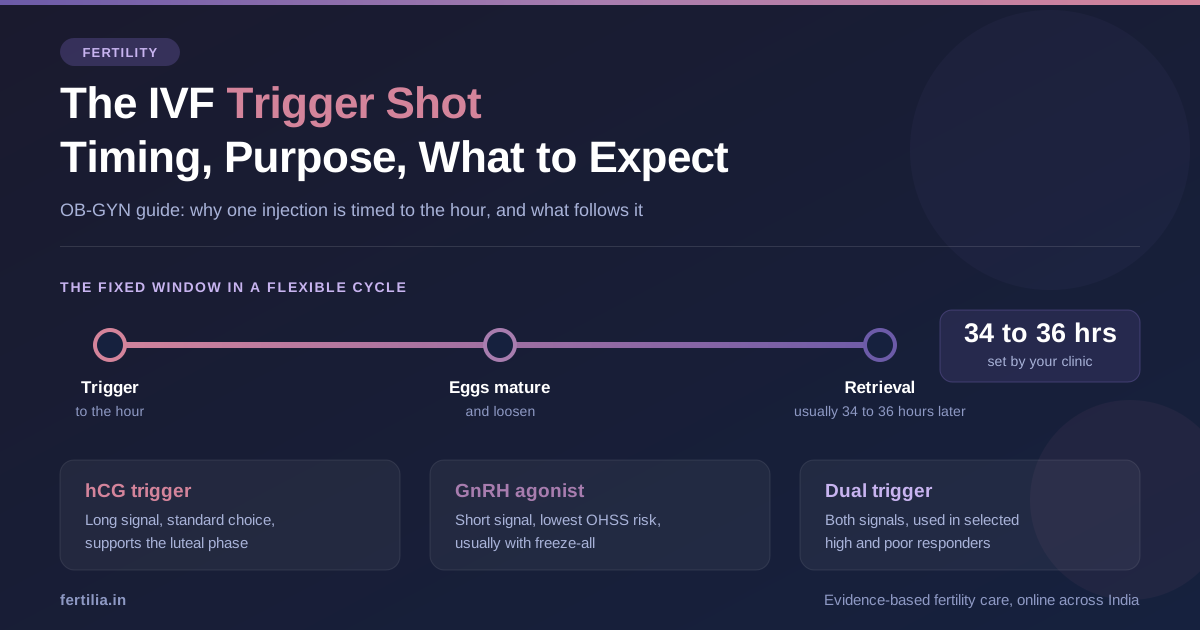
The interval between the trigger injection and egg retrieval is most commonly 34 to 36 hours, with some protocols and trigger types extending it further, and your clinic works backwards from its own retrieval slot to give you an injection time.
Go too early and the eggs are collected before maturation has finished, so a higher proportion come out immature and unusable. Go too late and you risk the follicles releasing their eggs into the pelvis before the needle gets there, which is not dangerous but means there is nothing to collect from those follicles.
What is less widely known is that the ideal interval is not the same for every trigger medication. A large single-centre retrospective study of 59,206 retrieval cycles found the optimal interval differed by trigger type: cycles triggered with hCG yielded the most mature MII oocytes with a shorter interval, while cycles triggered with a GnRH agonist did better with a longer one, and in the agonist group blastocyst formation was markedly higher when the interval exceeded 36.5 hours (Enatsu Y et al., F S Rep, 2025, PMID 41473569). The differences were more pronounced in older women.
This is worth knowing for one practical reason. If a friend tells you her trigger was 35 hours before retrieval and yours is 37, that is not a mistake on anyone’s part. Your clinics may be using different trigger drugs, and the interval is matched to the drug and to you. The instruction you were given is the one to follow.
A few practical notes on the night itself:
- Set two alarms, on two different devices, for fifteen minutes before the time. Almost nobody forgets the trigger. Plenty of women have been in traffic or in a meeting at the exact minute.
- Lay the medication out in the afternoon, not at 9:30 pm. Some trigger preparations need reconstitution with a supplied diluent, and discovering an unfamiliar two-vial process minutes before the deadline is avoidable stress.
- Have someone else know the time too. A husband, a sister, a friend on a phone call.
- If your trigger is intramuscular and you are not confident giving it, arrange the person who will do it a day in advance, not on the evening itself.
The mechanics of giving the injection itself are the same skills you have already been using all cycle, and my guide on doing IVF injections at home safely covers site rotation, storage, and technique in detail.
💜 In a stimulation cycle and unsure about your trigger instructions or what happens next? Message Dr. Suganya’s team on WhatsApp and we will walk through your protocol alongside whatever your IVF clinic has already told you.
The Three Trigger Types, and Why Your Clinic Chose Yours
hCG trigger
Human chorionic gonadotropin is structurally similar enough to LH to bind the same receptor, and it has been the standard trigger for decades. In India you will most often see it as choriogonadotropin alfa (a recombinant preparation, sold as Ovitrelle, given as a 250 microgram prefilled subcutaneous injection) or as a urinary-derived hCG given in the region of 5,000 to 10,000 IU, commonly intramuscular.
Its advantage is that it is long-acting: the receptor stays stimulated well past the maturation window, which also supports the corpus luteum and the early luteal phase afterwards. That same durability is its drawback. Sustained hCG activity is the main driver of ovarian hyperstimulation syndrome (OHSS), because it stimulates vascular endothelial growth factor and increases blood vessel permeability. If you have PCOS, a high antral follicle count, or a rapidly rising oestradiol, this is the mechanism your clinic is trying to avoid, and my post on OHSS symptoms, prevention and when to call your doctor goes through the full prevention toolkit.
GnRH agonist trigger
In an antagonist protocol, a GnRH agonist (leuprolide, triptorelin, or buserelin depending on the clinic) can be used instead. It works differently: rather than mimicking LH, it provokes your own pituitary into releasing a short burst of LH and FSH. The eggs mature, but the signal fades within hours rather than days, which is precisely why it protects against OHSS.
The Cochrane review of this question included 17 randomised trials with 1,847 women. In fresh autologous cycles, agonist triggering substantially reduced OHSS of any severity compared with hCG (OR 0.15, 95% CI 0.05 to 0.47; eight RCTs, 989 women, moderate-quality evidence). The same review found that in those fresh cycles, the agonist trigger was also associated with a lower live birth rate (OR 0.47, 95% CI 0.31 to 0.70; five RCTs, 532 women, moderate-quality evidence), attributed to the short-lived LH signal leaving the luteal phase underpowered (Youssef MA et al., Cochrane Database Syst Rev, 2014, PMID 25358904).
That finding is the reason an agonist trigger is so often paired with a freeze-all decision. Freezing the embryos removes the fresh transfer from the equation entirely, so the weakened luteal phase no longer matters, and the transfer happens later in a cycle prepared separately. If your clinic has told you agonist trigger and freeze-all in the same conversation, those two instructions are one decision, not two. My guide on fresh versus frozen embryo transfer covers what changes when the transfer moves to a later cycle.
Dual trigger
Some protocols combine a GnRH agonist with a low dose of hCG, aiming for the maturation benefit of both signals with less hCG exposure than a full trigger. It is used in two fairly different situations: in high responders, where the aim is to restore some luteal support that an agonist alone does not provide, and in poor responders, where the question is whether the combined signal improves egg yield and maturity. It is worth being clear that adding hCG back, even at a low dose, reintroduces some OHSS risk compared with an agonist-only trigger. Dual trigger lowers hCG exposure relative to a standard hCG trigger; it does not carry the same protection an agonist-only trigger does. A PRISMA systematic review and meta-analysis of seven studies covering 2,474 poor responders reported a higher clinical pregnancy rate with dual trigger (Sloth AT et al., Gynecol Endocrinol, 2022, PMID 34779694), though the included studies were largely observational and the authors were appropriately cautious about the strength of that evidence.
Dual trigger is an area where practice varies between good clinics. Yours may use it routinely, not use it at all, or reserve it for specific situations, and all three are defensible positions on the current evidence.
| hCG trigger | GnRH agonist trigger | Dual trigger | |
|---|---|---|---|
| How it works | Directly stimulates the LH receptor | Provokes your own pituitary LH surge | Both signals together |
| Duration of signal | Days | Hours | Mixed |
| OHSS risk | Highest of the three | Lowest | Lower than hCG alone |
| Typical use | Standard cycles, normal responders | High responders, PCOS, egg freezing, donor cycles | Selected high or poor responders |
| Usually paired with | Fresh or frozen transfer | Freeze-all in most fresh-cycle protocols | Varies by protocol |
None of these is a better or worse drug in the abstract. The choice is made from your antral follicle count, your oestradiol trend across the monitoring scans, your history in previous cycles, and whether a fresh transfer is planned. If you want to understand the reasoning in your own case, asking your reproductive endocrinologist directly (why this trigger, for me) is a completely reasonable question and one most are glad to answer.
What the Next 36 Hours Feel Like
For most women, surprisingly little happens, and that itself becomes a worry. Here is the usual shape of it.
The injection. Subcutaneous trigger preparations sting about as much as the stimulation injections have been stinging. Intramuscular hCG is a deeper injection into the upper outer buttock and is more uncomfortable, sometimes leaving the area tender for a day.
That night and the next day. Ovarian heaviness or a dragging fullness in the lower abdomen is common and expected. Your ovaries are enlarged from stimulation, and that does not change overnight. Some women notice mild nausea, breast tenderness, or a slight headache. Some notice nothing at all, which is equally normal and does not mean the trigger has not worked.
The day of retrieval. You come in fasting per your clinic’s instructions. There is no second injection to take on the morning of retrieval unless your clinic specifically says so.
Things worth reporting rather than sitting with: rapidly worsening abdominal distension, breathlessness, a sharp reduction in how much you are passing urine, or weight gain of more than one kilogram in twenty four hours (or more than three kilograms over three to four days). Those are OHSS signals rather than ordinary post-trigger sensations, and they are specifically discussed in the OHSS post linked above. They are uncommon, and clinics watch for them precisely so you do not have to self-diagnose.
One more practical thing. If you take a home pregnancy test in the days after an hCG trigger, it can read positive from the trigger medication itself rather than from a pregnancy, because the test detects the same hormone you have just injected. This is the single most avoidable source of heartbreak in the whole cycle. Wait for the blood test your clinic schedules. My post on the two week wait after IUI, IVF or transfer covers the timing of that test and why home testing before it misleads so reliably.
When the Timing Goes Wrong
This is the section most women want, and the reassuring part is that clinics deal with these situations routinely.
You realise you are late, but have not yet injected. Call the clinic first, whatever the hour, and follow the instruction they give you rather than deciding for yourself whether to go ahead. Depending on how late it is and which drug you are on, they may ask you to inject straight away, or they may want to shift the retrieval slot instead. Do not wait until morning to tell them. Retrieval is scheduled backwards from the trigger time, so the clinic needs to know the situation while there is still room to adjust it.
You think the injection did not go in properly. Perhaps the syringe leaked, or the pen did not click, or fluid ran back out of the site. Call the clinic and describe exactly what happened. Do not give a second dose on your own judgment. If you had an hCG-based trigger, clinics can check a serum hCG level the following morning to see whether an adequate level was reached; after a GnRH agonist trigger the check is a different one, usually post-trigger LH and progesterone, so the test your clinic orders depends on which drug you were given.
This matters more than it sounds. A review of empty follicle syndrome, where no eggs are retrieved despite apparently normal follicle growth, distinguishes a “false” form from a “genuine” one, and identifies the cause of the false form clearly as an error in hCG administration at the time of trigger (Revelli A et al., Reprod Biomed Online, 2017, PMID 28596003). Telling the clinic the same night gives them the best chance of doing something useful about it, sometimes a repeat or rescue trigger with the retrieval rescheduled. That is not a guarantee of a good outcome, but it is a far better position than the same problem being discovered on the retrieval table.
Your retrieval gets rescheduled. Occasionally the clinic moves the slot by a small margin. A modest shift that keeps you within the interval your clinic is aiming for is a scheduling adjustment rather than a sign anything has gone wrong. Interval does influence egg maturity, which is exactly why the clinic is the one making that call rather than leaving it to chance.
The cycle is cancelled before trigger. This happens for reasons that have nothing to do with the trigger itself (too few follicles responding, a premature LH rise, an OHSS risk judged too high for a safe retrieval), and my post on why IVF cycles get cancelled and what happens next goes through those situations and what usually changes in the next attempt.
If you are fitting all of this around a job, the trigger and retrieval are the two fixed points in an otherwise fairly flexible schedule, and my guide on managing an IVF cycle while working full-time covers how to plan leave around them when retrieval day is only confirmed two or three days in advance.
What To Do With This Before Your Trigger Night
- Write the exact time down when the clinic calls, and read it back to them.
- Confirm which medication you are taking as the trigger, and whether it is subcutaneous or intramuscular. These are different injections with different preparation.
- Check whether your medication needs mixing, and read that leaflet in the afternoon.
- Ask whether a fresh transfer is planned, because if you have been given an agonist trigger, the answer shapes what happens for the next several weeks.
- Set two alarms.
- Save the clinic’s after-hours number in your phone before the evening, not during the emergency.
- Do not test at home in the days afterwards.
At Fertilia, our IVF Support program sits alongside your IVF clinic rather than in place of it. The clinic owns the protocol, the drugs and the retrieval. What we look after is everything around it: understanding what you have been told, your metabolic and thyroid picture going into the cycle, nutrition and sleep through stimulation, and the part nobody schedules time for, which is how heavily this stretch weighs on you. Every one of our consultations happens over video, wherever in India or abroad you are.
💜 Going into an IVF cycle and want someone to help you understand the protocol you have been given? Message Dr. Suganya’s team on WhatsApp A ₹399 online video consultation covers your full picture, alongside whatever your IVF clinic has already advised.
Frequently Asked Questions
What exactly does the trigger shot do in IVF?
It completes the final maturation of the eggs inside your follicles and loosens them from the follicle wall so they can be collected. The daily stimulation injections grow the follicles; the trigger finishes the eggs inside them. Without it, the eggs would be retrieved immature and could not be fertilised.
How many hours after the trigger shot is egg retrieval?
Most commonly 34 to 36 hours, with some protocols extending further depending on the trigger used, and your clinic choosing a specific time for you. The optimal interval differs by trigger drug: a large retrospective study of 59,206 cycles found hCG-triggered cycles yielded the most mature eggs with a shorter interval, while GnRH agonist cycles did better with a longer one, particularly beyond 36.5 hours (Enatsu Y et al., F S Rep, 2025, PMID 41473569). Follow the exact time your clinic gives you rather than a general figure.
What happens if I take the trigger shot late?
Call your clinic immediately, even if it is the middle of the night, and tell them the situation before you decide anything yourself. If you have already injected, tell them the actual time you did it. Retrieval is scheduled backwards from the trigger, so if the trigger moved, the retrieval time may need to move with it. A late trigger the clinic knows about in time is usually something they can work around.
Why did my clinic use a GnRH agonist trigger instead of hCG?
Usually to reduce OHSS risk. An agonist trigger produces a short-lived LH surge rather than sustained hCG activity, and the Cochrane review of 17 trials found it substantially reduced OHSS compared with hCG in antagonist cycles (Youssef MA et al., Cochrane Database Syst Rev, 2014, PMID 25358904). The same review found lower live birth rates in fresh transfers after an agonist trigger, which is why it is generally paired with freezing all embryos and transferring in a later cycle.
Can the trigger shot make a pregnancy test positive?
Yes, if you had an hCG-based trigger. Home pregnancy tests detect hCG, and they cannot tell injected hCG apart from hCG produced by a pregnancy, so a test taken too soon can read positive from the medication alone. This is why clinics schedule a blood test at a specific point instead. Waiting for that test spares you a false result in either direction.
Does the trigger injection hurt?
Subcutaneous trigger preparations such as choriogonadotropin alfa feel much like the stimulation injections you have already been giving yourself. Intramuscular hCG is a deeper injection and is more uncomfortable, sometimes leaving the area tender for about a day. Ovarian heaviness over the following day is common and expected, because your ovaries are enlarged from stimulation.
What if I think my trigger injection did not go in properly?
Call the clinic and describe exactly what you saw, whether that was leakage, a pen that did not click, or fluid running back out. Do not repeat the dose on your own judgment. If your trigger was hCG-based, your clinic can check a serum hCG level the next morning to see whether an adequate level was reached; after a GnRH agonist trigger they would check LH and progesterone instead. This matters because an administration error at trigger is a recognised cause of retrieving no eggs despite normal-looking follicles (Revelli A et al., Reprod Biomed Online, 2017, PMID 28596003). Caught the same night, your clinic may be able to act on it, sometimes with a repeat trigger and a rescheduled retrieval. That is not certain to work, but it is a much better position than finding out on the day.