There is a question that tends to arrive with a clinic webpage open in another tab. Somewhere on it is a protocol called mini IVF, or natural IVF, priced at what looks like a fraction of the quote already sitting in the inbox from a different centre. The question that follows is the reasonable one: if this exists, and it costs less, why did nobody mention it to me?
I’m Dr. Suganya Venkat, an OB-GYN with over fifteen years of clinical experience, and in the video consultations I run at Fertilia this question has become noticeably more common over the last year. Partly because Indian clinics have started marketing these protocols directly, and partly because the conventional IVF bill genuinely is out of reach for a lot of couples.
The answer is not that these protocols are a secret, or a gimmick. They are real, they have a respectable evidence base, and for certain women they are a sensible choice. They are also routinely misunderstood, in a specific direction: the saving is smaller than the advertising suggests, and it is not evenly distributed across everyone who might be offered one.
This post covers what natural cycle and mini IVF actually involve, what the randomised evidence says about success rates, what the costs look like in India once you separate the package price from the total, who these protocols genuinely suit, and the questions worth asking before you sign up for one.
The Three Things These Names Refer To
The terminology is loose, and different clinics use the same words differently, which is the first practical problem. Broadly there are three approaches sitting under these labels.
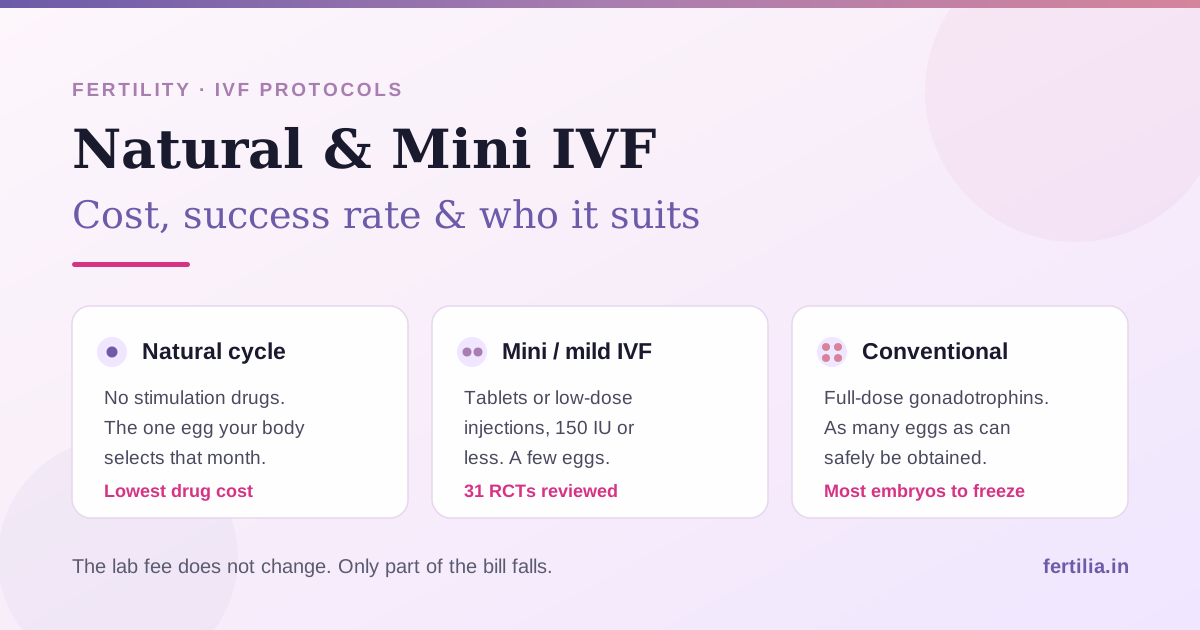
Natural cycle IVF. No stimulation drugs at all. Your body selects one follicle in the usual way, the clinic monitors it with scans, and when it is ready they retrieve that single egg, fertilise it in the lab, and transfer the embryo if one develops. The whole point is that no gonadotrophins are used.
Modified natural cycle IVF. Very close to the above, but with small additions to make the timing controllable: typically a trigger injection to time the retrieval, sometimes an antagonist injection with a small amount of gonadotrophin to stop you ovulating before the retrieval slot. Still one egg, or occasionally two. Most clinics that advertise natural IVF are in fact doing this version, because a genuinely unassisted cycle is difficult to schedule.
Mini IVF, also called minimal or mild stimulation IVF. Here there is stimulation, just much less of it. Oral tablets (clomiphene or letrozole) alone or combined with low-dose injections, aiming to grow a handful of follicles rather than ten or fifteen. In the research literature this is usually defined by dose: 150 IU or less of gonadotrophin daily counts as mild, against the 225 to 450 IU typical of a conventional cycle.
The shorthand that holds up reasonably well: natural cycle aims for the one egg your body was going to produce anyway, mini IVF aims for a few, and conventional IVF aims for as many as can be safely obtained.
Everything downstream of the retrieval is identical in all three. Fertilisation in the lab, embryo culture, ICSI where the sperm needs it, transfer, freezing. The protocols differ in how eggs are obtained, not in what happens to them afterwards.
What the Evidence Shows on Success Rates
This is where the marketing and the trial data part company, so it is worth being precise about what has been measured.
Mild and minimal stimulation
The most useful evidence here is a systematic review in Human Reproduction Update covering 31 randomised controlled trials, which compared mild dose IVF (150 IU or less daily) with conventional higher-dose IVF. Live birth rates per randomisation were similar in poor responders (RR 0.91, CI 0.68 to 1.22), normal responders (RR 0.88, CI 0.69 to 1.12) and hyper-responders (RR 0.98, CI 0.79 to 1.22), with moderate quality evidence. Cumulative live birth rates across five trials and 2,037 women were also similar (RR 0.96, CI 0.86 to 1.07). Mild stimulation produced fewer eggs and fewer embryos, but the proportion of high-grade embryos was comparable, and OHSS risk was significantly lower in normal and hyper-responders (Datta AK et al., Hum Reprod Update, 2021, PMID 33146690).
That is a genuinely encouraging finding, and it is worth reading carefully rather than enthusiastically. “Similar” here means the confidence intervals include the possibility of a modest disadvantage as well as a modest advantage. The same review found that cycle cancellation was more frequent with mild dosing among normal responders (RR 2.08, CI 1.38 to 3.14), on low quality evidence.
In poor responders specifically, a separate meta-analysis of 15 randomised trials found cumulative and fresh live birth rates comparable between mild and conventional stimulation, alongside a lower oocyte yield and a higher cancellation rate (RR 1.48, CI 1.08 to 2.02), with treatment cost significantly reduced (Montoya-Botero P et al., Hum Reprod Open, 2021, PMID 33614987).
Natural cycle
The evidence base here is thinner. The Cochrane review of natural cycle IVF, including both unstimulated and modified natural cycles, found six randomised trials with 788 women in total. There was no statistically significant difference in live birth rates against standard IVF (OR 0.68, CI 0.46 to 1.01, two studies, 425 women, moderate quality evidence). The reviewers translated that into something more usable: for a woman with a 53% chance of live birth using standard IVF, the chance with natural cycle IVF would range somewhere from 34% to 53% (Allersma T et al., Cochrane Database Syst Rev, 2013, PMID 23990351). The review is over a decade old and the evidence was limited by imprecision, which is itself informative about how much high-quality comparison has been done.
Observational data gives a sense of scale. A cohort of 638 women aged 39 or under starting a first modified natural IVF cycle reported live birth rates per started cycle of 11.6%, 12.4% and 17.0% across three AMH groups, with AMH not predicting outcome (Preaubert L et al., Reprod Biomed Online, 2019, PMID 31272809). Those are per-cycle numbers from a single centre, and they are lower per attempt than a good conventional cycle in a young woman would be.
Reading these numbers properly
Two distinctions do most of the work here.
The first is per cycle versus per attempt at a baby. A protocol that yields one egg gives you one chance per retrieval, and a proportion of retrievals will yield no usable embryo. A protocol that yields ten eggs may produce embryos to freeze, which means further transfers from a single retrieval. When you compare a single natural cycle against a single conventional cycle, you are not comparing like with like in terms of how many transfer opportunities each one buys.
The second is who was studied. The reassuring mild-stimulation data comes largely from trials in poor responders and in women where high doses were not producing proportionate benefit anyway. A woman with good ovarian reserve who would have produced twelve eggs on a standard protocol is in a different position from a woman whose ovaries yield three eggs regardless of dose. In the second case, lowering the dose costs little. In the first, it may cost more than the price difference saves.
💜 Been offered a mini or natural IVF protocol and unsure whether it fits your situation? Message Dr. Suganya’s team on WhatsApp and we will go through your reports alongside whatever your fertility clinic has recommended.
What They Cost in India
Here is the part that brings most women to these protocols, and it needs the arithmetic done honestly.
An IVF bill has several components. The base procedure and lab fee, stimulation medication, monitoring scans and blood tests, ICSI where needed, embryo freezing, and any transfer that follows. Mini and natural cycle protocols reduce some of those components substantially and leave others entirely untouched.
What falls: the medication cost, which is the single biggest variable in a conventional bill. Monitoring, to a smaller degree, since fewer scans are sometimes needed.
What does not fall: the retrieval procedure, anaesthesia, laboratory work, embryologist time, ICSI, freezing and transfer. The laboratory does the same work for one egg as it does for twelve.
One Indian clinic that publishes a component-level price list, Ayuh Fertility Centre, quotes mild or mini IVF at ₹80,000 to ₹1,10,000 for the procedure against ₹1,20,000 to ₹1,40,000 for standard IVF, and estimates the medication component at ₹8,000 to ₹25,000 for mini IVF against ₹25,000 to ₹60,000 for conventional (ayuhfertilitycentre.com, checked 22 September 2026). Their all-in estimates come to ₹1,00,000 to ₹1,40,000 for a mini IVF cycle against ₹1,60,000 to ₹2,20,000 for a conventional one.
That is one clinic’s published pricing, not a national rate, and prices vary widely by city and centre. For the conventional baseline across Indian cities, my full breakdown of IVF costs in India for 2026 has the component-by-component and city-by-city figures.
| Natural / modified natural | Mini IVF | Conventional IVF | |
|---|---|---|---|
| Stimulation drugs | None, or minimal | Oral tablets, low-dose injections | Full-dose gonadotrophins |
| Eggs targeted | One, occasionally two | A few | As many as safely possible |
| Medication cost | Lowest | Substantially reduced | The largest variable in the bill |
| Lab and procedure cost | Unchanged | Unchanged | Unchanged |
| OHSS risk | Effectively absent | Lower | The risk this protocol manages |
| Cancellation risk | Highest | Higher than conventional | Lowest |
Two cautions about the price comparison, both of which I would rather you hear from me than discover from a bill.
Advertised package prices are frequently not comparable with each other. Some Indian clinics advertise natural cycle packages from around ₹35,000 to ₹50,000, but those figures often exclude medications, freezing, and sometimes the transfer itself. A quote stated with medicines included and a quote stated without are two different kinds of number wearing the same rupee sign. Always ask for a written all-inclusive estimate for one complete cycle.
The per-cycle saving can disappear across the full journey. If a mini or natural cycle yields fewer embryos, more cycles may be needed to reach the same point. Three natural cycles at ₹80,000 each cost more than one conventional cycle at ₹2,00,000 that produced embryos to freeze. The number that matters for your planning is the cost of getting to a baby, not the cost of getting to a retrieval. The clinic quoted above makes this same caution in its own pricing discussion, which I think speaks well of it.
Who These Protocols Genuinely Suit
Based on the evidence above and on how these decisions play out in practice, there are situations where a milder approach makes real sense.
Women with genuinely diminished ovarian reserve, where high doses have not delivered. This is the strongest case. If a previous cycle used a high gonadotrophin dose and still produced two or three eggs, the extra medication was bought and not converted into extra eggs. The trial data in poor responders supports comparable outcomes at lower cost here. If this describes your situation, my post on poor ovarian response in IVF goes through what else can be adjusted.
Women at meaningful OHSS risk where a fresh transfer is wanted. Lower stimulation lowers this risk, which the mild-stimulation review found significant in normal and hyper-responders. That said, it is not the only tool for this, and an antagonist protocol with an agonist trigger and a freeze-all is often the more standard route. My post on OHSS symptoms, prevention and when to call your doctor covers the full prevention toolkit.
Women who cannot tolerate high-dose stimulation, whether because of a previous difficult cycle, a medical reason to minimise hormone exposure, or a considered personal preference after being told the trade-offs.
Women for whom the alternative is no treatment at all. This matters in India more than the international literature reflects. If a conventional cycle is genuinely unaffordable and a milder one is within reach, then the real comparison is not mini versus conventional. It is mini versus nothing, and that changes the calculation considerably.
Where I would want a proper conversation before agreeing:
Good ovarian reserve and a first cycle. If your AMH and antral follicle count suggest your ovaries will respond well, a conventional protocol is likely to give you embryos to freeze, and those frozen embryos are additional chances from one retrieval. Choosing the cheaper protocol here can mean paying for more retrievals later.
Time pressure. Milder protocols carry a higher cancellation rate, which means a higher chance that a given month yields nothing. If age or a medical timeline makes each month count, that matters more than the price difference.
When the protocol is being offered rather than chosen. If a clinic leads with mini IVF as a headline price without discussing your ovarian reserve or your prior cycles, ask why it is right for you specifically. A good reproductive endocrinologist will have a clear answer, and most are glad to explain the reasoning.
None of this is a reason to distrust the clinic recommending one. These are legitimate protocols with a real evidence base, and a clinic suggesting mild stimulation for a poor responder is following the evidence, not cutting corners. The question is whether the reasoning fits you, and that is a question you are entitled to ask directly.
Questions Worth Asking Before You Decide
- Which of the three protocols is this, exactly? Natural, modified natural, or mini with stimulation. Ask for the drug list.
- What does the quoted price include and exclude? Specifically: medications, monitoring scans, anaesthesia, ICSI, freezing, storage, and the transfer.
- Why this protocol for me? Ask for the reasoning from your AMH, antral follicle count, and any previous cycle.
- What is the expected egg yield, and what happens if it is one or none? Ask about the cancellation policy and whether any fee is refunded.
- How many cycles would you expect this to take? This converts a per-cycle price into a realistic total.
- Would a conventional cycle be expected to give me embryos to freeze? If yes, ask how that changes the comparison.
- What is the plan if this cycle does not produce an embryo? Knowing the next step in advance removes a good deal of the distress if it happens.
If a cycle does get stopped partway, my post on why IVF cycles get cancelled and what happens next covers what typically changes in the attempt that follows. And if you are still at the stage of deciding whether IVF of any kind is your next step, my decision framework on whether you need IVF is the better place to start.
At Fertilia, our IVF Support program works alongside your fertility clinic rather than in place of it. The clinic owns the protocol and the laboratory. What we look after is the surrounding picture: understanding what you have been offered and why, your thyroid and metabolic status going into a cycle, nutrition and sleep through the weeks of treatment, and the financial planning that almost nobody gets help with. Every consultation happens over video, wherever in India or abroad you are.
💜 Trying to work out which IVF protocol makes sense for your situation and your budget? Message Dr. Suganya’s team on WhatsApp A ₹399 online video consultation covers your full picture, alongside whatever your fertility clinic has already advised.
Frequently Asked Questions
Is mini IVF cheaper than conventional IVF?
Per cycle, usually yes, because the medication component falls substantially. One Indian clinic publishing component-level pricing quotes mini IVF medications at ₹8,000 to ₹25,000 against ₹25,000 to ₹60,000 for conventional (ayuhfertilitycentre.com, checked 22 September 2026). The laboratory, retrieval and transfer costs do not change, so the saving is on one part of the bill rather than all of it. Across a full journey the saving can shrink or disappear if more cycles are needed, so ask your clinic how many cycles they would expect.
Does natural cycle IVF have a lower success rate?
Per cycle, generally yes, though the randomised evidence is limited. The Cochrane review found no statistically significant difference in live birth rates against standard IVF across two studies and 425 women, and translated that into a range: for a woman with a 53% chance using standard IVF, natural cycle IVF would give somewhere between 34% and 53% (Allersma T et al., Cochrane Database Syst Rev, 2013, PMID 23990351). A single-centre cohort of 638 modified natural cycles reported live birth rates per started cycle of 11.6% to 17.0% (Preaubert L et al., Reprod Biomed Online, 2019, PMID 31272809).
Is mini IVF as effective as conventional IVF?
The evidence is more reassuring here than for natural cycle. A review of 31 randomised trials found similar live birth rates per randomisation with mild dosing in poor, normal and hyper-responders, and similar cumulative live birth rates across 2,037 women, with moderate quality evidence (Datta AK et al., Hum Reprod Update, 2021, PMID 33146690). Fewer eggs were retrieved, but the proportion of good-quality embryos was comparable. Cycle cancellation was more frequent with mild dosing in normal responders.
Who is the best candidate for minimal stimulation IVF?
The clearest case is a woman with diminished ovarian reserve whose previous high-dose cycle still produced only a few eggs, since the extra medication was not converting into extra eggs. Others include women at meaningful OHSS risk, women with a reason to limit hormone exposure, and women for whom a conventional cycle is financially out of reach so the real alternative is no treatment. A first cycle in a woman with good ovarian reserve is where the case is weakest.
What is the difference between natural cycle IVF and modified natural cycle IVF?
Natural cycle IVF uses no stimulation drugs at all and works with the single follicle your body selects. Modified natural cycle adds small interventions to make the timing controllable, usually a trigger injection and sometimes an antagonist with a little gonadotrophin to prevent ovulation before the retrieval slot. Most clinics advertising natural IVF are running the modified version, because scheduling a completely unassisted retrieval is difficult. Ask which one you are being offered.
Why do mini and natural IVF cycles get cancelled more often?
Because there is less margin. When a cycle depends on one or a few follicles, a follicle that does not develop as expected, or an early ovulation before the retrieval, leaves nothing to collect. The meta-analysis in poor responders found a higher cancellation rate with mild stimulation (RR 1.48, CI 1.08 to 2.02) alongside comparable live birth rates (Montoya-Botero P et al., Hum Reprod Open, 2021, PMID 33614987). Ask your clinic what their cancellation policy means for the fee.
Should I ask my clinic about mini IVF if they have not mentioned it?
Yes, and it is a perfectly ordinary question to raise. Ask why the protocol they have proposed is the right one for your ovarian reserve and history, and whether a milder approach was considered. Most fertility specialists will explain their reasoning readily. The answer may well be that a conventional protocol is expected to give you frozen embryos and therefore more chances from one retrieval, which is a sound reason worth understanding rather than a brush-off.