The first time most women hold the syringe themselves, their hand shakes a little. Some ask a husband or a sister to do it instead. A few call the clinic in a mild panic after the first bruise appears the next morning, certain something has gone wrong. None of this means you are doing it wrong. It means you are new at something that, by the end of your stimulation, will feel almost routine.
Self-administering IVF injections at home is standard practice, not a shortcut or a risk your clinic is asking you to take on alone. This post walks through exactly how it is done correctly: where on your body to inject, how to rotate sites, how to store the medication, what a normal bruise looks like versus one worth mentioning to your clinic, and what actually happens if you are late or miss a dose.
Is Self-Injecting for IVF Safe?
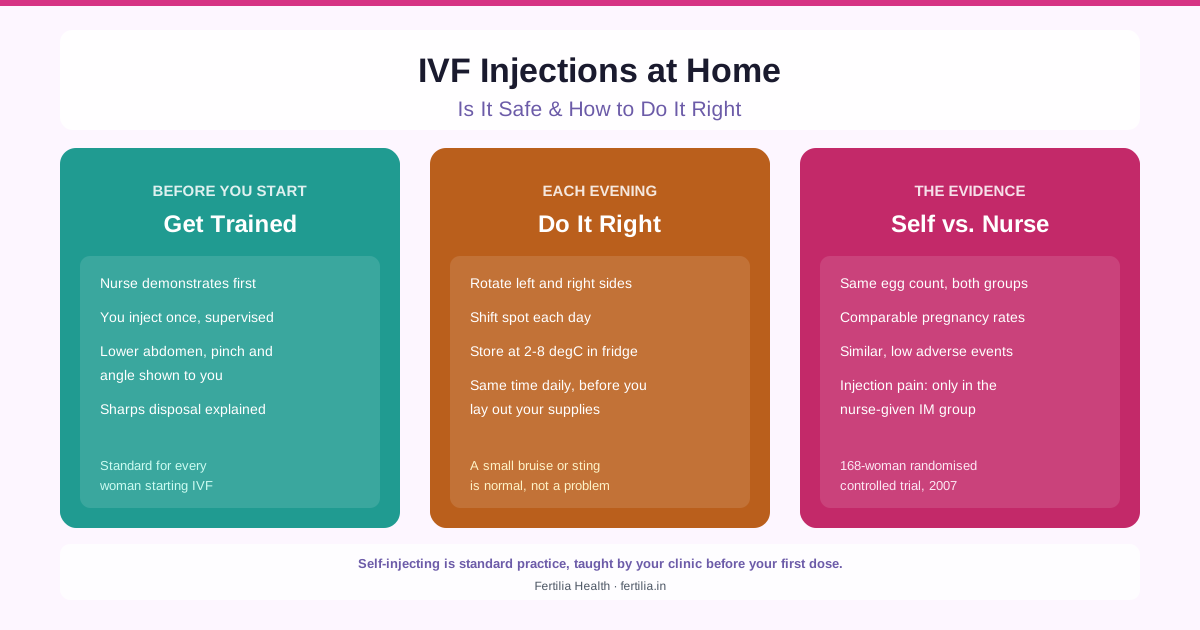
Yes, and there is direct trial evidence behind that answer, not just clinic reassurance. A randomised, controlled study of 168 women undergoing IVF compared a highly purified hMG preparation (a stimulation hormone) injected subcutaneously by the woman herself against a conventional hMG preparation injected intramuscularly by a nurse (Alviggi et al., Reprod Biol Endocrinol, 2007, PMID 18053198). The number of eggs collected was statistically the same between the two groups (7.46 on average with self-injection versus 7.86 with intramuscular injection), pregnancy rates were comparable, and the overall rate of adverse events was similar and low in both groups (2.4% versus 3.7%). The one meaningful difference actually favoured self-injection: pain at the injection site was reported only in the group that received intramuscular injections from a nurse, in 13.9% of those patients.
In plain terms, doing your own subcutaneous injections at home is not a compromise on safety or outcome. In that trial, self-injection matched nurse-given intramuscular injection on egg numbers and pregnancy rates, and it was reported as less painful. One trial of two hMG preparations does not settle the question for every stimulation drug, route, or situation, so your own protocol and who administers each injection is something your clinic will guide you on.
What self-injection does not replace is your clinic’s monitoring. The scans and blood tests that track how your ovaries are responding are a separate part of the cycle from the injections themselves, and no amount of correct injection technique changes how your body responds to the medication. If you are still mapping out how those monitoring visits fit around a working day, our IVF while working guide covers the scan schedule and the injection timing window in more detail.
Before Your First Dose: What Training Should Cover
Almost every fertility clinic in India teaches self-injection as a standard part of starting an IVF cycle. You are not expected to arrive knowing how to do this. A proper training session, usually with a nurse before your first dose, should cover:
- How to draw up the medication, if you are using a vial and syringe rather than a pre-filled pen (some stimulation drugs come as a powder that needs mixing with a diluent, others as a ready-to-use pen)
- The correct injection site, almost always the lower abdomen, a few centimetres to either side of your navel
- How to pinch a fold of skin and the right angle for the needle, so the medication goes into the fatty layer under the skin (subcutaneous) rather than deeper into muscle
- How to dispose of needles safely, usually into a sharps container your clinic provides
- What a normal reaction looks like, so you know what to expect versus what to flag
Ask for an actual demonstration, and then do one injection yourself in front of the nurse before you leave with your medication. Doing it once under supervision teaches your hands what a video or a leaflet cannot. If your clinic has not offered this and you are about to start your first cycle, it is reasonable to ask for it directly. Most clinics expect the request and build it into the first visit.
If you are about to start stimulation and want to walk through the injection routine before your first dose, message Dr. Suganya on WhatsApp for a ₹399 video consultation. It is available online, pan-India.
Site Rotation: Why It Matters and How to Do It
Most stimulation and trigger injections go into the lower abdomen, in the soft tissue on either side of the navel, avoiding the navel itself and any scars. Because you will be injecting daily, sometimes for eight to twelve days or longer, using the exact same spot every time makes the skin sore and more likely to bruise.
A simple rotation pattern works well: alternate left and right side each day, and move slightly, a couple of centimetres, from the previous day’s spot within that side. Some women find it easiest to mentally divide the abdomen into a few zones and work through them in sequence rather than trying to remember an exact point from the day before. There is no single correct pattern your clinic will insist on; the goal is simply not repeating the same few millimetres of skin night after night.
If a particular area still feels tender or looks bruised, skip it for a day or two and use the opposite side instead. The medication absorbs just as well from any healthy area of the abdomen.
Bruising, Stinging, and Small Bumps: What Is Normal
A small bruise at the injection site, especially the next morning, is common and not a sign anything has gone wrong. So is brief stinging as the medication goes in, particularly with certain formulations, and a small, firm bump under the skin that softens over a day or two.
What is worth mentioning to your clinic rather than watching quietly: swelling that keeps growing rather than settling, redness that spreads outward from the injection site, warmth or fever, or pain that is sharp and does not ease within a few minutes. These are uncommon, but your clinic would rather hear about them and reassure you than have you sit with worry through the rest of your stimulation. This is a different picture from ovarian hyperstimulation syndrome (OHSS), which is a whole-body response to the stimulation medication rather than a reaction at the injection site; our OHSS guide covers what that looks like and when to call your clinic about it.
A useful habit: apply gentle pressure with a cotton ball for a few seconds right after the injection rather than rubbing the area, which can make bruising slightly worse. Ice, briefly, on a spot that stings can also help.
Storing Your Medication Correctly
This is the detail that trips up more women than the injection technique itself, mostly because it is easy to get busy and forget.
Storage requirements vary a great deal by brand and formulation. Some gonadotropins are kept refrigerated at 2 to 8°C, while others may be stored below 25°C for a defined period, and trigger medications and pen formulations have their own instructions again. The leaflet that comes with your specific medication and your clinic’s own instructions are what to follow, not a general rule you read elsewhere. None of these medicines should be frozen, and freezing can happen through direct contact with an ice pack, so if you are travelling with medication or carrying it through a hot Indian afternoon, use an insulated pouch with the medication kept away from direct contact with the cold pack, and ask your clinic how long your particular product can be out of its usual storage.
If you are ever unsure whether a dose was left out of the fridge for longer than it should have been, whether during a power cut, a forgotten bag, or a long commute, call your clinic and ask before injecting it. Most clinics would rather field that call than have you inject a dose that may have lost potency.
What to Do If You Miss a Dose or Run Late
Life does not pause for a stimulation cycle. A late meeting, a family emergency, or simply losing track of time can mean an injection happens later than planned, or in rare cases, gets missed altogether.
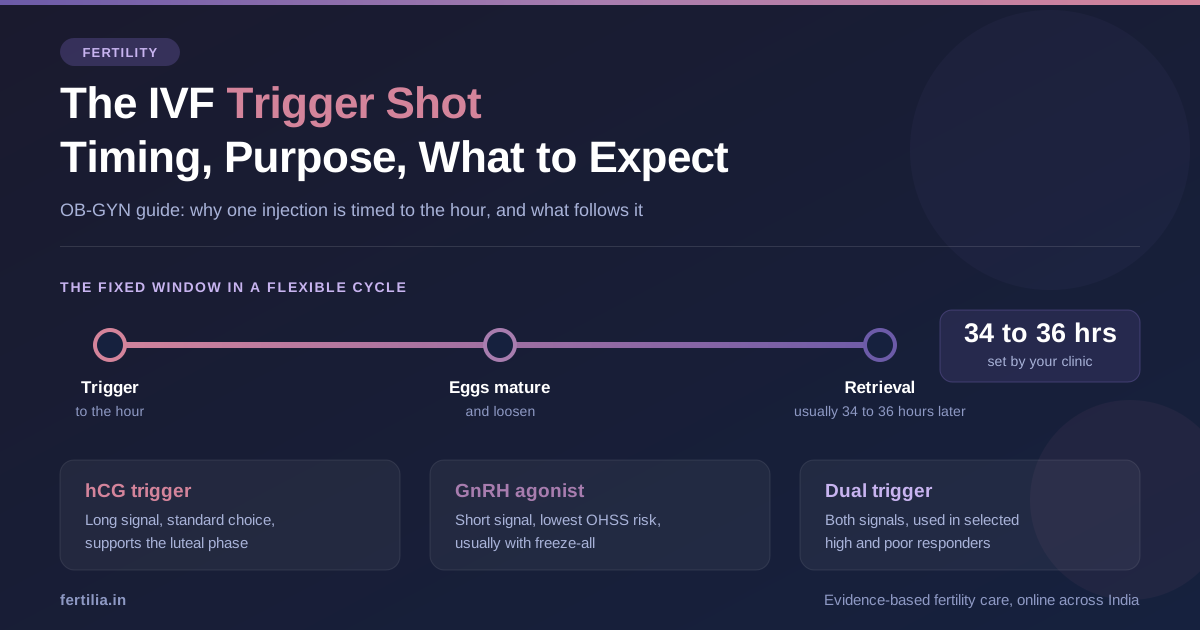
How much a delay matters depends on which drug it is, so the right response is to call your clinic and tell them what happened, not to guess or assume it is fine. Clinics that run daily stimulation protocols see this regularly and generally have a same-day plan for a late or missed dose. What you should never do on your own: double up the next dose to “catch up,” skip the missed dose without telling anyone, or change your injection time by more than an hour or two without checking first. Your trigger injection is the most obviously time-critical of these, timed to a specific hour precisely because it sets your retrieval time; that single dose has essentially no room for lateness, and your clinic will make this clear when they give you the timing. It is not the only time-sensitive injection, though. Antagonist injections such as cetrorelix or ganirelix, which are used to hold off early ovulation, are also tied to a daily window, and a delayed or missed dose can allow a premature LH surge. If one of those is late, call your clinic straight away rather than waiting for the next scheduled dose.
A late or missed dose is not something to judge on your own, and it is not something to sit with in silence either. It means you make one phone call, as soon as you notice, and your clinic tells you what to do next for that specific medication. Once your injections and retrieval are behind you, a different kind of waiting begins; our two-week wait guide covers what to expect in the stretch between transfer and your pregnancy test.
A Simple Routine That Makes This Easier
By the second week, most women describe the injection itself as the least stressful part of the day. A few habits help get there faster:
- Do it at roughly the same time each evening. Consistent timing helps your clinic interpret your scan results, and a routine reduces the chance of simply forgetting.
- Lay everything out before you start: the medication at room temperature (if that is what your clinic advises), an alcohol swab, the syringe or pen, and your sharps container, so you are not searching for something mid-injection.
- Let your skin dry after the alcohol swab before injecting; injecting through damp alcohol can sting more than it needs to.
- Keep a small, simple log, even just a note on your phone, of which side and roughly which spot you used, so rotation stays easy to track.
- If needle anxiety is real for you, say so. Some women do better having a partner or family member handle the actual injection while they look away; others prefer full control themselves because it feels less like something being done to them. Both are fine. There is no version of this that you are required to feel calm about by day three.
Frequently Asked Questions
Is it safe to do IVF injections myself at home? Yes. A randomised controlled trial of hMG preparations, comparing self-administered subcutaneous injection with nurse-given intramuscular injection, found comparable egg counts, comparable pregnancy rates, and a similar overall rate of adverse events between the two approaches, with injection-site pain reported only in the group that received intramuscular injections (Alviggi et al., Reprod Biol Endocrinol, 2007, PMID 18053198).
Where exactly should I inject IVF stimulation medication? Many stimulation medications are given subcutaneously, into the fatty layer of the lower abdomen, a few centimetres to either side of the navel, avoiding the navel itself and any scars. Route and site are product-specific, though: some hMG and hCG trigger preparations are prescribed as intramuscular injections instead. Follow the prescription, the product leaflet, and your clinic’s training for each individual drug rather than assuming every injection goes into the same place.
How do I rotate injection sites correctly? Alternate between the left and right side of your lower abdomen each day, and shift slightly within that side rather than using the exact same spot repeatedly. This reduces soreness and bruising over a stimulation course that can run eight to twelve days or longer.
I have a bruise after my injection. Is that normal? A small bruise, mild stinging, or a soft bump that fades over a day or two is common and expected. Growing swelling, spreading redness, warmth, fever, or pain that does not ease within a few minutes is uncommon and worth calling your clinic about.
What happens if I miss an injection or give it late? Call your clinic and tell them what happened rather than guessing. How much a delay matters depends on which drug it is, and clinics generally have a plan for a missed or late dose. Never double a dose to catch up on your own. Your trigger injection is timed precisely and has essentially no flexibility, and antagonist injections such as cetrorelix or ganirelix are time-sensitive too, because a delay there can allow early ovulation, so call your clinic immediately if either one is late.
Do IVF injections need to be refrigerated? Some do and some do not. Storage requirements vary by brand and formulation: several gonadotropins are kept refrigerated at 2 to 8°C, while others may be stored below 25°C. None should be frozen or left in direct contact with an ice pack. Follow the leaflet with your specific medication and your clinic’s guidance rather than a general rule. If a dose may have been exposed to heat for longer than you are confident is safe, call your clinic before using it.
Can my husband or a family member give me the injection instead? Yes. Many women prefer to have a partner or family member handle the actual injection while they look away, and this is completely reasonable. Ask your clinic to train whoever will actually be giving the injections, not just you.
IVF ke injections ghar par khud lagana surakshit hai kya? (Is it safe to self-administer IVF injections at home?) Haan, yeh IVF treatment ka ek normal hissa hai. Ek randomised trial mein subcutaneous self-injection aur nurse dwara diye gaye intramuscular injection ke beech eggs ki sankhya aur pregnancy rate mein koi bada antar nahi paya gaya, aur self-injection mein dard kam bataya gaya. Clinic aapko pehli dose se pehle sahi tareeka sikhati hai.
I’m Dr. Suganya Venkat, and in Fertilia’s IVF Support program, the first injection session is often the one women worry about most before their cycle starts, and the one they mention least by the end of it. If you want to walk through your own protocol, the specific medications, and the injection routine before you begin, you can WhatsApp Dr. Suganya Venkat directly, or start with the fertility guide for a fuller picture of the IVF journey. For what the medications covered here typically add to a full cycle’s price, our IVF cost guide has the current breakdown.