Sometimes the call from the lab after an IVF egg collection brings good news: more embryos have developed than can be transferred at once. The next question on the clinic’s form, and in your head, is what it will cost to keep them. One website says embryo freezing costs Rs 25,000. Another says Rs 2.5 lakh. Both are quoting real figures, and they are describing two different things.
I’m Dr. Suganya Venkat, an OB-GYN, and in Fertilia’s online IVF Support program a large part of my work with couples is reading clinic quotes line by line before they commit. Embryo freezing is one of the lines that confuses people most, because the first-year charge and the storage bill that follows are priced separately and rarely shown together. This post is about that cost: what the freezing fee covers, what drives it up or down, what storage adds each year, and what to ask before you sign a storage contract.
What This Post Covers
- The short answer on embryo freezing cost in India in 2026
- Why two quotes for “embryo freezing” can differ by lakhs
- The factors that set the freezing fee
- Annual storage fees, and what the ART Act says about how long embryos can be stored
- When freezing is built into the medical plan
- What using a frozen embryo later adds
- Questions to ask before you sign
If you are freezing unfertilised eggs rather than embryos, the costs and decisions are different, and our egg freezing cost guide covers that path.
The Short Answer
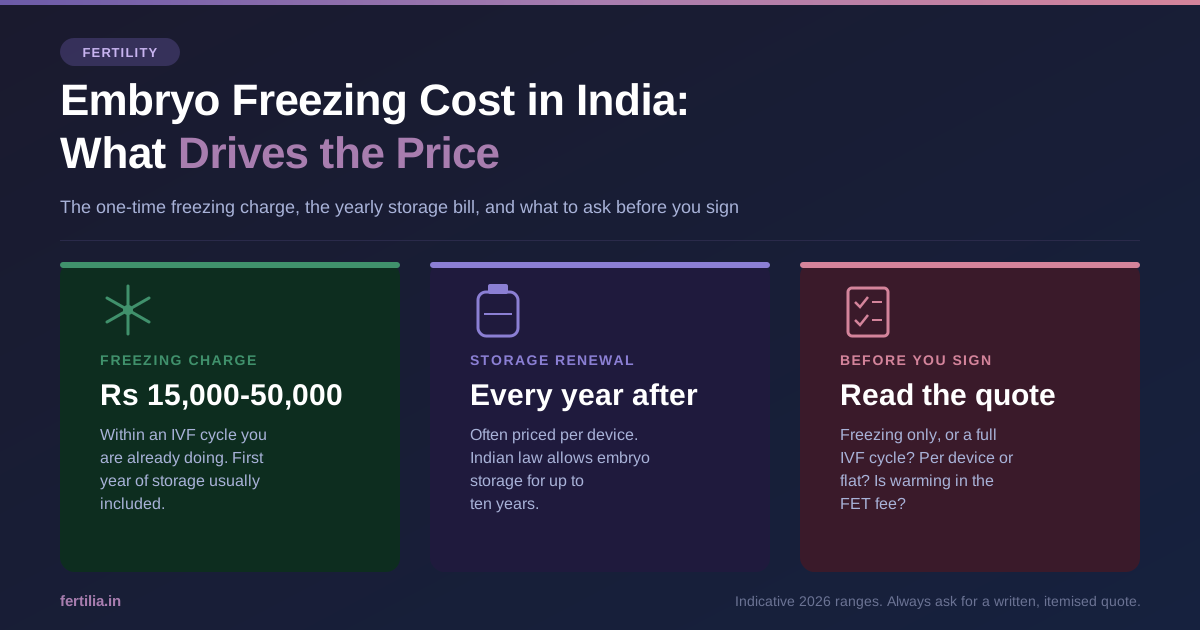
When embryos are frozen as part of an IVF cycle you are already doing, the freezing (vitrification) charge in India typically falls between Rs 15,000 and Rs 50,000, and most clinics include storage for the first year. From the second year, an annual storage renewal fee applies, commonly somewhere around Rs 5,000 to Rs 30,000 a year depending on the clinic and on how many storage devices your embryos occupy.
Two published examples, checked on the clinics’ own pages in October 2026:
- Nova IVF lists embryo freezing in Hyderabad from Rs 22,000 for two cryotops (novaivffertility.com), and describes the cost as up to Rs 30,000 per cryotop, with each cryotop holding two embryos, for a year of storage.
- Iswarya IVF lists embryo freezing in Chennai at Rs 15,000 to Rs 30,000 per cycle, with an annual storage fee on top and frozen embryo transfer charged separately (iswaryafertility.com).
Birla Fertility’s cost page (birlafertility.com, checked October 2026) puts storage beyond the first year at Rs 5,000 to Rs 20,000 a year.
Why Quotes Range From Rs 15,000 to Rs 2.5 Lakh
The same Birla Fertility page quotes an average “embryo freezing cost” of about Rs 1.47 lakh, and some of its city pages go past Rs 2.5 lakh. That does not contradict the figures above. Freezing embryos from nothing first needs embryos to exist, which means stimulation, egg retrieval and fertilisation, and the page lists those charges among the factors that shape its total. It also notes that when freezing is part of your IVF cycle, it is charged in addition to the IVF treatment cost.
So there are two questions hiding inside “how much does embryo freezing cost”:
- You are already doing IVF and have spare embryos. You are paying the freezing and storage charge only. This is the Rs 15,000 to Rs 50,000 figure.
- You are starting from scratch to create and freeze embryos (for example, before cancer treatment or to delay pregnancy). You are paying for a full IVF cycle plus freezing. Our IVF cost breakdown puts an all-in cycle at roughly Rs 1.5 lakh to Rs 3.5 lakh, and the freezing charge is added to that.
Before you compare two quotes, check which of these each one is describing.
What Sets the Freezing Fee
How many storage devices your embryos need
Many clinics price freezing and storage per device (a cryotop, straw or vial), not per embryo. If each device holds two embryos, five embryos may need three devices, and the fee scales with that. Some clinics prefer to freeze one embryo per device so that only one needs to be warmed at a time, which can mean more devices and a higher fee, but no wasted embryo if you only need one. Ask how many embryos go into each device and why.
The freezing method
Most IVF labs now freeze embryos by vitrification, an ultra-rapid freezing method, rather than the older slow-freeze technique. The evidence behind that shift is strong: a systematic review and meta-analysis prepared to inform WHO guidance pooled seven randomised trials covering 3,615 embryos and found significantly better embryo survival after vitrification than after slow freezing (Rienzi L et al., Hum Reprod Update, 2017, PMID 27827818). Vitrification uses dedicated devices and media and takes skilled hands, which is part of what you are paying for. If a quote seems unusually low, it is fair to ask which method the lab uses.
The embryo stage at freezing
Embryos can be frozen at Day 3 (cleavage stage) or Day 5 (blastocyst stage). Growing embryos to Day 5 means extra days in culture, which some clinics bill separately. Fewer embryos usually reach Day 5, so there may be fewer to freeze. Our guide to Day 3 vs Day 5 embryo transfer explains how clinics make that call.
Lab running costs
Frozen embryos sit in liquid nitrogen at minus 196 degrees Celsius, and keeping them there safely costs money every day: nitrogen top-ups, tank monitoring and alarms, backup tanks, witnessing systems to prevent identity mix-ups, and record-keeping. You rarely see any of this, but it is part of both the freezing fee and the yearly storage charge.
City and clinic positioning
As with every IVF line item, metro location, hospital brand and overheads shape the price. A well-run lab in a tier-2 city can offer the same vitrification at a lower fee because its costs are lower. A higher price can reflect a better-resourced lab, but it does not prove one.
If you have a quote in hand and are not sure what it includes, we can go through it with you over a video consultation. WhatsApp us at +91 99402 70499 to set up a time with Dr. Suganya.
The Storage Bill: What It Adds Up To Over Time
The freezing fee is a one-time charge. Storage is a yearly charge that continues for as long as your embryos stay frozen.
Here is a worked example with assumed mid-range figures (your clinic’s rates will differ): a freezing charge of Rs 30,000 including year one, then Rs 15,000 a year in renewal. Storing for three years costs Rs 60,000 in total. Storing for five years costs Rs 90,000. If your clinic charges per device and your embryos are split across three devices, the renewal part can be higher.
Some points worth knowing:
- Ask whether renewal is per device or a flat fee. This decides how the bill grows with the number of embryos you store.
- Ask whether paying for several years upfront costs less. Policies differ between clinics.
- Keep the renewal date somewhere you will see it. Clinics set their own rules on reminders and on what happens when a renewal is missed, and those rules are written into your consent form. Read that section before you sign, and keep your phone number and email up to date with the clinic.
How long embryos can be stored in India
Under Section 28(2) of the Assisted Reproductive Technology (Regulation) Act, 2021, an embryo “shall be stored for a period of not more than ten years”. At the end of that period it is allowed to perish, or it can be donated to a research organisation registered under the Act, with the consent of the couple or individual (indiankanoon.org, Section 28, checked October 2026). This limit is a legal one. It is not a statement about the embryo’s biological lifespan.
Does storage time affect success?
This question comes up often, and the evidence is mostly reassuring. A study of 58,001 vitrified Day 5 blastocysts over 11 years found no association between storage time and live birth rate in multivariable analysis; the factors that mattered were things like embryo quality, age and body mass index (Cobo A et al., Am J Obstet Gynecol, 2024, PMID 38527601). A single-centre retrospective study from China reported a lower live birth rate for good-quality blastocysts stored for more than five years, with no effect seen for cleavage-stage embryos, and its authors note their findings still need to be confirmed in other studies (Zhan S et al., Hum Reprod, 2024, PMID 38960877).
Put together: for the few years most couples store embryos, storage time does not appear to be what decides the outcome. If you expect to store for many years, it is reasonable to talk through your family-planning timeline with your fertility doctor.
When Freezing Is Part of the Medical Plan
For many couples, freezing is planned from the start of the cycle.
Freeze-all cycles. Some clinics freeze every embryo and transfer in a later, calmer cycle rather than transferring fresh. The evidence for this depends on who you are. In a randomised trial of 1,508 women with PCOS, frozen embryo transfer led to a higher live birth rate after the first transfer (49.3% vs 42.0%) and a lower rate of ovarian hyperstimulation syndrome (1.3% vs 7.1%), but a higher rate of preeclampsia (4.4% vs 1.4%) (Chen ZJ et al., N Engl J Med, 2016, PMID 27509101). In a trial of 2,157 ovulatory women, live birth rates did not differ significantly between frozen and fresh transfer (48.7% vs 50.2%), though OHSS was less common in the frozen group (Shi Y et al., N Engl J Med, 2018, PMID 29320646).
This means a freeze-all plan is a case-by-case decision. If your clinic recommends it, ask what it is meant to achieve for you. A strong response to stimulation, with a higher chance of OHSS, is a common and good reason. Our frozen vs fresh embryo transfer guide covers the full decision.
Spare embryos. When a cycle produces more good embryos than you transfer, freezing the rest gives you another attempt without another round of stimulation and egg retrieval. For most couples, one freezing charge plus storage costs far less than a second stimulated cycle.
Fertility preservation. Couples facing cancer treatment sometimes create and freeze embryos before chemotherapy. Our guide to fertility preservation before cancer treatment compares that option with egg freezing.
What Using a Frozen Embryo Later Costs
Freezing and storage are only half of the path. When you are ready to use an embryo, it is warmed and transferred in a frozen embryo transfer (FET) cycle, which has its own medicines to prepare the lining, monitoring scans and the transfer itself. Our IVF cost guide puts an FET cycle at roughly Rs 30,000 to Rs 85,000, including the lining medicines. The FET protocol guide walks through what that cycle involves.
Ask whether the warming (thaw) charge is part of the FET fee or a separate line.
A Sample Budget
| Component | Typical range (2026) | Notes |
|---|---|---|
| Embryo freezing, first year of storage included | Rs 15,000 to Rs 50,000 | When done within an IVF cycle you are already paying for |
| Storage renewal, from year two | About Rs 5,000 to Rs 30,000 a year | Per device or flat; varies by clinic |
| Frozen embryo transfer cycle | Rs 30,000 to Rs 85,000 | Includes lining medicines; per transfer |
| Full IVF cycle to create embryos (if starting from scratch) | Rs 1.5 lakh to Rs 3.5 lakh | See the IVF cost guide |
| PGT-A embryo testing | Optional; case-specific | See the PGT-A guide |
Freezing and storage figures are from the Nova IVF, Iswarya IVF and Birla Fertility pages cited above, checked October 2026. FET and IVF ranges are from our IVF cost guide. These are indicative ranges, not quotes. Always ask for a written, itemised estimate.
If a clinic suggests testing embryos before freezing or transfer, our PGT-A guide covers who it helps and what it costs.
Questions to Ask Before You Sign a Storage Contract
- Is the quoted figure for freezing only, or does it include the IVF cycle?
- How many embryos go into each device, and is the fee per device or per cycle?
- Is the first year of storage included? What is the renewal fee after that, and can it change?
- Which freezing method does your lab use, and what is your embryo survival rate after warming?
- Is the warming charge included in the FET fee?
- How are the storage tanks monitored, and is there a backup if one fails?
- What does the consent form say will happen if a renewal is missed, or if our circumstances change?
- Can the embryos be moved to another clinic later, and what does that cost?
A clinic that answers these clearly and in writing is making it easier for you to plan, and that is worth weighing alongside the price.
Practical Takeaways
- Check whether a quote covers freezing only or a whole IVF cycle before you compare.
- Expect a one-time freezing charge, then a yearly storage bill from year two.
- Ask whether pricing is per device, and how many embryos go in each.
- Budget the FET cycle separately; it is a distinct cost when you use the embryos.
- Indian law allows embryo storage for up to ten years.
- Get every number in writing.
FAQ
How much does embryo freezing cost in India? When embryos are frozen during an IVF cycle you are already doing, the freezing charge is typically Rs 15,000 to Rs 50,000, and most clinics include the first year of storage. After that, storage renewal commonly runs about Rs 5,000 to Rs 30,000 a year. Higher figures of Rs 1.5 lakh or more usually include the IVF cycle needed to create the embryos.
What is the annual storage fee for frozen embryos? It varies by clinic. Birla Fertility’s published range for storage beyond the first year is Rs 5,000 to Rs 20,000 a year, and some clinics price storage per device, such as per cryotop. Ask whether the renewal fee is per device or flat, and whether it can change over time.
Is embryo freezing included in the IVF package? Sometimes. Some packages include freezing and the first year of storage; others list them separately. Ask for a written list of what the package includes before you compare clinics.
How long can embryos be stored in India? Under Section 28(2) of the ART (Regulation) Act, 2021, embryos can be stored for up to ten years. After that, with the couple’s consent, they are either allowed to perish or donated to a registered research organisation.
Does storing embryos for a long time lower the chance of pregnancy? A large study of 58,001 vitrified blastocysts found no association between storage time and live birth rate. One single-centre study reported a lower live birth rate for good-quality blastocysts stored beyond five years, a finding its authors say needs confirmation. For the few years most couples store embryos, storage time does not appear to be the deciding factor.
Is it cheaper to freeze embryos than to do another IVF cycle? Usually, yes. A freezing charge plus storage and a later frozen embryo transfer costs considerably less than a new stimulated cycle, which runs Rs 1.5 lakh to Rs 3.5 lakh all-in. The value depends on how many good-quality embryos you have to freeze.
Embryo freezing ka kharcha kitna hota hai? Agar aap pehle se IVF cycle kar rahe hain, to embryo freeze karne ka kharcha aam taur par Rs 15,000 se Rs 50,000 hota hai, jismein pehle saal ka storage shamil hota hai. Uske baad har saal storage ka alag fee lagta hai, clinic ke hisaab se lagbhag Rs 5,000 se Rs 30,000.
If you are weighing whether to freeze, how long to store, or how a quote compares, a conversation about your own reports and plan will help more than a general range. Dr. Suganya offers online video consultations pan-India at Fertilia for Rs 399. Message us on WhatsApp to book a time.
Consultation is online, pan-India, via video call or phone.