Are these implantation cramps? (Quick answer)
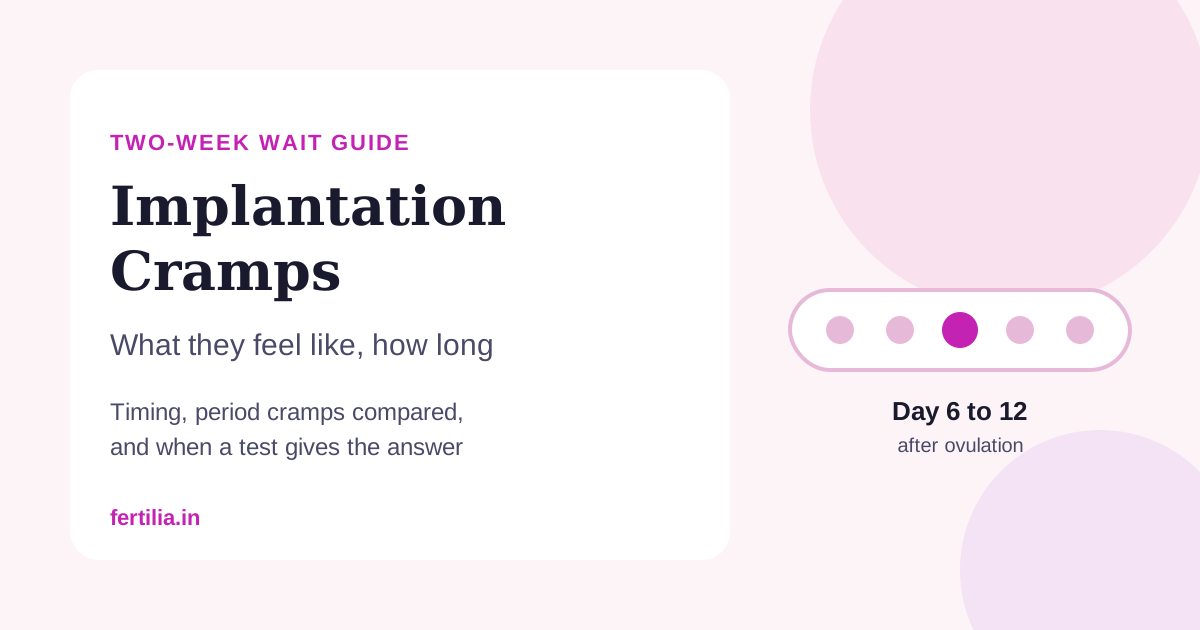
If implantation causes anything you can feel, it is usually a mild, dull, period-like ache low in the middle of your pelvis, somewhere around 6 to 12 days after ovulation, that comes and goes and, from what women describe, fades within a few hours to a day or two. Many women who go on to have a healthy pregnancy feel nothing at all. Because this ache is almost identical to the cramps many women get before a period, no cramp can tell you whether you are pregnant. A home pregnancy test on the day your period is due can.
It is day 23 of your cycle. You have been trying for a baby, and today there is a faint pulling low in your tummy. Your period is not due for another five days. Is this your period getting ready, or is it the embryo settling in? You search, you read ten forums, and every one says something different.
I’m Dr. Suganya Venkat, and in more than fifteen years as an OB-GYN, the two-week wait is the stretch where women message me most about small sensations. I want to give you a clear picture of what implantation cramps are, what they usually feel like, how long they last, how they compare with period cramps, and the few signs that mean you should get checked rather than wait.
In this guide:
- What implantation is, and when it happens in your cycle
- What implantation cramps feel like and how long they last
- Implantation cramps vs period cramps (and why the two overlap)
- When to take a pregnancy test
- Signs that are not implantation and need a doctor
- What you can do during the wait
What happens at implantation?
After an egg is fertilised in the fallopian tube, the embryo takes several days to travel down into the uterus. Once it arrives, it attaches to the lining (the endometrium) and begins to burrow in. This is implantation. From that point, the developing placenta starts making hCG, the hormone a pregnancy test detects.
The best data on timing comes from a study that collected daily urine samples from 221 women trying to conceive. In pregnancies that continued, hCG first appeared 6 to 12 days after ovulation, and in 84% of them implantation happened on day 8, 9 or 10 (Wilcox AJ et al., N Engl J Med, 1999, PMID 10362823).
In a 28-day cycle with ovulation around day 14, that puts implantation roughly between day 20 and day 26, which is also exactly when many women start to feel premenstrual. That overlap is the root of all the confusion.
What do implantation cramps feel like?
There is very little research that measures implantation cramps on their own. What women describe, and what I hear in consultations, tends to look like this:
- Mild. A dull ache, light pulling or a sense of fullness, not pain that stops you from working or sleeping.
- Low and central. Felt low in the pelvis, in the middle or across both sides. Some women feel it in the lower back.
- On and off. It comes in waves over a few hours, rather than building up steadily.
- Sometimes with a little spotting. A few women notice light pink or brown spotting at the same time. Our guide to implantation bleeding covers what that looks like.
How long do they last? No study has measured an implantation cramp on its own, so there is no proven duration. What women describe is an ache that fades within a few hours to a day or two. Cramping that keeps getting stronger over several days is more likely to be your period starting, or something else that should be looked at.
It is worth saying clearly: many women who conceive never feel any implantation cramp. Feeling nothing is normal and tells you nothing about whether this cycle worked.
Implantation cramps vs period cramps
This is the question everyone wants answered, so here is the comparison I go through with women on video calls:
| Implantation cramps | Premenstrual / period cramps | |
|---|---|---|
| Timing | 6 to 12 days after ovulation, often a few days before your period is due | Usually 1 to 2 days before and during the first days of the period |
| Strength | Mild, often barely noticeable | Mild to strong, often building as the period starts |
| Pattern | Comes and goes, then fades | Tends to peak with the flow, then ease |
| Bleeding | None, or light spotting for a day or two | A period that builds into normal flow |
| What follows | A missed period and a positive test | Your period |
Notice how much the two columns overlap. The progesterone that rises after ovulation causes bloating, breast tenderness and pelvic heaviness in every cycle, pregnant or not. So the working rule I give women is simple: treat the cramp as information about your body this week, not as an answer about pregnancy. If you usually get period cramps, read our period cramps guide for what eases them.
Cramps on one side right in the middle of the cycle are a different thing again. That is often ovulation pain, covered in the mittelschmerz guide.
💗 Two-week wait feeling long? Dr. Suganya Venkat consults online across India over video call. Message us on WhatsApp and the team will help you book a consultation (₹399 in India, US $20 from outside India).
Cramps after a positive test
Once the test is positive, mild cramps often continue for a while as the uterus grows and blood flow to the pelvis rises. They are very common: in a study that followed 341 newly pregnant women every day from 2 to 7 weeks after conception, 85% reported lower abdominal cramping (Sapra KJ et al., Hum Reprod, 2016, PMID 26936888). The same study found that cramping together with bleeding was more often linked with an early loss than cramping alone, which is why bleeding with cramps in early pregnancy is worth a same-day call to your doctor.
For what is normal in the weeks after a positive test, see our guide to cramps in early pregnancy.
When to take a pregnancy test
Testing too early is the most common reason for confusion. hCG only begins to rise after implantation and takes a few days to reach a level a home test can pick up.
- Best time: on the day your period is due, or after. First-morning urine is the most concentrated.
- If it is negative and your period still has not come: repeat it in 2 to 3 days.
- If your cycles are irregular: count about 3 weeks from the last time you had unprotected sex.
Our step-by-step home pregnancy test guide explains how to read faint lines. If your period is late and the test stays negative, the missed period, negative test guide explains the usual reasons.
After IUI or IVF: follow your clinic’s instructions on when to test, usually a blood beta-hCG about two weeks after the procedure. Progesterone support and trigger injections can cause cramping and, in the case of an hCG trigger, a false-positive home test if you test too soon. Our two-week wait after IUI or IVF guide walks through what is expected.
Signs that are not implantation
Implantation is mild. The following are not part of it.
Go to an emergency department straight away if you could be pregnant and have severe pain, pain with shoulder-tip pain, dizziness or fainting, or heavy bleeding. These need urgent care, not a phone call later.
Call your doctor the same day for:
- Milder pain that keeps getting worse, or stays on one side
- Bleeding heavier than spotting, or bleeding with clots, if you might be pregnant
- Fever, chills or a bad-smelling discharge
- Burning or pain when passing urine
None of these automatically means something serious. They simply have causes that are easy to find and treat once a doctor looks, and one of them, an ectopic pregnancy, needs to be ruled out early with a test and scan. Our guide to ectopic pregnancy signs explains what doctors check and why.
Searching in Hindi?
Many women type this question in Hinglish, for example “implantation pain kab hota hai” (when does implantation pain happen?) or “pregnancy ke shuru me pet me dard” (tummy pain in early pregnancy). Whatever words you use, the timing and signs above are the same.
What you can do during the wait
- Note it down. Write the cycle day, how strong the ache felt, and whether there was spotting. Over a few cycles, this tells you what your usual premenstrual pattern looks like.
- Rest and warmth. A warm water bag on the lower tummy or a warm shower helps most mild cramps.
- Paracetamol is the usual choice if you need something for pain while you might be pregnant. Check with your doctor before taking ibuprofen or other NSAIDs while trying to conceive.
- Keep life normal. Light walking, work, normal meals like idli, dal and rice all carry on. Implantation is not disturbed by everyday activity.
- Wait for the test date. Symptom-checking every hour is exhausting. Pick the day you will test and let that be the answer.
If you have been trying for a while and cycles keep ending in a period, it may be time for a proper look at ovulation, tubes and semen. At Fertilia, Dr. Suganya Venkat works through this with couples across India in the online Fertility program, alongside any treatment you are already having.
Frequently Asked Questions
What do implantation cramps feel like?
Usually a mild, dull ache or light pulling low in the pelvis, sometimes in the lower back, that comes and goes. It is often milder than a period cramp, and many women feel nothing at all.
How long do implantation cramps last?
Research has not measured this directly. Women who notice them usually describe an ache that fades within a few hours to a day or two. Cramps that build up steadily over several days are more likely to be a period starting or another cause.
How many days after ovulation do implantation cramps happen?
Implantation happens 6 to 12 days after ovulation, most often on day 8, 9 or 10. Any cramping linked to it would fall in that window, usually a few days before your period is due.
Implantation pain kab hota hai? (When does implantation pain happen?)
Around a week after ovulation, roughly day 20 to 26 of a 28-day cycle. It is usually mild and short, and it cannot be told apart from premenstrual cramps by feel alone.
Can I tell implantation cramps from period cramps?
Not reliably. Timing, strength and pattern overlap a lot, because progesterone causes similar sensations in every cycle. A pregnancy test on the day your period is due is the only way to know.
Is it normal to have no implantation cramps?
Yes. Most women who conceive do not notice anything at implantation. Having no cramps says nothing about whether you are pregnant.
When should I worry about cramps in the two-week wait?
Go to an emergency department straight away for severe pain, pain with shoulder-tip pain, dizziness or fainting, or heavy bleeding. Call your doctor the same day for milder pain that keeps worsening or stays on one side, bleeding heavier than spotting, fever, or burning when you pass urine.
You Do Not Have to Read Every Twinge Alone
The two-week wait can feel longer than the whole rest of the month. If you are trying to conceive and want a doctor to look at your cycles with you, our free guide to getting pregnant is a calm place to start.
Have a question about cramps or your cycle? WhatsApp Dr. Suganya to book an online video consultation, ₹399 in India and US $20 from outside India.