If your fertility specialist has raised donor eggs as an option, you are probably sitting with two feelings at once: relief that there is still a path forward, and a quiet grief that it looks different from the one you imagined. Both are normal, and neither cancels the other out.
I am Dr. Suganya Venkat, an OB-GYN with fifteen years of experience, and donor egg IVF is a conversation I have with a specific group of women at Fertilia: those with diminished ovarian reserve that has not responded to stimulation, women with premature ovarian insufficiency, and couples who have been through repeated IVF cycles with poor embryo quality despite everything else being optimised. This guide covers who is genuinely a candidate, how the process works under Indian law, what it costs in 2026, and what the success-rate data shows.
Who Is a Candidate for Donor Egg IVF
Donor eggs are not a first-line option. They come up after a workup has established that the eggs themselves, not the uterus, the sperm, or another treatable factor, are the limiting step. The situations where this conversation genuinely applies:
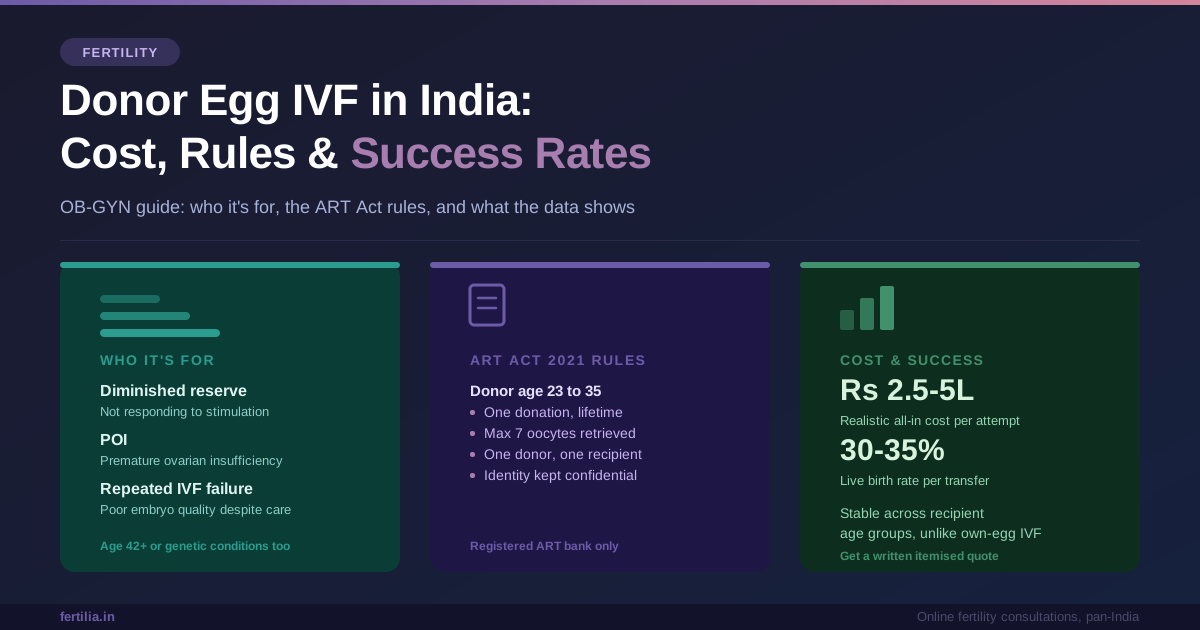
Diminished ovarian reserve that does not respond to stimulation. Some women have a low antral follicle count and a low AMH, and despite well-managed stimulation protocols, retrieve very few eggs, or eggs that repeatedly fail to fertilise or develop. When two or more well-run cycles with a woman’s own eggs produce the same poor result, donor eggs become a realistic next step rather than a third repeat of the same cycle. If you have not yet compared your AMH and antral follicle count, AMH vs AFC: Which Ovarian Reserve Test and What Each Costs explains what each test tells you and where they disagree.
Premature ovarian insufficiency (POI). When the ovaries stop producing viable eggs before age 40, whether from a known cause (autoimmune, genetic, prior chemotherapy or radiation) or no identified cause at all, donor eggs are usually the most direct route to pregnancy, because there are no eggs of adequate quality to work with.
Repeated IVF failure with poor embryo quality. This is different from repeated implantation failure with good embryos, which points toward a uterine or immunological cause rather than the eggs. When embryos consistently arrest, fragment, or fail to reach blastocyst stage across multiple cycles despite a competent lab and protocol, egg quality is the more likely explanation. Recurrent Implantation Failure: Causes and the ERA Test covers how we tell these two pictures apart.
Age-related decline, typically after 42 to 43. Egg quantity and quality both decline steeply in the early 40s, and by the mid-to-late 40s the chance of a chromosomally normal embryo from a woman’s own eggs is low enough that donor eggs meaningfully change the odds. IVF Success Rates India 2026: Age-Wise Data Explained shows exactly how steep that decline is.
Known genetic conditions. A small number of women carry a genetic condition that they do not want to risk passing on, and where donor eggs are the more direct route than pre-implantation genetic testing on their own embryos. PGT-A Testing in IVF: Who Needs It and What It Costs covers the alternative of testing your own embryos, which is the right conversation to have before assuming donor eggs are necessary.
This is not a decision to make from a single disappointing cycle. If you are earlier in that conversation, Do You Need IVF? An OB-GYN’s Honest Decision Framework and Low AMH and Pregnancy: Can You Still Conceive? are worth reading first.
How Donor Egg IVF Works in India: The Legal Framework
Egg donation in India is governed by the Assisted Reproductive Technology (Regulation) Act, 2021, and the ART Rules, 2022. This is not an informal arrangement between two families, it has to go through a registered ART bank or clinic, and the rules are specific:
- Donor age: oocytes may only be obtained from women between 23 and 35 years old.
- One donation, lifetime. Under Section 27(4) of the ART Act, an oocyte donor may donate only once in her life. This is a lifetime cap, not a per-year limit, and it replaced the older, less restrictive guidance that circulated before the Act came into force.
- Maximum 7 oocytes may be retrieved from the donor in that single donation cycle.
- One donor, one recipient. An ART bank cannot supply eggs from a single donor to more than one commissioning couple.
- Anonymity is protected. Donor identity is not disclosed to the recipient or the resulting child, though the child may access limited, non-identifying medical or genetic information through the prescribed process.
- Mandatory screening. Donors undergo infectious disease screening, and clinics are required to maintain records with the National Registry while preserving anonymity.
Before proceeding at any clinic, it is reasonable to ask directly: is this bank ART-registered, what screening has the donor completed, and is this donor’s donation being used for your cycle only. A clinic that cannot answer these plainly is not one to proceed with.
Fresh vs Frozen Donor Eggs
Indian clinics typically offer two structures:
Fresh donor cycle. The donor’s stimulation and retrieval are timed to your endometrial preparation, so the eggs are fertilised and transferred without freezing in between. This can mean a tighter window and less flexibility in scheduling, but avoids any question of freeze-thaw survival.
Frozen (vitrified) donor eggs. Eggs from a screened, already-retrieved donor are frozen and available from an egg bank, so your cycle only involves endometrial preparation and the transfer, on your own timeline. Vitrification (rapid freezing) has closed most of the survival gap between fresh and frozen donor eggs that existed with older, slower-freezing methods, though your embryologist can tell you the specific survival and fertilisation rates their lab is seeing with frozen eggs.
Either way, your own role in the cycle is endometrial preparation: oestrogen and progesterone to build and time the uterine lining to match the donor’s retrieval or the frozen egg’s thaw, monitored by ultrasound. You do not undergo ovarian stimulation yourself for a donor egg cycle.
Donor Egg IVF Cost in India, 2026
This is where the numbers get confusing, because clinics quote the donor-related charge, the lab and procedure fee, and the recipient’s own medication cost as separate line items, and a headline number often reflects only one of them.
| Component | Typical Cost (2026) |
|---|---|
| Donor screening, selection, compensation | ₹80,000–₹1.5 lakh |
| Donor stimulation and retrieval (fresh cycle) | Often bundled into the donor package above |
| IVF lab, fertilisation, embryo culture | ₹20,000–₹60,000 |
| ICSI (commonly used with donor eggs) | ₹15,000–₹45,000 |
| Recipient endometrial preparation, medicines, monitoring | ₹8,000–₹30,000 |
| Embryo transfer | ₹15,000–₹30,000 |
| Realistic all-in total, per attempt | ₹2.5–₹5 lakh |
Source: Indira IVF’s published 2026 cost guide, cross-checked against Nova IVF and Apollo Fertility’s published pricing pages. Ranges reflect wide variation by city, clinic, and whether ICSI, freezing, or PGT-A are added. Always request a written, itemised quote before starting.
What is usually excluded from the headline figure and worth asking about specifically: embryo freezing and annual storage (₹15,000–₹40,000), a frozen embryo transfer if the fresh transfer does not proceed (₹30,000–₹60,000), and PGT-A on the resulting embryos if you choose it. For a full breakdown of what a standard (non-donor) IVF cycle costs by comparison, see IVF Cost in India 2026: Rs 1.5-3.5 Lakh Per Cycle Explained.
Ask the clinic explicitly whether the quoted price covers one transfer only, or all viable embryos from that donor cycle, and what happens financially if the cycle needs to be repeated with a new donor.
Message Dr. Suganya on WhatsApp about donor egg IVF
Donor Egg IVF Success Rates
This is good news, and worth understanding clearly: donor egg IVF largely removes the age-related decline in success that affects IVF with a woman’s own eggs, because the embryo’s chromosomal competence is driven mainly by the donor’s (young) egg, not the recipient’s age.
ESHRE’s Egg Donation patient information leaflet (https://www.eshre.eu/-/media/sitecore-files/SIGs/GSCA/IRHEC/Leaflets/ESHRE---Egg-Donation.pdf), citing HFEA data, reports live birth rates of around 30 percent per embryo transferred with donor eggs, and this rate stays broadly similar across recipient age groups, unlike IVF with a woman’s own eggs, where success falls steeply after 35. A large SART-based US cohort of over 2,500 donor-oocyte cycles found a 35.4 percent live birth rate per cycle overall, with no statistically significant difference across recipient age bands from under 35 up to 40 and above, when the donor egg quality itself was controlled for.
The recipient’s uterus does not appear to be strongly age-sensitive through the early-to-mid 40s in most data. Where outcomes do decline is in the late 40s and beyond, particularly after 50, likely reflecting changes in uterine receptivity and pregnancy-related risk that are separate from egg quality.
The practical takeaway: with donor eggs, your own age matters far less than it does in a standard IVF cycle. What matters more is the quality of the donor cohort, the lab’s embryology standards, and whether your endometrium responds well to preparation, which your doctor can usually assess before you commit to a cycle.
The Legal, Ethical, and Emotional Dimensions
Anonymity is built into the law, and that is deliberate. The ART Act protects both the donor and the recipient family from having identity disclosed, which many couples find genuinely relieving, this is not an arrangement that requires an ongoing relationship with the donor.
Many families are built this way, successfully. There is no biological or psychological reason a child conceived with a donor egg is any less fully yours; the pregnancy, birth, and everything after are entirely real. This is worth saying plainly, because the grief that can accompany this decision sometimes gets tangled up with a worry that does not hold up: that donor conception makes the resulting family somehow less complete. It does not.
What to tell the child is a personal decision, and there is no single right answer. Some families choose openness from early childhood, framed simply and age-appropriately. Others choose privacy. What research on donor-conceived families consistently shows is that the specific choice matters less than the emotional climate around it, a family where the topic (if disclosed) is met with warmth and without shame tends to do well regardless of when disclosure happens. This is a conversation worth having with a counsellor or your treating doctor before you need to have it with a child, not a decision to make under pressure.
This decision belongs to you and your fertility team together. Your gynaecologist and your fertility specialist working together is how this usually goes best, coordinating the medical timeline while you make the emotional decisions on your own terms.
FAQs
Is donor egg IVF legal in India? Yes. It is legal and regulated under the Assisted Reproductive Technology (Regulation) Act, 2021, and the ART Rules, 2022, provided it is conducted through a registered ART bank or clinic that follows the donor age (23–35), one-time lifetime donation limit, and anonymity requirements set out in the law.
How much does donor egg IVF cost in India? A realistic all-in budget for one donor egg IVF attempt in India in 2026 is ₹2.5 lakh to ₹5 lakh, covering donor screening and compensation, the IVF lab and embryo culture, ICSI, recipient endometrial preparation, and the embryo transfer. This figure is based on Indira IVF’s published cost guide, cross-checked against other major clinics.
What is the success rate of donor egg IVF? Live birth rates with donor eggs are typically around 30 to 35 percent per cycle or transfer, and this rate stays broadly consistent across recipient age groups, unlike IVF with a woman’s own eggs. This is because embryo quality with donor eggs depends mainly on the donor’s age, not the recipient’s.
Can I choose my own egg donor in India? No. Under the ART Act, donor identity is confidential and donation must go through a registered ART bank, which matches donors to recipients based on physical and other characteristics without disclosing identity. Known-donor or informal arrangements outside a registered bank are not legally compliant.
Does my age still matter with donor eggs? Much less than with your own eggs. Data shows donor egg success rates stay broadly stable across recipient age groups through the early-to-mid 40s, because a young donor’s eggs largely determine embryo chromosomal quality. Outcomes may decline in the late 40s and beyond, reflecting changes in uterine receptivity rather than egg quality.
How many times can one donor donate eggs in India? Only once in her lifetime. Section 27(4) of the ART Act sets this as a strict one-time lifetime limit, with a maximum of seven oocytes retrieved in that single donation, and those eggs may be used for only one recipient.
Donor egg IVF ki cost India mein kitni hoti hai? India mein donor egg IVF ka ek attempt ka total kharcha, donor screening, IVF lab, ICSI, aur embryo transfer milaake, typically ₹2.5 lakh se ₹5 lakh ke beech hota hai. Yeh clinic aur city ke hisaab se alag ho sakta hai, isliye written quote lena zaroori hai.
If donor eggs have come up in your fertility conversation, or you are still trying to understand whether your own numbers point that way, this is exactly the kind of decision that benefits from an unhurried conversation with someone who can look at your specific reports. Dr. Suganya offers online video consultations pan-India at ₹399, and the 90-day IVF Support program is built to prepare your body and your decision-making for whichever path you choose.
Message Dr. Suganya on WhatsApp for a ₹399 Online Consultation
Consultation is online, pan-India, via video call or phone.