The message usually comes as a phone call or a line on a lab report: “Your Pap smear shows some abnormal cells” or “Your HPV test is positive. We would like you to have a colposcopy.” Many women spend the next few days searching the word, reading the worst possible stories, and lying awake.
So here is the reassuring part first. An abnormal Pap or a positive HPV test most often reflects an HPV infection or low-grade cell changes, and most of these clear up on their own. In a well-known study that followed young women every six months, a new HPV infection lasted a median of just eight months before the body cleared it (Ho GY et al., N Engl J Med, 1998, PMID 9459645). A colposcopy is how your gynaecologist takes a closer, calmer look to decide whether anything needs doing at all.
I’m Dr. Suganya Venkat, an OB-GYN with more than 15 years of clinical experience. I also hold an MD in Pathology, so the biopsy reports that follow a colposcopy are documents I can read from both sides of the microscope. This post is the walk-through I give women who come to me worried after an abnormal result.
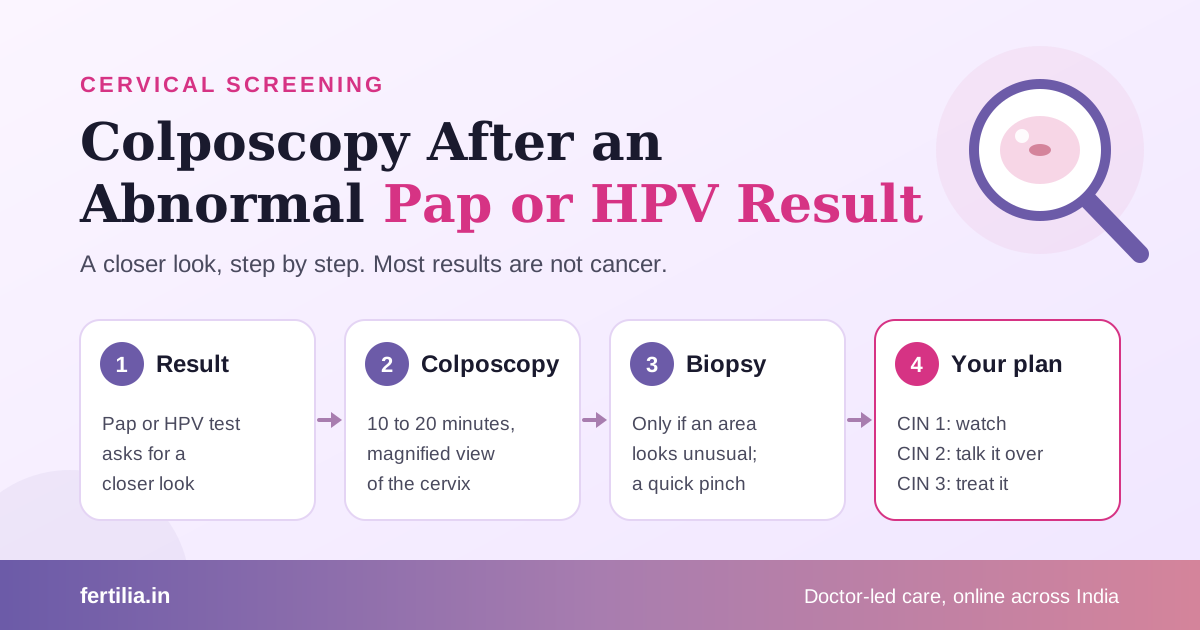
The short answer: a colposcopy is a 10 to 20 minute outpatient examination in which the doctor looks at your cervix through a magnifying instrument that stays outside your body. If an area looks unusual, a tiny biopsy is taken. The plan is based on the biopsy result read together with your Pap and HPV results and how clearly the cervix could be seen: usually watchful follow-up for low-grade changes, and a short, simple treatment for higher-grade changes. Cervical cell changes usually take years to progress, so there is time to do each step properly.
Here is what this post covers:
- Why you were referred for colposcopy
- What happens during the examination, minute by minute
- Biopsy: what it feels like and how to care for yourself after
- How to read your colposcopy and biopsy report (CIN 1, 2 and 3)
- What happens next for each result, including LLETZ (LEEP)
- Colposcopy in pregnancy, and fertility after treatment
- Common questions
Why You Were Referred for Colposcopy
Cervical screening is a two-stage process. The Pap smear and the HPV test are screening tests: they sort women into “very low risk, see you at your next routine screen” and “worth a closer look”. A colposcopy is the closer look. If you are not sure which test you had or how screening is scheduled, our guide to cervical cancer screening and when to get tested explains the whole ladder.
The usual reasons for a referral are:
- HPV positive for type 16 or 18, even if the Pap smear is normal. These two types are the ones most strongly linked to higher-grade changes, so they usually go straight to colposcopy.
- HPV positive for another high-risk type that is still there on a repeat test, typically a year later.
- An abnormal Pap smear, such as ASCUS with a positive HPV test, LSIL, ASC-H, HSIL or atypical glandular cells (AGC).
- A positive VIA test (visual inspection with acetic acid), which many government screening camps in India use instead of a Pap smear.
- A cervix that looks unusual on routine examination, or bleeding after sex that needs a closer look.
Modern guidelines decide the next step by your overall risk, which combines your current result with your past results, rather than by a single report line (Perkins RB et al., J Low Genit Tract Dis, 2020, PMID 32243307). That is why two women with the same Pap result can be given different advice: one may be asked to repeat the test in a year, the other referred for colposcopy now. Neither is being treated carelessly or over-cautiously.
Before the Appointment: Small Things That Help
- Book it outside your period. Light spotting is fine, but a heavy flow can hide the view. If your period starts on the day, call the clinic and ask.
- Skip vaginal creams, pessaries and douching for a day or two before, and avoid sex the night before. All of these can make the surface harder to read.
- Tell the doctor if you might be pregnant, if you are breastfeeding, or if you have had cervical treatment before.
- If speculum examinations are very painful for you, say so when you book. A smaller speculum, more time and a calmer pace make a large difference. If pain makes any internal examination difficult, our vaginismus program explains how this is treated gently.
- Eat normally and bring someone along if that helps you feel settled. You do not need to fast, and most women go back to their day afterwards.
What Happens During a Colposcopy
The examination itself feels much like a Pap smear, only longer. Here is the usual sequence:
- Position and speculum. You lie on the examination couch with your legs supported, and a speculum is inserted to hold the vaginal walls apart, exactly as for a Pap smear.
- The colposcope. This is a magnifying instrument on a stand, with a bright light, that sits about a forearm’s length away from you. Nothing goes inside you except the speculum. Many clinics show the image on a screen, and you can ask to see it.
- Acetic acid. The doctor dabs a dilute acetic acid solution (similar to vinegar) on your cervix. Areas with abnormal cells briefly turn white, which is called “acetowhite”. You may feel a mild tingling or cold sensation.
- Iodine (sometimes). Lugol’s iodine may be applied next. Healthy cells stain dark brown, while abnormal areas stay pale. The iodine can leave a yellow-brown discharge for a day.
- Biopsy, if needed. If any area looks unusual, one or more tiny samples are taken from it. If everything looks healthy and your earlier results were low-risk, a biopsy is often not needed. After a high-grade Pap result, a positive HPV 16 or 18 test, or when the transformation zone cannot be fully seen, samples may still be taken, including from inside the cervical canal.
The whole visit typically takes 10 to 20 minutes, and much of that is setting up. A doctor examines a particular region called the transformation zone, the ring where the two kinds of cervical cells meet and where almost all HPV-related changes begin. Your report will say whether this zone could be seen fully. It often moves inside the cervical canal after menopause, and also in some younger women, so a partly visible zone is a common finding, not a sign that something is wrong.
The Biopsy: What It Feels Like and Aftercare
A punch biopsy removes a piece of tissue roughly the size of a grain of rice. Most women feel a sharp pinch or a brief period-like cramp, and because it lasts only a moment, it is usually done without anaesthetic. A study of women at their first colposcopy found that those who had a biopsy or treatment reported more pain than those who had the examination alone (Kola-Palmer S et al., Eur J Cancer Care, 2016, PMID 26087280), so it is reasonable to expect some discomfort if a biopsy is taken, and reasonable to ask for a moment’s pause.
Sometimes the doctor also takes an endocervical sample (endocervical curettage, or ECC), gently scraping cells from inside the cervical canal, usually when the transformation zone cannot be fully seen. This tends to cause a cramp for a minute or two.
After a biopsy:
- Expect light bleeding or spotting for a few days. A paste is often used to stop bleeding, and it comes out as a dark brown or black, gritty discharge. This looks alarming but is normal.
- Use pads, not tampons or menstrual cups, and avoid sex until the spotting settles, usually a few days, or as long as your doctor advises.
- A paracetamol tablet is usually enough for any cramping.
- Call your doctor if bleeding is heavier than a normal period, you develop a fever, or the discharge becomes foul-smelling. These are uncommon, and they are easily treated when they do occur.
Questions About Your Result or Your Colposcopy Report?
💜 Not sure what your Pap, HPV or biopsy report means? Message Dr. Suganya on WhatsApp to book a ₹399 video consultation. Keep your Pap, HPV and biopsy reports ready, and we will go through them line by line.
Reading Your Report: CIN 1, CIN 2 and CIN 3
You may get two documents: the colposcopy report (what the doctor saw) and the histopathology report (what the pathologist saw under the microscope in your biopsy). The histopathology report carries the diagnosis.
| Report term | What it means | Usual next step |
|---|---|---|
| Normal / no dysplasia / cervicitis | No precancerous cells in the sample | Return to screening, often with an earlier repeat test |
| CIN 1 (LSIL) | Mild changes, usually a sign of an active HPV infection | Watchful follow-up, typically a repeat HPV-based test in about a year |
| CIN 2 (HSIL) | Moderate changes | Treatment, or close monitoring in selected women |
| CIN 3 (HSIL), including CIS | More marked changes that are still precancerous, confined to the surface lining | Treatment |
| AIS (adenocarcinoma in situ) | Precancerous changes in the glandular cells of the canal | Excisional treatment with specialist follow-up |
CIN stands for cervical intraepithelial neoplasia. “Intraepithelial” means the changes are confined to the surface lining of the cervix. CIN is a precancerous finding, which means it is not cancer, and treating it is how cervical cancer is prevented.
How often do these changes go away without treatment? A classic review of decades of natural-history studies estimated that about 60% of CIN 1 regresses, about 30% persists, about 10% progresses to CIN 3, and only around 1% progresses to invasive cancer, with the chance of progression rising as the grade rises (Ostör AG, Int J Gynecol Pathol, 1993, PMID 8463044). That rising risk is the reason higher grades are treated.
For CIN 2, a meta-analysis of 36 studies and 3,160 women managed without treatment found that, at 24 months, about 50% of lesions had regressed, 32% had persisted and 18% had progressed. In women under 30, regression was higher, at about 60% (Tainio K et al., BMJ, 2018, PMID 29487049). This is why CIN 2 in a younger woman who hopes to have children can sometimes be watched closely instead of being treated straight away.
Two other phrases often worry women unnecessarily. “Cervical erosion” or “ectropion” describes a red area that is normal glandular tissue on the outer cervix, and it is not precancer; our guide to cervical erosion and ectropion explains it. “Koilocytes” simply means the pathologist can see cell changes caused by HPV.
What Happens Next, Result by Result
If your biopsy is normal or CIN 1
Usually, nothing more is done today. If your earlier Pap result was low-grade, your gynaecologist will usually ask you to repeat an HPV-based test, often in about a year, and colposcopy again only if that test is abnormal. If your Pap smear showed a high-grade change (such as HSIL or ASC-H) or atypical glandular cells, a normal or CIN 1 biopsy may have missed a higher-grade area, so a repeat colposcopy or a diagnostic excision may still be advised. If CIN 1 persists for a couple of years, treatment may be discussed, but many women never need it.
If your biopsy shows CIN 2
The options are treatment or observation. Under current US risk-based guidelines, observation is an acceptable choice for women with CIN 2 who are concerned about the effect of treatment on future pregnancies, provided the junction where the two cell types meet (the squamocolumnar junction) and the upper edge of the abnormal area could both be fully seen, and any sample taken from inside the cervical canal did not show CIN 2 or worse, or CIN that could not be graded. It involves colposcopy and testing about every six months (Perkins RB et al., J Low Genit Tract Dis, 2020, PMID 32243307). This works only if you can attend every visit reliably. If follow-up would be hard, treatment is usually the safer choice.
If your biopsy shows CIN 3
Treatment is recommended, except during pregnancy (see below). The most common treatment is:
- LLETZ (large loop excision of the transformation zone), also called LEEP. A thin wire loop with an electric current removes the affected area in one piece. It is done as an outpatient procedure under local anaesthetic and usually takes 10 to 15 minutes. The removed tissue goes to the lab, which confirms the diagnosis and checks whether abnormal cells reach the edges of the sample. Even when the edges are clear, follow-up tests are still needed.
- Ablation (thermal ablation or cryotherapy) destroys the abnormal cells instead of removing them. It suits smaller lesions where the whole transformation zone is visible.
- Cone biopsy (cold knife conisation) removes a larger cone of tissue and is used in specific situations, such as glandular changes or a lesion reaching high into the canal.
After LLETZ, expect a watery or blood-stained discharge for two to four weeks, and avoid sex, tampons and swimming for about four weeks, or as your doctor advises. About six months later you will have a follow-up HPV-based test, often called a “test of cure”, to confirm the treatment worked.
Colposcopy During Pregnancy
Abnormal results are sometimes found at a booking visit, when a Pap smear is done as part of antenatal care. Colposcopy is safe in pregnancy and does not harm the baby. The focus during pregnancy is on making sure there is no cancer, not on treating precancer:
- The doctor will examine the cervix and may take a biopsy if a high-grade change or anything more is suspected.
- An endocervical sample (ECC) is not taken during pregnancy.
- Treatment of CIN 2 or CIN 3 is normally postponed until after delivery, with a repeat colposcopy during pregnancy if needed and a full reassessment a few weeks after the baby is born.
The pregnancy cervix has more blood flow and looks different, so a biopsy may bleed a little more. This is expected and settles with pressure.
Will Treatment Affect My Fertility or a Future Pregnancy?
This is the question I am asked most often. The evidence on getting pregnant is reassuring, and the evidence on later pregnancy is worth knowing before any treatment.
Getting pregnant: a meta-analysis of 15 studies found no evidence that treatment for CIN reduces the chance of conceiving (Kyrgiou M et al., BMJ, 2014, PMID 25352501). The same review found a higher rate of miscarriage in the second trimester after treatment (1.6% versus 0.4%), although the overall miscarriage rate was similar.
Carrying a pregnancy: a Cochrane review of 69 studies found that women who had cervical treatment had a higher risk of preterm birth (10.7% versus 5.4% in untreated women). The risk was higher after excision than after ablation, higher after larger or repeat procedures, and rose with the depth of tissue removed. Women with CIN who had not been treated also had a slightly higher baseline risk than the general population, and the authors note that most of the evidence was of low or very low quality (Kyrgiou M et al., Cochrane Database Syst Rev, 2017, PMID 29095502).
Put plainly, in that review about nine in ten pregnancies after treatment did not end in preterm birth, and the size of the risk depends on how much tissue was removed. Practical things that help:
- Ask before treatment how much tissue is likely to be removed, especially if you are planning a pregnancy soon.
- Keep your treatment report and tell your obstetrician about it at your first antenatal visit. Some obstetricians monitor the length of the cervix by scan in later pregnancy; our post on cervical length and a short cervix in pregnancy explains what that measurement means.
- Know the signs of early labour, so you can act calmly if they appear. Our guide to preterm labour signs lists them.
Waiting for Results: Looking After Yourself
The wait for a biopsy result, usually one to two weeks depending on the lab, is often harder than the procedure. A few things women find useful:
- Remember what the test is for. Colposcopy exists to find changes early, while they are still precancerous and simple to treat.
- An HPV result says nothing about fidelity. HPV is extremely common, an infection can stay quiet for many years before it shows up on a test, and there is no way to tell when or from whom it was acquired.
- Ask your doctor how you will get the result, and by when, so you are not left waiting on an uncertain phone call.
- Keep going with your screening. Once your follow-up is complete, you return to regular screening on the schedule your doctor sets. If you are planning tests and want a sense of the costs involved, our Pap smear cost guide covers lab and hospital prices across India.
- Ask about HPV vaccination if you have not had it. It does not clear an infection you already have, but it can protect against HPV types you have not met. Our HPV vaccine guide covers ages, doses and cost.
For broader help with periods, bleeding and when to get checked, Fertilia’s Period Health Guide is a useful companion.
Practical Takeaways
- Go for the colposcopy, and go calmly. It is a closer look, not a diagnosis of cancer.
- Book it outside your period and avoid creams, douching and sex for a day or two beforehand.
- Expect 10 to 20 minutes, a speculum, a vinegar-like solution, and possibly a pinch-like biopsy.
- After a biopsy, use pads, avoid sex until the spotting stops, and expect a dark discharge for a few days.
- The biopsy report, read with your Pap and HPV results, guides the plan. CIN 1 is usually watched; CIN 3 is treated; CIN 2 depends on your age, plans and ability to attend follow-up.
- Planning a pregnancy? Say so before any treatment, and keep your treatment report for your obstetrician.
- Finish your follow-up tests, including the test of cure after treatment.
Frequently Asked Questions
Does colposcopy hurt?
For most women, the examination itself feels like a slightly longer Pap smear: some pressure from the speculum and a mild tingle from the solution. If a biopsy is taken, expect a sharp pinch or a short cramp. This is the question behind searches like “colposcopy me dard hota hai kya”, and the answer is that it is usually uncomfortable rather than painful, and over quickly.
Does a colposcopy referral mean I have cancer?
No. Colposcopy is the standard next step after many abnormal screening results, and most women referred have HPV-related changes or no significant changes at all. Its purpose is to find precancerous changes early, when treatment is simple.
How long does it take to get colposcopy biopsy results?
Usually one to two weeks, depending on the laboratory. The colposcopy report (what the doctor saw) is available on the day; the biopsy report (what the pathologist saw) takes longer and carries the diagnosis.
My HPV test is positive but my Pap smear is normal. Why do I need colposcopy?
If the HPV type is 16 or 18, colposcopy is usually advised even with a normal Pap smear, because these types carry the highest risk of hidden higher-grade changes. If it is a different high-risk type, your doctor may suggest repeating the test in a year instead, since most infections clear by then.
Can I have a colposcopy during my period?
It is better to reschedule if your flow is heavy, because blood can hide the cervix. Light spotting at the start or end of a period is usually fine. Call the clinic and ask.
Can I have a colposcopy if I am pregnant?
Yes. Colposcopy is safe in pregnancy. A biopsy may be taken if a high-grade change is suspected, but an endocervical sample is not taken, and treatment of precancerous changes is usually postponed until after delivery.
Will LLETZ or LEEP stop me from getting pregnant?
Research has not shown that treatment reduces the chance of conceiving. It is linked to a higher risk of preterm birth and second-trimester miscarriage in a later pregnancy, with the risk rising with the depth of tissue removed. Tell your gynaecologist if you are planning a pregnancy before treatment, and your obstetrician about the treatment once you are pregnant.
Talk It Through With Someone Who Reads These Reports Every Week
An abnormal result can make the next appointment feel enormous. In video consultations at Fertilia, Dr. Suganya Venkat goes through Pap, HPV, colposcopy and biopsy reports with women from across India, explains each term, and helps you work out the questions to take back to your own gynaecologist, who will carry out the examination and any treatment.
💜 Waiting on a colposcopy or a biopsy result? Message Dr. Suganya on WhatsApp to book a ₹399 video consultation, and we will plan the next step together.
This post is for education and does not replace advice from your own gynaecologist, who knows your full history and has examined you.