Your daughter’s school sent home a health circular this week. Or your gynaecologist mentioned it at your last check-up. Or you are 36 and wondering whether it is still worth getting vaccinated now.
This guide covers every practical question: which HPV vaccines are available in India, which age group needs how many doses, what each one costs at private clinics, whether you can still benefit as an adult, and what the government’s free program covers.
What HPV Is and Why the Vaccine Exists
HPV stands for human papillomavirus. It is one of the most common sexually transmitted infections in the world, and in most cases the body clears it quietly on its own within a couple of years, with no symptoms or treatment needed.
The concern is with certain persistent strains. Types 16 and 18 in particular can cause cell changes in the cervix that, if not caught and managed, may progress to cervical cancer over many years. Together, HPV 16 and 18 account for roughly 70 percent of cervical cancer cases worldwide (WHO, 2023 fact sheet on HPV and cervical cancer).
The vaccine trains the immune system to recognise and block these strains before any exposure happens. This is why it works best when given early in life, before sexual contact begins. It does not treat existing HPV infection or existing cancer. It is purely a prevention tool.
HPV Vaccines Available in India
Four HPV vaccines are currently in use in India. They differ in how many strains they cover and how much they cost.
| Vaccine | Manufacturer | Strains covered | Notes |
|---|---|---|---|
| Cervavac | Serum Institute of India | 6, 11, 16, 18 | India’s own quadrivalent vaccine. Most affordable option. |
| Cervarix | GSK | 16, 18 | Bivalent (the two main cancer-causing strains only). Less commonly stocked now at most clinics. |
| Gardasil | MSD (Merck) | 6, 11, 16, 18 | Quadrivalent. Same strain coverage as Cervavac. |
| Gardasil 9 | MSD (Merck) | 6, 11, 16, 18, 31, 33, 45, 52, 58 | Nine-valent. Broadest coverage. Significantly more expensive. |
Strains 6 and 11 cause genital warts. Strains 16 and 18 are the primary cancer-causing types. Gardasil 9 adds five more cancer-associated strains on top of those four.
Cervavac is functionally equivalent to Gardasil in the strains it covers. It was evaluated in Indian population studies before approval by the Drug Controller General of India, and immunogenicity data has been comparable. For most families choosing between these two, the practical difference is price, not protection.
Cervarix (bivalent) covers fewer strains and is now less commonly stocked at most private clinics. If you cannot find it, Cervavac or Gardasil are the straightforward alternatives.
Gardasil 9 is worth considering if broader strain coverage is a priority or if your doctor recommends it. The cost is substantially higher.
The Dose Schedule
The number of doses depends on your age at the time of the first dose, regardless of which vaccine you choose.
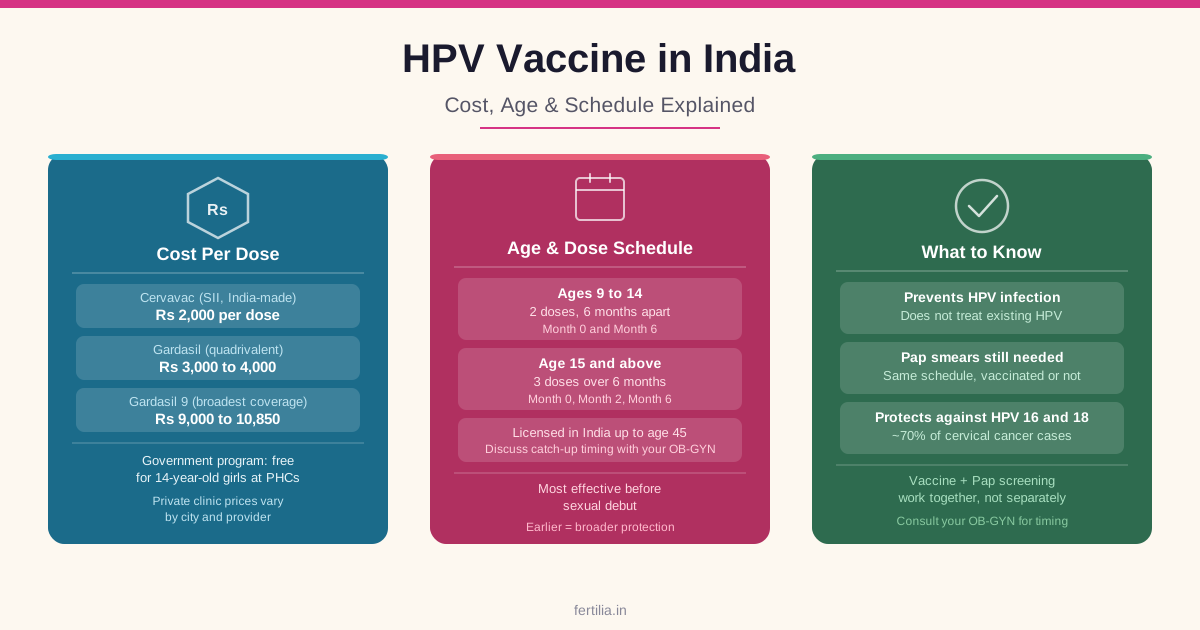
Ages 9 to 14: two doses
Girls who start the series between age 9 and 14 need only two doses, given six months apart. The standard schedule for Cervavac, Gardasil, and Gardasil 9 in this age group is dose one at month 0, dose two at month 6. For Cervarix, it is the same: 0 and 6 months.
Two doses work at this age because the immune response in children and early adolescents is stronger than in adults. Fewer doses achieve the same level of protection.
Age 15 and above: three doses
Anyone who starts vaccination at 15 or older needs three doses over six months. The schedule for Cervavac and Gardasil is month 0, month 2, and month 6. Cervarix uses 0, 1, and 6 months. Completing all three doses on schedule matters for this age group; cutting the series short reduces protection.
Immunocompromised individuals: three doses regardless of age
If someone is immunocompromised (including women living with HIV), three doses are recommended even if the series starts before age 15. A weaker immune response means more doses are needed to build reliable protection.
The single-dose question
A 2025 update from the Indian Academy of Paediatrics (IAP) noted that emerging evidence suggests a single dose of HPV vaccine may offer strong and lasting protection for immunocompetent girls aged 9 to 15 (IAP Update 2025, PMID 41954836). The WHO is actively reviewing this data as well. The standard Indian schedule remains two doses for this age group until formal guidance is updated, but it is worth raising with your paediatrician if cost or access is a barrier.
For more on this, read our guide on HPV Vaccine Before Pregnancy.
What It Costs
Prices below are approximate private-market rates for India in 2025 to 2026, based on published clinic and pharmacy data. They can vary by city, hospital, and available stock. Consultation fees are separate and not included.
Per dose:
- Cervavac: Rs 2,000
- Cervarix: Rs 2,500 to 3,500
- Gardasil: Rs 3,000 to 4,000
- Gardasil 9: Rs 9,000 to 10,850
Total for a complete series:
Ages 9 to 14 (two doses):
- Cervavac: Rs 4,000
- Gardasil: Rs 6,000 to 8,000
- Gardasil 9: Rs 18,000 to 21,700
Age 15 and above (three doses):
- Cervavac: Rs 6,000
- Gardasil: Rs 9,000 to 12,000
- Gardasil 9: Rs 27,000 to 32,500
Metro cities and large corporate hospitals typically charge at the higher end of these ranges. Smaller private clinics and pharmacy outlets may be closer to the lower end. Always confirm the current price at your chosen provider before booking, as prices do change.
The Government’s Free Vaccination Program
India’s National Technical Advisory Group on Immunisation (NTAGI) recommended including HPV vaccination in the Universal Immunization Program. Starting in 2024 to 2025, the central government began rolling out a free HPV vaccination program for 14-year-old girls through government health centres and primary health centres. The vaccine used in this program is Cervavac.
Coverage is still being phased in state by state and is not yet uniformly available in every district. If your daughter is 14, it is worth asking at your nearest government hospital or PHC whether the program has reached your area. If it has, there is no cost through this channel.
For girls outside the 14-year-old target group, or for adult women, the government program does not yet cover those age groups. Vaccination is available through private clinics at the costs listed above.
Can You Still Get Vaccinated as an Adult?
This is the question many women in their late twenties, thirties, and early forties bring to their gynaecologist. The short answer is yes, up to age 45, though the benefit is lower than it would have been at age 12.
The IAP states clearly that catch-up vaccination may be offered to older women and that the vaccine is licensed in India up to age 45 (IAP HPV Vaccine Information, iapindia.org). FOGSI’s 2024 consensus guidance for India similarly notes that adult women who were not vaccinated earlier should discuss the option with their gynaecologist.
Why the benefit is lower in adults: most adults have already been exposed to at least some HPV strains through sexual contact. The vaccine cannot clear existing infection, so it protects only against strains you have not yet encountered. The earlier you vaccinate, the more strains are blocked before any exposure happens.
That said, most people have not been exposed to all four or all nine strains. Partial protection is still real protection. A woman at 32 who has never been vaccinated has likely not encountered all of the strains Cervavac or Gardasil 9 cover, so there is still a meaningful benefit to vaccination.
After 45, vaccination is generally not recommended, as there is limited efficacy data in this age group and most women in this range have been exposed to a broader range of strains.
If you are between 27 and 45 and unsure whether the vaccine makes sense in your situation, that is a conversation worth having with your OB-GYN based on your specific health history.
Talk to Dr. Suganya about HPV vaccination and cervical health (Rs 399, video call, pan-India) →
What the Vaccine Does Not Cover
The HPV vaccine is highly effective at preventing infection with the strains it covers. It does not prevent infection from every strain of HPV, and it does not treat or reverse infection that is already present.
This means two things practically. First, vaccinated women still need regular Pap smear screening. The standard intervals (Pap smear every 3 years from age 21 to 29, Pap or co-test every 3 to 5 years from age 30 to 65) apply whether you are vaccinated or not. The vaccine and Pap smears work together as a complementary system, and one does not replace the other.
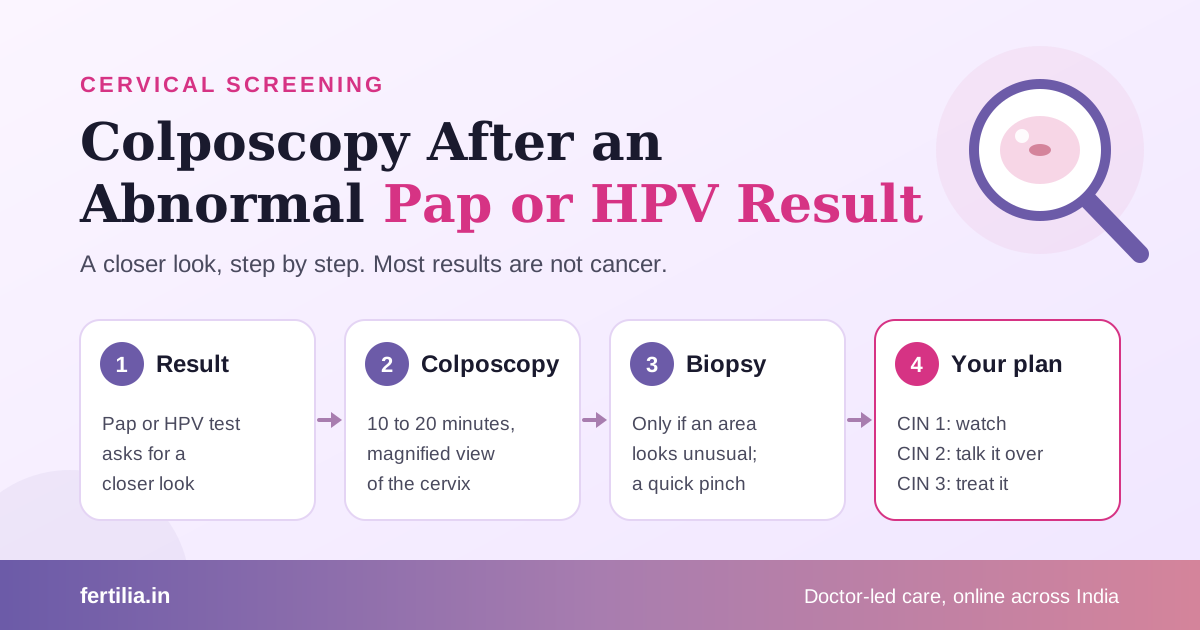
Second, if you have already had an abnormal Pap smear result, that needs separate evaluation and follow-up. The vaccine is not part of the management of an existing finding.
For a full explanation of Pap smear screening in India, including costs at major labs and what different results mean, see the companion post on Pap smear cost, timing, and what the test checks.
For women in the TTC phase, HPV vaccination status is one of several things worth reviewing before trying to conceive. The preconception fertility workup guide covers what tests are worth doing and in what order.
For an overview of how preventive care, lifestyle support, and clinical management work together in women’s health, the guide to multidisciplinary hormonal health care gives the broader picture.
Frequently Asked Questions
Which HPV vaccine is best in India?
For most families, Cervavac is the practical first choice. It covers the four HPV strains most responsible for cervical cancer and genital warts (types 6, 11, 16, and 18), it is manufactured in India by the Serum Institute, and it is the most affordable option at around Rs 2,000 per dose. Gardasil covers the same four strains at a higher price. Gardasil 9 adds five more cancer-associated strains and costs significantly more. All four vaccines available in India are approved and effective for their licensed strain coverage. The decision between them comes down to budget and your doctor’s recommendation for your specific situation.
Can I get the HPV vaccine after marriage?
Yes. The vaccine is licensed in India up to age 45, and it can be given to married women. The effectiveness is lower after sexual debut because some exposure to HPV strains may have already occurred, but the vaccine still protects against strains you have not yet encountered. Whether it makes sense for you depends on your age and history, which is worth discussing with your gynaecologist before deciding.
Is Cervavac the same as Gardasil?
Cervavac and Gardasil are both quadrivalent HPV vaccines covering the same four strains (6, 11, 16, and 18). They are made by different manufacturers, Cervavac by Serum Institute of India and Gardasil by MSD in the United States. Both underwent clinical evaluation before approval; Cervavac was additionally evaluated in Indian population studies. In terms of which strains they protect against, they are equivalent. The main practical difference is price.
Does my daughter need two doses or three doses?
If she receives her first dose between age 9 and 14, she needs two doses, given six months apart. If she is 15 or older when she gets the first dose, she needs three doses over six months. The number of doses is determined by the age at first vaccination, not by subsequent doses. If she turns 15 after her first dose but before her second, she still completes the two-dose schedule she started on.
Is the HPV vaccine free in India?
A government-run free vaccination program for 14-year-old girls has been rolling out since 2024 to 2025 through government health centres and PHCs, using Cervavac. Availability varies by state and district. If your daughter is 14, it is worth checking at the nearest government hospital whether your area is covered. For other age groups, the vaccine is available at private clinics at the prices listed in this guide.
Can I still benefit from the HPV vaccine at 35?
You can, though the benefit is lower than it would have been at 12. The vaccine is licensed in India up to age 45, and catch-up vaccination is recommended by IAP for women who were not vaccinated earlier. At 35, you have likely been exposed to some HPV strains but probably not all four or nine covered by available vaccines. Your gynaecologist can help you weigh the potential benefit against the cost based on your health history.
If I am vaccinated, do I still need Pap smears?
Yes, you do. The vaccine protects against the strains most commonly responsible for cervical cancer, but it does not cover every HPV strain, and it offers no protection against cell changes that may have started before vaccination. Current guidelines recommend continuing Pap smear screening at the same intervals for both vaccinated and unvaccinated women. Vaccination and screening work together as a two-part prevention system.