A woman messaged me last month with two screenshots side by side. One clinic had quoted her ₹6,000 for the arm implant. Another, in the same city, had quoted ₹14,000. Her question was the obvious one: which of these is the real price, and what is the second clinic adding that the first one is not?
It is a fair question, and the answer turns out to be more interesting than either number. For most medicines and medical devices in India that carry a notified ceiling price, there is a published maximum and you can check it yourself. The contraceptive implant is not one of them. That single fact explains almost all of the spread she was looking at.
I’m Dr. Suganya Venkat, an OB-GYN with over fifteen years of clinical experience, and in the video consultations I run at Fertilia this gap between quotes comes up often enough that it is worth laying out properly. This post is about what you are actually paying for when you are quoted a price for a contraceptive implant, why two clinics in the same city can differ by eight thousand rupees, where the free public-sector route fits, and the one line item that most women do not think to ask about until three years later.
If you want the clinical side first, how the implant works, what it does to bleeding patterns and how quickly fertility returns, that is covered in my guide to the birth control injection and implant in India. This post assumes you have decided the method might suit you and are now trying to budget for it.
Why There Is No Fixed Price to Look Up
India controls the price of essential medicines through the Drugs (Prices Control) Order, 2013. Formulations that appear in the National List of Essential Medicines get a notified ceiling price, and no manufacturer may charge above it.
The contraceptives section of the National List of Essential Medicines 2022 (section 18.2) lists five things: the combined ethinylestradiol and levonorgestrel tablet, the levonorgestrel tablet, ormeloxifene (Centchroman), the hormone-releasing IUD containing 52 mg of levonorgestrel, and the copper IUD. Etonogestrel, the hormone in the single-rod arm implant, does not appear anywhere in that document.
The practical consequence shows up when you compare it with the hormonal IUD. The NPPA’s ceiling price order S.O. 1575(E) of 25 March 2026 fixes the 52 mg levonorgestrel IUD at ₹4,202.06 per device excluding applicable GST, effective 1 April 2026 (row 365; the effective date is in note (a) on page 50). Search the same 51-page notification for the implant and you will not find it. I checked the full document on 22 September 2026.
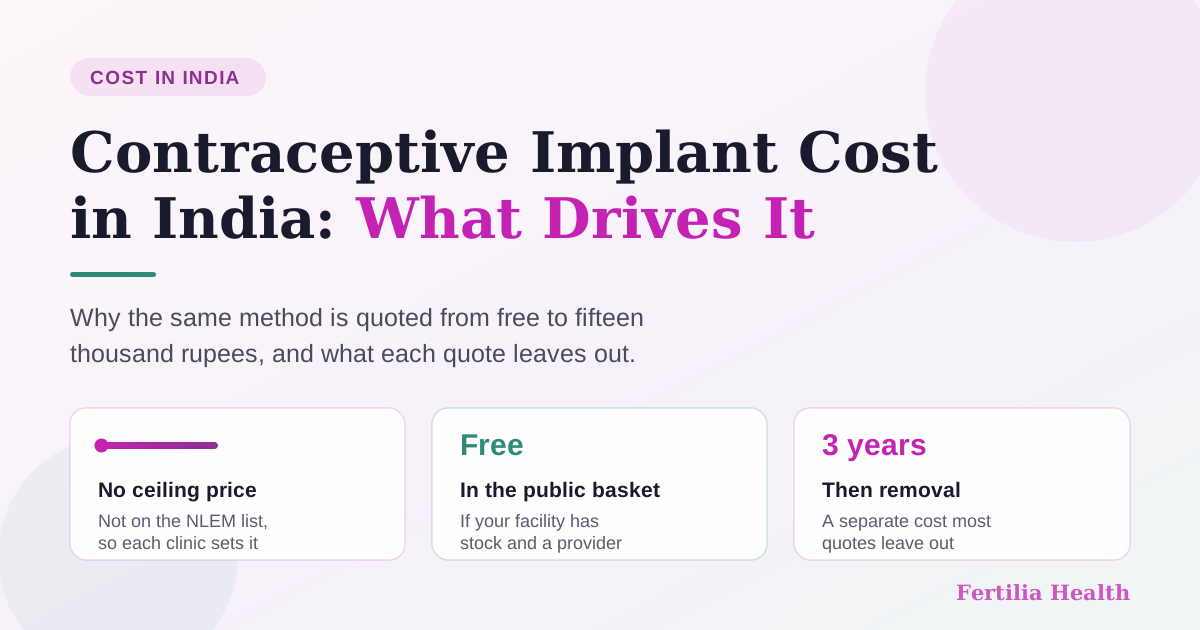
So when a clinic quotes you a price for an arm implant, it is not applying a regulated maximum and then adding a fee. It is setting a price, which is how an unscheduled device works in India. That is the reason two quotes can sit ₹8,000 apart with both providers acting perfectly properly.
The Free Route Comes First
Before any private quote, know that this method is in the public programme.
The Ministry of Health’s family planning programme booklet lists the “Subdermal Contraceptive Implant (Single Rod)” in the national contraceptive basket alongside IUCDs, the Antara injection, Mala N, Chhaya and condoms, and states plainly: “All available methods are provided free of cost through public health facilities and ASHAs.” Section 2.3 describes the implant as effective for three years, inserted by a trained provider (MBBS and above) at designated health facilities.
Two things are worth understanding about that sentence, and I would rather you hear them before you travel than after.
“Free” covers the method as provided, not only the rod. The booklet’s wording is about the methods in the basket being provided free through public facilities, so at a facility that is stocked and staffed for it, you are not buying the device separately from the procedure. The same booklet instructs providers to issue an implant card recording the insertion date, the site and the due date of removal, and tells women to keep it because removal happens at the designated facility. Ask at the time of insertion how removal is handled there in three years.
Being in the basket does not guarantee it is available at your nearest PHC today. The booklet specifies designated facilities and a trained MBBS-or-above provider, which is a narrower set than every primary health centre. Before making a trip, call the district family planning office, the district hospital or your local UPHC and ask two specific questions: is the single-rod subdermal implant in stock, and is there a trained insertion provider available. An ASHA can usually help you find out where to go.
If both answers are yes, your cost for three years of contraception is nothing, and the rest of this post is useful mainly as a reference for what you are being spared.
What You Are Paying For in a Private Quote
When a private clinic quotes a single figure, it usually bundles between four and seven separate things. Understanding the components is what lets you compare two quotes that look nothing alike.
| Component | What it covers | Why it varies |
|---|---|---|
| The device | The sterile pre-loaded applicator containing the etonogestrel rod | No notified ceiling price, so it depends on the clinic’s procurement and the brand stocked |
| Consultation | History, eligibility assessment, ruling out pregnancy | Some clinics fold this in, some bill it separately |
| Insertion procedure | Local anaesthetic, sterile field, the few minutes of the procedure itself, consumables | Doctor’s professional fee and facility overheads, which is where a hospital and a small clinic diverge most |
| Follow-up review | The visits at around six weeks and three months that the programme booklet encourages | Often included, sometimes charged per visit |
| GST | Applicable tax on the device and services | May or may not be shown in the quoted figure |
| Removal after three years | A second, separate procedure | Very often excluded from the original package |
That last row is the one I most want you to notice, and it gets its own section below.
What actual Indian providers publish. Very few clinics put implant pricing on a public page at all, which is itself informative. Two that do, checked on 22 September 2026:
- La Femme Fertility Clinic (Wakad, Pune) lists the subdermal implant (Implanon) at ₹5,000 to ₹10,000, alongside the hormonal IUD at ₹8,000 to ₹15,000 and the copper IUD at ₹300 to ₹2,500 (lafemmeivf.in).
- Metropolis Healthcare’s patient-education page states that in most private hospitals and clinics the implant “typically ranges between ₹10,000 and ₹15,000, excluding insertion or removal fees” (metropolisindia.com).
Those two ranges barely overlap, and one of them explicitly excludes the procedure while the other appears to include it. I am quoting them not because either is a national rate, but because the disagreement between two published Indian sources tells you more about this market than either figure alone. Treat any single number you read online, including these, as one provider’s position rather than a benchmark.
💜 Trying to work out whether the implant is the right method for you before you compare prices? Message Dr. Suganya’s team on WhatsApp and we can go through your history, your plans for a future pregnancy, and what to ask a local provider, over a video consultation.
The Line Item Almost Nobody Asks About: Removal
The implant lasts three years. At the end of that, it has to come out, whether or not you want another one. That removal is a separate procedure with its own cost, and it is routinely left out of the figure you are quoted on day one.
Ask about it at the point of insertion, not in year three. The reason is practical: if you have moved city, or the clinic has changed hands, or the doctor who inserted it has left, you are negotiating a removal with a provider who did not sell you the package.
Most removals are straightforward. In a study of 184 women having a single-rod etonogestrel implant removed in an ordinary, non-specialised family planning clinic, the implant was correctly positioned in 88.1% of cases, and median difficulty and pain scores were low (Soares JTP et al., Eur J Contracept Reprod Health Care, 2025, PMID 40838306). Nurses performed 21% of the removals with no significant difference in difficulty or pain compared with doctors.
The same study identified what makes a removal harder: an absent scrolling sign, meaning the rod cannot be felt to move under the skin, was associated with substantially greater difficulty, and fibrosis around the rod, present in 26.4% of cases, roughly quadrupled the odds of a difficult removal.
An implant that cannot be felt is the situation that generates an unexpected bill, because it may need ultrasound localisation or referral to someone with specific experience. A rod can become non-palpable if it was inserted deeper than the subcutaneous layer, if there has been significant weight gain since insertion, or if it has migrated from the insertion site (Sium AF et al., Public Health Chall, 2025, PMID 40756455). That same paper notes a detail worth knowing at the time of purchase: Nexplanon is radiopaque, meaning it shows on X-ray, while the older Implanon is not. Both contain 68 mg of etonogestrel.
So at the point of insertion, ask the provider to write down the brand and note it on your implant card. If it ever needs locating, that one line saves a great deal of trouble.
A note on three years versus five
You may come across newer international sources describing this implant as lasting five years. That is a real change, and it is worth understanding correctly because it affects the cost arithmetic below.
On 16 January 2026 the US FDA approved a supplement to Nexplanon’s application extending its approved duration of use from three years to five (FDA approval letter, NDA 021529/S-027, checked 22 September 2026). That is a United States labelling decision for that specific product.
India’s national programme documentation still describes the single-rod implant as effective for three years, and that is the replacement interval your provider here will work to. Do not extend your own removal date on the strength of a US label or an internet comparison. Ask your provider which brand you have been given and what replacement date they are recording on your implant card, and plan to the date on the card.
Cost Per Year Is the Comparison That Makes Sense
An implant’s price lands as a single payment, which makes it feel expensive next to a monthly strip of pills. Spread across what it actually buys, the arithmetic looks different.
| Method | Typical private cost | Protection period | Roughly per year |
|---|---|---|---|
| Single-rod implant | ₹5,000 to ₹15,000 (private, varies widely) | 3 years | ₹1,700 to ₹5,000 |
| Removal at end of term | Often billed separately, no published national rate | One-off | Ask before you insert |
| 52 mg hormonal IUD | ₹4,202.06 device ceiling plus insertion and GST | Several years, confirm against the current Indian package insert | Lower per year than the implant in most quotes |
| Copper IUD | ₹300 to ₹2,500 privately, free in the public programme | 380A for 10 years, 375 for 5 years (NHM booklet, section 2.1) | Lowest of the reversible methods |
| Combined pill | ₹100 to ₹500 a month | While taken | ₹1,200 to ₹6,000 |
| DMPA injection | ₹100 to ₹300 per dose privately, free under Antara | 3 months per dose | ₹400 to ₹1,200 |
Private figures in this table are from the two provider sources cited above, checked 22 September 2026; the IUD device ceiling is from the NPPA notification. Your local quotes will differ.
Two caveats on this framing. Per-year cost only works out if the implant stays in for its full three years, and unpredictable bleeding is the most common reason women choose early removal, which shortens the period the cost is spread across. And a method you find difficult to live with is not a bargain at any per-year figure. The budget question sits underneath the suitability question, never above it.
What you are buying with the implant, and what the per-year number does not capture, is that once it is in there is nothing to remember, nothing to buy monthly and nothing to go and collect. In an integrated analysis of 11 international studies covering 923 non-breastfeeding women and 24,100 cycles of exposure, there were no pregnancies during treatment with the etonogestrel implant (Graesslin O et al., Eur J Contracept Reprod Health Care, 2008, PMID 18330813). That same analysis found six of the post-treatment pregnancies occurred within 14 days of removal, which is the other half of what you are paying for: the protection stops promptly when you decide it should.
If you are weighing the implant against an IUD specifically, my comparison of Mirena and the copper T in India goes through that decision in detail, and the full comparison of contraceptive options in India sets both against the pill, the injection and permanent methods.
What to Ask Before You Pay
Bring this to the consultation, or send it as a message before you book.
- Is this quote all-inclusive? Ask specifically whether it covers consultation, the device, insertion, consumables, follow-up visits and GST.
- Which brand, and what is the pack MRP? Ask to see the sealed pack. Note the brand and expiry on your implant card.
- What does removal cost after three years, and is it included? Get this answer in writing now, not in 2029.
- What is charged if the implant is difficult to locate at removal? A clinic that has thought about this will have an answer.
- Who will remove it? Confirm the clinic has a provider trained in removal, not only insertion.
- Have you checked the government facility first? If your district hospital or UPHC has stock and a trained provider, the whole bill may be zero.
What It Is Called Locally
Unlike the pill or the copper T, this device has no settled common-language name in Tamil or Hindi, which matters if you are asking at a facility where the consultation happens in the local language. Women and providers generally refer to it in English as “the implant” or the arm rod, or by the brand name, even mid-sentence in another language.
So the phrase that gets you a straight answer at a government facility is the programme’s own name: subdermal contraceptive implant, single rod. Ask for that by name, and ask about stock and a trained provider in the same sentence. Asking for “the arm injection” will often get you directed to the Antara injection instead, which is a different method with a different return-to-fertility profile.
Frequently Asked Questions
What does a contraceptive implant cost in India?
It is free through the National Family Planning Programme at designated public facilities that have stock and a trained provider, as the Ministry of Health’s family planning booklet states. Privately, published Indian provider prices range from about ₹5,000 to ₹15,000, and quotes vary in whether they include insertion, follow-up and GST. There is no regulated ceiling price for this device, so there is no single correct figure to compare against.
Why do two clinics in the same city quote such different prices?
Because etonogestrel does not appear in the National List of Essential Medicines 2022, so it carries no NPPA ceiling price under the Drugs (Prices Control) Order. Each provider sets its own figure based on procurement, professional fee and facility overheads, and each bundles a different set of components into the headline number. The hormonal IUD, which is on the list, has a notified device ceiling of ₹4,202.06 excluding GST, which is why its pricing is far more consistent.
Is the implant really free at government hospitals?
The programme booklet states that all methods in the national basket, which includes the single-rod subdermal implant, are provided free through public health facilities and ASHAs. The condition is availability: insertion is done by a trained MBBS-or-above provider at designated facilities, so not every centre offers it on any given day. Call ahead and ask about stock and a trained provider before travelling.
Does the quoted price include removal after three years?
Usually not, and this is the most common gap in a private quote. Removal is a separate procedure with its own charge. Ask for the removal cost in writing at the time of insertion, including what happens if the implant turns out to be difficult to locate.
How much does implant removal cost in India?
There is no published national rate, and clinics differ in whether they bill it separately or fold it into a replacement. A straightforward removal is a short procedure: in a study of 184 women in a non-specialised clinic, most implants were correctly positioned and both difficulty and pain scores were low. A non-palpable implant needing ultrasound localisation or referral will cost more, which is why the brand and the implant card matter.
Is the implant cheaper than the pill or the IUD over time?
Spread over three years, a private implant works out to roughly ₹1,700 to ₹5,000 a year, which sits in a similar band to the pill and above the copper IUD and the DMPA injection. The copper IUD is generally the least expensive reversible method per year of protection. The per-year calculation only holds if the implant stays in for its full three years, so if unpredictable bleeding would prompt you to have it removed early, the arithmetic changes.
Should I choose a method based on cost?
Cost belongs in the decision, particularly when a method is paid for out of pocket in a single payment. It should not lead it. Bleeding pattern, whether you might want a pregnancy sooner than planned, whether you are breastfeeding and your medical history all determine whether a method suits you, and a cheaper method you stop using in four months protects you less than a costlier one you keep. Work out suitability first, then compare quotes within that.
💜 Have a quote in hand and want a second opinion on whether the method fits you? Talk it through with Dr. Suganya Venkat on WhatsApp We consult online across India by video call, and we are glad to work alongside whichever provider will be inserting or removing it locally.
Sources checked 22 September 2026: National List of Essential Medicines 2022 (CDSCO), section 18.2; NPPA ceiling price order S.O. 1575(E) dated 25 March 2026, row 365 and note (a); Ministry of Health family planning programme booklet, section 2.3 and the contraceptive basket list; published price pages at lafemmeivf.in and metropolisindia.com.