You laugh at something on the phone, or the baby’s cry makes you stand up quickly, or a sneeze catches you off guard, and there it is: a small wet patch you did not expect.
Many women tell me about this only at the very end of a consultation, almost as an afterthought, and usually with an apology. Some have been wearing a pad every day for months without mentioning it to anyone at home. I’m Dr. Suganya Venkat, an OB-GYN with over 15 years of caring for women through pregnancy and the months after it, and I want to say this clearly at the start: leaking urine after delivery is common, it has a physical cause, and there is a lot you can do about it.
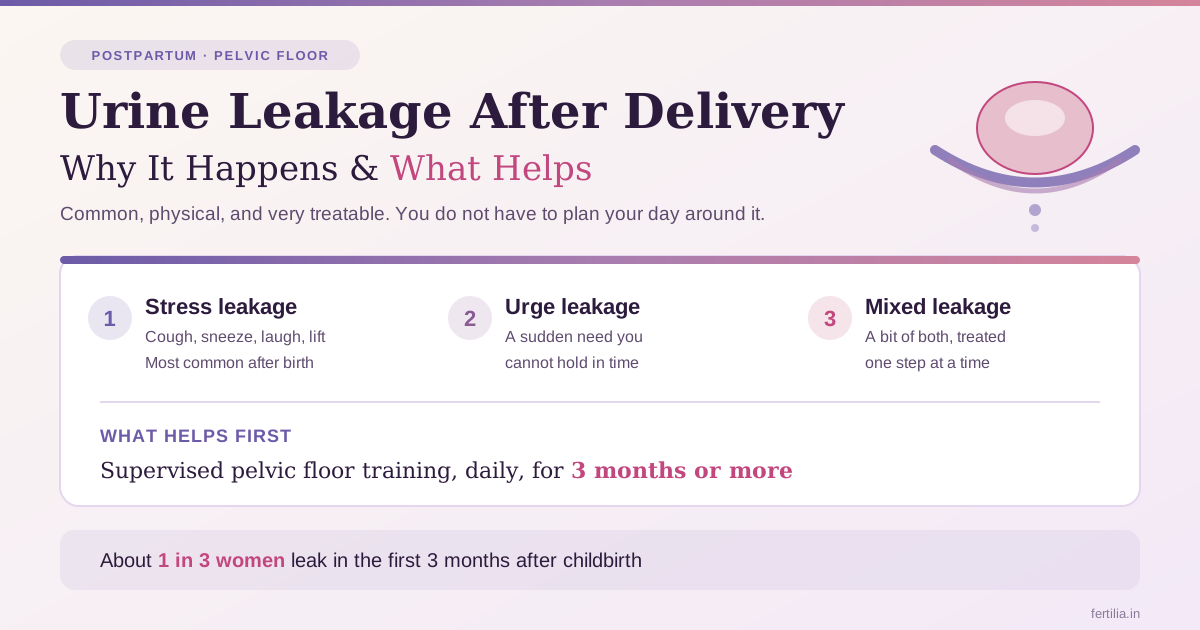
The short answer: about one in three women has some urine leakage in the first three months after childbirth. Most of it is stress leakage, triggered by coughing, sneezing, lifting or laughing, because the pelvic floor muscles and the tissues supporting the bladder were stretched during pregnancy and birth. Supervised pelvic floor muscle training is the first treatment, and starting early, then keeping it up, matters more than anything else.
Here is what this post covers:
- Why leakage happens after delivery
- The three types of leakage, and how to tell which one you have
- How common it is, and who is more likely to have it
- The signs that need a doctor sooner
- A step-by-step plan that helps
- What it is called in Tamil and Hindi, and common questions
If your main concern is a feeling of heaviness or a bulge in the vagina, that is a different problem (pelvic organ prolapse), and it is worth mentioning to your gynaecologist separately. This post stays with leakage.
Why Leakage Happens After Delivery
Your bladder sits on a hammock of muscle and connective tissue called the pelvic floor. Those muscles do two jobs for continence. They hold the bladder neck and urethra up in the right position, and they squeeze shut around the urethra when pressure in the abdomen suddenly rises, like when you cough.
Pregnancy and birth ask a great deal of that hammock:
- Nine months of extra weight from the growing baby, uterus and fluid press down on it continuously.
- Pregnancy hormones soften connective tissue so the pelvis can open for birth. That softening also affects the supports around the bladder.
- A vaginal birth stretches the pelvic floor muscles far beyond their usual length, and the nerves that supply them can be stretched too. A long pushing stage, a large baby, or an assisted delivery with forceps or vacuum adds to that strain. A perineal tear involves the same area and can take its own time to settle.
After the birth, the muscles are weaker and slower to react. So when you cough, the squeeze that used to happen automatically comes a fraction too late or too gently, and a little urine escapes. In many women this improves as the tissues recover over the following weeks. In others it lingers, and that is where active treatment comes in.
A caesarean birth reduces the stretch on the pelvic floor, but it does not remove the effect of the pregnancy itself, so women who had a C-section can leak too.
Stress, Urge or Mixed: Which Type Is Yours?
Knowing your type matters because the treatment is slightly different for each.
| Type | What it feels like | Typical triggers | First treatment |
|---|---|---|---|
| Stress leakage | A spurt or a few drops with no warning | Coughing, sneezing, laughing, lifting the baby, getting up from the floor, walking fast | Pelvic floor muscle training |
| Urge leakage | A sudden, strong need to pass urine, and you cannot reach the toilet in time | Key in the door, sound of running water, washing vessels, a full feeling that comes on quickly | Bladder training |
| Mixed leakage | Both of the above | Both | Both, starting with whichever bothers you more |
After delivery, stress leakage is by far the most common. Urge symptoms are also worth noting, especially if you have started drinking less water to avoid accidents, or if you are going to the toilet “just in case” every half hour.
How Common Is It, and Who Is More Likely to Leak?
A systematic review of population-based studies found that in the first three months after childbirth, 33% of women had some urine leakage. Leakage at least once a week was reported by about 12%, and daily leakage by about 3%. The average rate after vaginal delivery (31%) was roughly double the rate after caesarean section (15%) (Thom DH, Rortveit G, Acta Obstet Gynecol Scand, 2010, PMID 21050146).
So if you are leaking, you are in very large company, even if no one in your family has ever spoken about it.
A 12-year study that followed 3,763 women in the UK and New Zealand after childbirth found that leakage was more likely to persist in women who were older at their first birth, had more births, or were overweight (MacArthur C et al., BJOG, 2016, PMID 25846816). In the same study, women who had delivered only by caesarean were less likely to have persistent leakage, but women who had a mix of caesarean and vaginal births were not. A C-section is not a reason on its own to choose one, and it does not guarantee you will stay dry.
The same study found something important about timing. Among women who already had leakage at three months after the birth, about three-quarters still reported it 12 years later. I share this not to worry you, but because it changes the advice: leakage that is still there a few months after delivery is unlikely to fade by itself, so it is worth treating rather than waiting it out. The good news is that treatment is simple, safe and can be started at home.
When Leakage Needs a Doctor Sooner
Most postpartum leakage is the stress type and can be managed with the plan below. A few patterns should be checked by a doctor rather than treated with exercises alone:
- A constant trickle, day and night, with no sense of needing to go. Rarely, this comes from a small abnormal opening between the bladder and the vagina (a fistula), usually after a long or difficult labour. It is uncommon and it can be repaired, but it needs an examination.
- Being unable to pass urine, or passing only small amounts with a full, uncomfortable bladder, in the first days after birth. The bladder can be slow to empty fully after an epidural or a long labour, and an overfull bladder can dribble. Tell your nurse or doctor straight away if this happens.
- Burning, pain, fever, cloudy or blood-tinged urine. These point to a urinary infection, which can also cause sudden urgency. Our guide on UTI symptoms and when to see a doctor explains what to look for.
- A bulge or a dragging, heavy feeling in the vagina, which suggests prolapse alongside the leakage.
- Leakage of stool or wind you cannot control, which sometimes accompanies a deeper tear and deserves its own assessment.
Each of these has its own specific treatment, which is why an examination helps. Postpartum urine leakage also has a natural place in the 6-week postpartum checkup, so bring it up there even if no one asks.
💜 Leaking when you cough, sneeze or lift your baby? Message Dr. Suganya on WhatsApp and talk it through privately over a ₹399 video consultation, from anywhere in India or abroad.
What Helps: A Step-by-Step Plan
Step 1: Pelvic floor muscle training, done properly and kept up
This is the foundation. The UK’s National Institute for Health and Care Excellence recommends a trial of supervised pelvic floor muscle training for at least 3 months as the first treatment for stress or mixed leakage, with a programme of at least 8 contractions, 3 times a day, continued if it helps (NICE guideline NG123, 2019, nice.org.uk/guidance/ng123).
How well does it work? In women with stress leakage generally (not only after childbirth), a Cochrane review of trials found that women doing pelvic floor training were about eight times more likely to report being cured than women given no treatment: 56% compared with 6% (Dumoulin C et al., Cochrane Database Syst Rev, 2018, PMID 30288727).
For women who have just had a baby, the evidence is more mixed, and I would rather you hear that from me than discover it later:
- In a trial of 747 women who were still leaking three months after the birth, nurse-guided pelvic floor exercises plus bladder training reduced leakage at one year: 60% still had some leakage compared with 69% in the usual-care group, and severe leakage fell from 32% to 20% (Glazener CM et al., BMJ, 2001, PMID 11557703).
- In a smaller Norwegian study, women who did an 8-week supervised postpartum training course had less stress leakage and stronger pelvic floor muscles one year after delivery than matched women who did not (Mørkved S, Bø K, BJOG, 2000, PMID 10955436).
- When the women from the 747-woman trial were followed up 12 years later, the difference between the groups had gone. By then, only about half the women in either group were still doing their exercises (Glazener CM et al., BJOG, 2014, PMID 24148807).
- The 2020 Cochrane review of pelvic floor training around childbirth found the effect of postnatal training as a treatment for leakage is still uncertain, mainly because many trials were small and the programmes varied a lot (Woodley SJ et al., Cochrane Database Syst Rev, 2020, PMID 32378735).
What I take from all of this for my patients: the exercises help when they are done correctly and consistently, the benefit is real in the first year, and it fades when women stop. So the aim is a short daily habit that stays part of your life, like brushing your teeth.
The technique itself (finding the right muscles, holding, releasing, building up) is covered step by step in our guide to Kegel exercises for women. Two points I add for new mothers:
- Start gently, and let comfort guide you. Light squeezes that you can do lying down while feeding are a reasonable start after a normal delivery once the area is not too sore. If you had stitches, a deeper tear or a C-section, check with the doctor who delivered you before building up.
- Supervision makes a difference. Many women squeeze their buttocks, thighs or tummy instead of the pelvic floor, or bear down instead of lifting. A pelvic floor physiotherapist can correct this quickly. In Fertilia’s postpartum program, this part of the plan is guided by our pelvic floor physiotherapist, Dr. Maitri Daga, over video calls. If an internal examination is needed to check the muscles, we suggest a gynaecologist or women’s health physiotherapist near you, alongside the online plan.
Step 2: Learn “the knack” for coughs and sneezes
The knack is simply a deliberate pelvic floor squeeze just before and during a cough, sneeze, laugh or lift. In a small randomised study of 27 older women with mild to moderate stress leakage, learning this one skill reduced urine loss with a medium cough by an average of 98% within a week (Miller JM et al., J Am Geriatr Soc, 1998, PMID 9670874). Those women were not postpartum, but the technique costs nothing and many new mothers find it useful while their muscles rebuild. Practise it every time you pick up your baby from the cot or the floor.
Step 3: Bladder training, if urgency is part of the picture
If your main problem is rushing to the toilet, NICE recommends bladder training for at least 6 weeks as the first treatment for urge or mixed leakage (NICE NG123, recommendation 1.4.11). In practice this means:
- For two or three days, note down when you pass urine and when you leak. A simple notebook or phone note is enough.
- When the urge comes, stand still, do a few quick pelvic floor squeezes, take slow breaths, and wait for the wave to settle before walking to the toilet.
- Gradually stretch the time between toilet visits by 10 to 15 minutes, aiming over a few weeks for about every 3 to 4 hours during the day.
- Stop going “just in case” before every small task. It trains the bladder to signal at lower volumes.
Step 4: Everyday habits that take pressure off the bladder
- Do not cut down on water. It is tempting, but concentrated urine irritates the bladder and makes urgency worse, and you need fluids for recovery and breastfeeding. Spread your water through the day and ease off a little in the last hour or two before sleep.
- Notice tea and coffee. NICE suggests a trial of reducing caffeine for women with an overactive bladder (NG123, recommendation 1.4.1). If you are on four cups of filter coffee or chai a day and have urgency, try cutting back for two weeks and see if it changes.
- Keep your stools soft. Straining on the toilet pushes down on the pelvic floor every day. Dal, vegetables, fruit, enough water and gentle walking help. Our guide to constipation after delivery has safe options if diet alone is not enough.
- Lift with your pelvic floor switched on. Breathe out and do a gentle squeeze as you lift the baby, the bucket or the pressure cooker, rather than holding your breath and pushing down.
- Return to exercise in stages. Running, skipping and jumping put a lot of load on a recovering pelvic floor. Build up gradually, as described in our guide on postpartum exercise and when to start. Leakage during an activity is a useful sign that the pelvic floor needs more time at the previous level.
- Work towards a healthy weight, without rushing it. NICE advises weight loss for women with leakage who have a BMI above 30 (NG123, recommendation 1.4.3). In the months after birth, this is a gradual goal, not a crash diet, especially while breastfeeding.
Step 5: If it is still not better after a proper trial
If leakage is still bothering you after about three months of correctly done, supervised exercises, the next step is a fuller assessment by a gynaecologist or urogynaecologist. Depending on the type of leakage, options can include a vaginal support device (pessary), medicines for urgency, or, for stress leakage that has not responded to physiotherapy, surgery. Surgery is a later step, and its timing is planned with your gynaecologist, including whether you hope to have more children. For most women after childbirth, it never comes to that.
What It Is Called in Tamil and Hindi
Many women search for this in their own language, or describe it at home in words that never make it to the doctor.
| Language | Term | Meaning |
|---|---|---|
| Tamil | சிறுநீர் கசிவு (siruneer kasivu) | Urine leakage |
| Hindi | पेशाब का रिसाव (peshab ka risav) | Urine leakage |
| Hindi (common phrasing) | delivery ke baad peshab nikalna | Passing urine involuntarily after delivery |
Whatever words you use, the symptom is the same, and so is the plan above.
Frequently Asked Questions
Is it normal to leak urine after a normal delivery?
It is common. About one in three women has some leakage in the first three months after childbirth, and it is about twice as common after a vaginal birth as after a caesarean. Common does not mean you have to live with it, though. Pelvic floor training is the first treatment, and the earlier you start, the better.
Delivery ke baad peshab nikalna: does it stop on its own?
Some leakage in the first few weeks often improves as the tissues recover. But leakage that is still present around three months after the birth tends to persist unless it is treated. In a large 12-year study, about three-quarters of women who were leaking at three months were still leaking years later. That is why daily pelvic floor exercises, ideally with some supervision, are worth starting now.
Can I have urine leakage after a C-section?
Yes. A caesarean reduces the stretch on the pelvic floor during birth, but the pregnancy itself still puts weight and hormonal softening on the bladder supports for nine months. Leakage rates after caesarean are lower, roughly half those after vaginal birth in the research, but not zero. The same exercises help.
When can I start Kegel exercises after delivery?
After an uncomplicated normal delivery, gentle squeezes can usually begin within the first days, once the area is comfortable, and built up slowly. If you had stitches, a deeper tear or a C-section, ask the doctor who delivered you when to start and how much to do. If the squeezes cause pain, stop and get them checked.
Should I drink less water so that I leak less?
No. Drinking too little makes urine concentrated, which irritates the bladder and can make urgency worse, and you need fluids for recovery and breastfeeding. Drink steadily through the day, ease off a little before bedtime, and try cutting down on tea and coffee if urgency is a problem.
Will the leakage get worse with my next pregnancy?
Having more births was linked with persistent leakage in long-term studies, so it is worth strengthening your pelvic floor before the next pregnancy and continuing during it. In women who were not leaking at the start of pregnancy, doing pelvic floor exercises in pregnancy lowered the chance of leakage in late pregnancy by about 62% (Woodley SJ et al., Cochrane Database Syst Rev, 2020, PMID 32378735).
Do I need surgery for urine leakage after delivery?
Most women do not. Surgery is considered only for stress leakage that has not improved after a proper trial of supervised pelvic floor training, usually at least three months, and its timing is planned with your gynaecologist. Physiotherapy, bladder training and simple daily habits come first.
You Do Not Have to Plan Your Day Around the Toilet
Leaking urine after having a baby can make you avoid laughing out loud, skip walks, or worry about every sneeze. It is one of the most treatable postpartum problems, and the steps that help are simple, safe and can begin at home this week.
If you would like a plan that fits your delivery, your symptoms and your daily routine, our free normal delivery postpartum care guide is a good place to start, and the Fertilia postpartum program brings pelvic floor rehabilitation, recovery and follow-up together in one plan.
💜 Ready to stop worrying about every sneeze? Message Dr. Suganya on WhatsApp to book a ₹399 video consultation. We will work out which type of leakage you have and the right next step for you.