Maybe you are going back to work next month. Maybe your toddler is two and you feel ready. Maybe you are simply tired, your body wants to be your own again, and you have been quietly wondering whether you are allowed to feel that way. You are.
There is no wrong reason to stop breastfeeding, and no single right age. What makes the difference is how you stop. A slow, planned wean is far kinder to your breasts, to your baby, and to you than stopping all at once. This guide walks you through it step by step.
I’m Dr. Manjari, the lactation professional at Fertilia, and I have supported more than 10,000 breastfeeding mothers, many of them right through to the last feed. Here is the plan I talk mothers through.
What this post covers:
- When to stop, and what the guidelines say about timing
- The step-by-step method for gradual weaning
- What to give your baby in place of a breastfeed, by age
- Keeping your breasts comfortable while your milk reduces
- Helping a baby or toddler who does not want to stop
- When you need to stop quickly
- The feelings that can come with the last feed
When Is the Right Time to Stop?
The World Health Organization and UNICEF recommend exclusive breastfeeding for the first six months, and then continued breastfeeding alongside solid foods up to two years of age or beyond (WHO infant and young child feeding fact sheet, checked October 2026).
That is general guidance, and your own circumstances count. The NHS puts it simply: it is up to you and your baby to decide when you want to finish breastfeeding (nhs.uk, How to stop breastfeeding, checked October 2026). Every feed you have given has counted.
A few situations are worth a pause before you decide:
- A breastfeeding problem is pushing you to stop. Sore nipples, pain, or a worry about low supply are often fixable with a better latch. If you would like to keep going but it hurts or feels like too little milk, read our guide to increasing your breast milk supply first, or ask for help before you decide.
- You are going back to work. Going back to work does not have to mean stopping completely: some mothers keep the morning and night feeds and give expressed milk or formula while they are at work.
- You need a medicine. Most medicines can be taken while breastfeeding. Tell your doctor or pharmacist that you are feeding before you assume you must stop.
The Gentle Way: Drop One Feed at a Time
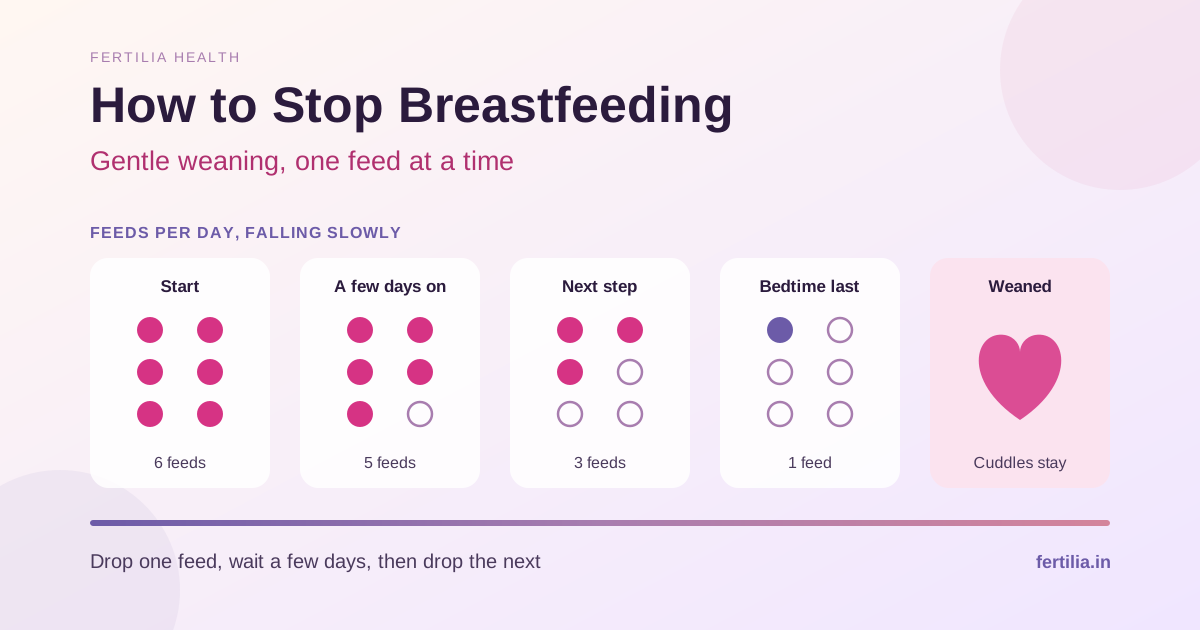
Your breasts make milk in response to how often milk is removed. When a feed is skipped regularly, your body gradually makes less milk. Gradual weaning works with this system: you reduce demand slowly, and your supply follows without a painful build-up.
Both the NHS and the Australian Breastfeeding Association recommend this approach, noting that stopping gradually helps prevent overfull, hard breasts and mastitis (Australian Breastfeeding Association, Weaning, checked October 2026).
Step 1: Pick the first feed to drop
Choose the feed your baby seems least interested in, or the one that is hardest for you to fit in. It does not matter which one you start with. Some mothers prefer to keep the night and bedtime feeds until last, so their baby still has that comfort while the daytime feeds go.
Step 2: Replace it
At that time of day, offer the replacement instead (see the age table below), along with a cuddle, a walk, or a change of scene. If your baby is older, an activity often works better than a substitute drink.
Step 3: Wait a few days
Give your breasts and your baby a few days to settle into the new pattern. If your breasts feel very full, you are moving faster than your body can adjust: stay at this step a little longer.
Step 4: Drop the next feed
Once you are both comfortable, choose the next feed and repeat. Waiting a few days, or longer if you still feel full, between each drop is a comfortable pace for most mothers.
Step 5: The last feeds
The bedtime feed is usually the last to go. Shorten it first, then replace it with a new routine: a story, a song, a back rub, or a parent other than you settling the baby for a few nights.
How long does all this take? According to the NHS, stopping completely can take anything from a few weeks to several months. There is no prize for speed.
💜 Planning to wean and not sure where to start? WhatsApp Dr. Suganya’s team to book a ₹399 video consultation. Tell us your baby’s age and your current feeding pattern, and we will make a weaning plan around your day.
What to Give Instead of a Breastfeed, by Age
This is the part mothers most often ask about. The answer depends on how old your baby is.
| Baby’s age | What replaces a dropped breastfeed | Notes |
|---|---|---|
| Under 6 months | Infant formula, by bottle | Breast milk or formula is still your baby’s whole diet. Your paediatrician can guide quantities. |
| 6 to 12 months | Infant formula, by bottle or an open cup | Solids are building up, but milk is still the main drink. Cow’s milk is not suitable as the main drink before 1 year, though it can go into food. |
| Over 1 year | Usually no replacement feed needed | If your toddler eats a variety of family foods and drinks, offer water or milk in a cup with meals and snacks. |
These age points follow the NHS guidance on stopping breastfeeding. If your baby was born early, has a medical condition, or is not growing well, check with your paediatrician before you begin. Solid food should be added alongside milk, not used to replace it, in the first year.
A note on mixed feeding. You do not have to choose between all or nothing. Many mothers combine some breastfeeds with some formula feeds for months. The NHS suggests waiting until your supply is well established (around 6 to 8 weeks) before you begin, and then replacing one regular feed at a time.
Keeping Your Breasts Comfortable While Your Milk Reduces
Even with a slow wean, you will probably feel fuller than usual for a day or two after each feed you drop. That fullness is your signal to slow down, not to push through.
What helps:
- Express just enough to feel comfortable. Hand express or pump a little when your breasts feel tight. Do not empty them. Removing a small amount relieves pressure without telling your body to make more.
- Cool compresses after expressing. A cold pack wrapped in a thin cloth, for 15 to 20 minutes, eases swelling.
- A supportive, well-fitting bra. Supportive, not tight. Binding the breasts with a cloth or a tight band adds to the pressure.
- Cold cabbage leaves. A Cochrane review of treatments for breast engorgement found cold cabbage leaves may ease breast pain and hardness compared with routine care, though the evidence is of low to very low certainty (Zakarija-Grkovic I et al., Cochrane Database Syst Rev, 2020, PMID 32944940). Those trials were in breastfeeding mothers with engorgement, not in mothers who were weaning, so treat cabbage as an extra comfort measure.
- Mild painkillers if you need them. Ask your doctor or pharmacist which one suits you.
- Drink when you are thirsty. Cutting down on water does not reduce milk supply. The Australian Breastfeeding Association notes this too (Stopping your milk supply, checked October 2026).
Check your breasts every day. A firm, tender lump that does not soften after you express, a red or darker patch, or a fever with aches and chills means one area of the breast is inflamed. Express just enough to feel comfortable, use cool compresses, and hold off on dropping the next feed until it settles. If you feel unwell or the redness spreads, see a doctor the same day. Our mastitis guide explains the signs and what to do in the first 12 to 24 hours.
For a fuller look at managing heavy, full breasts, see our breast engorgement guide.
About jasmine flowers (malligai poo)
In many Tamil homes, grandmothers suggest tying malligai poo (மல்லிகைப்பூ, jasmine flowers, often just called mallipoo) over the breasts to dry the milk. There is one study on this. In a 1988 trial, jasmine flowers applied to the breasts to suppress milk in the days after birth lowered prolactin less than the medicine bromocriptine, but engorgement, milk production and the need for painkillers were similar in both groups (Shrivastav P et al., Aust N Z J Obstet Gynaecol, 1988, PMID 3214386).
That trial was in the first days after birth, not in mothers weaning an older baby. If your family suggests jasmine, treat it as a traditional comfort measure alongside, never instead of, dropping feeds gradually.
When Your Baby Does Not Want to Stop
Babies and toddlers breastfeed for comfort as well as food, so expect some protest. A few approaches mothers find useful:
- Get ahead of the request. If your toddler always asks for a feed first thing in the morning, be up, dressed and ready with breakfast before they wake.
- Change the routine. Feeds are often tied to a place: a chair, your bed, a time of day. Changing the setting, going out, or having another family member handle that time can break the link.
- Don’t offer, don’t refuse. Stop offering the breast, but do not refuse when your child asks. This is a slow method, but it often suits toddlers who find a firm “no” upsetting.
- Shorten before you stop. Make feeds shorter, with a gentle end (“a little milk, then we go to see the birds”), before you drop them.
- Separate feeding from sleep. Move the bedtime feed earlier, so it is no longer the last thing before sleep, and build a new wind-down routine. At night, a cuddle or a sip of water from another parent can settle a waking toddler.
- Choose a calm stretch. If your child is unwell, teething badly, or adjusting to something big, such as a new sibling or a move, it is fine to pause the weaning and pick it up again later.
Please avoid putting anything bitter, such as neem paste or bitter gourd juice, on your nipples to put a child off. It confuses and frightens a child who is looking for comfort, and anything on your skin ends up in your child’s mouth.
Your baby may be clingier for a while after weaning. Plenty of cuddles and time together help, and your closeness carries on in other ways.
If You Need to Stop Quickly
Sometimes a gradual wean is not possible: a sudden illness, a medicine that cannot be combined with breastfeeding, a long separation, or the loss of a baby. The same principle applies, done faster.
- Replace feeds faster. You might replace one or two feeds a day straight away, or every second feed. If you are stopping because of a medicine that cannot be combined with breastfeeding, ask your doctor whether all breastfeeds need to stop at once. If they do, give your baby a replacement (see the age table above) at every feed, express only for your own comfort, and do not give your baby that expressed milk unless your doctor says it is safe.
- Express only for comfort. When your breasts feel too full, express just enough to soften them, then gradually express less often. Over days to weeks, you may need to express only every few days, then not at all.
- Watch closely for lumps and redness, since sudden weaning raises the chance of blocked areas and mastitis.
Can tablets dry up the milk? Medicines that lower prolactin, the milk-making hormone, can suppress lactation in the first days after birth. In one small trial after caesarean delivery, a single dose of cabergoline suppressed milk about as well as two weeks of bromocriptine (Giorda G et al., Gynecol Obstet Invest, 1991, PMID 2037265). But a Cochrane review of 62 trials found only weak evidence for lactation-suppressing medicines, most of which are no longer available, and no trials comparing non-drug methods with no treatment (Oladapo OT and Fawole B, Cochrane Database Syst Rev, 2012, PMID 22972088). These studies were in women who had just given birth. Whether one of these medicines suits you, early or later in breastfeeding, depends on your own health and risks and on the prescribing guidance. These are prescription medicines with side effects, so they are a decision for your doctor, never something to take on a friend’s or a chemist’s suggestion.
The Feelings That Come With the Last Feed
Weaning changes your hormones as well as your routine. Prolactin and oxytocin, the hormones of milk-making and let-down, fall as breastfeeding ends. Many mothers notice tearfulness, irritability, or simply not feeling like themselves for a while, especially after a quick wean. The Australian Breastfeeding Association describes these changes and notes that they usually settle within a few weeks.
Even a planned, wanted wean can bring a sense of loss. You might feel relief and sadness on the same day. Both are normal.
For a smaller number of women, mood changes are stronger. A 2025 literature review found nine patients in six published case reports who developed psychiatric symptoms after stopping breastfeeding, mostly insomnia and anxiety, and the authors called for more research (Meidl KA et al., J Acad Consult Liaison Psychiatry, 2025, PMID 39427882). Case reports cannot tell us how often this happens, but they are a reason not to brush off low mood, anxiety, or sleeplessness that lasts more than a couple of weeks after weaning. Severe anxiety, or barely being able to sleep at all, deserves a prompt check with a doctor rather than waiting. If you have thoughts of harming yourself or your baby, or you see or hear things others do not, get emergency help straight away, however long it has been. Our guide to postpartum depression signs and support can help you judge when to reach out.
Your body after weaning. If your periods stayed away while you breastfed, they usually return after feeds reduce. Ovulation comes before the first period, so you can conceive before you see a bleed. If you are not planning another pregnancy soon, sort out contraception before you wean, not after. Our guide to the first period after delivery covers what to expect, including when a missing period after weaning deserves a check.
What It Is Called in Tamil and Hindi
| Language | Words families use |
|---|---|
| Tamil | Breast milk is thaai paal (தாய்ப்பால்). Weaning is often described as paal marakka vaippathu (பால் மறக்க வைப்பது), helping the child “forget” the milk. Jasmine flowers are malligai poo (மல்லிகைப்பூ). |
| Hindi | Breastfeeding is stanpan (स्तनपान). Weaning is doodh chhudana (दूध छुड़ाना), as in “bachche ka doodh kaise chhudaye?” |
Practical Takeaways
- Decide on your own timeline. WHO’s “two years or beyond” is general guidance; when you stop is your decision.
- Drop one feed at a time, starting with the easiest, and wait a few days before the next.
- Under one year, replace each feed with formula; over one year, a toddler eating family food usually needs no replacement.
- Express only for comfort, and check your breasts daily for a lump, redness or fever.
- Keep bedtime for last and build a new wind-down routine before you drop it.
- Plan contraception before you wean, because ovulation can return before your first period.
- Take your feelings seriously. Sadness after the last feed is common; low mood that lasts is worth a doctor’s time.
For a broader guide to the months after birth, download our free postpartum care guide.
Frequently Asked Questions
How long does it take to stop breastfeeding?
With gradual weaning, anything from a few weeks to several months. Dropping one feed every few days, and slowing down whenever your breasts feel too full, is a comfortable pace for most mothers. Toddlers who feed mainly for comfort can take longer.
How long does breast milk take to dry up after the last feed?
It varies. It depends on your baby’s age, how much milk you were making, and how much milk is still being removed. Some mothers find it takes days, others a few weeks, and it is common to leak a little or express a few drops for longer. That is normal and not a reason to worry.
Bachche ka doodh kaise chhudaye, how do I stop breastfeeding at night?
Leave the night and bedtime feeds for last. First, move the bedtime feed earlier so your baby is not falling asleep at the breast. Then shorten it, and replace it with a story, a song, or a back rub. For a few nights, it often helps if your husband or another family member settles the baby when they wake.
Can I stop breastfeeding suddenly?
You can, but it is harder on your breasts and often on your baby. If you must stop quickly, replace feeds faster, express just enough to stay comfortable, and check your breasts every day for lumps or redness. See a doctor the same day if you develop a fever or a red, painful area.
Do I need tablets to dry up my milk?
Usually not. Gradual weaning lets your supply fall on its own. Medicines that lower prolactin are prescription drugs with side effects and are less effective once breastfeeding is established. If you feel you need one, discuss it with your doctor.
Is it normal to feel sad after I stop breastfeeding?
Yes. Hormones shift as feeds end, and the last feed can bring a real sense of loss even when you chose to stop. These feelings usually settle within a few weeks. If low mood, anxiety or poor sleep lasts longer or feels heavy, please speak to a doctor.
Can I start breastfeeding again if I change my mind?
Sometimes, yes. According to the NHS, regular expressing, putting your baby to the breast, and skin-to-skin contact can encourage milk to return. It can take time and may not bring back a full supply; how well it works partly depends on how well established your supply was before you stopped. Ask for lactation support early if you want to try.
Ending Breastfeeding on Your Terms
The way you finish breastfeeding can be as gentle as the way you started. One feed at a time, with comfort for your breasts and plenty of cuddles for your little one, the last feed can come quietly, at a pace that suits you both. At Fertilia, Dr. Manjari works with mothers over video call to build weaning plans that fit work, family routines and a baby’s temperament, and the same support continues in our Postpartum program.
💜 Want a weaning plan made for you and your baby? Message Dr. Suganya’s team on WhatsApp to book a ₹399 video consultation, available online across India.
Written by Dr. Manjari, MBBS, Lactation Professional at Fertilia Health. This guide is general information and does not replace an individual assessment of you and your baby.