“I’m still feeding the baby, so I can’t get pregnant, right?” Almost every new mother has heard some version of this from an elder, a friend, or her own instinct. It is partly true. Breastfeeding does hold back fertility after birth, and used in a specific, structured way it is a recognised contraceptive method with its own name: the lactational amenorrhea method, or LAM.
The word “partly” is where the trouble lies. LAM works well only while three conditions hold at the same time, and those conditions slip away quietly in real family life: a top-up bottle in the evening, a baby who starts sleeping through, a return to work. This post explains what those three conditions are, how reliable LAM is when they hold (with the numbers from the actual studies), how long it tends to last for most women, and what to do the day it stops applying.
When a breastfeeding mother asks Dr. Suganya Venkat about this in a Fertilia video consultation, she does not start with a percentage. She starts with three questions. You can ask yourself the same three questions as you read.
Here is what this post covers:
- The three conditions, and what each one means in day-to-day terms
- How reliable LAM is, study by study
- Why the protection ends at six months
- How long LAM lasts in practice, and the gap between “breastfeeding” and “using LAM”
- Pumping, working mothers, and night feeds
- What to switch to, and when
- Frequently asked questions
The Three Conditions: All Three, at the Same Time
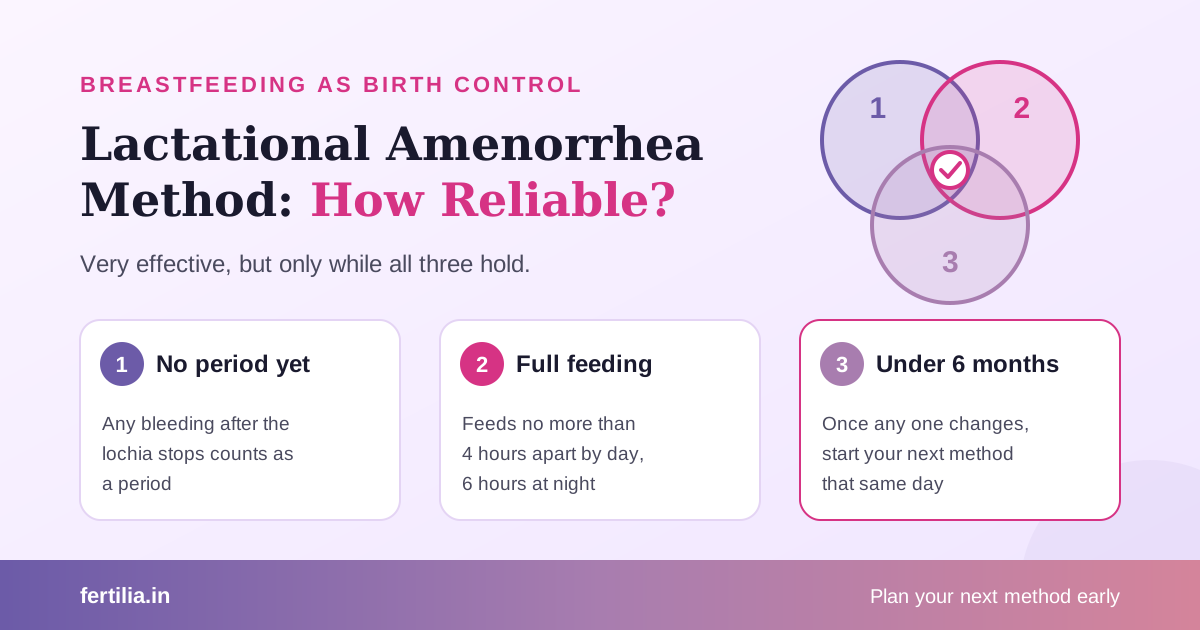
LAM is not “breastfeeding, therefore protected”. It is a method with a definition, first set out by an international group of researchers at Bellagio, Italy, in 1988 (Kennedy KI et al., Contraception, 1989, PMID 2656086). LAM is still taught with the same three conditions today, and all of them must be met:
- Your periods have not returned.
- You are fully or nearly fully breastfeeding. In practice, this is usually taken to mean gaps between feeds of no more than 4 hours in the day and 6 hours at night.
- Your baby is less than 6 months old.
If you can answer yes to all three, LAM is working for you. If any one becomes a no, LAM has ended, even if the other two are still true.
What “fully or nearly fully” means
The WHO Family Planning Handbook (fphandbook.org, chapter 20, read October 2026) gives the working definitions:
- Fully breastfeeding covers exclusive breastfeeding and almost-exclusive breastfeeding, where the baby gets vitamins, water or other nutrients only once in a while.
- Nearly fully breastfeeding means the baby gets some other food or liquid, but more than three-fourths of all feeds are breast milk.
So an occasional vitamin drop does not end LAM. A regular formula bottle every evening, or daily cow’s milk or other feeds given by a well-meaning relative, can. For the baby’s own health, exclusive breastfeeding for six months remains the recommendation; the definition just tells you where the contraceptive effect starts to weaken. Our guide to exclusive breastfeeding and how to keep it going covers the practical side of that.
Why breastfeeding prevents pregnancy at all
The WHO handbook explains that LAM works mainly by stopping the ovaries from releasing an egg: frequent breastfeeding temporarily holds back the hormones that trigger ovulation. This is why frequency matters more than quantity. Long gaps between feeds, especially at night, are when the effect fades.
How Reliable Is LAM? What the Studies Found
When all three conditions hold, LAM is effective. The Bellagio group’s conclusion, drawn from thirteen prospective studies, was that it gives more than 98% protection from pregnancy in the first six months (Kennedy KI et al., Contraception, 1989, PMID 2656086). Studies that then tested LAM as a method, with women choosing it and being followed month by month, found results in the same range:
| Study | Setting | Result with correct LAM use, first 6 months |
|---|---|---|
| Perez A et al., Lancet, 1992 (PMID 1348806) | Santiago, Chile, 422 women | 0.45% |
| Kazi A et al., Fertil Steril, 1995 (PMID 7672141) | Karachi and Multan, Pakistan | 0.6% |
| Ramos R et al., BMJ, 1996 (PMID 8876092) | Manila, Philippines, 485 women | 99% effective |
| Labbok MH et al., Contraception, 1997 (PMID 9262927) | 11 sites across several countries | 98% or higher efficacy confirmed |
| Peterson AE et al., Contraception, 2000 (PMID 11172792) | 9 sites, only two contacts with a provider | No pregnancies |
A Cochrane review, which summarised the studies narratively because they were too varied to combine, is a little more cautious. Two controlled studies of LAM users reported six-month pregnancy rates of 0.45% and 2.45%, and eight uncontrolled studies reported anywhere from 0% to 7.5% (Van der Wijden C and Manion C, Cochrane Database Syst Rev, 2015, PMID 26457821). The spread reflects how differently women followed the method across studies.
The WHO handbook sums it up in two numbers. Used correctly, there is less than 1 pregnancy per 100 women in the first six months. As LAM is commonly used, there are about 2 per 100. The difference between those two figures is almost entirely about whether all three conditions were being met.
The Pakistan study is close to home
The Pakistan study is worth a closer look for Indian readers, because the families resemble many of ours: most women delivered at home with a midwife, and all had breastfed a previous child. With monthly home visits from a Lady Health Visitor, LAM held up well: while women were fully or nearly fully breastfeeding, had no periods and were not using another method, the pregnancy rate was 0.6% (Kazi A et al., Fertil Steril, 1995, PMID 7672141).
Why the Protection Ends at Six Months
This is the part that surprises people most. Ovulation does not wait for your first period. It comes before it. That means a woman can release an egg, and become pregnant, without ever having seen a period after delivery.
A pooled analysis of nine studies measured this directly. Among breastfeeding women who still had no periods, the chance of having ovulated was about 31 per 100 by six months and about 67 per 100 by twelve months (Kennedy KI and Visness CM, Lancet, 1992, PMID 1346183). Pregnancy rates during amenorrhoea alone, regardless of how much the baby was breastfed, were 2.9 per 100 at six months and 5.9 per 100 at twelve months, compared with 0.7 per 100 at six months for women meeting all three LAM conditions.
Two things follow from that:
- “No period yet” is not a guarantee by itself. The longer it has been since delivery, the less a missing period tells you.
- The six-month limit is there for a reason. Around six months, babies start solid food, feeds space out, and the chance of ovulation keeps climbing. LAM was designed and tested for the first six months only.
If you would like to understand what happens when cycles do come back, our post on when your first period after delivery returns explains the timeline and what a first period usually feels like.
💜 Breastfeeding and not sure if LAM still covers you? Message Dr. Suganya on WhatsApp to book a ₹399 video consultation. Tell us your baby’s age, how often you feed day and night, and whether any bleeding has returned, and we will work out together whether you need another method now.
How Long LAM Lasts in Practice
On paper, LAM gives you six months. In practice, many women move outside the conditions earlier, and that is normal; it is not a failure of breastfeeding.
- In the Cochrane review, the proportion of women whose periods had returned by six months ranged from about 11% to 39% across studies (Van der Wijden C and Manion C, Cochrane Database Syst Rev, 2015, PMID 26457821).
How often LAM is used correctly
The method is often assumed rather than used. An analysis of 73 national health surveys in 45 countries found that only 26% of women who said they were using LAM met the criteria for correct use (Fabic MS and Choi Y, Stud Fam Plann, 2013, PMID 23720003). The other three-quarters were missing at least one of the three conditions, such as a baby past six months, regular other feeds, or periods already back. They were counting on a method that had already ended for them.
The fix is simple: check the three conditions regularly, not once. A useful habit is to ask yourself the three questions at every vaccination visit for your baby, since those come round every few weeks in the first months anyway.
Pumping, Working Mothers, and Night Feeds
If you are returning to work
The WHO handbook says women who are separated from their babies can still use LAM if feeds are less than 4 hours apart, and can express milk at least every 4 hours, but that pregnancy rates may be slightly higher. That caution comes from the one study that looked at this. Among 170 urban, middle-class women who planned to return to work before 120 days after delivery, and who were supported to express milk and keep their babies on breast milk only, the six-month pregnancy rate was 5.2% (Valdés V et al., Contraception, 2000, PMID 11172791). The study authors advised that separation from the baby might raise the risk.
So if you are going back to work before six months, it is reasonable to start another method at that point rather than relying on pumping alone. Our guide to pumping and storing breast milk has practical tips for keeping your supply going at work.
When your baby sleeps through the night
Parents celebrate the first long night’s sleep, and rightly so. For LAM, though, a gap of more than 6 hours at night means condition two is no longer being met. If your baby has started sleeping a long stretch regularly, treat that as the signal to add another method.
Any bleeding that looks like a period
After the lochia (the bleeding and discharge after birth) has stopped, treat any return of bleeding as your period for LAM purposes, even if it is light. It is simpler and safer to start another method than to wait and see whether it was “a real period”.
What to Use Next, and When to Start
The point at which LAM ends is the point to start something else. Ideally, decide before then, so you are not choosing in a hurry. Many women use LAM as a bridge: it covers the first weeks while they recover, and they move to a longer-term method by the six-week checkup or soon after. In one multicentre study, two-thirds of LAM users had moved on to another method by seven months after birth (Peterson AE et al., Contraception, 2000, PMID 11172792).
The WHO handbook advises that a breastfeeding woman can choose another method at any time, but preferably not one containing oestrogen while her baby is under six months old. Options that are generally suitable while breastfeeding include:
- The progestin-only pill (mini pill)
- Chhaya (centchroman), India’s non-hormonal pill, taken twice a week for the first three months and then once a week, available free through government facilities
- The Antara injection or the implant
- The Copper-T or hormonal IUD, which can also be fitted at delivery
Our guide to birth control after delivery compares these side by side, including timing, breastfeeding and return of fertility. If an IUD appeals to you, the postpartum IUD guide explains the two windows for fitting one.
If LAM ended and you had unprotected sex
There is still time to act. Emergency contraception is an option while breastfeeding. Our i-Pill and Unwanted 72 guide explains that a single levonorgestrel dose usually does not mean you need to stop breastfeeding, and how soon it should be taken. Because a breastfeeding mother may have no period to wait for, and early pregnancy can have no signs, the simple next step is a home pregnancy test 21 days after the last unprotected sex, whether or not you have any bleeding or symptoms.
One more thing LAM does not do
LAM gives no protection against sexually transmitted infections. Condoms are the method for that, and can be used alongside LAM.
Practical Takeaways
- LAM is a real, well-studied method, and very effective while all three conditions hold: no period, full or nearly full breastfeeding, and a baby under six months.
- Correct use gives less than 1 pregnancy per 100 women in six months; typical use about 2 per 100.
- Ovulation comes before your first period, so “no period yet” alone is not protection, especially as the months pass.
- Top-up bottles, a long night’s sleep, a return to work, or any bleeding after the lochia has stopped all end LAM.
- Re-check the three conditions every few weeks, not once.
- Have your next method chosen before LAM ends; non-oestrogen methods are generally preferred while your baby is under six months.
What It Is Called in Tamil and Hindi
In Tamil, breast milk is thaippaal (தாய்ப்பால்), and in Hindi, breastfeeding is stanpan (स्तनपान). Contraception is karuthadai (கருத்தடை) in Tamil and garbhnirodhak (गर्भनिरोधक) in Hindi. Many women search the question in Hinglish, for example “breastfeeding se pregnancy ruk sakti hai kya” or “doodh pilate waqt pregnancy ho sakti hai”. The answer is the same in any language: yes, it can prevent pregnancy, but only while all three LAM conditions hold.
Frequently Asked Questions
What is the lactational amenorrhea method?
LAM is the planned use of breastfeeding as contraception in the first six months after birth. It works only while three conditions are all true: your periods have not returned, you are fully or nearly fully breastfeeding (no gap over 4 hours by day or 6 hours at night), and your baby is under six months old.
How effective is LAM?
Used correctly, fewer than 1 in 100 women become pregnant in the first six months, according to the WHO Family Planning Handbook. As it is commonly used, about 2 in 100 do. Controlled studies have reported six-month pregnancy rates of 0.45% and 2.45%.
Can I get pregnant while breastfeeding?
Yes. Breastfeeding protects you well only while all three LAM conditions are met. Ovulation can happen before your first period after delivery, so once any condition changes, you can become pregnant without having seen a period.
Breastfeeding se pregnancy ruk sakti hai kya? (Can breastfeeding prevent pregnancy?)
It can, for the first six months, if you have had no period and your baby gets breast milk almost exclusively, day and night. If you give formula top-ups regularly, have long gaps between feeds, or your baby is over six months, start another method.
Does pumping breast milk count for LAM?
It can, if you express at least every 4 hours, but the protection may be lower. In the one study of working mothers who expressed milk, the six-month pregnancy rate was 5.2%. If you are separated from your baby for long hours, adding another method is the safer choice.
Does spotting mean LAM has stopped working?
Once the bleeding after delivery (lochia) has fully stopped, treat any return of bleeding, even light spotting, as a period for LAM purposes and start another method. This is a cautious rule, and it avoids guesswork.
Which contraceptive can I use while breastfeeding?
The mini pill, Chhaya, the Antara injection, the implant, the Copper-T and the hormonal IUD are generally suitable while breastfeeding. Pills containing oestrogen are usually avoided while your baby is under six months. Your doctor can help you choose based on whether you want something daily or long-acting.
A Method That Works When You Know Its Rules
LAM is not a myth and not a gamble. It is a good, free, natural bridge in the first months after birth, for women who know its three rules and check them as life changes. When one rule stops applying, that is simply the day to move to your next method.
💜 Want help choosing the method that comes after LAM? Message Dr. Suganya on WhatsApp to book a ₹399 video consultation, available online across India. You can also download our free normal delivery and postpartum care guide for the first weeks after birth.