The two-week wait ends the way it began: with a blood test. And then the number comes back, and it isn’t the one you were hoping for.
I am Dr. Suganya Venkat, an OB-GYN with fifteen years of experience, and I sit across from women in this exact moment more often than any brochure about fertility treatment prepares you for. The first IUI cycle fails for most couples who try it. That single sentence is clinically true and does very little to soften how it feels the day you read the report.
What I want to do in this post is what I would do in my clinic the same week: walk through what a negative IUI result actually tells us (and what it does not), what I review before deciding on the next cycle, and how to think about the question everyone eventually asks, when does it stop making sense to repeat IUI and start considering IVF instead.
Here is what this post covers:
- Why one failed cycle is not diagnostic on its own
- What gets reviewed before your next step is decided
- What changes between IUI cycles, and what doesn’t
- The evidence-based point at which IVF becomes the better option
- How to hold the emotional weight of this without losing the plan
One Failed Cycle Is Not a Verdict
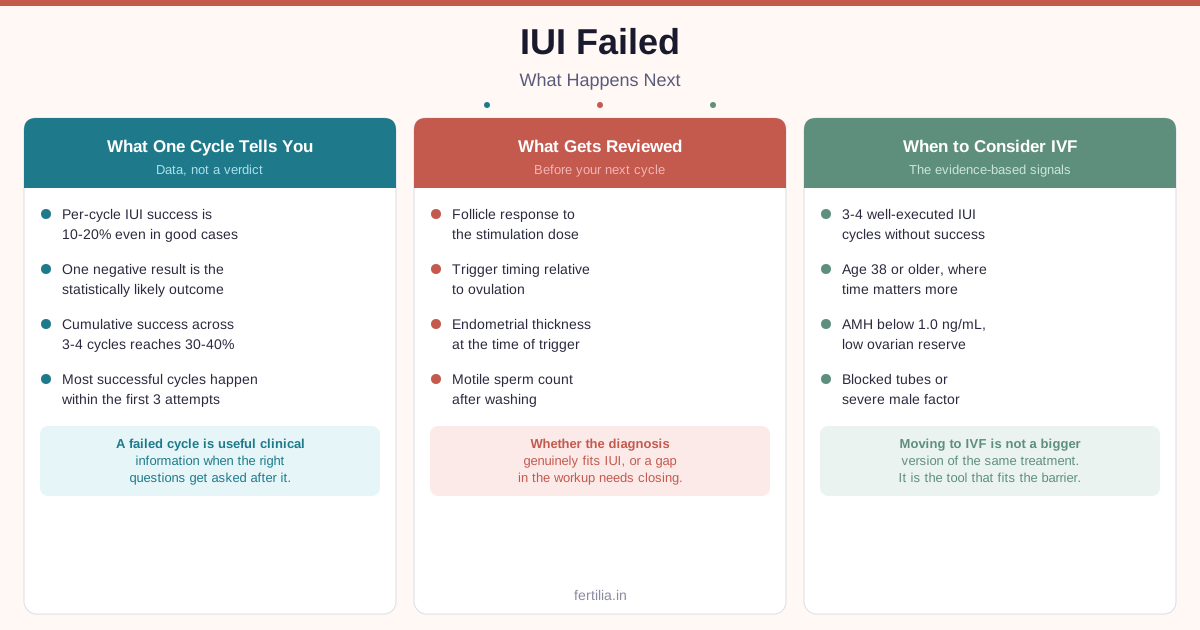
Here is the number that matters most right now: per-cycle IUI success sits at roughly 10 to 20%, depending on age, diagnosis and sperm parameters (Veltman-Verhulst et al., 2012). That means, for a good-prognosis couple, a single cycle is expected to not work somewhere between 80 and 90% of the time. A negative result after one cycle is not a sign that something is wrong. It is the most statistically likely outcome of any single attempt, including well-managed ones.
I say this not to minimise how much it hurts. It is a real loss, even in the earliest stage of treatment, and it deserves to be acknowledged as one. But clinically, one negative cycle is a data point, not a diagnosis. It tells us the treatment did not work this time. It does not, by itself, tell us why, and it does not mean the plan is wrong.
Cumulative success across 3 to 4 cycles reaches roughly 30 to 40% for couples with a favourable prognosis (unexplained infertility, one open tube, adequate sperm parameters). For more detail on how those numbers build cycle over cycle and what moves them, see our guide to IUI success rates in India.
What I Review Before Your Next Cycle
A failed cycle is genuinely useful clinical information, if the right questions get asked afterward. Before deciding whether to repeat IUI, adjust the protocol, or discuss IVF, this is what I go through with a patient.
1. Follicle Response to Stimulation
How many follicles developed, and how did they grow through monitoring? A single dominant follicle that grew well and triggered at the right size tells a different story than a sluggish or excessive response. If the ovaries responded poorly to a standard dose, the next cycle may need a different medication or a higher dose. If there was an over-response with several follicles, the cycle may need to be managed more conservatively to reduce the risk of high-order multiples, which sometimes means cancelling stimulation rather than proceeding.
2. Trigger Timing
The insemination has to happen in a narrow window, usually 34 to 40 hours after the trigger injection. If the timing was off by even half a day, relative to when ovulation actually occurred, that alone can explain a negative result without anything being wrong with the underlying treatment plan. This is one of the most common, most fixable reasons a first cycle does not work.
3. Endometrial Thickness
The lining needs to reach a workable thickness, generally at least 7mm, by the time of the trigger for the embryo (once fertilisation has happened) to have a reasonable chance of implanting. A thin lining on the day of trigger is a specific, addressable finding, not a reason to abandon IUI altogether. There are protocol adjustments for it.
4. Sperm Preparation Numbers
What matters here is not the raw semen analysis, it is the total motile sperm count (TMSC) after washing on the day of the procedure. A cycle with a TMSC below 5 million faces a meaningfully lower chance of success than one above 10 million. If the post-wash count was on the low end, that is worth knowing and addressing, sometimes through a longer preparation window before the next attempt, sometimes through a different lab protocol.
5. Whether IUI Fits the Diagnosis
This is the review step that gets skipped most often. IUI works well for unexplained infertility, mild male factor, and ovulation disorders including PCOS. It does not work if a tube is blocked, and it performs poorly with moderate to severe endometriosis. If the original diagnosis was incomplete, if tubal patency was assumed rather than confirmed by an HSG, for instance, a failed cycle is the moment to close that gap before trying again.
Just had a negative result and not sure what to ask your doctor next? Dr. Suganya can review your cycle details, your monitoring data, and your diagnosis together, and help you understand what actually happened this cycle.
What Changes Between Cycles, and What Doesn’t
Not every failed cycle calls for a different plan. Sometimes the right decision is to repeat the same protocol, because the monitoring showed nothing that needed correcting and the cycle simply did not result in pregnancy this time, which, per the numbers above, is the expected outcome most of the time.
A repeat of the same protocol usually makes sense when:
- Follicle development, trigger timing, and endometrial thickness were all within normal ranges
- Sperm parameters after washing were adequate
- This was your first or second attempt
- No new information suggests a different underlying issue
A protocol adjustment is usually indicated when:
- Ovarian response was weaker or stronger than expected on the current dose
- Trigger timing needs to shift based on how this cycle’s follicles actually grew
- A switch from oral medication (Clomiphene) to injectable gonadotropins may improve follicle development for the next attempt
- Endometrial thickness was borderline and needs a specific intervention
A move to injectable gonadotropins specifically is one of the more common escalations after one or two unsuccessful cycles on oral medication, particularly if follicle response was limited. This is not the same as moving to IVF. It is a stronger version of the same IUI approach, and it carries its own success-rate improvement in the right candidates.
When the Evidence Points to IVF Instead
This is the question I hear most in this conversation: how many failed IUI cycles before it makes sense to stop and move to IVF?
The evidence-informed convention that most fertility specialists work from is 3 to 4 well-executed IUI cycles before recommending a switch to IVF (ASRM, 2020; Custers et al., 2012). “Well-executed” matters here: 3 to 4 cycles where the follicle response, timing, and sperm preparation were all appropriate for that cycle. Cycles that were cancelled, poorly timed, or complicated by a factor that has since been corrected don’t fully count toward that number in the same way.
There are also situations where I would recommend moving to IVF earlier than the standard 3 to 4 cycles, rather than repeating IUI for its own sake:
- Age 38 or older, where each additional month of IUI represents a real cost in time that IVF’s higher per-cycle success rate can recover
- AMH below 1.0 ng/mL, indicating a lower ovarian reserve where IVF’s ability to retrieve multiple eggs in one cycle offers a meaningfully better strategy than sequential single-follicle attempts
- A newly confirmed tubal blockage, endometriosis stage 3 to 4, or a semen analysis showing severe male factor, any of which IUI cannot meaningfully overcome regardless of how many cycles are attempted
- Two or more cycles with poor or absent ovarian response despite dose adjustment, suggesting the underlying issue may not respond to further stimulation attempts
None of this means IUI failed you, or that IVF is a bigger, better version of the same treatment. It means the clinical picture has told us something specific: which tool fits the barrier in front of you. For the fuller comparison of who needs which treatment and why, our guide on IUI vs IVF walks through the decision framework in detail, and Dr. Suganya’s honest decision framework for whether IVF is the right next step goes further into how to have that conversation with your own doctor.
There is also a cost dimension worth thinking through alongside the clinical one. Multiple additional IUI cycles at a low per-cycle rate can, in total, cost close to what a single IVF cycle costs, without the higher per-attempt success rate that IVF offers. Our IUI cost breakdown lays out real per-cycle numbers so you can weigh this alongside your own odds, not in the abstract.
What This Doesn’t Mean
It doesn’t mean your body failed. IUI has a built-in per-cycle probability that is well below 50% even in the best circumstances. A negative result at those odds is not evidence that something is broken.
It doesn’t mean you did something wrong. Nothing about diet, stress, or how carefully you followed instructions changes the statistical baseline of a single IUI attempt in any dramatic way. This is a numbers reality of the treatment itself.
It doesn’t mean the next cycle will fail too. Cumulative success rates rise specifically because most couples who conceive with IUI do so within the first three to four cycles, not the first one.
It doesn’t mean you have to decide anything today. The review of your cycle, and the decision about what comes next, usually happens over one or two follow-up conversations with your doctor, not in the moment you see the result.
Coping With Another Two-Week Wait
If you are heading into another cycle, the emotional weight of repeating the two-week wait is real and worth naming directly, not pushing past. Many women describe a second or third wait as harder than the first, because hope has to be rebuilt each time against the memory of the last result.
A few things that genuinely help, from what I hear from women going through repeat cycles at Fertilia:
- Have a plan before you start, not just a hope. Ask your doctor: if this cycle doesn’t work, what is the plan for the next one? Knowing the answer in advance takes some of the free-floating anxiety out of the wait itself.
- Let the wait be boring on purpose. Symptom-checking multiple times a day tends to increase distress without adding any real information; most early symptoms in the two-week wait come from progesterone, not from whether implantation happened. Our guide on the two-week wait goes through this in detail.
- Keep your support circle informed on your terms. You do not owe updates to anyone, including well-meaning family, on their schedule.
- If a cycle result brings grief, treat it as grief. For some women, especially after a second or third attempt, the loss carries real grief-adjacent weight. Our guide on coping after a loss may be useful even outside the context of a confirmed pregnancy loss, because the emotional territory overlaps.
- Take a cycle off if you need one. A month spent recovering emotionally and physically, rather than rushing into the next attempt, is a valid and sometimes clinically sensible choice.
Preparing for your next step after a failed cycle? Whether that’s another IUI attempt or a conversation about IVF, Dr. Suganya can walk through your monitoring data with you and help build the plan.
Chat with Dr. Suganya on WhatsApp →
Fertilia’s 90-day IVF Support program is built for exactly this stage, reviewing what happened, adjusting the plan, and supporting you through whichever treatment comes next.
Frequently Asked Questions
My IUI failed. What should I do first?
Book a follow-up with your doctor to review the cycle specifically: follicle response, trigger timing, endometrial thickness, and post-wash sperm count. This review, not a general “try again,” is what should shape your next step. Most clinics schedule this as a short consultation within a week or two of the result.
How many failed IUI cycles is normal before it works?
Most couples who conceive with IUI do so within the first three to four cycles. A single failed cycle, or even two, is well within the expected range and is not, on its own, a reason for concern.
Should I do the same protocol again, or does it need to change?
That depends entirely on how the failed cycle went. If follicle development, timing, and sperm parameters were all appropriate, repeating the same approach is often reasonable. If any of those were off, an adjustment (dose, medication, or timing) is usually indicated for the next attempt.
When should I stop doing IUI and move to IVF?
The general clinical convention is 3 to 4 well-executed IUI cycles before discussing IVF, though this shifts earlier for women 38 and older, women with AMH below 1.0 ng/mL, or anyone with a diagnosis IUI cannot overcome (blocked tubes, severe male factor, advanced endometriosis).
Does a failed IUI mean I need more tests?
Sometimes. If your original workup was incomplete, for example if tubal patency was assumed rather than confirmed, a failed cycle is a reasonable prompt to close that gap. If your workup was already thorough, a failed first cycle usually does not require new testing before trying again.
Is it normal to feel grief after a failed IUI?
Yes. A failed cycle is a real loss, even at an early stage of treatment, and it is common to feel it that way. This does not mean something is wrong with how you are coping, and it is worth acknowledging rather than minimising.
Can lifestyle changes between cycles make a real difference?
Some factors are worth addressing between attempts: thyroid function, Vitamin D and B12 status, and sperm quality (which reflects roughly the prior 3 months). These will not override a structural barrier like a blocked tube, but for cycles limited by ovarian response or sperm parameters, they can genuinely shift the odds for the next attempt.
How soon after a failed IUI can I try again?
Most clinics can start a new cycle the following month, once your period arrives and baseline scans confirm your ovaries have returned to a resting state. There is no fixed medical requirement to wait longer than that unless your doctor identifies something specific to address first.
Dr. Suganya Venkat is an OB-GYN with 15+ years of clinical experience. She founded Fertilia to give every woman access to personalised, evidence-based fertility guidance through online consultations, pan-India.