Somewhere around the seventh or eighth month of pregnancy, a hospital counsellor or a company representative brings up cord blood banking. There is usually a brochure, a mention of stem cells, and a phrase that tends to stick: “biological insurance for your baby.” Then a form to sign, and a price that runs into tens of thousands of rupees.
Most women I see are being asked to decide this in the middle of an already overwhelming trimester, without a clear sense of what they are actually paying for or how likely it is to matter.
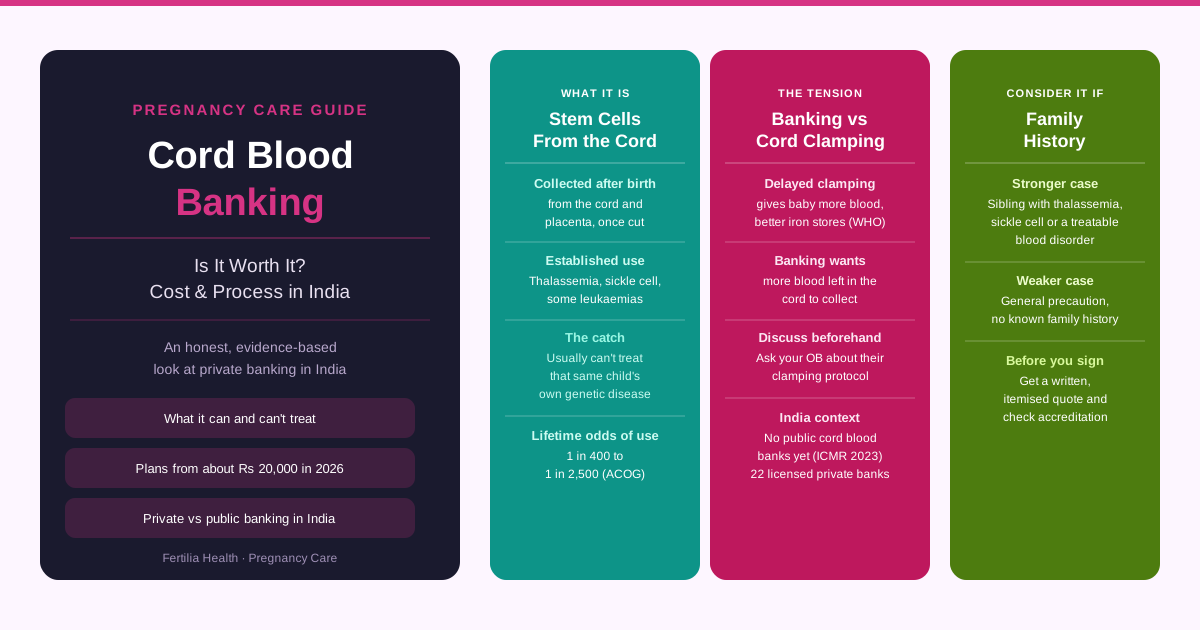
The short answer, before the detail: routine private cord blood banking is not recommended for every pregnancy. Both the American College of Obstetricians and Gynecologists (ACOG Committee Opinion No. 771, 2019, acog.org) and the Indian Council of Medical Research (National Guidelines for Stem Cell Research, 2017, icmr.gov.in) state that storing cord blood as general “insurance” is not supported by current evidence. Where it does make sense is directed banking: when an existing sibling or close family member has a condition treatable by a stem cell transplant, such as thalassemia or certain leukaemias. The rest of this post explains why the line falls there, what it costs in India, and how to think it through with your obstetrician.
What Cord Blood Banking Is
After your baby is born and the umbilical cord is clamped and cut, blood remains in the cord and placenta that would otherwise be discarded. That blood contains haematopoietic stem cells, the cells that give rise to all the different cell types in your blood: red cells, white cells, and platelets.
Collection happens in the minutes right after birth, before the placenta is delivered. A needle draws blood from the cord into a collection bag. It takes about five to ten minutes and does not involve the baby directly once the cord is clamped. One important principle, stated plainly in ACOG’s guidance: collection must always remain secondary to the care of mother and baby. It should not compromise obstetric or neonatal care, and it should not alter the routine practice of delayed cord clamping, so collection proceeds only when it is clinically appropriate on the day. The collected blood is then transported to a laboratory, tested for infectious diseases, processed, and cryopreserved (frozen and stored long-term) in liquid nitrogen.
Those stored stem cells can later be used in a haematopoietic stem cell transplant, the same category of treatment used for certain blood cancers, immune disorders, and inherited blood disorders like thalassemia. This is the same broad category of transplant that bone marrow or peripheral blood stem cells are also used for. Cord blood is simply one more possible source.
What It Can Treat, and What It Cannot
This is the part the marketing usually blurs, and it is the single most important thing to understand before you pay for anything.
Established, evidence-backed uses. Cord blood transplants are a recognised treatment for a specific list of conditions: certain leukaemias and lymphomas, some inherited metabolic disorders, some immune deficiencies, and inherited blood disorders including thalassemia and sickle cell disease. In a study of 44 children who received cord blood transplants from a related donor for thalassemia or sickle cell disease, disease-free survival was 79 percent for thalassemia and 90 percent for sickle cell disease, with no transplant-related deaths in that group (Locatelli F et al., Blood, 2003; PMID 12424197). These are real, established uses, and they explain why cord blood banking exists as a medical field at all.
The catch with your own baby’s condition. ACOG’s Committee Opinion No. 771 states this precisely: cord blood collected from a newborn cannot be used to treat a genetic disease or malignancy in that same child, because the stored blood carries the same genetic variant, or the same premalignant cells, that led to the condition. Three situations are worth separating. For an inherited (genetic) disorder, the child’s own unit carries the same mutation, so a donor is needed. For a childhood leukaemia, the concern is that premalignant cells may already have been present at birth, so donor cells are again preferred. Where a stored unit genuinely can shine is the third situation: as a matched or partially matched donor unit for a sibling or close family member with a treatable condition. That distinction is exactly why directed banking has a real use case while “banking for the baby’s own future illness” mostly does not.
What it is not currently evidence-backed for. The “insurance for future disease” framing usually implies a much broader range of uses, including regenerative medicine for conditions like autism, cerebral palsy, or diabetes. Research into these applications is ongoing, but ACOG is explicit that there is currently no evidence supporting the use of an autologous cord blood sample in regenerative medicine. If a sales conversation implies your stored unit will one day treat a broad range of future conditions, that claim runs ahead of the evidence available today.
How likely is your family to actually use it? ACOG’s exact words are worth quoting: “The estimated lifetime probability of an individual to develop an indication for autologous umbilical cord blood transplant ranges from 1 in 400 to 1 in 2,500.” Read that carefully. It is the probability of ever developing an indication, over a whole lifetime, not the probability that a stored unit is actually retrieved and used. Whether a specific banked unit would be usable when needed depends on the condition, the cell dose, and the transplant decision at the time.
None of this means cord blood banking is pointless. It means the honest use case is narrower than “insurance for anything that could go wrong,” and it matters enormously which category your family falls into before you decide.
Private Banking vs Public Banking
Private (family) banking means you pay a company to collect and store your baby’s cord blood exclusively for your family’s potential future use. It sits in a bank, reserved, accessible only to you, for as long as your storage agreement runs.
Public banking means the cord blood is donated at no cost to you, added to a searchable public registry, and made available to any matched patient who needs it, similar to donating blood. You do not pay for it, and you generally cannot reserve it for your own family later, though ACOG notes that a family member with a documented condition that could benefit from a related donor’s cord blood may register for directed donation.
Here is where India differs from countries with a mature public system. The ICMR’s Guidelines for Umbilical Cord Blood Banking (2023, icmr.gov.in) state two facts side by side: at present, India does not have public umbilical cord blood banks, and there are 22 licensed cord blood banks in the country, licensed and monitored by the Central Drugs Standard Control Organization (CDSCO, whose website carries the register). Put together: the licensed banks that exist are private. If you want to donate your baby’s cord blood publicly in India the way you might donate blood, that infrastructure does not currently exist. Chennai readers may remember the Jeevan Stem Cell Foundation, which ran a public cord blood bank for some years; per its listing with the Parent’s Guide to Cord Blood Foundation (parentsguidecordblood.org, checked September 2026) it has stopped accepting donations for want of funding. Almost every cord blood banking conversation you will have in an Indian hospital is, by default, a private banking conversation.
This is worth knowing because it changes the framing of the decision. In a country with strong public banking, choosing not to pay for private storage still means the cord blood can help someone else. In India today, choosing not to bank privately usually means the cord blood is simply not collected, since there is no public system to redirect it to.
Cord Blood Banking vs Delayed Cord Clamping
This is a genuine tension, and both sides of it are worth stating plainly.
Delayed cord clamping, waiting at least one to three minutes after birth before clamping the cord, allows more blood to transfuse from the placenta into your baby before the cord is cut. This has its own well-established benefits. In a randomised controlled trial of 400 healthy term babies, delayed clamping (at least 180 seconds) resulted in meaningfully higher iron stores at four months, with iron deficiency occurring in under 1 percent of babies in the delayed group versus nearly 6 percent in the early clamping group (Andersson O et al., BMJ, 2011; PMID 22089242). The World Health Organization’s guideline on delayed umbilical cord clamping (2014, who.int) recommends clamping not earlier than one minute for term and preterm babies who do not need immediate resuscitation.
Cord blood collection wants the opposite: the more blood stays in the placenta and cord, the higher the collection yield.
Some banks and hospitals describe a compromise, clamping after a shorter delay of thirty to sixty seconds and then collecting. Be clear-eyed about what that is: a thirty-second delay does not meet the WHO recommendation of at least one minute, and ACOG’s position is that collection should not alter the routine practice of delayed cord clamping at all, with the rare exception of a medical indication for directed donation. In other words, the major professional bodies place the newborn’s placental transfusion ahead of the collection yield, and any deviation from that ordering is something to discuss explicitly with your obstetrician, not something to discover in the delivery room.
If you are considering banking, ask your obstetrician directly what clamping protocol they will use and how it affects both the newborn benefit and the collection. This is a conversation to have before labour. If you want to understand the wider set of decisions this conversation usually sits alongside, our guides to signs labour is starting and what to expect with a C-section delivery cover the rest of the birth-plan picture.
Cost of Cord Blood Banking in India
Private cord blood banking in India is typically sold as an upfront fee covering collection, transport, infectious-disease testing and processing, plus storage, which is either billed annually or prepaid for a fixed term.
Rather than quote vague market ranges, here are the published headline prices of two large CDSCO-licensed providers, from their own price pages, accessed 3 September 2026:
- LifeCell (lifecell.in): an annual plan at Rs 20,330 upfront for testing and processing, with a storage fee renewed each year (about Rs 4,000 per year, per its listing with the Parent’s Guide to Cord Blood Foundation, parentsguidecordblood.org); a 21-year plan at Rs 49,144 one-time; and a 75-year plan at Rs 63,551 one-time. Sample-collection charges can be extra depending on the delivering hospital, and EMI options are advertised. Compare the plans like for like before choosing: the annual plan looks cheapest on day one, but over the same 21 years it comes to roughly Rs 20,330 plus twenty renewals at about Rs 4,000, close to Rs 1,00,000, or about double the one-time 21-year plan.
- Cordlife India (cordlifeindia.com): 21-year client agreements, listed at about Rs 45,750 initial cost with long-term storage included, per the same foundation’s India listing.
So as of September 2026, advertised headline prices for cord blood banking cluster between roughly Rs 20,000 and Rs 65,000 depending on the provider and how many years of storage are prepaid, not the lakh-plus figures older articles often quote. Prices change with promotions and city, banking cord tissue alongside cord blood costs more, and headline figures do not always include collection charges or taxes. Always request a written, itemised, GST-inclusive quote from the specific bank you are considering before deciding, and ask what happens if you stop paying: whether the unit is discarded, released, or offered for donation or research.
Questions worth asking any provider directly:
- Is this cord blood only, or cord blood plus cord tissue plus other add-ons?
- What is included in the upfront fee, and what is billed separately, including collection charges and GST?
- What is the exact storage term, and what happens at the end of it?
- What accreditation does the lab hold, and how long has the company been storing units (a track record matters for a service you are trusting for two decades)?
- What is their actual retrieval record: how many units have they released for a real transplant, not just how many they store?
Who Might Genuinely Consider Private Banking
Given everything above, private cord blood banking makes the most clinical sense for a specific group of families, not as a general recommendation for every pregnancy.
A stronger case exists when:
- There is a known family history of a condition treatable by stem cell transplant, such as thalassemia, sickle cell disease, or certain leukaemias, particularly in an older sibling or close relative who could be a transplant candidate needing a matched donor.
- A sibling has already been diagnosed with a condition where a related donor’s cord blood could be clinically useful. This is directed donation, and ACOG specifically supports considering it. India’s own guidance agrees: the ICMR’s stem cell research guidelines describe private storage as advisable when there is an elder child in the family with a condition treatable with these cells and the mother is expecting the next baby.
A weaker case exists when:
- You are banking purely as a general precaution with no known family history, based on the “biological insurance” framing alone. ACOG’s Committee Opinion No. 771 does not support routine private banking on this basis, and the ICMR guidance says parents in this situation should be educated about the limitations of banking rather than sold on it.
- The primary reason is a compelling sales conversation in your third trimester rather than a specific, discussed indication.
If your family has a relevant history, this is worth a direct conversation with your obstetrician and, if needed, a paediatric haematologist, well before your due date, so you have time to choose a bank and prepare properly.
Trying to think through what makes sense for your specific pregnancy? A video consultation with Dr. Suganya Venkat is a good place to talk through your family history, your hospital’s clamping protocol, and whether private banking fits your situation. Message on WhatsApp to book a time.
Frequently Asked Questions
Is cord blood banking painful for the baby?
No. Collection happens after the cord has been clamped and cut and your baby has been handed to you or the paediatric team. The blood is drawn from the detached cord and placenta, not from your baby directly.
Does cord blood banking affect my delivery?
The guiding rule, per ACOG, is that collection must not compromise obstetric or neonatal care and should not alter routine delayed cord clamping. So your labour is managed on its own merits, and collection happens only when clinically appropriate. The one real planning point is clamping timing, discussed above: agree it with your obstetrician beforehand, because collection yield and delayed clamping pull in opposite directions.
Can I bank cord blood for a C-section delivery?
Yes. Collection is possible after both vaginal and caesarean births, though your obstetrician’s clamping protocol still applies either way.
What happens to the cord blood if I don’t bank it?
If you do not arrange private banking, the cord and placenta, including the remaining blood, are discarded as biological waste after delivery. In India today, with no public cord blood banks at present per the ICMR’s 2023 guidelines, choosing not to privately bank usually means the blood is not collected or preserved at all.
Kya cord blood banking zaroori hai? (Is cord blood banking necessary?)
Nahi, yeh zaroori nahi hai har pregnancy ke liye. Agar family mein koi genetic ya blood disorder ki history nahi hai, toh ACOG (American College of Obstetricians and Gynecologists) aur ICMR dono ke guidance ke mutabik, routine “insurance” ke taur par private banking karna zaroori nahi maana jaata. Agar family history hai, jaise thalassemia ya sickle cell disease, toh apne doctor se ek dedicated conversation zaroor karein.
How is cord blood different from cord tissue banking?
Cord blood contains haematopoietic stem cells, the ones used in the transplants described above. Cord tissue (the umbilical cord itself) contains a different cell type, mesenchymal stem cells, whose clinical applications are still research-stage rather than established treatment. Worth knowing: the ICMR’s public FAQ on cord blood banking (icmr.nic.in) notes that CDSCO licensing covers umbilical cord blood banking, and that storage of other tissues such as cord tissue is not covered by that licence. If a provider offers cord tissue as an add-on, evaluate it separately and ask them directly about its regulatory status.
If I choose private banking, how long is the cord blood usable?
Two different things get mixed up here. Your storage contract defines how long the bank is obliged to keep the unit, commonly 21 years, sometimes longer. Biological viability is a separate question, and the published evidence on it is reassuring: cord blood units cryopreserved for 21 to 23.5 years showed 80 to 100 percent recovery of functional blood-forming progenitor cells, and stem cells from units stored up to 21 years still engrafted long-term in laboratory models (Broxmeyer HE et al., Blood, 2011; PMID 21393480). So properly stored units appear to remain usable for at least two decades. Ask your specific provider for their own published viability data. Once your baby arrives, that stored unit is one of several things you will be coordinating alongside their vaccination schedule and other newborn-care decisions in the first weeks.
Can we still donate cord blood if we don’t want to pay for private storage?
Not at present, in most of India. The ICMR’s 2023 guidelines state that India currently has no public umbilical cord blood banks. If donation matters to you, ask your hospital directly whether any research programme or institutional tie-up exists locally, but do not assume one will be available.
Questions like this come up often in the third trimester, alongside the birth plan and everything else on the pre-delivery list. If you want to talk through where cord blood banking fits into your specific pregnancy, message Dr. Suganya Venkat on WhatsApp to book a video consultation, or start with our free Pregnancy Guide. For ongoing support through the third trimester and the birth plan itself, her Pregnancy Care program covers this and the rest of the pre-delivery list.