A woman in the Fertilia program once forwarded me a photo of her embryology report the same evening it was handed to her, before she had even left the clinic parking lot. The message underneath it said only: “Is 3BB bad?” She had one embryo, a single code on a page, and no one available at 8 PM to tell her what it meant. She sat with that question overnight.
That gap, between receiving a grading report and understanding it, is one of the more avoidable sources of anxiety in an IVF cycle. The grade itself is not a verdict. It is a description, written in a shorthand embryologists use every day and most patients see for the first time on the day it matters most. This post walks through what each part of a blastocyst grade actually measures, what the letters and numbers do and do not predict, and how that single code fits into the larger decision about your transfer.
What a Blastocyst Is, and Why Day 5 Is Different From Day 3
After fertilisation, an embryo divides for several days before reaching the blastocyst stage, usually by day 5 or day 6 of development. By this point, the embryo has organised itself into two distinct parts with two different jobs: an inner cell mass, the cluster of cells that will go on to form the baby, and a trophectoderm, the outer ring of cells that will form the placenta. A day-3 embryo, by contrast, is still a simple ball of 6 to 10 identical-looking cells that has not yet organised into these two roles.
This distinction is the reason blastocyst grading looks the way it does. Grading a day-3 embryo mostly counts cells and looks at fragmentation. Grading a blastocyst evaluates three separate things: how far the embryo has expanded, how good the future-baby cells look, and how good the future-placenta cells look. More information, but also more codes to read.
Reading the Code: Expansion, Inner Cell Mass, Trophectoderm
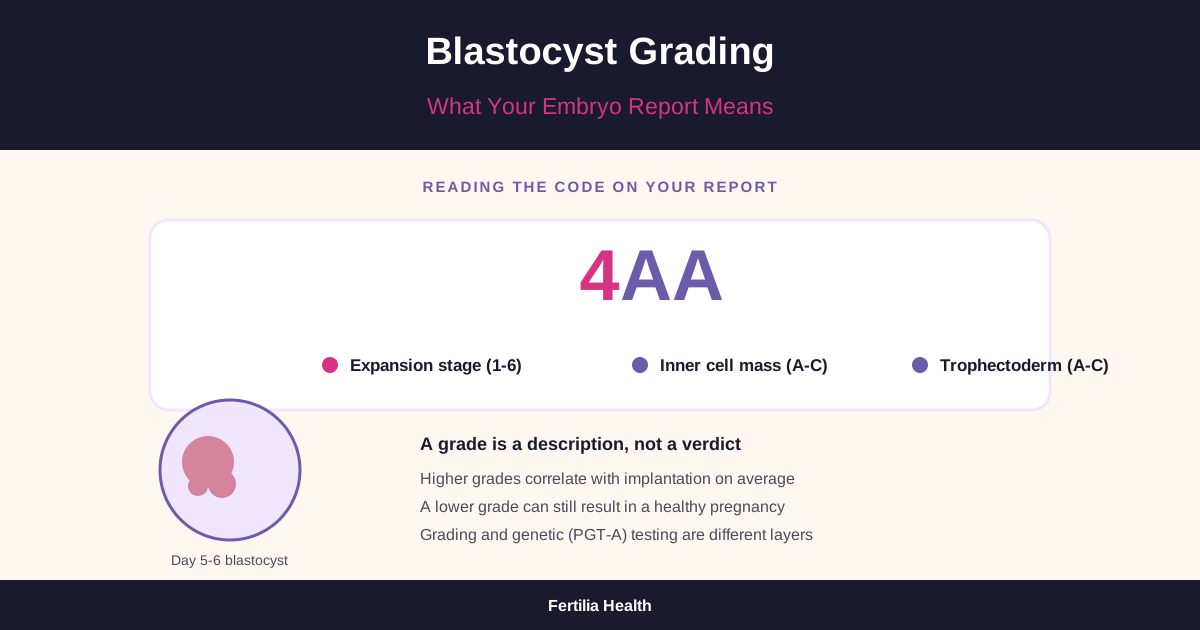
Most Indian IVF labs use a version of the Gardner grading system, which is why your report likely shows a number followed by two letters, something like 4AA, 3BB, or 5AB. Each part means something distinct.
The number (1 to 6): expansion stage. This describes how much the blastocyst has expanded and, at the higher numbers, whether it has started hatching out of its outer shell.
- 1 to 3: early to full blastocyst, still expanding within its shell
- 4: expanded blastocyst, the shell has thinned
- 5: hatching, the embryo is beginning to emerge from the shell
- 6: fully hatched
A higher expansion number generally reflects a more developmentally advanced embryo at the time it was graded, though a 3 or 4 assessed on the correct day is not a concerning finding by itself.
The first letter (A, B, or C): inner cell mass grade. This looks at the cluster of cells destined to become the baby.
- A: many cells, tightly packed
- B: several cells, more loosely grouped
- C: very few cells
The second letter (A, B, or C): trophectoderm grade. This looks at the outer ring of cells destined to become the placenta.
- A: many cells forming a cohesive layer
- B: fewer cells, a looser layer
- C: very few cells, a sparse layer
So a report reading 4AA describes an expanded blastocyst with a well-formed inner cell mass and a well-formed trophectoderm layer. A 3BB describes a full blastocyst with a moderately graded inner cell mass and trophectoderm. Neither number is a pass or fail mark. It is a snapshot description an embryologist writes down while looking down a microscope, and different embryologists grading the same embryo can reasonably land a grade apart from each other, which is one reason your own clinic’s interpretation of your specific report always carries more weight than any general guide, including this one.
What Grade Does and Does Not Predict
Grading correlates with implantation and pregnancy outcome, which is the entire reason the system exists (Gardner et al., Fertil Steril, 2019, PMID 31623746). A higher-graded blastocyst is, on average, somewhat more likely to implant than a lower-graded one. That is a real, useful pattern.
What it is not is a guarantee in either direction. A lower-grade blastocyst can still implant and result in a healthy, ongoing pregnancy. Morphology grade and chromosomal normalcy (whether an embryo is genetically euploid) are related but separate pieces of information, and grade alone does not reliably predict which embryos are chromosomally normal (Minasi et al., Hum Reprod, 2016, PMID 27591227). A 3BB that is genetically normal can outperform a 4AA that is not, and there is no way to know which is which from morphology grading alone. This is the layer PGT-A testing adds when it is used: grading describes what an embryo looks like, PGT-A tests what its chromosomes actually are. They are different, complementary pieces of information, not competing scores.
If your report shows a mix of grades across several embryos, or if your best-graded embryo did not implant on a first attempt, that is not evidence something went wrong that could have been prevented. It reflects the genuine limits of what morphology can predict, not a failure on anyone’s part, including your body’s.
How the Grade Is Communicated to You
Different clinics hand over this information differently, and knowing the format in advance takes some of the pressure off decoding it alone. Some embryologists walk you through the report in person or over a call the same day, explaining each embryo’s grade and which one they recommend transferring first. Others send a written report through a patient portal or WhatsApp, with the grading code but limited explanation, expecting the clinical team to interpret it at your next appointment. If your clinic does the second, and no one has walked you through what the code means, it is entirely reasonable to ask them to, or to bring the report to a video consultation for someone to go through it with you rather than searching a code alone at 9 PM.
If you have your embryo report in hand and want to understand what your specific numbers mean for your transfer, message Dr. Suganya on WhatsApp for a ₹399 video consultation. It is available online, pan-India.
Day 3 vs Day 5: Why Many Clinics Now Wait
Not every clinic transfers at the blastocyst stage. Some transfer on day 3, when the embryo is still a simple cluster of cells, particularly when only a small number of embryos are developing and the team prefers not to risk losing them in the additional two days of lab culture. Growing an embryo to day 5 lets the embryology team watch which ones continue developing normally and which stop, information that is not available on day 3. The trade-off is that not every embryo that looks fine on day 3 will reach the blastocyst stage, so a cohort of five day-3 embryos might produce two or three blastocysts by day 5.
Neither approach is universally correct. Your clinic’s recommendation depends on how many embryos you have, your age, and your specific history, and this is a decision made with your treating embryology and clinical team, not a default either way.
Single Embryo Transfer and Why Grade Matters for That Decision
When more than one good-quality blastocyst is available, many Indian clinics now recommend transferring a single embryo rather than two, specifically because transferring one well-graded blastocyst at a time meaningfully lowers the chance of a twin pregnancy while keeping live birth rates similar to transferring two (Ubaldi et al., Hum Reprod, 2015, PMID 26150408). This is where grading becomes practically useful beyond satisfying curiosity: it helps your clinical team decide which embryo to transfer first and which to freeze for a later attempt if needed, through frozen embryo transfer. If you are weighing a single versus a double transfer, the conversation is worth having explicitly with your clinic rather than assuming more embryos at once means better odds.
Grading also intersects with lab-level decisions some clinics offer as add-ons, such as assisted hatching or EmbryoGlue. These are separate choices from grading itself and are worth understanding on their own terms rather than assuming a lower grade automatically means an add-on is needed.
What This Means If You Are Looking at Your Report Right Now
If you are reading this with a report in hand, a few things are worth holding onto. The grade describes what the embryologist observed on the day of grading, not a permanent judgment on the embryo’s potential. A single grade, on its own, does not tell you whether a pregnancy will succeed or not, in either direction. And the team best placed to interpret your specific numbers, in the context of your age, your history, and how many embryos you have, is the one that has been managing your cycle from the start.
At Fertilia, Dr. Suganya Venkat, an OB-GYN with over 15 years of clinical experience, works with women through exactly this moment, translating an embryology report into a plain-language conversation about what happens next, alongside the clinic already managing the IVF cycle itself.
Frequently Asked Questions
What does a blastocyst grade like 4AA mean? The number describes how expanded the blastocyst is (1 to 6, with higher numbers meaning more developed or hatching). The first letter grades the inner cell mass, the cells that will form the baby. The second letter grades the trophectoderm, the cells that will form the placenta. A 4AA describes an expanded blastocyst with a well-formed inner cell mass and trophectoderm layer.
Is a 3BB blastocyst good or bad? Neither. A 3BB is a full blastocyst with moderately graded inner cell mass and trophectoderm cells, a common and viable grade. Grading is a description, not a pass or fail score, and moderately graded embryos implant and result in healthy pregnancies regularly.
Does a lower blastocyst grade mean IVF will fail? No. Grading correlates with implantation likelihood on average, but a lower-graded embryo can still implant and result in a healthy, ongoing pregnancy. Morphology grade does not reliably predict whether an embryo is chromosomally normal, which is a separate piece of information from grading.
What is the difference between blastocyst grading and PGT-A testing? Grading describes what an embryo looks like under a microscope, its expansion, inner cell mass, and trophectoderm. PGT-A tests the embryo’s actual chromosomes for genetic normalcy. A well-graded embryo is not automatically genetically normal, and a moderately graded embryo is not automatically abnormal. The two are complementary, not interchangeable.
Why do some clinics transfer on day 3 instead of waiting for day 5? Day-3 transfer is common when only a small number of embryos are developing, since some clinics prefer not to risk losing embryos during the additional two days of lab culture needed to reach the blastocyst stage. Waiting to day 5 lets the embryology team see which embryos continue developing normally, but not every day-3 embryo will reach that stage.
Should I transfer one embryo or two if I have more than one good blastocyst? This is a decision to make with your clinical team, but transferring a single well-graded blastocyst at a time is increasingly the recommended approach where more than one good embryo is available, since it meaningfully lowers the chance of a twin pregnancy while keeping live birth rates similar to a double transfer.
Can two different embryologists grade the same embryo differently? Yes, grading involves some subjective assessment, and it is normal for two embryologists to land a grade apart from each other on the same blastocyst. This is one reason your own clinic’s interpretation of your specific report matters more than any general grading guide.
If you have an embryo report you are trying to make sense of, or you are deciding between transfer options, a conversation with someone who can walk through the specific numbers with you is often more useful than searching the code alone.
Book a ₹399 video consultation on WhatsApp
For the full picture of preparing for treatment, see the complete guide to getting pregnant and our guide to ICSI vs IVF.